
How Neuroaesthetics is Turning Interior Design into Preventive Mental Healthcare
Architects and neuroscientists are teaming up to prove that the shape, color, and texture of our rooms directly alter our brain chemistry and nervous systems.
By Factlen Editorial Team
- Neuroarchitects & Designers
- Advocates for transforming interior design from a subjective art into an evidence-based science.
- Cognitive Neuroscientists
- Researchers focused on the biological mechanisms behind aesthetic experiences.
- Evidence-Based Healthcare Advocates
- Professionals pushing for the redesign of medical facilities to accelerate patient recovery.
What's not represented
- · Low-income housing developers
- · Traditional interior decorators
Why this matters
We spend roughly 90% of our lives indoors. Understanding how the geometry, lighting, and textures of our homes and workplaces affect our nervous systems empowers us to design spaces that actively reduce stress and boost cognitive performance.
Key points
- Neuroaesthetics studies how interior design choices directly alter brain chemistry and nervous system responses.
- Curvilinear spaces and fractal patterns reduce cognitive load and activate the brain's pleasure centers.
- Biophilic design, which incorporates nature, has been shown to boost workplace productivity by 15 percent.
- Hospitals are adopting neuroaesthetic principles to lower patient anxiety and accelerate the physical healing process.
- The field relies on biometric data, such as fMRI scans and heart-rate monitors, to prove the biological impact of beauty.
We spend the vast majority of our lives indoors, yet we rarely consider how the geometry of a room might be altering our brain chemistry. For decades, interior design was treated as a matter of subjective taste or functional utility. But a rapidly growing discipline is proving that our nervous systems are constantly decoding our physical environments, turning the spaces we inhabit into active participants in our mental well-being.[7]
This field is known as neuroaesthetics—the scientific study of how the human brain processes and responds to beauty, art, and spatial design. Originally confined to analyzing how we look at paintings in a gallery, neuroaesthetics has aggressively expanded into architecture and interior design. It operates on a profound premise: beauty is not just in the eye of the beholder; it is a measurable biological event that shapes our mental health.[4][8]
The foundation of this movement traces back to 1990, when neurobiologist Semir Zeki discovered that perceiving something beautiful—whether visual, musical, or mathematical—consistently activates the same specific region of the brain. Since then, advanced functional magnetic resonance imaging (fMRI) and electroencephalogram (EEG) technologies have allowed scientists to map exactly how spatial stimuli elicit neurological responses.[1][3]
When a person enters an aesthetically pleasing environment, the brain's medial orbitofrontal cortex lights up. This is the region linked to emotional regulation, decision-making, and the processing of rewards. By designing interiors that actively stimulate this area, architects can effectively lower the production of stress hormones like cortisol and foster a baseline of positive affect.[1][5]

According to researchers mapping human-building interactions, our experience of a room is shaped by three distinct neural networks: the sensory-motor network, the knowledge-meaning network, and the emotion-valuation network. A space only feels truly restorative when it satisfies all three, providing physical comfort, intuitive navigation, and a sense of emotional safety.[6]
To prove that these internal shifts are measurable, tech and design giants have begun conducting real-world experiments. At the 2019 Salone del Mobile in Milan, Google partnered with Muuto and Reddymade Architecture to create "A Space for Being." Visitors walked through differently designed rooms while wearing custom wristbands that tracked their heart rate, breathing, and body temperature. The biometric data proved that subtle changes in lighting, texture, and acoustics triggered immediate, involuntary physiological reactions.[3]
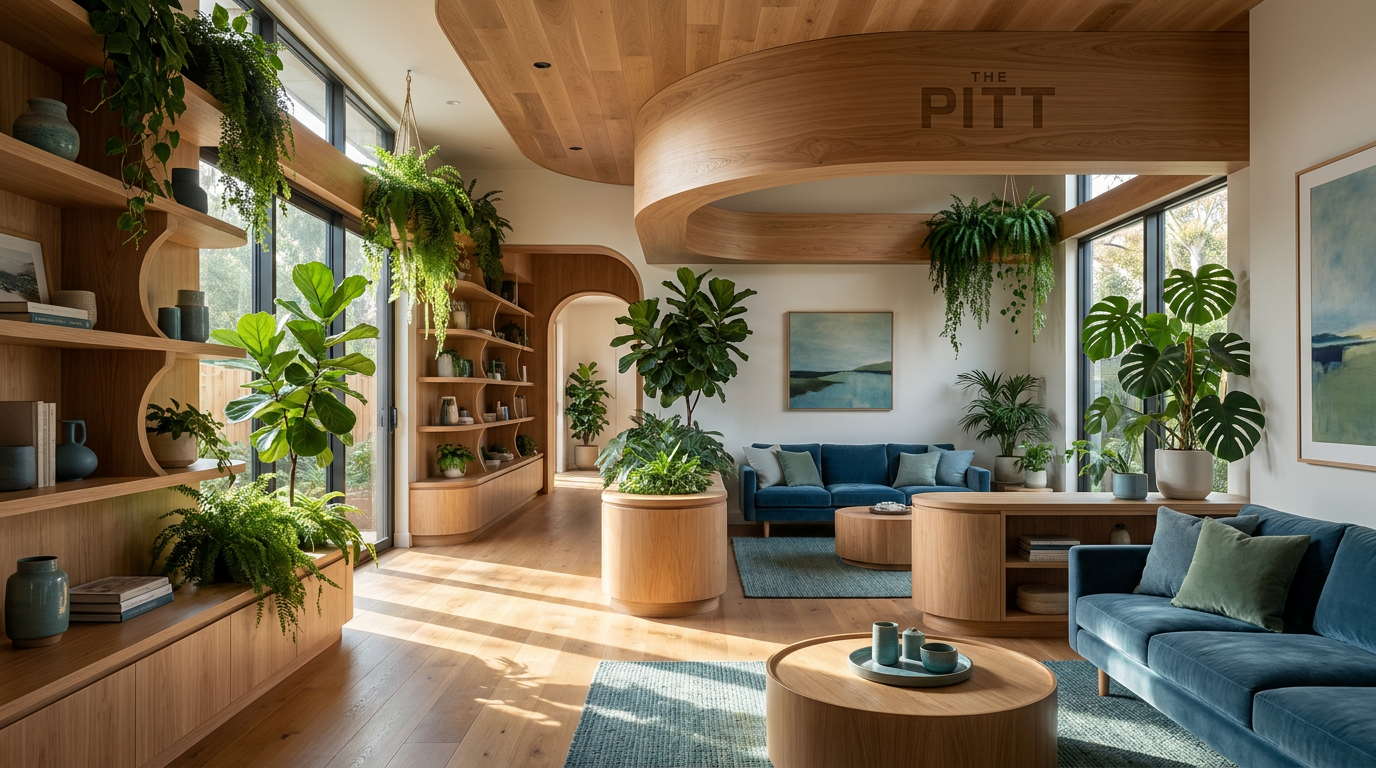
One of the most consistent findings in neuroaesthetic research involves the shape of the spaces we inhabit. Studies utilizing fMRI scans have demonstrated that curvilinear spaces—rooms featuring curved walls, rounded furniture, and arched doorways—activate brain areas related to pleasure and comfort. In contrast, environments dominated by sharp, jagged angles can induce low-level anxiety, as the brain subconsciously processes them as potential physical threats.[1]

One of the most consistent findings in neuroaesthetic research involves the shape of the spaces we inhabit.
The brain's preference for certain patterns also extends to "organized visual complexity," particularly fractal structures. Fractals are complex geometric patterns that repeat at different scales, ubiquitous in nature from fern leaves to coastlines. Recent research indicates that the human brain processes natural fractals with high "perceptual fluency," meaning it takes very little cognitive effort to decode them. Incorporating fractal patterns into architecture significantly reduces cognitive load and stress.[2]
This preference for natural geometry is a core component of biophilic design, which seeks to reconnect indoor spaces with the natural world. Visual access to greenery, indoor plants, or even high-quality images of natural scenes has been shown to lower anxiety and improve working memory. The presence of organic forms reminds the brain of evolutionary safe havens, generating an unconscious sense of refuge.[1][8]
The practical impacts of these biological responses are striking. In commercial settings, the integration of neuroaesthetic and biophilic principles translates directly into human performance. Studies have shown that employees working in biophilic offices report a 15 percent increase in productivity and significantly lower rates of fatigue compared to those in standard, sterile environments.[1][6]

Beyond sight, neuroaesthetics heavily emphasizes tactile engagement. Humans tend to feel more comfortable and welcomed when surrounded by natural textures like wood or woven fabrics. Touching or even just looking at these materials stimulates the somatosensory cortex, producing deep-seated feelings of warmth and belongingness that synthetic materials often fail to evoke.[1]
Color psychology and lighting design are also being rewritten by neuroscience. Natural light is critical for regulating circadian rhythms, which dictate sleep quality and cognitive performance. Meanwhile, specific color palettes stimulate different emotional processing centers; blues and greens reliably promote calmness and focus, while warm tones like terracotta can boost energy and stimulate social interaction.[8]
Perhaps the most urgent application of neuroaesthetics is in the healthcare sector. Architects are increasingly turning to the human brain for inspiration when designing medical facilities, particularly for patients with mental and behavioral health issues. The traditional hospital model—sterile white walls, harsh fluorescent lighting, and windowless corridors—is being replaced by environments designed to actively assist the healing process.[5]

While a building cannot cure a disease, reducing a patient's baseline anxiety allows their immune system to function more effectively. Patients have been shown to heal faster and require less pain medication when they have access to dynamic daylighting and views of a beautiful garden. As architect Suchi Reddy notes, people might forget the exact details of how a space looked, but they rarely forget how it made their nervous system feel.[1][5][7]
Despite its rapid growth, neuroaesthetics is not without its skeptics and limitations. The field must constantly navigate the tension between universal biological baselines and subjective cultural conditioning. What one culture perceives as a calming, organized space, another might view as stark or uninviting. Furthermore, researchers caution against treating neuroaesthetics as a comprehensive framework that can solve all urban health issues on its own.[2][4][7]
Nevertheless, the shift from intuitive design to evidence-based neuroarchitecture represents a fundamental change in how we build our world. As health certifications for buildings become as rigorous as those for food or medicine, the industry is recognizing that interior design is essentially a form of preventive mental healthcare. By aligning aesthetics with empathy and hard science, designers are transforming static buildings into active allies of human flourishing.[1][7]
How we got here
1990
Neurobiologist Semir Zeki discovers that perceiving beauty activates a specific, consistent area of the brain.
2018
The Academy of Neuroscience for Architecture highlights the measurable psychological impact of spatial design on mental health.
2019
Google and Muuto launch 'A Space for Being' in Milan, using biometric wristbands to prove rooms alter physiological states.
2025
Post-pandemic design shifts heavily toward neuroaesthetics, with mental health certifications for buildings becoming industry standards.
Viewpoints in depth
Neuroarchitects & Designers
Advocates for transforming interior design from a subjective art into an evidence-based science.
This camp believes that because humans spend the vast majority of their lives indoors, architects have a moral imperative to design for the nervous system. They rely on biometric data and neuroimaging to justify design choices, arguing that elements like natural light, curvilinear shapes, and biophilia are not mere trends, but biological necessities for human flourishing. Their goal is to make mental health certifications as standard for buildings as structural safety codes.
Cognitive Neuroscientists
Researchers focused on the biological mechanisms behind aesthetic experiences.
For neuroscientists, the built environment is a massive, real-world laboratory for studying the brain's reward pathways. They focus on how the orbitofrontal cortex and somatosensory cortex process spatial geometry, fractal patterns, and textures. While supportive of better design, this camp often cautions against overstating the claims of neuroaesthetics, emphasizing that while a beautiful room can lower cortisol and reduce cognitive load, it cannot replace medical interventions for severe mental health conditions.
Evidence-Based Healthcare Advocates
Professionals pushing for the redesign of medical facilities to accelerate patient recovery.
This perspective views neuroaesthetics through the lens of patient outcomes. They argue that traditional hospital designs—characterized by harsh lighting, sharp angles, and sterile materials—actively induce stress and hinder the immune system. By advocating for 'healing architecture' that incorporates natural light, garden views, and comforting textures, they aim to reduce the need for pain medication and shorten hospital stays, proving that good design has a measurable clinical ROI.
What we don't know
- How much of our aesthetic preference is universally biological versus culturally conditioned.
- The exact long-term clinical outcomes of neuroaesthetic hospital designs compared to traditional facilities.
Key terms
- Neuroaesthetics
- The scientific study of how the brain processes and responds to beauty, art, and spatial design.
- Biophilic Design
- An architectural approach that connects building occupants more closely to nature through plants, natural light, and organic materials.
- Orbitofrontal Cortex
- A region of the brain involved in emotional regulation and decision-making that is positively stimulated by pleasing environments.
- Fractal Structure
- Complex geometric patterns that repeat at different scales, commonly found in nature, which the brain processes with high perceptual fluency.
- Somatosensory Cortex
- The part of the brain that processes tactile sensations like touch and texture, stimulated by materials like wood and woven fabrics.
Frequently asked
What is the difference between interior design and neuroaesthetics?
Traditional interior design focuses on visual appeal and function. Neuroaesthetics uses neuroscience to measure exactly how those design choices alter brain chemistry, heart rate, and nervous system responses.
Can the shape of a room really change my mood?
Yes. Studies using fMRI and EEG show that curvilinear spaces (curved walls and furniture) activate brain areas related to pleasure and comfort, making people feel calmer than spaces with sharp, jagged angles.
How can I apply neuroaesthetics to my home?
Maximize natural light, incorporate indoor plants or natural wood textures, use calming colors like blues and greens in rest areas, and reduce visual clutter to lower your brain's cognitive load.
Sources
Source coverage
8 outlets
3 viewpoints surfaced








[1]Pearl AcademyCognitive Neuroscientists
The Brain, Beauty, and Built Environments
Read on Pearl Academy →[2]MDPI EncyclopediaCognitive Neuroscientists
Current Understanding of Health and Urban Environment: Focus on Neuroaesthetics
Read on MDPI Encyclopedia →[3]Connections by FinsaNeuroarchitects & Designers
What is neuroaesthetics and how can it be applied in interior design?
Read on Connections by Finsa →[4]ArchDailyNeuroarchitects & Designers
Neuroaesthetics and Neuroarchitecture: Designing for the Mind
Read on ArchDaily →[5]FreethinkEvidence-Based Healthcare Advocates
Can 'neuroaesthetics' make healthcare more effective?
Read on Freethink →[6]ModulyssNeuroarchitects & Designers
Neuroaesthetics: Transforming Commercial Spaces Through Thoughtful Design
Read on Modulyss →[7]Factlen Editorial TeamEvidence-Based Healthcare Advocates
Synthesis by Factlen editorial team
Read on Factlen Editorial Team →[8]Melissa LaRosa InteriorsNeuroarchitects & Designers
Neuroaesthetics in Interior Design: How Spaces Shape Mood, Memory, and Mental Health
Read on Melissa LaRosa Interiors →

Every angle. Every day.
Get lifestyle stories with full source coverage and perspective breakdowns delivered to your inbox.