
How NCAA Gymnastics Stepped Out of the Olympic Shadow to Become a Ratings Powerhouse
Fueled by NIL rules and a joyful team culture, collegiate gymnastics is shattering viewership and attendance records while extending the careers of elite athletes.
By Factlen Editorial Team
- NCAA Growth Advocates
- Celebrate the massive viewership gains, NIL empowerment, and the entertainment value of the college format.
- Elite Purists & Scoring Critics
- Concerned that 'vibes-based' judging and overscoring dilute the technical integrity of the sport.
- Athlete Welfare Advocates
- Focus on how the collegiate system extends careers and provides a healthier, less isolating environment.
What's not represented
- · International Gymnastics Federations
- · Youth Club Coaches
Why this matters
The explosion of college gymnastics proves that women's sports can thrive by prioritizing athlete welfare and team joy over grueling isolation. It offers a blueprint for how modern athletics can build massive audiences while keeping athletes financially empowered and physically healthy.
Key points
- NCAA women's gymnastics is experiencing unprecedented growth, with the 2026 championships drawing a record 1.1 million viewers.
- NIL rules now allow elite Olympians to compete in college while earning endorsement money.
- The collegiate environment offers a team-focused, supportive culture that contrasts with the isolation of elite training.
- Gymnasts are enjoying significantly longer careers, often balancing NCAA seasons with international elite competitions.
- A debate continues over NCAA scoring, as critics argue the 'Perfect 10' system has led to overscoring and 'vibes-based' judging.
The 2026 NCAA Women's Gymnastics Championships delivered a definitive statement on the sport's soaring trajectory, drawing a record 1.1 million viewers on ABC and peaking at 1.7 million. [2][2]
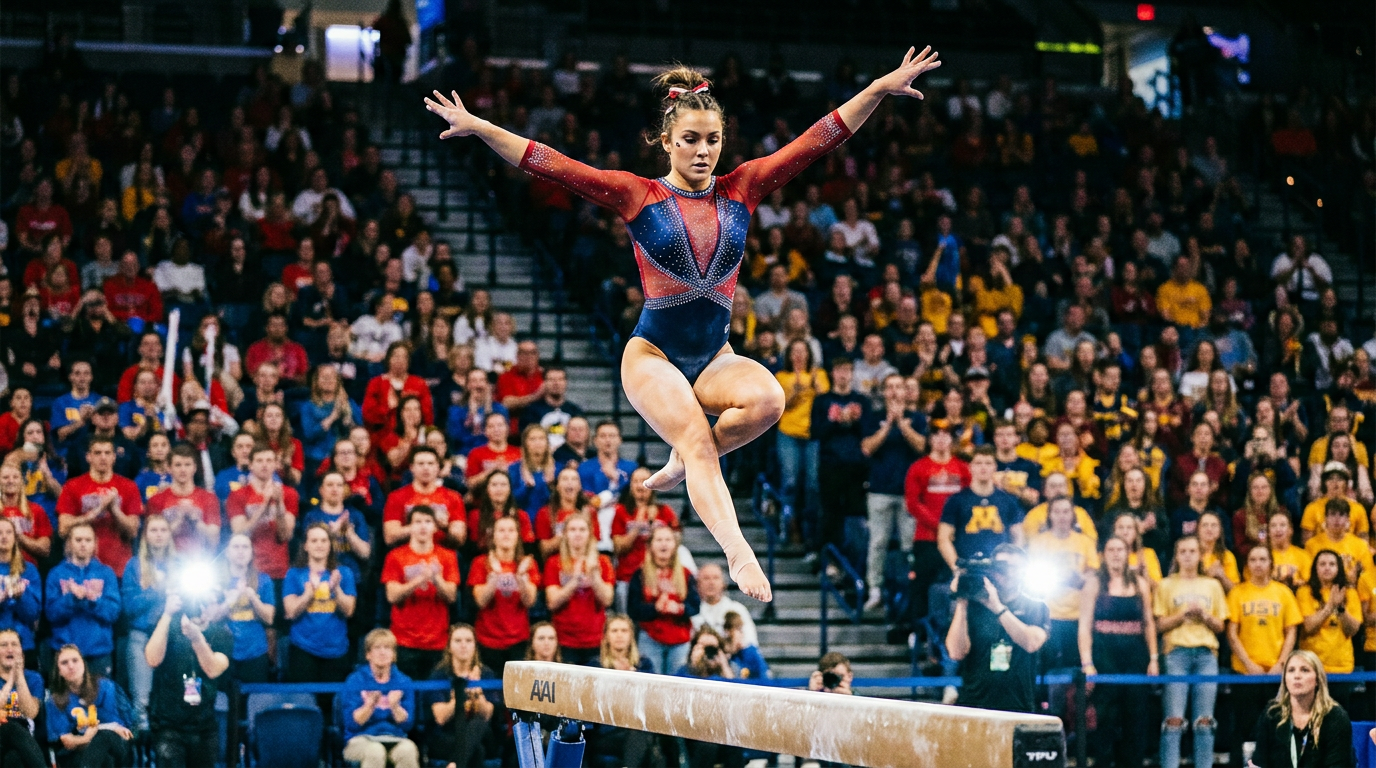
The surge in popularity extends far beyond the postseason. Regular-season meets are routinely shattering attendance records across the country. Utah has averaged over 15,000 fans per meet, LSU recently broke the 13,500 mark for a home opener, and programs like Michigan State have been forced to move gymnastics events into massive basketball arenas just to accommodate the overwhelming ticket demand. [1][1]
For decades, the collegiate level was widely viewed as the place where elite gymnastics careers went to quietly end. The Olympic Games were the undisputed pinnacle of the sport, and the NCAA was treated as a secondary, less rigorous afterthought. [4][4]

That narrative has been completely rewritten over the past few years. The primary catalyst for this transformation was the NCAA's adoption of Name, Image, and Likeness (NIL) rules, which fundamentally altered the financial reality for female athletes. [6][6]
Before the NIL era, top-tier gymnasts faced a brutal ultimatum: turn professional to accept lucrative endorsement money and forfeit their college eligibility, or maintain their amateur status and compete in the NCAA for free. [5][5]
Today, athletes no longer have to choose. Global superstars and Olympians like Suni Lee, Jordan Chiles, and Jade Carey have brought immense star power to the collegiate floor, cashing in on their fame while simultaneously competing for their universities. [4][4]
This influx of elite talent has highlighted a massive cultural divide between the two levels of the sport. Elite gymnastics is notoriously isolating and grueling; athletes often train upwards of 30 hours a week, are frequently homeschooled, and spend their entire year peaking for just a handful of high-stakes international meets. [4][4]
This influx of elite talent has highlighted a massive cultural divide between the two levels of the sport.
NCAA gymnastics, by contrast, is entirely team-focused. Gymnasts train together, compete every single weekend during the season, and prioritize the collective team score over individual glory. The atmosphere is loud, joyful, and deeply supportive, offering a stark contrast to the solitary pressure of the elite track. [5][5]

The scoring systems perfectly reflect this philosophical divide. Elite international competition utilizes an open-ended Code of Points, a system that heavily rewards extreme difficulty and boundary-pushing skills, even if the execution is not entirely flawless. [4][4]
The NCAA, however, still relies on the iconic "Perfect 10." Because college routines are shorter and slightly less difficult—designed to accommodate weekly competitions and full-time academic schedules—the premium is placed entirely on precision, artistry, and absolute perfection. [4][4]
Fans have overwhelmingly embraced the Perfect 10. It provides an easily understandable benchmark for greatness; when a gymnast sticks a flawless landing, the roaring crowd knows exactly what score to demand from the judges. [3][3]
Yet, this crowd-pleasing system has sparked intense debate within the sport. In the 2024 season alone, judges handed out 87 perfect 10s, leading to accusations of "overscoring" and "vibes-based" judging, where enthusiastic home crowds seemingly influence the marks. [3][3]

LSU star Livvy Dunne recently voiced concerns over attempts to strictly rein in the scores. She argued that making 10s exceedingly rare could hurt the sport's entertainment value, warning that alienating the casual fans who tune in to see perfection could result in empty seats and stalled momentum. [3][3]
Despite the ongoing debates over scoring mechanics, the structural changes have undeniably improved overall athlete welfare. Gymnastics careers are getting significantly longer; athletes are no longer forced into retirement at age 18, and many are now successfully balancing NCAA seasons with Elite Olympic runs well into their twenties. [5][5]
As the sport looks toward the future, its primary challenge will be managing its own explosive success. With meets moving to larger arenas, major networks expanding their live coverage, and athletes finding sustainable financial footing, NCAA gymnastics has permanently stepped out of the Olympic shadow to become a standalone powerhouse. [6][6]
How we got here
2006
Elite gymnastics abandons the Perfect 10 in favor of an open-ended scoring system.
July 2021
The NCAA adopts Name, Image, and Likeness (NIL) rules, allowing athletes to profit from endorsements.
April 2023
The NCAA Women's Gymnastics Championship breaks 1 million viewers for the first time since 2007.
January 2026
Regular-season meets shatter attendance records, with some universities moving events to basketball arenas to meet demand.
April 2026
The NCAA Championships set a new viewership record of 1.1 million on ABC.
Viewpoints in depth
NCAA Growth Advocates
Celebrate the massive viewership gains, NIL empowerment, and the entertainment value of the college format.
This camp points to the undeniable numbers: 1.1 million viewers for the national championships and sold-out basketball arenas for regular-season meets. They argue that the combination of NIL financial freedom and the highly engaging 'Perfect 10' scoring system has created a golden era for the sport. By leaning into the entertainment value and team-oriented joy, NCAA gymnastics has built a sustainable, highly marketable product that no longer relies solely on the four-year Olympic cycle for relevance.
Elite Purists & Scoring Critics
Concerned that 'vibes-based' judging and overscoring dilute the technical integrity of the sport.
While celebrating the sport's growth, this viewpoint expresses concern over the integrity of collegiate scoring. Critics point to the proliferation of perfect 10s—87 in a single recent season—as evidence of 'overscoring,' where judges reward crowd energy and athlete popularity rather than strict technical perfection. They argue that a narrower scoring window fails to distinguish between a solid routine and a truly flawless one, and advocate for stricter accountability to maintain the sport's athletic credibility.
Athlete Welfare Advocates
Focus on how the collegiate system extends careers and provides a healthier, less isolating environment.
For this group, the most significant victory is the paradigm shift in gymnast longevity and mental health. Historically, the elite track was an isolating, grueling grind that forced athletes into early retirement by age 18. The NCAA environment offers a supportive team culture, balanced academic life, and the ability to earn a living through NIL. Advocates celebrate that gymnasts can now safely compete into their mid-20s, seamlessly transitioning between college seasons and international elite competitions without sacrificing their well-being.
What we don't know
- Whether the NCAA will permanently adjust the judging criteria to reduce the frequency of Perfect 10s without alienating casual fans.
- How the proposed House v. NCAA revenue-sharing settlement might impact funding for non-revenue sports like gymnastics.
Key terms
- Name, Image, and Likeness (NIL)
- NCAA rules allowing college athletes to earn money from endorsements and sponsorships without losing their amateur status.
- Perfect 10
- The maximum possible score in NCAA gymnastics, rewarding flawless execution over extreme difficulty.
- Open-ended scoring
- The system used in Elite (Olympic) gymnastics where scores have no maximum limit, combining difficulty and execution.
- Elite gymnastics
- The highest level of international competition, including the World Championships and the Olympic Games.
Frequently asked
Why are so many Olympians competing in college now?
Changes to NIL rules allow athletes to earn money from endorsements while competing in the NCAA, meaning they no longer have to choose between going pro and going to college.
How is NCAA scoring different from the Olympics?
NCAA uses a maximum score of a 'Perfect 10' focusing on flawless execution of slightly easier routines, while the Olympics use an open-ended system that heavily rewards extreme difficulty.
Can gymnasts compete in both NCAA and Elite at the same time?
Yes. Many top gymnasts now balance their college seasons with international Elite competitions, leading to longer overall careers.
Sources
Source coverage
6 outlets
3 viewpoints surfaced






[1]Sports Business JournalNCAA Growth Advocates
Data Drive: NCAA gymnastics vaulting over previous viewership, attendance records
Read on Sports Business Journal →[2]Just Women's SportsNCAA Growth Advocates
2026 NCAA Gymnastics Championships Final Draws Record 1.1M Viewers
Read on Just Women's Sports →[3]The GuardianElite Purists & Scoring Critics
Livvy Dunne is worried about the future of women's college gymnastics
Read on The Guardian →[4]AP NewsAthlete Welfare Advocates
For decades, college gymnastics lived in the shadow of elite competition. Not anymore.
Read on AP News →[5]Inside GymnasticsAthlete Welfare Advocates
The Paradigm Shift: Balancing Elite and NCAA Gymnastics
Read on Inside Gymnastics →[6]Factlen Editorial TeamAthlete Welfare Advocates
Synthesis by Factlen editorial team
Read on Factlen Editorial Team →
More in sports
See all 11 stories →Injury
US Weightlifting Star Mattie Rogers Cleared for Competition Following Two-Year Nerve Injury Rehabilitation
0 sources
Standings
Global Weightlifting Standings Reset as Sport Pivots to New LA2028 Weight Classes
0 sources
Receiving Record
Calvin Johnson Backs Rams' Puka Nacua to Break His All-Time NFL Receiving Record
0 sources

NBA Finals
New York Knicks Win First NBA Championship in 53 Years, Defeating Spurs in Five Games
0 sources

Every angle. Every day.
Get sports stories with full source coverage and perspective breakdowns delivered to your inbox.