
Steam Deck OLED vs. ROG Ally X: Which Handheld Gaming PC Wins in 2026?
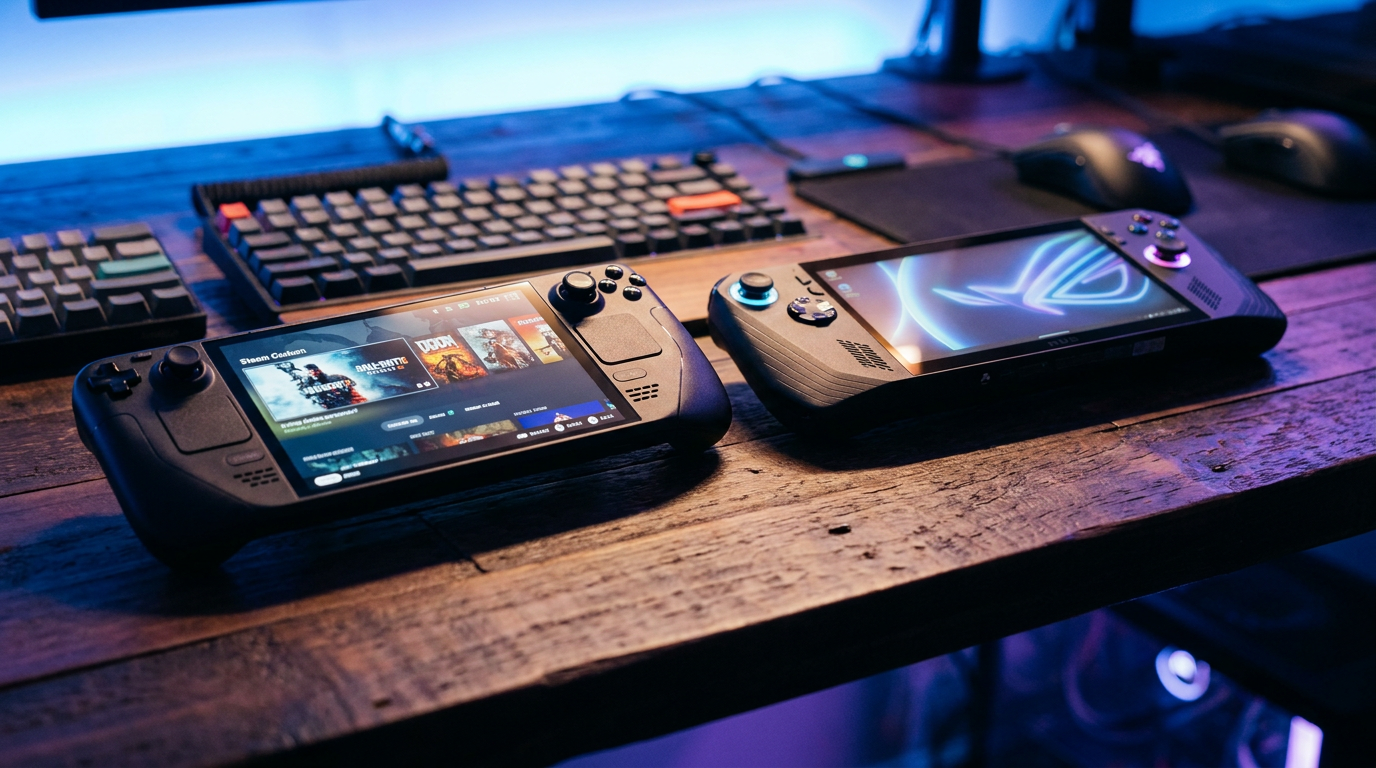
The handheld PC market has fractured into two distinct philosophies: the console-like simplicity of the Steam Deck OLED and the raw Windows power of the ASUS ROG Ally X.
By Factlen Editorial Team
- Console Purists
- Gamers who prioritize a frictionless, reliable user experience over raw graphical fidelity.
- Power Maximizers
- Enthusiasts who demand the highest possible frame rates and total software freedom.
- Hardware Agnostics
- Users seeking the perfect middle ground between powerful silicon and optimized software.
What's not represented
- · Nintendo Switch Loyalists
- · Casual Mobile Gamers
Why this matters
Dropping $500 to $800 on a portable gaming PC is a major investment. Understanding the trade-offs between software simplicity and raw hardware power ensures you buy the device that actually fits your daily gaming habits.
Key points
- The handheld PC market is split between the console-like SteamOS and the flexible but demanding Windows 11 ecosystem.
- Valve's Steam Deck OLED excels in battery efficiency, user interface simplicity, and vibrant HDR visuals.
- The ASUS ROG Ally X delivers superior raw performance, a 120Hz display, and native compatibility with all game launchers.
- Choosing between the two depends entirely on whether a player values frictionless software or uncompromised hardware power.
The handheld gaming PC market has officially matured from a niche hardware experiment into a legitimate, mainstream alternative to traditional desktop gaming. In 2026, players are no longer forced to choose between portability and performance, as the latest generation of devices can comfortably run demanding triple-A titles on a subway or a couch. The industry has consolidated around a few major players, transforming what was once a novelty into a highly competitive hardware category where battery life, screen fidelity, and operating systems dictate the winner.[1][3]
Beneath the impressive hardware specifications lies a fundamental philosophical divide that defines the 2026 landscape. The market has fractured into two distinct approaches: the curated, console-like simplicity of Linux-based operating systems versus the unrestricted, brute-force flexibility of native Windows 11. This software posture has proven to be just as decisive as the silicon powering the devices, forcing consumers to decide whether they value a frictionless user interface or absolute desktop freedom.[5]
Two flagship devices currently represent the absolute peaks of these competing philosophies: Valve's Steam Deck OLED and the ASUS ROG Ally X. After months of iterative updates and market shifts, these two heavyweights have emerged as the definitive choices for portable PC gaming. While both promise desktop-grade performance in a portable shell, they cater to entirely different types of players, making the decision less about which device is objectively better and more about how the user actually intends to play.[7]

The case for the Steam Deck OLED centers entirely on its frictionless, "it just works" user experience. Valve has meticulously tuned SteamOS to feel less like a computer and more like a dedicated gaming console. Users can press the power button, instantly wake the device from sleep, and jump right back into a game without navigating driver updates, background launcher updates, or intrusive operating system pop-ups. This tight integration of hardware and software creates a durability of experience that raw benchmark numbers simply cannot quantify.[4][7]
The case against the Steam Deck OLED lies in its inherent software limitations and aging processing power. Because SteamOS is built on Linux, it relies on a compatibility layer to run Windows games, which creates a hard barrier for titles utilizing kernel-level anti-cheat software. Players looking to dive into competitive multiplayer shooters like Call of Duty or Fortnite will find themselves entirely locked out without cumbersome workarounds, and the device's older APU struggles to maintain high frame rates in the most demanding 2026 releases.[1][6]
The evidence supporting the Steam Deck OLED is most visible in its battery efficiency and visual fidelity. Valve's custom 50-watt-hour battery, paired with a highly optimized power draw, allows the device to run lighter indie titles for up to 12 hours. Furthermore, the 7.4-inch HDR OLED display provides inky deep blacks and vibrant color contrast that LCD panels cannot replicate, making atmospheric single-player games look significantly better despite running at lower internal resolutions.[4][5]

The case for the ASUS ROG Ally X is built on uncompromised raw power and total ecosystem flexibility. By running native Windows 11, the Ally X operates as a genuine miniature PC, granting players immediate access to Xbox Game Pass, the Epic Games Store, and every anti-cheat system on the market. It is designed for power users who want the highest local performance available in a handheld format, complete with USB4 docking capabilities and easily upgradeable storage.[5][6]
The case for the ASUS ROG Ally X is built on uncompromised raw power and total ecosystem flexibility.
The case against the ROG Ally X focuses on the persistent friction of using a desktop operating system on a 7-inch touchscreen. Windows 11 requires significantly more maintenance, from managing background processes to navigating tiny interface elements. More critically, the Windows sleep mode remains notoriously unreliable; players hoping to pause a game for ten minutes often return to find the device has crashed or drained its battery, forcing them to rely on traditional save points rather than instant resume.[3][7]
The evidence supporting the ROG Ally X is found in its staggering benchmark performance and brute-force hardware solutions. The device features a 120Hz variable refresh rate display that makes gameplay incredibly smooth, powered by an AMD Ryzen Z1 Extreme chip that can hit 50 frames per second on medium settings in games like Cyberpunk 2077—a scenario where the Steam Deck hovers around 30. ASUS also solved the battery drain issue by packing a massive 80-watt-hour battery into the chassis, allowing it to match or beat the Deck's longevity even under heavy loads.[5][7]

Complicating this binary choice is the arrival of hybrid devices like the Lenovo Legion Go S, which ships natively with SteamOS. This 2026 release proves that major hardware manufacturers are recognizing the appeal of Valve's operating system, offering a middle ground that pairs superior processing power and an 8-inch screen with the console-like simplicity of the Steam ecosystem. It highlights how much of an albatross Windows can be on a handheld, as the SteamOS version runs games up to 21% faster than its Windows counterpart.[1][2]
Ergonomics and long-term repairability also play a crucial role in the comparison. The Steam Deck remains the king of comfort for users with larger hands, featuring full-sized analog sticks and dual trackpads that make strategy games playable on the go, alongside an unmatched partnership with iFixit for easy DIY repairs. Conversely, the ROG Ally X offers a slightly more compact, Xbox-style layout that many find preferable for extended sessions, though it lacks the versatile trackpads of its rival.[7]
Ultimately, the Steam Deck OLED fits well when the user prioritizes a seamless, console-like experience and primarily plays single-player titles or verified games within the Steam ecosystem. It is the ideal choice for gamers who value the stunning contrast of an OLED screen, want reliable instant-resume functionality, and prefer to spend their time playing rather than tinkering with settings or updating drivers.[7]

The Steam Deck OLED does not fit when the user relies heavily on subscription services like Xbox Game Pass or regularly plays competitive multiplayer shooters that require Windows-based anti-cheat software. It is also the wrong choice for players who demand the highest possible frame rates in cutting-edge triple-A releases, as its aging silicon simply cannot keep pace with newer handheld processors.[1][7]
The ASUS ROG Ally X fits well when the user wants a portable powerhouse and needs native access to multiple game launchers without relying on third-party workarounds. It is the definitive choice for players who prioritize 120Hz smoothness, want the flexibility to dock the device as a full desktop PC, and are willing to trade a bit of user-interface elegance for absolute graphical fidelity and raw performance.[5][7]
The ASUS ROG Ally X does not fit when the user hates troubleshooting Windows quirks or wants a device that wakes perfectly from sleep every single time. It is also less suitable for gamers on a strict budget, as its premium components and massive battery demand a significantly higher price tag than the entry-level Steam Deck models.[3][7]
How we got here
Feb 2022
Valve launches the original Steam Deck, proving the viability of the modern handheld PC market.
Jun 2023
ASUS releases the first ROG Ally, introducing a high-performance Windows alternative to the space.
Nov 2023
Valve releases the Steam Deck OLED, significantly improving battery life and screen quality.
Jul 2024
ASUS launches the ROG Ally X, doubling the battery capacity and fixing the original model's shortcomings.
Early 2026
Manufacturers like Lenovo begin releasing handhelds natively running SteamOS, bridging the gap between hardware power and software simplicity.
Viewpoints in depth
Console Purists
Gamers who prioritize a frictionless, reliable user experience over raw graphical fidelity.
This camp argues that a handheld device should function like a dedicated console, not a miniature desktop. They point to the Steam Deck's instant sleep/wake functionality, lack of background driver updates, and highly optimized battery draw as the gold standard. For these players, the inability to play certain anti-cheat games is an acceptable trade-off for an operating system that never crashes during a commute.
Power Maximizers
Enthusiasts who demand the highest possible frame rates and total software freedom.
Power maximizers view the handheld form factor as an extension of their high-end desktop rigs. They argue that being locked out of Xbox Game Pass or major multiplayer shooters is a dealbreaker. By embracing Windows 11 on devices like the ROG Ally X, they accept the clunkiness of the operating system in exchange for 120Hz refresh rates, USB4 docking capabilities, and the freedom to install any modification or launcher they desire.
Hardware Agnostics
Users seeking the perfect middle ground between powerful silicon and optimized software.
This emerging perspective believes that players shouldn't have to choose between good hardware and good software. They champion hybrid solutions, such as installing SteamOS on third-party devices like the Lenovo Legion Go S. They argue that Windows is an albatross on handheld battery life and performance, and that the future of the industry lies in pairing Valve's highly efficient operating system with the absolute fastest chips available from AMD and Intel.
What we don't know
- When Valve will officially announce the hardware specifications and release window for a true next-generation Steam Deck 2.
- Whether Microsoft will eventually release a dedicated, lightweight 'Windows Handheld Mode' to fix the current operating system friction.
Key terms
- APU (Accelerated Processing Unit)
- A single chip that combines both the central processor (CPU) and graphics processor (GPU), commonly used in handheld PCs to save space and improve efficiency.
- SteamOS
- A Linux-based operating system developed by Valve that provides a streamlined, console-like interface for gaming without the clutter of a desktop.
- Variable Refresh Rate (VRR)
- A display technology that syncs the screen's refresh rate with the game's frame rate, eliminating visual screen tearing and stuttering.
- Anti-Cheat Software
- Security programs used in multiplayer games to prevent hacking, many of which require Windows and actively block Linux-based systems like the Steam Deck.
- TDP (Thermal Design Power)
- A measure of how much power a computer chip is allowed to draw, which directly impacts both gaming performance and battery life.
Frequently asked
Can I play Xbox Game Pass on the Steam Deck?
Not natively. You have to stream it via the cloud or go through a complex process to install Windows, whereas the ROG Ally X runs it natively out of the box.
Which handheld has better battery life?
For low-demanding indie games, the Steam Deck OLED wins due to its efficient chip. For high-performance AAA games, the ROG Ally X's massive 80Whr battery takes the lead.
Do I need to buy my PC games again?
No. Both devices are essentially portable computers, meaning you can download and play the games you already own on Steam, Epic, or other PC launchers.
What exactly is SteamOS?
SteamOS is a Linux-based operating system developed by Valve, designed specifically to make a handheld PC feel and operate seamlessly like a traditional gaming console.
Sources
Source coverage
7 outlets
3 viewpoints surfaced







[1]PC GamerHardware Agnostics
The best handheld gaming PC in 2026
Read on PC Gamer →[2]PCMagHardware Agnostics
The Best Handheld Gaming PCs for 2026
Read on PCMag →[3]Tom's HardwareHardware Agnostics
Best Handheld Gaming PCs 2026
Read on Tom's Hardware →[4]Rock Paper ShotgunConsole Purists
The best handheld PCs in 2026
Read on Rock Paper Shotgun →[5]Windows ForumPower Maximizers
Handheld PC Showdown: Steam Deck vs ROG Ally X
Read on Windows Forum →[6]EnebaPower Maximizers
ROG Ally vs Steam Deck: Which is better in 2026?
Read on Eneba →[7]Bachynski BlogConsole Purists
The Verdict: Which Handheld Should You Buy in 2026?
Read on Bachynski Blog →
More in entertainment
See all 17 stories →Audiobook Boom
The Science Behind the Audiobook Boom: Why Listening Is Reading to Your Brain
0 sources

Streaming Wars
The Great Re-Bundling: How 2026's Streaming Mega-Deals Are Curing Subscription Fatigue
0 sources

Vinyl Revival
Vinyl Record Sales Cross Historic $1.4 Billion Mark as Gen Z Drives Physical Music Revival
0 sources

Philanthropy Milestone
Michael J. Fox Foundation Surpasses $3 Billion in Funding, Ushers in 'Precision Medicine' Era for Parkinson's
0 sources

Every angle. Every day.
Get entertainment stories with full source coverage and perspective breakdowns delivered to your inbox.