
SpaceX Raises Record $75 Billion in Historic Public Market Debut
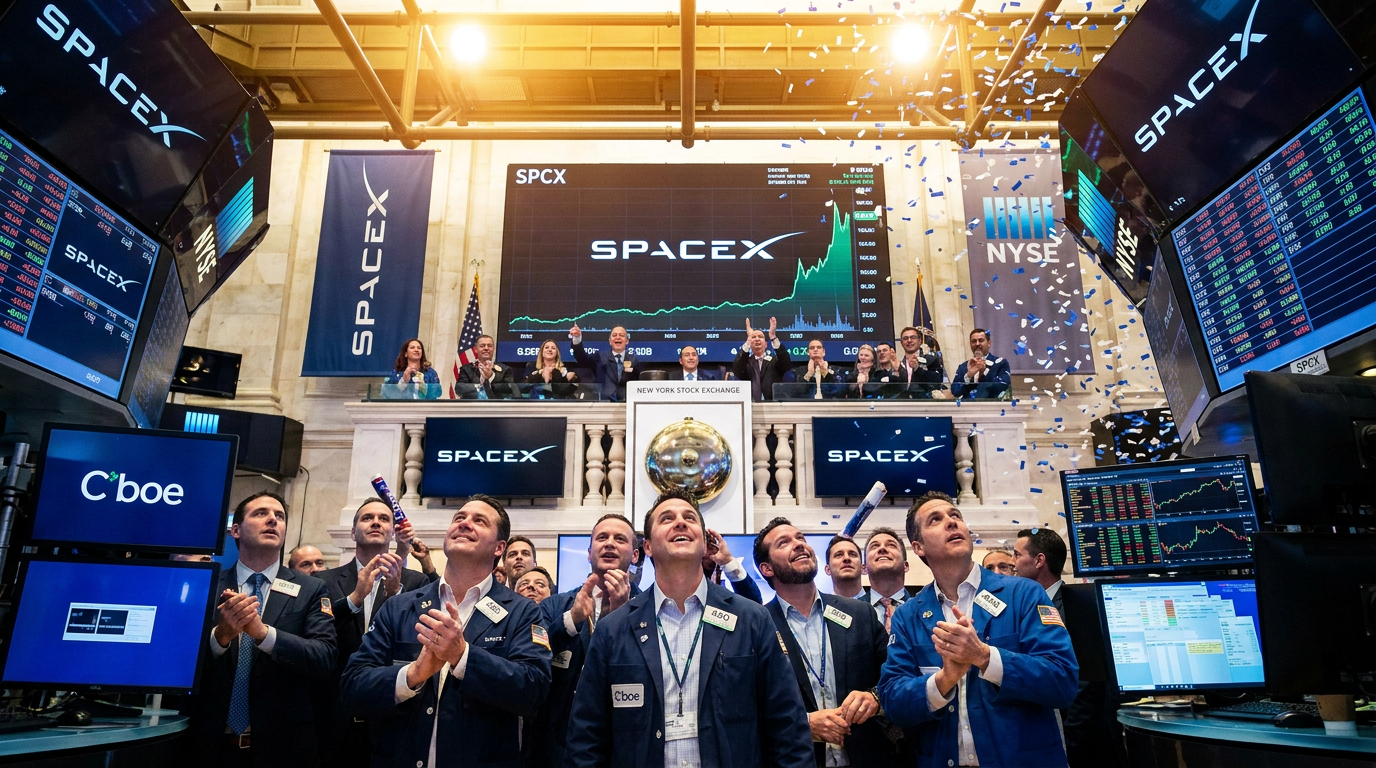
SpaceX has successfully completed the largest initial public offering in history, raising $75 billion and bucking traditional Wall Street norms. The landmark debut has energized both retail and institutional investors, signaling strong market confidence in the commercial space sector.
By Factlen Editorial Team
- Retail & Growth Investors
- View the IPO as a generational opportunity to invest directly in the space economy and Elon Musk's long-term vision.
- Institutional Finance
- Focus on the unprecedented scale of the $75 billion raise, the windfall for underwriting banks, and the demonstration of deep market liquidity.
- Broad Market Analysts
- Emphasize the 'halo effect' the successful mega-IPO has on broader equity markets and overall investor sentiment.
What's not represented
- · Traditional Aerospace Competitors
- · Space Policy Regulators
Why this matters
The sheer scale of SpaceX's public debut injects massive liquidity and optimism into the stock market, validating the commercial space industry as a foundational pillar of the future economy. For everyday investors, it opens direct access to a previously private aerospace giant, while setting a new template for how mega-cap tech companies might approach going public.
Key points
- SpaceX raised $75 billion in the largest initial public offering in history.
- The offering bucked traditional Wall Street norms, successfully balancing institutional stability with retail investor access.
- Major investment banks like JPMorgan and Goldman Sachs are expected to see significant trading income boosts from the mega-IPO.
- The successful debut has created a 'halo effect,' lifting broader stock market sentiment and demonstrating deep market liquidity.
- Capital from the IPO will likely accelerate Starlink expansion and the Starship launch program.
SpaceX has successfully executed the largest initial public offering in financial history, raising a staggering $75 billion and fundamentally reshaping the landscape of mega-cap public debuts. The highly anticipated offering shattered previous records, injecting a massive wave of optimism into the broader equities market and cementing the commercial space sector as a dominant force in the global economy.[1][3]
Rather than adhering strictly to traditional Wall Street roadshows, the aerospace giant bucked established norms by structuring the offering to maximize both institutional stability and retail access. Elon Musk’s approach to the IPO has been widely praised by financial analysts, with market observers noting that the execution could hardly have gone better for the company or its new shareholders.[1][4]
The sheer scale of the capital raise places SpaceX in a league of its own, dwarfing the historic debuts of companies like Alibaba and Saudi Aramco. Financial institutions and underwriters, including JPMorgan and Goldman Sachs, are expected to reap significant windfalls from the transaction, providing a substantial boost to the banking sector's second-quarter trading income.[3][7]

For retail investors, the opportunity to finally own a piece of the commercial space pioneer has sparked a buying frenzy. Many market participants are drawing direct comparisons to Tesla’s early days on the public market, analyzing whether the current valuation leaves room for the kind of exponential growth seen in Musk’s electric vehicle venture over the past decade.[2][5]
Institutional investors have been equally aggressive in securing allocations. Pension funds, mutual funds, and sovereign wealth vehicles piled into the offering, driven by the consistent revenue generation of SpaceX's Starlink satellite internet constellation and the successful development milestones of its Starship launch vehicle.[6]
Institutional investors have been equally aggressive in securing allocations.
The successful debut is already having a measurable "halo effect" on broader market sentiment. Analysts point out that the successful absorption of a $75 billion equity issuance demonstrates immense underlying strength and liquidity in the financial system, helping to ease recent concerns about market fatigue and tech-sector valuations.[8]

This influx of capital arrives at a time when historical data suggests a strong probability of continued market growth. Market strategists note that despite daily geopolitical headlines, the underlying mechanics of the stock market remain robust, with statistical models indicating a 68% chance that equities will end the year higher.[2][8]
Beyond the immediate financial metrics, the IPO serves as the ultimate validation of the commercial space economy. By transitioning from a venture-backed disruptor to a publicly traded behemoth, SpaceX has proven that space exploration and satellite infrastructure can be highly lucrative, self-sustaining business models.[4][5]
The $75 billion war chest provides SpaceX with unprecedented financial firepower. Industry watchers expect the capital to be aggressively deployed toward scaling Starlink's global infrastructure, accelerating the cadence of Starship launches, and funding the long-term research and development required for crewed missions to Mars.[3][6]

As trading continues to stabilize following the initial surge, the focus will inevitably shift from the mechanics of the IPO to the company's quarterly performance metrics. Wall Street will now demand the transparency and consistent earnings growth expected of a public company, marking a new, highly scrutinized—but undeniably triumphant—chapter for the world's most valuable space enterprise.[1][4]
How we got here
Early 2000s
SpaceX is founded by Elon Musk with the goal of reducing space transportation costs and enabling the colonization of Mars.
2020
SpaceX becomes the first private company to send human astronauts to the International Space Station.
2024-2025
The Starlink satellite internet division achieves global profitability, while the Starship rocket completes crucial orbital test flights.
June 2026
SpaceX successfully executes its IPO, raising a record $75 billion and transitioning to a publicly traded company.
Viewpoints in depth
Retail & Growth Investors
Enthusiastic about the democratization of space investment and the potential for long-term exponential growth.
For years, everyday investors could only watch from the sidelines as venture capitalists and private equity firms reaped the rewards of SpaceX's soaring private valuations. The IPO represents a long-awaited democratization of the space economy. Many in this camp are drawing direct parallels to Tesla's early days, arguing that despite the massive initial valuation, the company's near-monopoly on reusable launch vehicles and satellite internet provides a runway for decades of compounding growth.
Institutional Finance
Focused on the mechanics of the massive capital raise, banking windfalls, and what it signals for market liquidity.
Wall Street institutions view the $75 billion raise as a masterclass in capital market execution. Beyond the immediate windfall in underwriting fees for major banks, analysts see the market's ability to smoothly absorb such a massive equity issuance as a highly bullish signal for the broader economy. It proves that institutional capital is abundant and willing to deploy aggressively for companies with proven, dominant market positions, easing fears of a liquidity crunch.
Aerospace Industry Watchers
Viewing the public debut as the ultimate validation that commercial space is a mature, self-sustaining industry.
For decades, space exploration was viewed as a cost center—a domain strictly for government agencies funded by taxpayer dollars. Industry experts argue that SpaceX's blockbuster IPO permanently shatters that paradigm. By proving that a space company can command the largest public offering in history, SpaceX has validated the commercial space sector as a foundational pillar of the modern industrial economy, likely triggering a new wave of investment into adjacent aerospace startups.
What we don't know
- How the intense quarterly earnings pressure of the public markets will affect SpaceX's long-term, high-risk research and development timelines.
- The exact breakdown of how the $75 billion will be allocated between Starlink expansion, Starship development, and Mars mission planning.
- How traditional aerospace competitors will adjust their strategies now that SpaceX has access to massive public market capital.
Key terms
- Initial Public Offering (IPO)
- The process by which a private company offers shares to the public for the first time, allowing it to raise capital from public investors.
- Mega-cap
- A designation for the largest publicly traded companies, typically those with a market capitalization exceeding $200 billion.
- Underwriter
- Financial institutions, like investment banks, that manage the IPO process, helping the company determine the initial stock price and selling the shares to investors.
- Retail Investor
- Individual, non-professional investors who buy and sell securities for their personal accounts, rather than on behalf of an institution.
Frequently asked
How much money did SpaceX raise in its IPO?
SpaceX raised a record-breaking $75 billion in its initial public offering, making it the largest public debut in financial history.
Can everyday investors buy SpaceX stock now?
Yes. Following the IPO, SpaceX shares are now publicly traded on the open market, allowing retail investors to buy and sell the stock through standard brokerage accounts.
What will SpaceX do with the $75 billion?
The capital is expected to fund the expansion of the Starlink satellite internet network, accelerate the Starship rocket program, and support long-term goals like crewed missions to Mars.
How did the IPO affect the broader stock market?
The successful mega-IPO injected optimism into the market, lifting broader equity sentiment and demonstrating that there is still massive liquidity and appetite for major tech offerings.
Sources
Source coverage
8 outlets
3 viewpoints surfaced







[1]MarketWatchRetail & Growth Investors
How Elon Musk nailed the SpaceX IPO: ‘I’m not sure that this could have gone much better’
Read on MarketWatch →Is it too late to buy SpaceX’s stock? Here’s how Tesla’s did after one day — and five years.
Read on MarketWatch →[3]CNBCBroad Market Analysts
SpaceX raises record $75 billion in historic public market debut
Read on CNBC →[4]BloombergInstitutional Finance
Musk's SpaceX Defies Wall Street Norms in Blockbuster IPO
Read on Bloomberg →[5]Fox BusinessRetail & Growth Investors
SpaceX IPO fuels retail investor frenzy, cementing American space dominance
Read on Fox Business →[6]Financial TimesInstitutional Finance
SpaceX valuation soars as institutional investors pile into mega-IPO
Read on Financial Times →[7]The Wall Street JournalInstitutional Finance
JPMorgan and Goldman Sachs reap windfall from SpaceX's massive public offering
Read on The Wall Street Journal →[8]ReutersBroad Market Analysts
SpaceX shares surge on first day of trading, lifting broader market sentiment
Read on Reuters →
More in finance
See all 18 stories →Market Rotation
Why Value Stocks Are Outperforming Growth Equities in 2026
0 sources

SpaceX IPO
SpaceX Completes Historic $75 Billion IPO, Pushing Valuation Past $2 Trillion
0 sources
Wealth Management
Robo-Advisors vs. Human Planners: Comparing Financial Guidance Tools in 2026
0 sources

IPO Mechanics
How SpaceX Bypassed Wall Street Norms to Pull Off the Largest IPO in History
0 sources
Every angle. Every day.
Get finance stories with full source coverage and perspective breakdowns delivered to your inbox.