
SpaceX Goes Public: Inside the $1.75 Trillion IPO Reshaping the Stock Market
SpaceX is making its historic debut on the Nasdaq, raising $75 billion in the largest IPO in financial history. Here is a deep dive into the company's valuation, the unprecedented retail demand, and the underlying financial risks.
By Factlen Editorial Team

- Retail Bulls
- Investors focused on SpaceX's market dominance, Starlink's growth, and the long-term potential of the space economy.
- Value Skeptics
- Analysts and advisors warning about the $1.75 trillion valuation, lack of profitability, and the dangers of retail FOMO.
- Macro Analysts
- Market observers tracking how the sheer size of the IPO is forcing institutional rebalancing across the tech sector.
What's not represented
- · Early SpaceX employees facing complex tax implications from their vested equity.
- · Competitors in the aerospace sector whose funding may dry up as capital consolidates around SpaceX.
Why this matters
The SpaceX IPO is the largest in financial history, giving everyday investors their first chance to own a piece of the commercial space economy. However, its unprecedented $1.75 trillion valuation and unique structure mean retail buyers must carefully weigh the hype against the fundamental financial risks.
Key points
- SpaceX is going public on the Nasdaq on June 12, 2026, under the ticker SPCX.
- The company set a fixed price of $135 per share, aiming to raise $75 billion.
- The offering values SpaceX at approximately $1.75 trillion, making it one of the most valuable U.S. companies.
- Retail investors have been allocated an unprecedented 30% of the available shares.
- Despite $18.7 billion in 2025 revenue, the company reported a $4.28 billion net loss in Q1 2026.
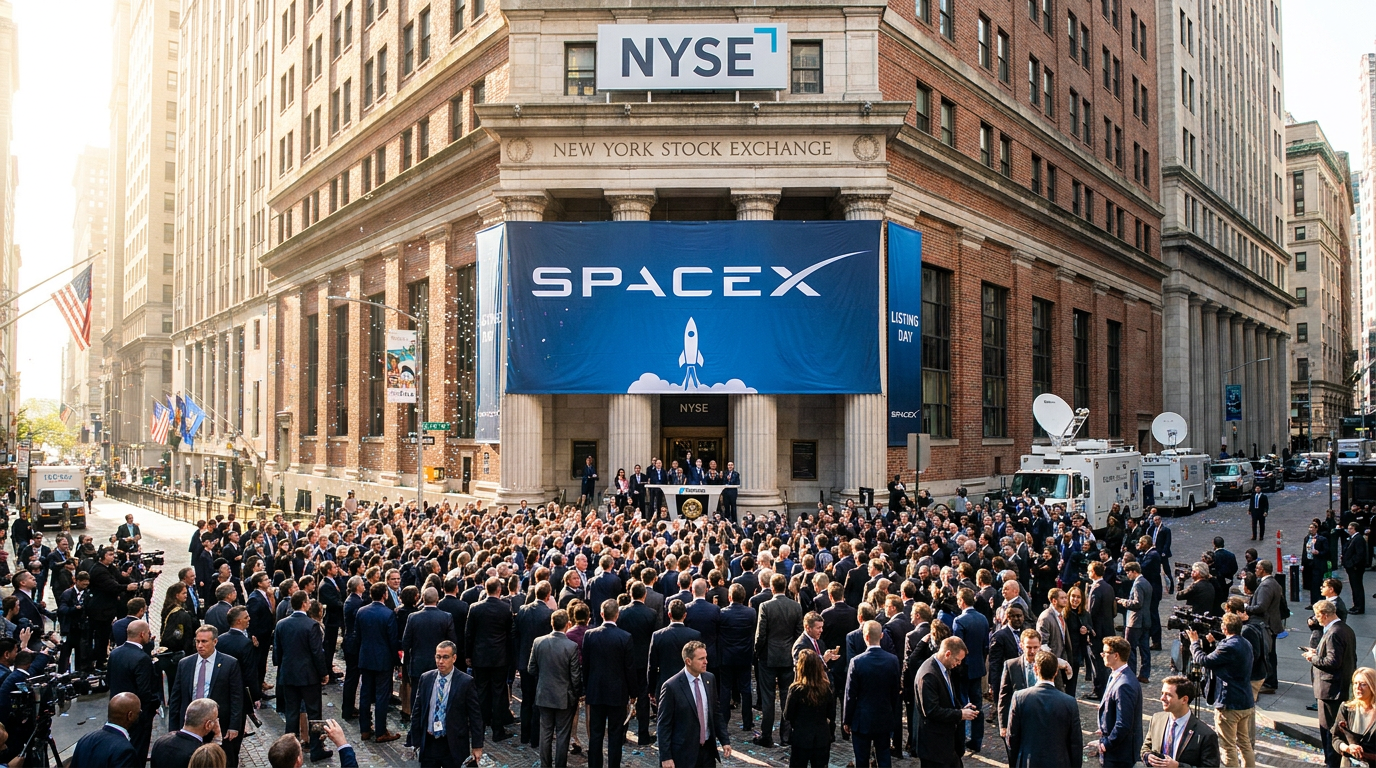
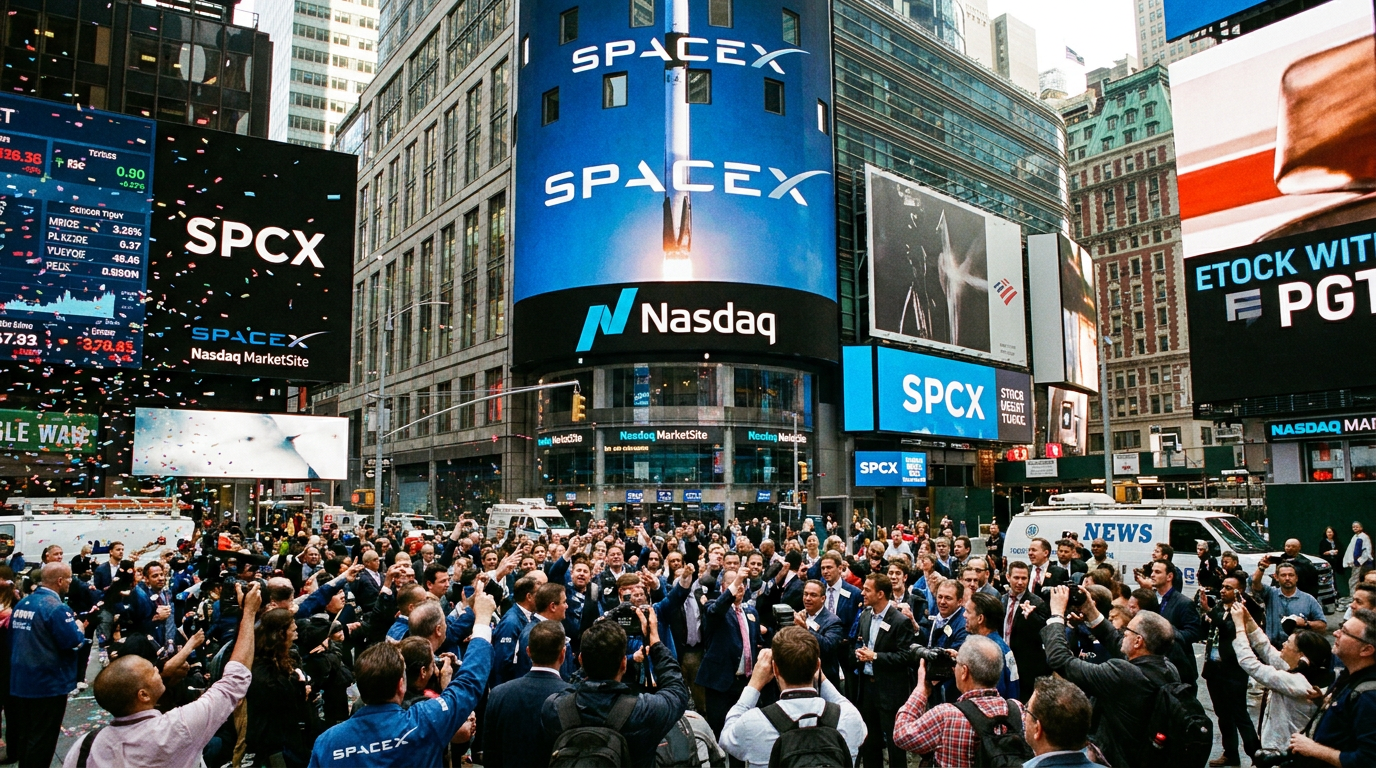
The wait is over. On June 12, 2026, Space Exploration Technologies Corp. will officially become a publicly traded company, debuting on the Nasdaq under the ticker symbol SPCX. The event shatters existing financial records: SpaceX is raising $75 billion, eclipsing Saudi Aramco's 2019 debut to become the largest initial public offering in history. For years, the prospect of a SpaceX listing was treated as a theoretical milestone; today, it is a tangible reality that is immediately reshaping the landscape of public equities.[2][4]
But the sheer size of the offering is only part of the story. In a highly unusual move for a mega-cap listing, SpaceX bypassed the traditional institutional book-building process—where investment banks gauge market demand over several weeks to narrow down a price range—and instead dictated a fixed price of $135 per share from the outset. At that price, the aerospace giant commands an implied valuation of approximately $1.75 trillion, instantly positioning it among the top echelon of the most valuable publicly traded companies in the United States, trailing only a handful of tech behemoths.[4][6]
The structural mechanics of this historic IPO are heavily tilted toward everyday traders. SpaceX has earmarked an unprecedented 30% of its float for retail investors, which is roughly three times the standard allocation typically reserved for an offering of this magnitude. The response from the public has been nothing short of staggering. Retail traders have submitted purchase orders exceeding $100 billion, meaning the offering is massively oversubscribed even before the full weight of institutional demand is tallied by the underwriting banks.[2][3]

This retail frenzy has prompted stark warnings from financial advisors and market analysts. Wealth managers caution that the 'fear of missing out'—or FOMO—surrounding the SpaceX debut is particularly dangerous for older investors who are nearing or already in retirement. Buying into a hype-driven IPO at peak valuation leaves little margin for error. A post-listing dip that might be a mere temporary blip for a thirty-year-old investor could prove devastating for a retirement portfolio that requires near-term stability and capital preservation.[1]
To understand the justification for the $1.75 trillion price tag, investors must look under the hood of the company's S-1 registration statement. The filing reveals a business growing at a breakneck pace, generating $18.7 billion in total revenue for the full year of 2025. The undisputed crown jewel of this revenue engine is Starlink, the company's low-Earth orbit satellite internet constellation, which accounted for $11.4 billion—or a massive 61%—of the company's total top line.[4]

Beyond its consumer broadband ambitions, SpaceX has established a near-monopoly in orbital logistics. The company captured over 50% of the global commercial launch market in recent years, successfully leveraging its fleet of reusable Falcon 9 and Starship rockets to drastically drive down the cost of reaching orbit. This operational dominance has effectively set a pricing ceiling that all global aerospace competitors must operate beneath if they hope to remain economically viable in the modern launch market.[5][6]
Beyond its consumer broadband ambitions, SpaceX has established a near-monopoly in orbital logistics.
The company's rapid ascent is occurring against the backdrop of a rapidly expanding commercial space sector. The global space economy reached an estimated $462 billion in 2026, driven by an insatiable demand for satellite communications, Earth observation data, and government defense contracts. Industry projections suggest this broader market could exceed $850 billion by 2035, providing a massive total addressable market for SpaceX to deploy its infrastructure and capture further market share.[5]
However, top-line dominance does not automatically equate to bottom-line profitability. The SEC filing lays bare the immense capital requirements of operating a vertically integrated space and technology conglomerate. In the first quarter of 2026 alone, SpaceX posted a staggering net loss of $4.28 billion. These losses are heavily driven by massive capital expenditures required for artificial intelligence infrastructure and the aggressive depreciation schedule of the rapidly expanding Starlink satellite network.[4][6]

The astronomical valuation has also sparked intense debate among institutional analysts. While some bullish investors view the $1.75 trillion figure as entirely justified by the company's monopoly-like grip on space access, others argue it is priced for absolute perfection. Independent research firms have modeled fair value estimates closer to $780 billion, suggesting that long-term investors might be better served waiting for the initial hype to subside before initiating a position.[3]
Corporate governance is another major friction point that has drawn regulatory scrutiny. In the weeks leading up to the IPO, lawmakers, including Senator Elizabeth Warren, petitioned the Securities and Exchange Commission to closely examine the offering. The primary concern centers on SpaceX's dual-class share structure, which grants CEO Elon Musk approximately 85% of the shareholder voting power despite holding only 42% of the equity. Critics argue this structure gives Musk unprecedented control and leaves public shareholders with virtually no avenue to influence corporate strategy.[2][4]
The sheer gravitational pull of the SPCX listing is already distorting the broader stock market. Institutional investors and sovereign wealth funds have reportedly been liquidating positions in other major technology stocks to free up the necessary capital for their massive SpaceX allocations. This sector-wide rebalancing highlights how the IPO is not just a liquidity event for a single aerospace company, but a macroeconomic catalyst that is actively reshaping technology portfolios across the globe.[3][6]

For retail investors who manage to secure shares at the $135 offering price, the immediate future will test their conviction. Market mechanics dictate that highly anticipated IPOs often experience extreme price volatility in their opening days of trading. Furthermore, investors must carefully monitor the impending lockup expirations—typically occurring 90 to 180 days post-listing—when company insiders and early private backers are legally permitted to sell their shares, potentially flooding the market with new supply and driving down the stock price.[6]
Ultimately, the SpaceX IPO represents a watershed moment in financial history, marking the precise point where the commercialization of space becomes a cornerstone of the public equities market. But as the opening bell rings on the Nasdaq floor, the true challenge for the investing public will be separating the undeniable operational triumphs of reusable rockets and global satellite internet from the cold, mathematical reality of a $1.75 trillion valuation.[6]
How we got here
April 1, 2026
SpaceX confidentially files its S-1 registration statement with the SEC.
May 20, 2026
The SEC publicly discloses the S-1 filing, revealing SpaceX's financials.
June 3, 2026
SpaceX breaks convention by announcing a fixed IPO price of $135 per share.
June 12, 2026
SpaceX officially begins trading on the Nasdaq under the ticker SPCX.
Viewpoints in depth
The Retail Bull Case
Investors focused on SpaceX's market dominance and the long-term potential of the space economy.
Proponents of the $1.75 trillion valuation point to SpaceX's absolute dominance in orbital logistics and the explosive growth of Starlink. Bulls argue that the company is not just a rocket manufacturer, but a foundational infrastructure provider for the next century of global communications and space exploration. From this perspective, the $28.5 trillion total addressable market justifies paying a premium today.
The Valuation Skeptics
Analysts warning about the lack of profitability and the dangers of retail FOMO.
Skeptics emphasize the cold financial reality of the S-1 filing, particularly the $4.28 billion net loss in the first quarter of 2026. They argue that while the technology is revolutionary, the stock is priced for absolute perfection. With independent fair value estimates hovering around $780 billion, these analysts warn that retail investors buying at the $135 IPO price are absorbing an immense amount of risk with little margin for error.
The Governance Critics
Lawmakers and corporate governance experts concerned about shareholder rights.
This camp, which includes lawmakers like Senator Elizabeth Warren, focuses on the structural risks of the company. Because CEO Elon Musk retains 85% of the voting power through a dual-class share structure, public investors have virtually no ability to influence corporate strategy or hold management accountable. Critics argue this unprecedented concentration of power is a significant risk factor that the market is currently ignoring.
What we don't know
- How the stock will perform once the 90-to-180-day insider lockup periods expire and early investors can sell.
- Whether the aggressive capital expenditures for AI infrastructure will yield a profitable return in the near term.
- How much of the $100 billion in retail demand will actually be fulfilled given the allocation limits.
Key terms
- Initial Public Offering (IPO)
- The process by which a private company offers its shares to the public for the first time.
- S-1 Filing
- The initial registration form a company must file with the SEC before going public, detailing its business model and financials.
- Float
- The number of a company's shares that are available for trading by the public.
- Lockup Period
- A predetermined window after an IPO during which company insiders and early investors are restricted from selling their shares.
- Dual-class Share Structure
- A corporate setup where different classes of shares have different voting rights, often used to keep control with founders.
Frequently asked
When does SpaceX stock start trading?
SpaceX is scheduled to debut on the Nasdaq on Friday, June 12, 2026.
What is the ticker symbol for SpaceX?
The company will trade under the ticker symbol SPCX.
Can retail investors buy shares?
Yes, SpaceX has allocated an unusually high 30% of its IPO shares specifically for retail investors.
Is SpaceX currently profitable?
No. Despite generating $18.7 billion in revenue in 2025, heavy investments in infrastructure led to a $4.28 billion net loss in Q1 2026.
Sources
Source coverage
6 outlets
3 viewpoints surfaced






[1]MarketWatchValue Skeptics
SpaceX IPO hype is massive — and the FOMO can ruin your retirement
Read on MarketWatch →[2]ForbesValue Skeptics
SpaceX Files For What Could Be Largest IPO In History
Read on Forbes →[3]Business InsiderRetail Bulls
An explosion of interest from retail traders
Read on Business Insider →[4]Securities and Exchange CommissionValue Skeptics
Space Exploration Technologies Corp. Form S-1 Registration Statement
Read on Securities and Exchange Commission →[5]Global Market InsightsMacro Analysts
Space Economy Market Size & Share 2026-2035
Read on Global Market Insights →[6]Factlen Editorial TeamMacro Analysts
Synthesis by Factlen editorial team
Read on Factlen Editorial Team →

More in finance
See all 55 stories →Mega-IPOs
The Mechanics of Mega-IPOs: What the Historic SpaceX Debut Means for Everyday Investors
5 sources
Mega-Cap IPOs
SpaceX Prices Historic $75 Billion IPO, Shattering Records and Rewriting Market Rules
8 sources
Bitcoin Maturation
Bitcoin's price is stabilizing—and economists say that's exactly what it needs to become a true currency
7 sources
Digital Payments
Crypto Enters Its 'Boring' Era as Volatility Drops and Stablecoins Power Global Payments
8 sources
Every angle. Every day.
Get finance stories with full source coverage and perspective breakdowns delivered to your inbox.