
SpaceX Hits Public Markets in Record-Breaking $1.75 Trillion IPO
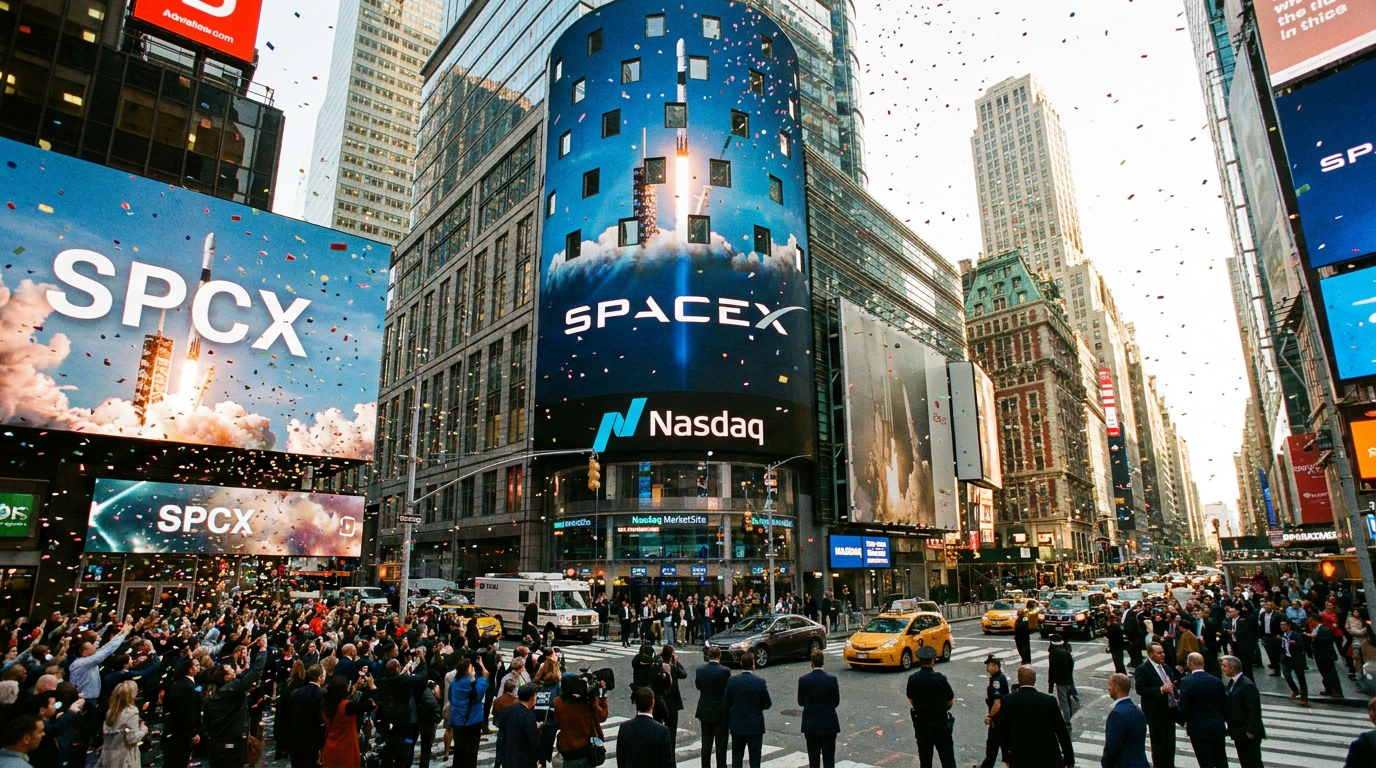
SpaceX has officially debuted on the Nasdaq under the ticker SPCX, raising $75 billion in the largest initial public offering in history. The landmark listing values the aerospace and AI giant at roughly $1.75 trillion, driven by massive retail demand and the rapid growth of its Starlink network.
By Factlen Editorial Team
- Growth Investors
- View the IPO as a generational opportunity to invest in a monopoly across space and AI.
- Value Skeptics
- Caution that the $1.75 trillion valuation outpaces current fundamentals and relies on untested tech.
- Market Analysts
- Focus on the unprecedented scale of the offering and its structural impact on public markets.
What's not represented
- · Traditional Telecommunications Providers
- · Index Fund Managers
Why this matters
The largest public offering in history democratizes access to the world's most valuable private company, allowing everyday investors to directly participate in the burgeoning space economy and the next wave of AI infrastructure.
Key points
- SpaceX raised $75 billion in its Nasdaq debut, shattering the previous IPO record.
- The listing values the combined aerospace and AI company at roughly $1.75 trillion.
- Starlink accounted for 61% of the company's $18.7 billion revenue in 2025.
- Retail investors were granted an unusually high 30% allocation of the available shares.
- The massive valuation includes a significant premium from SpaceX's recent merger with xAI.
SpaceX has officially entered the public markets, debuting on the Nasdaq under the ticker SPCX in the largest initial public offering in global financial history. Pricing its shares at $135, the aerospace and artificial intelligence conglomerate raised a staggering $75 billion, effortlessly shattering the previous $29.4 billion record set by Saudi Aramco in 2019. The landmark listing catapults SpaceX to a valuation of roughly $1.75 trillion, instantly placing it among the most valuable companies on Earth alongside tech titans like Apple, Microsoft, and Nvidia. For a company that has spent more than two decades strictly in private hands, the transition marks a watershed moment for both the aerospace industry and global capital markets.[2][3]
The sheer scale of the offering was met with unprecedented market enthusiasm. Order books swelled with more than $250 billion in investor demand, oversubscribing the available shares by nearly four times before the final pricing was even announced. In a highly unusual move for a mega-cap listing, SpaceX allocated a massive 30% of its float directly to retail investors through consumer brokerages like Fidelity, Robinhood, and Charles Schwab. This aggressive retail allocation effectively democratizes access to the space economy, allowing everyday traders to buy into a company that was previously accessible only to elite venture capital firms and institutional funds.[5][6]
While SpaceX is globally renowned for its reusable Falcon rockets and the ambitious Starship program, the financial engine driving this historic valuation is Starlink. The satellite broadband constellation accounted for roughly $11.4 billion—or 61%—of the company’s $18.7 billion total revenue in 2025. Starlink’s subscriber base doubled over the past year, generating robust cash flow that has transformed SpaceX from a capital-intensive launch provider into a dominant global telecommunications force. This recurring revenue stream provides the financial bedrock necessary to fund the company's more speculative, long-term engineering projects.[4][6]

Beyond space exploration and internet connectivity, the IPO prospectus revealed the massive financial impact of SpaceX's February 2026 merger with xAI, Elon Musk's artificial intelligence venture. The integration of xAI significantly expanded SpaceX's technological horizons, pitching the combined entity as a pioneer in "orbital compute"—the concept of placing AI data centers in space to bypass terrestrial energy constraints. This AI premium is a major driver of the $1.75 trillion valuation, attracting a new class of investors eager to capitalize on the intersection of aerospace infrastructure and artificial general intelligence.[3][4][7]
Despite the astronomical top-line growth, SpaceX enters the public markets with substantial near-term unprofitability. The company posted a net loss of $4.9 billion in 2025, largely driven by the massive capital expenditures required for AI infrastructure and Starship development. The xAI segment alone recorded an operating loss of over $6 billion, effectively subsidized by Starlink's profits. Critics and some financial analysts point out that pricing the company at nearly 94 times its 2025 revenue represents a multiple without precedent among mega-cap stocks, raising questions about the sustainability of the valuation.[3][4][7]

Despite the astronomical top-line growth, SpaceX enters the public markets with substantial near-term unprofitability.
This aggressive pricing has sparked intense debate among market watchers and institutional analysts. Researchers at Morningstar have cautioned that the valuation is "extremely speculative," arguing that while the core launch and Starlink businesses are undeniably strong, the multi-trillion-dollar price tag relies heavily on untested technologies and the long-term promise of multi-planetary colonization. Some bear-case models suggest a fundamental value closer to $800 billion, warning of a potential disconnect between the IPO hype and the company's current cash flow realities, advising investors to wait for a more attractive entry point.[1][3][4]
Conversely, bullish investors view the IPO as a rare opportunity to buy into a generational monopoly. Proponents argue that traditional revenue multiples fail to capture SpaceX's total addressable market, which spans global telecommunications, government defense contracts, and the burgeoning AI sector. By consolidating the world's most advanced launch capabilities with a rapidly expanding AI division, supporters believe SpaceX is uniquely positioned to dominate the next era of technological infrastructure, both on Earth and in orbit. For these investors, the near-term losses are a necessary investment in an insurmountable moat.[1][2]

As SPCX begins trading, all eyes are on how the stock will perform in its opening days and whether the massive retail allocation will lead to heightened volatility. The $75 billion in newly raised capital will immediately be deployed to accelerate Starship's development, expand the Starlink constellation, and build out xAI's computational capacity. For the broader market, SpaceX's successful debut signals a robust appetite for mega-cap tech offerings, potentially paving the way for other highly anticipated AI and tech listings later this year, while forever altering the landscape of public equities.[2][5][6]
How we got here
2002
Elon Musk founds SpaceX with the goal of reducing space transportation costs.
2019
SpaceX begins launching the Starlink satellite constellation to provide global broadband.
Dec 2025
A private tender offer values SpaceX at approximately $800 billion.
Feb 2026
SpaceX merges with xAI, significantly expanding its technological scope and valuation.
Jun 2026
SpaceX debuts on the Nasdaq, raising $75 billion in the largest IPO in history.
Viewpoints in depth
Retail & Growth Investors
Viewing the IPO as a generational opportunity to invest in a monopoly.
For growth-focused investors, SpaceX represents an insurmountable moat. The combination of reusable rocket technology, a dominant global satellite internet constellation, and a rapidly expanding AI division creates a unique conglomerate with virtually no peer. Retail investors, who were granted an unprecedented 30% of the IPO float, are largely ignoring the near-term unprofitability, viewing the $4.9 billion net loss as a necessary capital expenditure to secure long-term dominance in both orbital infrastructure and artificial general intelligence.
Value Analysts & Skeptics
Cautioning that the $1.75 trillion valuation outpaces current fundamentals.
Financial skeptics and value analysts, including researchers at Morningstar, argue that the IPO is priced for absolute perfection. At roughly 94 times its 2025 revenue, SpaceX is trading at a multiple that dwarfs even the most aggressive tech valuations. Skeptics point out that while Starlink is a proven cash generator, the massive capital drain of the xAI division and the Starship program introduces significant risk. They warn that the valuation relies too heavily on untested concepts like 'orbital compute' and multi-planetary colonization, leaving little room for execution errors.
What we don't know
- How the stock will perform in its initial weeks of trading given the unprecedented retail allocation.
- Whether the ambitious 'orbital compute' AI data centers will prove technologically and economically viable.
Key terms
- Initial Public Offering (IPO)
- The process of offering shares of a private corporation to the public in a new stock issuance.
- Float
- The regular shares a company has issued to the public that are available for investors to trade.
- Orbital Compute
- The theoretical deployment of data centers and artificial intelligence processing hardware in space.
- EBITDA
- Earnings before interest, taxes, depreciation, and amortization—a measure of a company's overall financial performance.
Frequently asked
What is the ticker symbol for SpaceX?
SpaceX trades on the Nasdaq exchange under the ticker symbol SPCX.
Can regular investors buy SpaceX stock?
Yes. In a rare move for a company of this size, SpaceX allocated 30% of its IPO shares directly to retail investors through major brokerages.
Is SpaceX profitable?
While its Starlink division generates significant profit, the overall company posted a net loss of $4.9 billion in 2025 due to heavy investments in AI and rocket development.
Sources
Source coverage
7 outlets
3 viewpoints surfaced







[1]BloombergMarket Analysts
The Bull and Bear Case for SpaceX
Read on Bloomberg →[2]ReutersGrowth Investors
SpaceX targets $1.75 trillion valuation in record-breaking IPO
Read on Reuters →[3]The GuardianValue Skeptics
SpaceX heads for record $1.78tn float amid fears it is overvalued
Read on The Guardian →[4]MorningstarValue Skeptics
6 Charts on SpaceX's Pre-IPO Financials
Read on Morningstar →[5]ForbesGrowth Investors
Ordinary People Can Soon Invest In OpenAI, Anthropic And SpaceX IPOs: Here's How—And Why It's Risky
Read on Forbes →[6]Capital.comMarket Analysts
SpaceX IPO Targets June 2026 After SEC Filing
Read on Capital.com →[7]BitMEXMarket Analysts
SpaceX IPO Guide: S-1 Breakdown, Valuation & Trading Strategy
Read on BitMEX →

More in business
See all 39 stories →Energy Shock
The Global Economic Shock of the Hormuz Closure: How $128 Oil is Rewriting 2026
9 sources

Strait of Hormuz
Why Global Oil Could Hit $150 a Barrel—and What It Means for the Economy
8 sources

Skills-Based Hiring
The End of the Job Description: Why Companies Are Shifting to 'Skills-Based' Management
6 sources

Longevity Tech
Longevity Biotech NewLimit Secures $435M Series C to Bring Age-Reversing Medicine to Human Trials
6 sources

Every angle. Every day.
Get business stories with full source coverage and perspective breakdowns delivered to your inbox.