
Community-Owned Solar Projects Hit Record Growth as Neighborhoods Take Control of the Grid
Driven by new state frameworks and grassroots funding, community solar capacity is surging in 2026, allowing renters and low-income households to bypass utility monopolies and co-own local renewable energy.
By Factlen Editorial Team
- Community Energy Advocates
- Argue that local ownership of renewable energy builds community wealth, democratizes the grid, and directly lowers utility bills for residents.
- State & Local Policymakers
- Focus on creating regulatory frameworks and grant programs that scale clean energy equitably while protecting non-participating ratepayers.
- Industry & Finance Analysts
- Emphasize the need to standardize credit enhancements and financing structures to move community solar projects into the mainstream capital market.
- Equity & Development Researchers
- Warn that without plural ownership structures, the green transition risks becoming an exclusive enclave that deepens existing economic inequalities.
What's not represented
- · Traditional Investor-Owned Utilities
- · Fossil Fuel Industry Representatives
Why this matters
Community solar democratizes the financial benefits of the green transition. By allowing renters and low-income families to subscribe to local energy projects, this model directly lowers monthly utility bills while keeping energy profits circulating within the local economy rather than flowing to massive utility monopolies.
Key points
- A UK community successfully over-funded the nation's first community-owned solar park battery, raising £640,000.
- Maryland announced $43 million in grants to build 69 community solar projects, prioritizing brownfields and low-income households.
- California finalized rules to responsibly expand its 560 MW community solar portfolio, launching a new rooftop array in East Oakland.
- Researchers warn that standardizing finance and mandating shared ownership are essential to prevent the green transition from deepening inequality.
Across the globe, a quiet revolution is reshaping how neighborhoods power their homes. In June 2026, the community solar movement—a model that allows renters, apartment dwellers, and low-income households to co-own or subscribe to local renewable energy projects—reached a series of unprecedented milestones. From urban rooftops in California to rural battery parks in the United Kingdom, communities are increasingly bypassing traditional utility monopolies to take direct ownership of their energy infrastructure.
The surge represents a fundamental shift in the green transition. For years, the benefits of solar energy were largely restricted to homeowners with the capital and roof space to install their own panels. Community solar democratizes that access. By pooling resources to build shared arrays on warehouses, brownfields, or local land, residents can subscribe to a portion of the power generated, receiving direct credits on their utility bills while decarbonizing their local grid.
The financial momentum behind these projects is accelerating rapidly. In Oxfordshire, England, the Low Carbon Hub recently launched a funding campaign for the UK’s first-ever community-owned solar park battery. The project at Ray Valley Solar aimed to raise £500,000 to install a £1.8 million battery system capable of storing clean electricity for 7,000 homes.[1]
The response was overwhelming. A month ahead of its deadline, the campaign blew past its target, with 270 local residents investing over £640,000. Because the project is over-raising, the community will own an even larger share of the battery, reducing reliance on commercial loans and keeping the financial returns circulating within the local economy.[1]

Across the Atlantic, state governments are heavily subsidizing the model to ensure equitable access. In early June, Maryland Governor Wes Moore announced $43 million in new grants to fund 69 community solar projects across the state. The initiative specifically targets low-income households, guaranteeing subscribers a minimum 12% discount on their electricity bills, though state officials note that actual savings for many families will exceed 25%.[3]
Maryland’s latest funding round also prioritizes projects built on brownfields—transforming former industrial wastelands into clean energy production hubs. By keeping energy generation close to where it is consumed, these localized grids minimize the power lost during transmission over long distances.[3]
California is also cementing its position as a community solar powerhouse. The California Public Utilities Commission (CPUC) recently finalized the implementation details of its Community Renewable Energy (CRE) Program, establishing a comprehensive framework to responsibly scale the state’s portfolio while protecting non-participating ratepayers from cost shifts.[2]
California is also cementing its position as a community solar powerhouse.
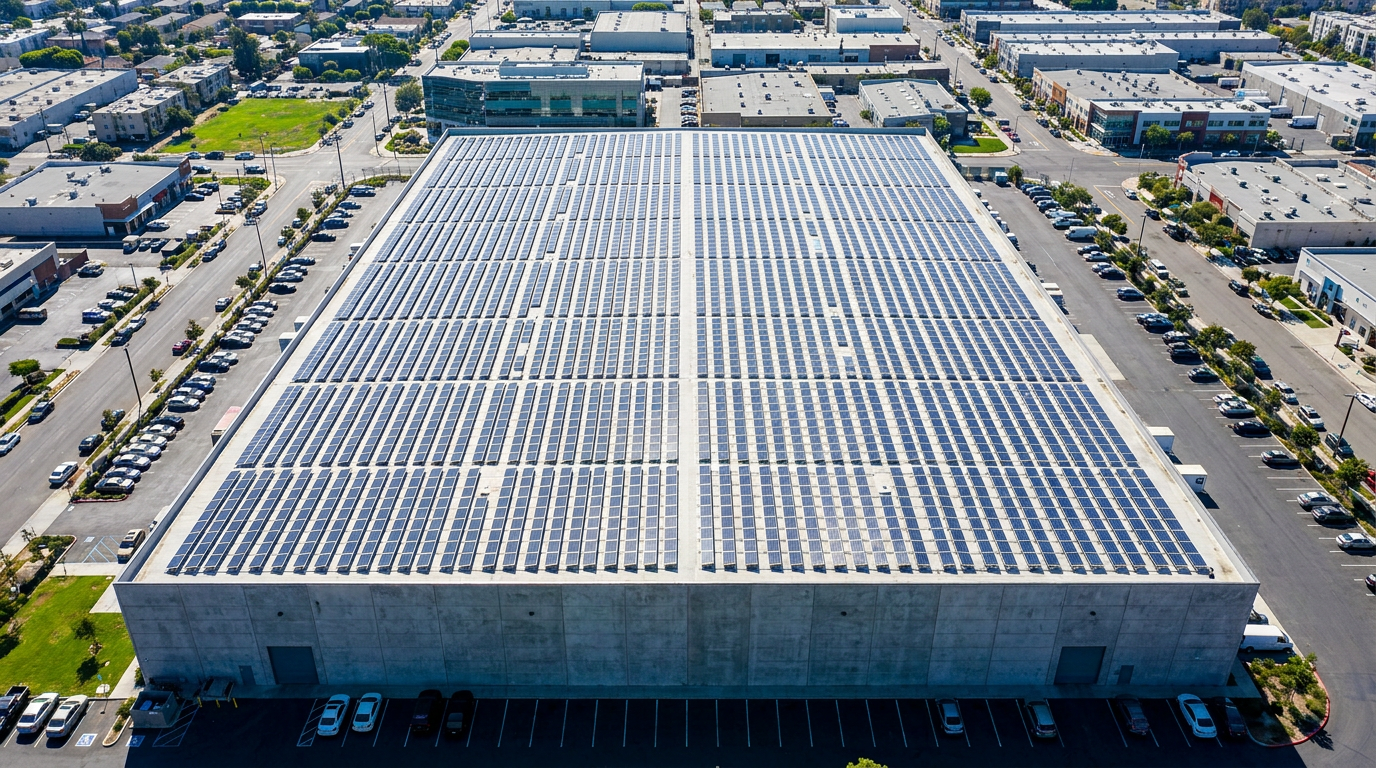
The state currently boasts more than 1,200 operating shared solar projects totaling 560 megawatts (MW), with another 430 projects under construction. To mark the program's expansion, officials gathered in East Oakland to inaugurate a new 0.72 MW community solar farm built atop a logistics warehouse owned by Prologis.[2][5]

Developed by Ava Community Energy, the Oakland installation operates under California’s Disadvantaged Communities Green Tariff. It provides income-qualified customers with 100% renewable electricity at a 20% discount. When stacked with other state assistance programs, participating households could see their monthly utility bills slashed in half.[5]
The national pipeline for these projects is massive. According to the Solar Energy Industries Association (SEIA), the United States installed 247 MWdc of community solar in the first quarter of 2026 alone. While legacy markets like California transition to new tariff structures, emerging programs in Illinois and the Mid-Atlantic are driving sustained growth, backed by an 8.2 GWdc near-term project pipeline.[6]

Despite the momentum, significant hurdles remain—chief among them, financing. A 2026 report by the clean energy think tank RMI highlighted that while many community solar projects work on paper, they often fail to fit into the rigid "credit box" of mainstream commercial banks.[8]
Small deal sizes, unfamiliar counterparties, and the perceived cash-flow risks of low-income subscribers can make traditional lenders hesitant. RMI emphasizes that to scale community clean energy without relying on perpetual government subsidies, the industry must standardize credit enhancements and strengthen the balance sheets of green banks and community lenders.[8]
Beyond the financial mechanics, researchers argue that community ownership is vital for the social legitimacy of the climate transition. A June 2026 report by Scotland’s Community Climate Action Hubs and the consultancy Regen warned that unless governments mandate shared ownership schemes, communities risk missing out on the wealth generated by the renewable energy boom.[4]
The Scottish report modeled that a community holding just a 2% stake in a local offshore wind development could receive around £45 million over the project's lifetime. However, without legal, financial, and technical support, volunteer-led organizations often struggle to negotiate these complex ownership arrangements with massive energy developers.[4]

This sentiment is echoed globally. Research published by Wits University in South Africa argues that if renewable energy assets remain concentrated among a narrow group of private investors, the green economy risks becoming an exclusive, capital-intensive enclave that deepens existing inequalities.[7]
By embracing plural ownership structures—where municipalities, cooperatives, and citizens directly invest in and govern their energy systems—societies can align the climate transition with broader developmental goals.[7]
How we got here
2022
The Low Carbon Hub sets up Ray Valley Solar, laying the groundwork for future community-owned battery storage.
Q1 2026
The United States installs 247 MWdc of community solar, driven heavily by expanding programs in the Mid-Atlantic and Illinois.
June 2026
Maryland Governor Wes Moore announces $43 million in grants for 69 new community solar projects.
June 2026
The Ray Valley Solar battery project in the UK exceeds its £500,000 community funding target a month ahead of schedule.
Viewpoints in depth
Community Energy Advocates
Argue that local ownership of renewable energy builds community wealth, democratizes the grid, and directly lowers utility bills for residents.
Advocates for energy democracy view community solar as a tool for economic justice. By allowing residents to own a stake in their local power generation, the financial returns of the energy transition stay within the community rather than flowing to distant shareholders or massive utility monopolies. Groups like Scotland's Climate Action Hubs emphasize that this model transforms passive consumers into active stakeholders, ensuring that the wealth generated by wind and solar directly funds local resilience and nature projects.
State & Local Policymakers
Focus on creating regulatory frameworks and grant programs that scale clean energy equitably while protecting non-participating ratepayers.
For regulators and lawmakers, community solar is a critical mechanism for meeting aggressive state decarbonization goals without leaving low-income residents behind. Policymakers in states like California and Maryland are actively designing tariff structures and grant programs that guarantee utility bill discounts for disadvantaged communities. However, they must carefully balance these incentives to ensure that the costs of grid maintenance and solar subsidies are not unfairly shifted onto non-participating ratepayers.
Industry & Finance Analysts
Emphasize the need to standardize credit enhancements and financing structures to move community solar projects into the mainstream capital market.
Financial analysts point out that while community solar is popular, it often struggles to secure traditional bank loans. Because these projects rely on subscriptions from diverse, sometimes lower-income customer bases, they don't fit neatly into the standard risk models used by commercial lenders. Organizations like RMI argue that the industry must develop standardized credit enhancements and rely on green banks to absorb early risks, allowing these localized assets to be bundled and sold on secondary markets without perpetual government subsidies.
What we don't know
- How quickly traditional commercial banks will adapt their lending criteria to finance smaller, community-owned energy projects without relying on state subsidies.
- Whether the UK government will officially mandate that all new commercial renewable energy developments offer an ownership stake to local communities.
Key terms
- Community Solar
- A shared renewable energy plant whose electricity is shared by more than one household, allowing subscribers to receive utility bill credits without installing panels on their own property.
- Disadvantaged Communities Green Tariff
- A California program that provides income-qualified residential customers in specific neighborhoods with 100% renewable energy at a discounted rate.
- Megawatt (MW)
- A unit of electrical power equal to one million watts, typically used to measure the output capacity of large-scale power plants and solar arrays.
- Brownfield
- A former industrial or commercial site where future use is affected by real or perceived environmental contamination, increasingly repurposed for solar farms.
Frequently asked
What exactly is community solar?
Community solar allows multiple people to benefit from a single, shared solar array. Subscribers purchase or lease a portion of the panels, and in return, they receive credits on their utility bills for the electricity generated.
Do I need to own a home to participate?
No. The primary benefit of community solar is that it is accessible to renters, apartment dwellers, and those whose roofs are unsuitable for traditional solar panels.
How much money does community solar save subscribers?
Savings vary by program, but many state-subsidized initiatives, such as those in Maryland and California, guarantee low-income subscribers a 12% to 25% discount on their monthly electricity bills.
Sources
Source coverage
8 outlets
4 viewpoints surfaced








[1]AZoCleantechCommunity Energy Advocates
Community Invests Over £640,000 for First-Ever Community-Owned Solar Park Battery
Read on AZoCleantech →[2]California Public Utilities CommissionState & Local Policymakers
CPUC Finalizes Key Implementation Details of the Community Renewable Energy Program
Read on California Public Utilities Commission →[3]Maryland.govState & Local Policymakers
Governor Moore Announces 69 New Grants Totaling $43 Million for Community Solar Projects
Read on Maryland.gov →[4]The Scottish BeaconCommunity Energy Advocates
Communities risk missing out on renewable energy wealth, report warns
Read on The Scottish Beacon →[5]Local News MattersCommunity Energy Advocates
A new community solar farm atop a Prologis warehouse in East Oakland launches
Read on Local News Matters →[6]Solar Energy Industries AssociationIndustry & Finance Analysts
US Solar Market Insight Q2 2026
Read on Solar Energy Industries Association →[7]Wits UniversityEquity & Development Researchers
The climate transition needs public and collective ownership
Read on Wits University →[8]RMIIndustry & Finance Analysts
Building the Systems Community Clean Energy Finance Needs
Read on RMI →

More in community
See all 10 stories →Community Land Trusts
Community Land Trusts Hit Historic Milestones, Securing Permanent Affordability Nationwide
7 sources
Community Repair
The Global Rise of Repair Cafes and Tool Libraries
7 sources
Energy Resilience
How Community Microgrids Are Rewiring Neighborhoods for Energy Independence
7 sources
Sharing Economy
The Rise of the 'Library of Things': How Neighborhoods Are Redefining the Sharing Economy
8 sources

Every angle. Every day.
Get community stories with full source coverage and perspective breakdowns delivered to your inbox.