
The Era of Local AI: How Small Language Models Are Turning Phones and Laptops Into Private AI Hubs
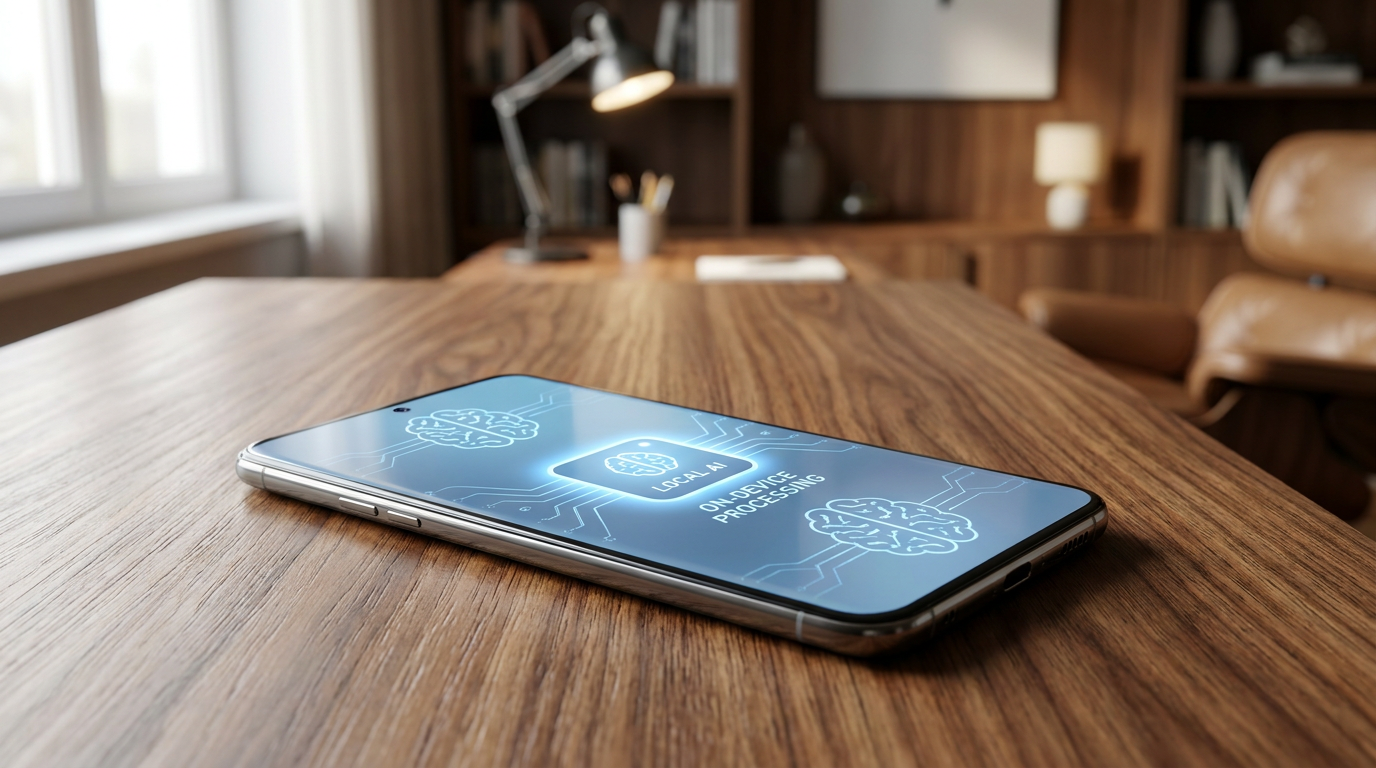
Advances in Small Language Models (SLMs) and neural processing hardware have made it possible to run highly capable AI entirely on consumer devices in 2026. This shift eliminates cloud latency, slashes costs, and guarantees absolute data privacy.
By Factlen Editorial Team

- Privacy & Security Advocates
- Argue that on-device AI is the only way to guarantee absolute data sovereignty.
- Hardware Ecosystem Builders
- View local AI as the primary catalyst for a massive consumer hardware upgrade cycle.
- Open-Source AI Developers
- Focus on democratizing AI access by removing the financial barriers of cloud API subscriptions.
What's not represented
- · Cloud Infrastructure Providers
- · Environmental Analysts
Why this matters
By moving AI processing from the cloud to your personal device, local models guarantee that your sensitive data never leaves your hardware. This shift also eliminates subscription fees and allows powerful AI assistants to work perfectly even when you have no internet connection.
Key points
- Small Language Models (SLMs) allow users to run capable generative AI entirely on their personal devices without an internet connection.
- Local inference guarantees absolute data privacy, as sensitive prompts and documents never leave the user's hardware.
- Apple recently raised the hardware floor for its most advanced on-device AI, requiring 12GB of RAM and excluding the base iPhone 17.
- Techniques like quantization can compress a 7-billion parameter model to fit into just 3.5GB of memory.
- Developers are adopting hybrid architectures, routing simple tasks to free local models while reserving complex reasoning for cloud APIs.
For the past three years, the generative artificial intelligence revolution has been strictly tethered to the cloud. Every drafted email, summarized document, and generated line of code required packaging user data, sending it to a remote server, and waiting for a computational response. While this centralized model allowed companies to deploy massive, resource-intensive neural networks, it came with significant compromises regarding privacy, latency, and offline availability. Now, in mid-2026, the paradigm is shifting decisively toward the edge. The industry is moving away from an exclusive reliance on cloud monoliths and embracing a future where highly capable AI runs quietly and privately on the hardware that billions of people already own.[6]
The catalyst for this architectural change is the rapid maturation of Small Language Models (SLMs). Unlike their massive cloud-based counterparts, which often contain hundreds of billions of parameters and require vast clusters of data center GPUs to function, SLMs are compact AI systems typically containing fewer than 10 billion parameters. These models are explicitly engineered for efficiency, designed to punch above their weight class and run entirely on consumer-grade hardware. By training on highly curated, high-quality datasets rather than scraping the entire internet, developers have proven that a smaller model can achieve remarkable fluency and utility for everyday tasks.[4][6]
This shift is fundamentally altering the economics and privacy guarantees of artificial intelligence. By processing data locally on the device, SLMs eliminate the need for cloud API calls, ensuring that sensitive corporate documents, personal health inquiries, or private messages never leave the user's hardware. For industries bound by strict compliance regulations, such as healthcare, finance, and legal services, this data sovereignty is not just a convenient feature; it is a strict regulatory requirement. Furthermore, local inference completely removes the recurring subscription costs and per-token API fees associated with cloud AI, making the technology significantly cheaper to operate at scale.[6]
The push for local AI is driving a massive hardware upgrade cycle across the technology industry, as manufacturers race to equip devices with the necessary computational muscle. Microsoft has aggressively positioned its 'Copilot+ PCs' as the new baseline for Windows computing. To qualify for this designation, a laptop must feature a Neural Processing Unit (NPU) capable of at least 40 Trillions of Operations Per Second (TOPS) and a minimum of 16 gigabytes of RAM. This hardware floor ensures that the device has enough memory to hold the model and enough specialized processing power to run it smoothly.[3]

These NPUs are specialized pieces of silicon designed specifically to execute the complex matrix math required by deep learning models far more efficiently than traditional processors. While a standard CPU or GPU can technically run an AI model, doing so requires massive amounts of electricity and generates significant heat. By offloading AI tasks to a dedicated NPU, modern laptops can run continuous background AI features—such as real-time audio translation, screen analysis, or predictive text generation—without destroying the device's battery life or crippling its overall system performance.[3]
Apple has similarly anchored its 2026 software strategy around local inference and hardware integration. At its Worldwide Developers Conference this week, the company unveiled the next generation of Apple Intelligence, powered by a new family of Apple Foundation Models (AFM 3). Apple's architecture relies heavily on its unified memory system, where the CPU, GPU, and Neural Engine all share the same pool of RAM. This design is particularly well-suited for AI inference, as it eliminates the bottleneck of constantly moving model weights back and forth between different components.[2]
While Apple's standard on-device models continue to run on devices with 8 gigabytes of RAM, the company introduced a more powerful local model this week that carries stricter requirements. To run Apple's most advanced on-device AI features—which include highly expressive voice generation and superior natural language understanding—users will need a device with at least 12 gigabytes of unified memory. This strict hardware floor means the upcoming base iPhone 17 is excluded from the most advanced local features, reserving them exclusively for the iPhone 17 Pro, the rumored iPhone Air, and Macs equipped with M3 chips or newer.[1]
Making these highly capable models fit onto consumer devices requires aggressive software optimization alongside hardware upgrades. The most critical technique enabling this revolution is quantization, a mathematical process that reduces the precision of the model's parameters. By compressing the neural network's weights from standard 16-bit floating-point numbers down to 4-bit integers, developers can drastically shrink the model's physical size. This technique allows a 7-billion-parameter model to reduce its memory footprint from 14 gigabytes down to just 3.5 gigabytes, allowing it to run comfortably on a standard laptop with minimal loss in reasoning quality.[4]

Making these highly capable models fit onto consumer devices requires aggressive software optimization alongside hardware upgrades.
Architectural innovations also play a crucial role in making local inference viable. Modern Small Language Models utilize techniques like grouped-query attention and sliding-window attention to reduce the computational overhead required during text generation. Instead of forcing every new word to mathematically attend to every single previous word in a massive document, the model focuses its computation only on the most relevant local context. This makes the inference process highly efficient, ensuring that the device does not run out of memory when processing longer documents or extended chat conversations.[4]
The result of these hardware and software optimizations is a dramatic improvement in latency. Cloud-based models inherently suffer from network delays, often introducing 200 to 800 milliseconds of lag before the first word is generated on the user's screen. In contrast, highly optimized local models running on modern Apple Silicon or Snapdragon X Elite chips can produce their first token in under 100 milliseconds. This near-instantaneous response time is critical for real-time applications like voice assistants, inline code completion, and augmented reality interfaces, where even slight delays break the user experience.[5]
Furthermore, local models provide absolute offline capability, freeing artificial intelligence from the constraints of internet connectivity. An SLM functions perfectly on an airplane without Wi-Fi, in a secure underground facility, or during a widespread network outage. For field workers, military applications, disaster response teams, and everyday consumers traveling through cellular dead zones, this reliability is transformative. It elevates generative AI from a novel cloud service that fails when the connection drops into a dependable, always-available utility that works exactly like a native calculator or notepad application.[5][6]
The open-weight ecosystem has dramatically accelerated this transition to the edge. Models like Microsoft's Phi-4, Google's Gemma 3, Meta's Llama 3.2, and Alibaba's Qwen 3 are freely available for developers to download, modify, and deploy. Alongside these models, open-source tools like Ollama and MLX have abstracted away the immense complexity of machine learning deployment. Today, anyone with a modern laptop and basic technical knowledge can spin up a private, fully functional AI assistant in a matter of minutes, completely bypassing the traditional tech giants' cloud ecosystems.[4][6]
Microsoft is also expanding the reach of local AI beyond its flagship Copilot+ hardware. The company recently announced that developers can now run Windows 11's local Language Model APIs on non-Copilot+ PCs, provided they have a supported dedicated graphics card, such as an RTX 30-series GPU with at least 6 gigabytes of VRAM. This experimental update broadens the ecosystem significantly, allowing millions of existing gaming laptops and desktop workstations to tap into native local AI features without requiring a dedicated NPU.[7]

Despite their remarkable efficiency, Small Language Models are not a wholesale replacement for massive frontier models. They are highly capable specialists rather than omniscient generalists. While a 4-billion-parameter model excels at summarizing text, formatting data, or drafting routine emails, it lacks the deep, multi-disciplinary reasoning and broad world knowledge of a 100-billion-parameter behemoth. If a user asks an SLM to solve a complex coding architecture problem or explain an obscure historical event, the smaller model is far more likely to hallucinate or provide a shallow answer.[5]
Because of this inherent limitation, the software industry is coalescing around a hybrid routing architecture. Modern applications are increasingly designed to use a local SLM as the first line of defense, handling 80 to 90 percent of routine user queries instantly and privately on the device. Only when a prompt requires complex reasoning, vast external knowledge, or heavy computational lifting is the request securely routed to a larger cloud model. This hybrid approach represents the true maturation of generative AI—delivering the privacy and speed of local computing alongside the boundless power of the cloud.[6]
How we got here
June 2024
Microsoft launches the first wave of Copilot+ PCs, establishing a 40 TOPS NPU baseline for Windows AI.
October 2024
Apple releases the first iteration of Apple Intelligence, bringing basic on-device AI to the iPhone 15 Pro.
Late 2025
Open-weight models like Mistral and Phi-3 prove that highly optimized small models can rival early cloud-based AI performance.
June 2026
Apple announces AFM 3 and introduces a strict 12GB RAM requirement for its most advanced on-device AI capabilities.
Viewpoints in depth
Privacy & Security Advocates
Argue that on-device AI is the only way to guarantee absolute data sovereignty.
For privacy advocates and enterprise compliance officers, the cloud is inherently a vulnerability. Sending sensitive corporate documents, personal health inquiries, or private messages to a third-party server introduces risk, regardless of the provider's data agreements. This camp views local AI as a fundamental right to digital privacy, ensuring that artificial intelligence can assist users without surveilling them. By keeping inference on the device, organizations can deploy AI in highly regulated sectors like finance and healthcare without violating GDPR or HIPAA frameworks.
Hardware Ecosystem Builders
View local AI as the primary catalyst for a massive consumer hardware upgrade cycle.
Device manufacturers and silicon designers see Small Language Models as the killer app that will drive consumers to replace their aging laptops and smartphones. By establishing strict hardware baselines—such as Microsoft's 40 TOPS NPU requirement or Apple's new 12GB RAM floor for advanced models—these companies are creating a clear demarcation between legacy hardware and the AI era. This camp argues that dedicated neural silicon is essential to run continuous background AI features without destroying battery life or crippling system performance.
Open-Source AI Developers
Focus on democratizing AI access by removing the financial barriers of cloud API subscriptions.
For developers and independent builders, Small Language Models represent freedom from the recurring costs and rate limits of centralized cloud providers. This community champions open-weight models like Llama 3.2 and Gemma 3, emphasizing that a highly optimized 4-billion parameter model can handle 90 percent of daily tasks just as well as a massive frontier model. They advocate for hybrid routing architectures, where applications default to free, local inference and only pay for cloud compute when deep reasoning is strictly necessary.
What we don't know
- Whether the current 12GB and 16GB RAM baselines will be sufficient for the next generation of local models in 2027.
- How quickly software developers will adopt hybrid routing versus relying entirely on familiar cloud APIs.
- The long-term impact of continuous local AI inference on the battery degradation of mobile devices.
Key terms
- Small Language Model (SLM)
- A compact artificial intelligence model, typically containing fewer than 10 billion parameters, designed to run efficiently on consumer hardware without requiring cloud connectivity.
- Neural Processing Unit (NPU)
- A specialized computer chip designed specifically to execute the deep learning math operations that make up AI models efficiently, saving battery life.
- Quantization
- A compression technique that reduces the precision of an AI model's parameters, drastically shrinking its memory footprint so it can fit on a laptop or phone.
- TOPS (Trillions of Operations Per Second)
- A metric used to measure the processing power of an NPU, indicating how many AI calculations the chip can perform in one second.
- Unified Memory
- An architecture where the CPU, GPU, and NPU share the same pool of RAM, allowing AI models to run much faster by eliminating the need to copy data between different chips.
Frequently asked
Can I run a Small Language Model on my current laptop?
Yes, provided you have enough memory. Most 4-bit quantized SLMs require at least 8GB of RAM to run comfortably, though 16GB is recommended for smooth multitasking while the model is loaded.
Are local AI models as smart as ChatGPT?
No. SLMs are highly capable specialists that excel at specific tasks like summarizing text, drafting emails, and basic coding. However, they lack the deep reasoning and vast world knowledge of massive cloud-based models.
Does running AI locally drain my device's battery?
Running complex math operations does consume power, but modern devices equipped with Neural Processing Units (NPUs) are designed to handle these specific AI workloads far more efficiently than standard CPUs, minimizing the impact on battery life.
Do I need an internet connection to use local AI?
No. Once the model is downloaded to your device, all processing happens locally. This allows you to use AI features on airplanes, in remote locations, or during network outages.
Sources
Source coverage
7 outlets
3 viewpoints surfaced







[1]MacRumorsHardware Ecosystem Builders
Apple's Most Powerful On-Device AI Now Requires iPhone 17 Pro or iPhone Air
Read on MacRumors →[2]Apple NewsroomPrivacy & Security Advocates
Apple introduces the next generation of Apple Intelligence
Read on Apple Newsroom →[3]Microsoft DeveloperHardware Ecosystem Builders
Copilot+ PCs Developer Guidance
Read on Microsoft Developer →[4]Machine Learning MasteryOpen-Source AI Developers
What Are Small Language Models?
Read on Machine Learning Mastery →[5]Dev.toOpen-Source AI Developers
My Own Experiments: Three Tasks, Two Models, Real Numbers
Read on Dev.to →[6]MediumPrivacy & Security Advocates
The Shift Toward On-Device Intelligence
Read on Medium →[7]Windows LatestOpen-Source AI Developers
Microsoft says you'll be able to run Windows 11's local Language Model APIs on non-Copilot+ PCs
Read on Windows Latest →

More in ai
See all 74 stories →AI Copyright
Supreme Court Rules AI Training is 'Fair Use' in Landmark Copyright Decision
8 sources

On-Device AI
The Year of Local AI: How Small Language Models Are Putting Privacy First
6 sources
On-Device AI
How Open-Weight Models Are Turning Everyday Laptops Into Private AI Assistants
7 sources

Materials Science
How AI and Autonomous Labs Are Ending Trial-and-Error Materials Science
8 sources

Every angle. Every day.
Get ai stories with full source coverage and perspective breakdowns delivered to your inbox.