
How AI and Autonomous Labs Are Ending Trial-and-Error Materials Science
Deep learning models have predicted hundreds of thousands of stable new materials, compressing centuries of traditional research into months and accelerating the development of next-generation batteries and solar cells.
By Factlen Editorial Team
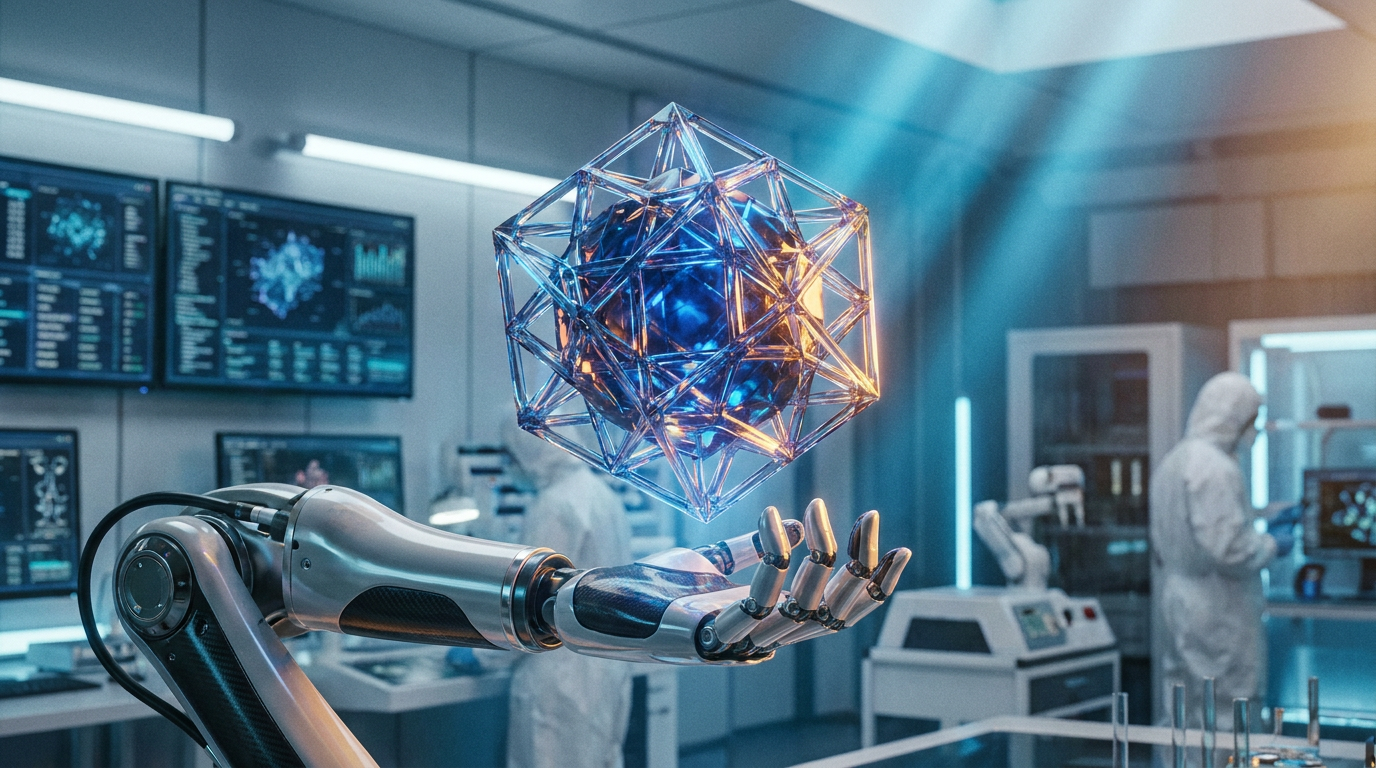
- Computational Material Scientists
- Focuses on the unprecedented scale of discovery and the power of graph neural networks to map uncharted chemical space.
- Industrial Engineers
- Emphasizes that theoretical stability in a lab does not equal commercial viability, stressing the need to design for manufacturability and cost.
- Autonomous Lab Pioneers
- Argues that the true breakthrough lies in closing the loop with robotics, allowing physical synthesis and validation to keep pace with AI predictions.
What's not represented
- · Environmental Toxicologists
- · Mining and Resource Economists
Why this matters
Everything from the range of an electric vehicle to the efficiency of a solar grid is constrained by the physical limits of current materials. By using AI to invent stable, high-performance compounds in days rather than decades, scientists are unblocking the hardware bottlenecks of the clean energy transition.
Key points
- AI models like DeepMind's GNoME have predicted 380,000 thermodynamically stable materials, compressing 800 years of traditional research into months.
- Generative AI and diffusion models are enabling 'inverse design,' allowing scientists to generate atomic structures based on desired physical properties.
- Autonomous laboratories are combining AI with robotics to physically synthesize and test these new materials 24 hours a day.
- Recent reviews show these robotic facilities achieving a 71% success rate in validating AI-predicted compounds.
- Significant challenges remain, including data scarcity in certain chemical classes and the difficulty of scaling lab synthesis to industrial manufacturing.
For most of human history, the discovery of new materials has been a grueling exercise in serendipity and brute-force trial and error. Vulcanized rubber was discovered by accident when Charles Goodyear dropped a mixture on a hot stove; the lithium-ion batteries powering modern electronics took decades of painstaking laboratory refinement to become commercially viable. Scientists would spend entire careers mixing compounds, altering temperatures, and hoping the resulting atomic lattice would exhibit the desired properties. It was a manual craft constrained by the limits of human intuition and the slow pace of physical experimentation, meaning the journey from a theoretical concept to a commercial product routinely spanned twenty to thirty years.[8]
Today, that timeline is collapsing. Artificial intelligence is executing a paradigm shift in materials science that mirrors the revolution AlphaFold brought to structural biology. By training deep learning models on vast databases of known chemical structures, researchers are no longer guessing how atoms might bond. Instead, they are deterministically computing the properties of materials before a single chemical is mixed in a beaker. This transition from empirical guesswork to data-driven prediction is fundamentally rewriting the economics and velocity of industrial research, offering a new toolkit to solve the most pressing hardware bottlenecks in clean energy, computing, and national security.[8]
The sheer scale of this acceleration was crystallized by Google DeepMind’s Graph Networks for Materials Exploration (GNoME) model. Trained on the world’s largest open-access materials databases, GNoME predicted the existence of 2.2 million new inorganic crystal structures. Crucially, the system identified 380,000 of these materials as thermodynamically stable. In materials science, thermodynamic stability is the ultimate prerequisite; if a predicted structure is unstable, it will spontaneously degrade and cannot be synthesized in the real world. By filtering out the physical impossibilities, the AI provided researchers with a massive, pre-vetted catalog of viable new matter.[1]
To understand the magnitude of this computational windfall, one must look at the historical baseline. Before the deployment of these advanced graph neural networks, humanity had collectively discovered and verified roughly 48,000 stable crystals over the entire history of modern science. DeepMind’s researchers estimate that uncovering the 380,000 stable materials identified by GNoME would have required approximately 800 years of traditional laboratory research. In a matter of months, the algorithm effectively expanded the frontier of known, stable materials by an order of magnitude, offering a vast new canvas for engineers to explore.[1]

The underlying mechanism driving this breakthrough relies on graph neural networks (GNNs). Unlike traditional AI models that process text or pixels, GNNs are uniquely suited to understand the complex, three-dimensional relationships between atoms in a crystal lattice. The model evaluates the connections—the "edges" of the graph—between individual atoms, predicting the energy state of the entire structure. By rapidly calculating these energy states, the AI can reliably forecast whether a novel combination of elements will hold together or fall apart, bypassing the need for immediate physical testing.[1]
While GNoME excels at discovering materials by screening millions of possibilities, a parallel breakthrough is occurring in "inverse design." Researchers at Boston University and Lawrence Livermore National Laboratory are utilizing diffusion models—the same underlying architecture that powers AI image generators—to design amorphous materials from scratch. Instead of asking the AI what properties a specific atomic structure will have, scientists input the desired properties they need, and the diffusion model generates a novel atomic arrangement that satisfies those constraints. This allows for the bespoke creation of complex, disordered structures like amorphous carbon, which are critical for advanced water filtration and next-generation battery electrodes.[4]
The immediate beneficiaries of this predictive power are the clean energy and climate tech sectors. A dedicated research initiative known as Energy-GNoME recently filtered DeepMind’s massive database specifically for applications in energy generation and conversion. The protocol identified 4,259 entirely new materials with a perovskite structure—a highly sought-after configuration that efficiently absorbs sunlight and converts it into electricity. Furthermore, the system flagged over 21,000 possible candidates for high-performance battery cathodes and 7,500 thermoelectric materials capable of recovering waste heat.[7]

The immediate beneficiaries of this predictive power are the clean energy and climate tech sectors.
Despite the staggering numbers, the materials science community remains acutely aware of the physical bottleneck that follows computational prediction. Critics and independent researchers note that predicting a material’s stability using AI, or even validating it through computationally expensive physics simulations like Density Functional Theory (DFT), is not the same as actually making it. A material might be theoretically stable on a server, but synthesizing it in a physical laboratory often requires highly specific temperatures, pressures, and precursor chemicals that the AI does not automatically provide.[6]
To bridge the chasm between digital prediction and physical reality, institutions like Los Alamos National Laboratory are pioneering the use of autonomous laboratories, or "A-Labs." These facilities combine the predictive power of AI with advanced robotics to physically synthesize and test new materials without human intervention. When an AI model predicts a promising new alloy capable of withstanding the extreme plasma heat of a nuclear fusion reactor, the A-Lab’s robotic arms automatically gather the pure elements, place them in an arc melter, and execute the synthesis.[2]
This creates a relentless, closed-loop system of scientific discovery. The autonomous lab operates twenty-four hours a day, seven days a week, mixing new compositions, testing their thermal and structural properties, and feeding the experimental results directly back into the AI model. If a synthesis fails, the AI learns from the physical failure, adjusts its parameters, and instructs the robots to try a modified approach. This continuous feedback loop effectively eliminates the downtime of human-driven research, turning the laboratory into a high-throughput factory for scientific validation.[2]
The early results from these robotic facilities are highly encouraging. Recent comprehensive reviews of AI integration in materials science indicate that autonomous laboratories are currently achieving a 71% synthesis validation success rate. This means that nearly three-quarters of the time, the robotic systems are successfully creating the novel materials predicted by the AI algorithms. By automating the most tedious and time-consuming aspects of physical chemistry, these systems are reducing the time required to validate a new material from several years to a matter of weeks.[3]

However, successfully synthesizing a material in a pristine national laboratory does not guarantee commercial viability. Industrial AI startups emphasize that theoretical stability and lab-scale synthesis often fail to account for the harsh realities of mass manufacturing. A newly discovered battery cathode might perform beautifully in a controlled environment, but if it requires rare, expensive elements or is too brittle to survive a commercial assembly line, it is useless to industry. Bridging this gap requires training AI models not just on chemical stability, but on supply chain constraints, cost metrics, and industrial manufacturability.[5]
Furthermore, the AI models themselves are constrained by the quality and availability of their training data. While databases like the Materials Project and NOMAD contain millions of entries, the data is not evenly distributed across all types of matter. Researchers estimate that up to 60% of materials classes suffer from severe data scarcity. This uneven landscape introduces algorithmic bias; the AI becomes highly proficient at predicting variations of well-documented materials, but struggles to innovate in underexplored chemical spaces where experimental data is sparse.[3]
There is also the persistent "black box" dilemma inherent to deep learning. While an AI model can accurately predict that a specific atomic arrangement will yield a highly efficient superconductor, it rarely explains the underlying physics of why the material behaves that way. For traditional materials scientists, this lack of interpretability is frustrating. It transforms the scientific method from a pursuit of fundamental understanding into an exercise in empirical optimization, where researchers know that a material works but cannot fully articulate the quantum mechanics responsible for its success.[3]

Despite these hurdles, the trajectory is unmistakable. The convergence of generative AI, massive computational databases, and autonomous robotics is permanently altering the landscape of physical engineering. The next frontier involves moving beyond passive structures to design "intelligent" materials—substances capable of self-repair, environmental adaptation, and dynamic response. As the algorithms ingest more physical data and the robotic labs become more sophisticated, the latency between imagining a new technology and holding its foundational material in your hand will continue to shrink.[8]
Ultimately, the integration of artificial intelligence into materials science represents the end of serendipity as the primary engine of physical discovery. Humanity is transitioning into an era of programmable matter, where the atomic structures required to build better batteries, cleaner energy grids, and faster semiconductors can be summoned on demand. While the journey from a digital prediction to a commercial product still requires rigorous engineering, the hardest part—finding the right arrangement of atoms in the vast darkness of chemical space—has largely been solved.[8]
How we got here
Pre-2020
Materials discovery relies heavily on serendipity, human intuition, and decades of trial-and-error laboratory work.
Late 2023
Google DeepMind publishes the GNoME paper, predicting 2.2 million new crystal structures and 380,000 stable materials.
2024
Microsoft introduces MatterGen, advancing generative AI techniques for the inverse design of materials.
2025
The Energy-GNoME project identifies thousands of specific candidates for next-generation solar cells and solid-state batteries.
2026
Autonomous laboratories achieve a 71% synthesis validation success rate, closing the loop between AI prediction and physical creation.
Viewpoints in depth
Computational Material Scientists
Focuses on the unprecedented scale of discovery and the power of graph neural networks to map uncharted chemical space.
For researchers rooted in data science and computational physics, the primary victory is the sheer volume of the new chemical frontier. By leveraging graph neural networks to predict the energy states of millions of atomic combinations, this camp argues that AI has effectively solved the 'search' problem in materials science. They view the massive databases generated by models like GNoME as a permanent paradigm shift, arguing that future breakthroughs in clean energy and computing will inevitably originate from these pre-vetted digital catalogs rather than human intuition.
Industrial Engineers
Emphasizes that theoretical stability in a lab does not equal commercial viability, stressing the need to design for manufacturability and cost.
Industrial engineers and manufacturing startups caution against over-celebrating digital predictions. They point out that a material can be thermodynamically stable but completely useless if it requires rare-earth elements that are too expensive to mine, or if its physical properties make it too brittle to survive a commercial assembly line. This camp argues that the next generation of AI models must be trained on supply chain constraints and industrial economics, ensuring that the materials discovered can actually be mass-produced at scale.
Autonomous Lab Pioneers
Argues that the true breakthrough lies in closing the loop with robotics, allowing physical synthesis and validation to keep pace with AI predictions.
Scientists operating at the intersection of AI and robotics argue that prediction is only half the battle. Because traditional laboratory validation is too slow to keep up with algorithms that generate hundreds of thousands of candidates, this camp focuses on 'A-Labs'—facilities where robots mix, melt, and test compounds 24/7. They believe the ultimate future of materials science is a fully closed loop, where AI not only predicts the material but directly controls the robotic hardware that synthesizes it, learning from every physical failure in real time.
What we don't know
- How many of the 380,000 theoretically stable materials can actually be manufactured at a commercial scale using current industrial equipment.
- Whether the AI models can overcome their 'black box' nature to explain the underlying quantum physics of their predictions.
- How the global supply chain will adapt to the sudden demand for obscure precursor elements required by these novel AI-designed alloys.
Key terms
- Graph Neural Network (GNN)
- An AI architecture that excels at understanding relationships, used to model how individual atoms connect within a crystal lattice.
- Density Functional Theory (DFT)
- A computationally expensive physics simulation used to verify the theoretical stability of an AI-predicted material.
- Inverse Design
- A method where scientists input desired physical properties, and the AI generates a novel atomic structure that matches those requirements.
- Perovskite
- A specific crystal structure that is highly efficient at absorbing sunlight, widely considered the future of solar cell technology.
- Diffusion Model
- An AI technique that starts with random noise and gradually refines it into a structured output, used here to generate new atomic arrangements.
Frequently asked
What makes a material thermodynamically stable?
A thermodynamically stable material has an atomic structure that will not spontaneously degrade or fall apart, meaning it can theoretically be synthesized and used in the real world.
How does AI predict new materials without physical testing?
AI uses graph neural networks trained on massive databases of known materials to calculate the energy states of new atomic combinations, predicting how they will bond.
Will these AI-discovered materials be in consumer products soon?
While the initial discovery phase has been drastically shortened, scaling these materials for mass manufacturing and commercial use still takes several years.
What is an autonomous laboratory?
An autonomous laboratory is a facility where advanced robotics mix, heat, and test chemical compounds 24/7 based on AI instructions, without requiring human intervention.
Sources
Source coverage
8 outlets
3 viewpoints surfaced








[1]Google DeepMindComputational Material Scientists
Millions of new materials discovered with deep learning
Read on Google DeepMind →[2]Los Alamos National LaboratoryAutonomous Lab Pioneers
Accelerating Materials Discovery with AI and Robotics
Read on Los Alamos National Laboratory →[3]ChemistrySelect (Wiley)Autonomous Lab Pioneers
Artificial Intelligence in Accelerating Materials Discovery: Opportunities and Challenges
Read on ChemistrySelect (Wiley) →[4]Boston UniversityComputational Material Scientists
AI Breakthrough Offers New Path to Designing Next-Gen Materials
Read on Boston University →[5]Osium AIIndustrial Engineers
DeepMind's GNoME Paper Illuminates AI-Driven Materials Discovery, But Challenges Remain
Read on Osium AI →[6]Mercatus CenterAutonomous Lab Pioneers
Foundation Models in Materials Science: Promise and Pitfalls
Read on Mercatus Center →[7]Energy and AIComputational Material Scientists
Energy-GNoME: A living database of selected materials for energy applications
Read on Energy and AI →[8]Factlen Editorial Team
Synthesis by Factlen editorial team
Read on Factlen Editorial Team →

More in ai
See all 74 stories →AI Copyright
Supreme Court Rules AI Training is 'Fair Use' in Landmark Copyright Decision
8 sources

On-Device AI
The Year of Local AI: How Small Language Models Are Putting Privacy First
6 sources

On-Device AI
How Open-Weight Models Are Turning Everyday Laptops Into Private AI Assistants
7 sources

Local AI
The Era of Local AI: How Small Language Models Are Turning Phones and Laptops Into Private AI Hubs
7 sources

Every angle. Every day.
Get ai stories with full source coverage and perspective breakdowns delivered to your inbox.