
U.S. and Iran Near Ceasefire Agreement to Reopen Strait of Hormuz
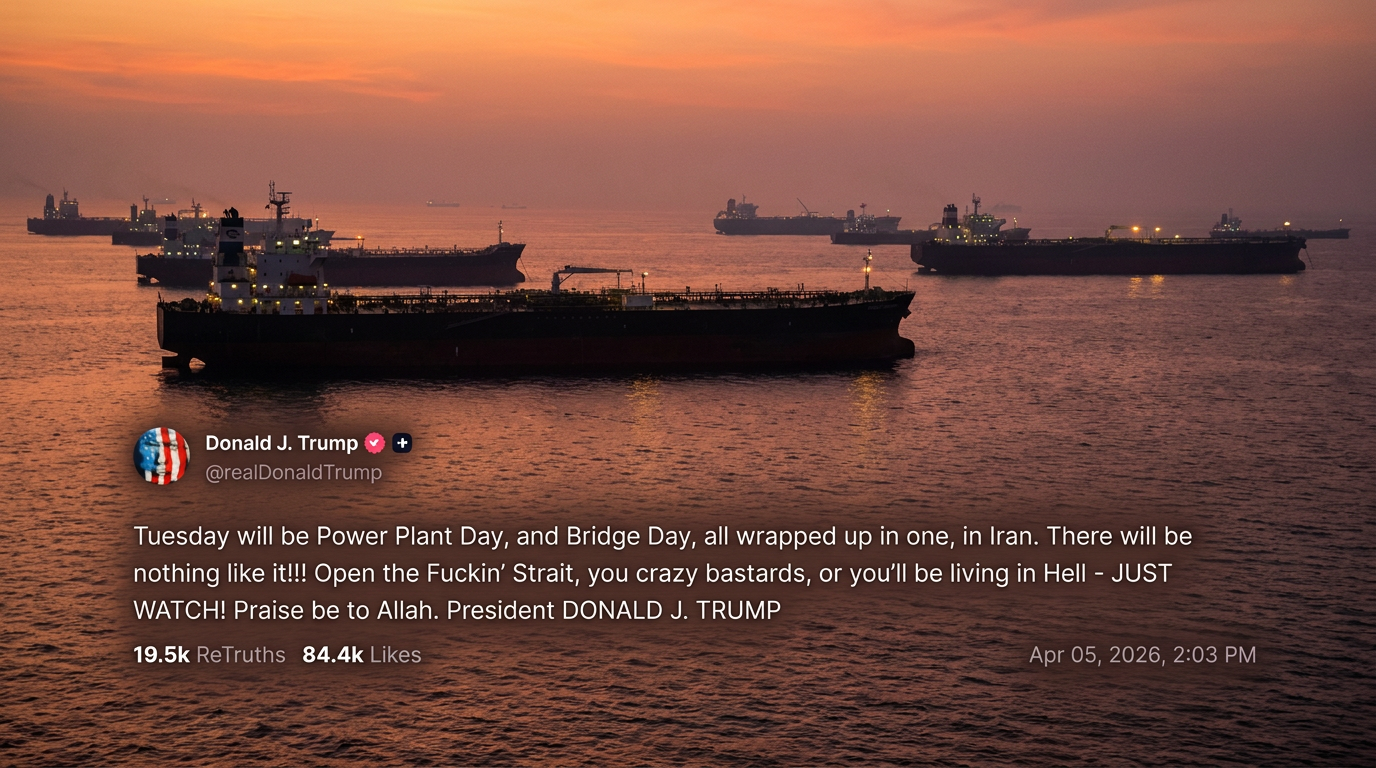
President Trump has called off planned airstrikes against Iran, announcing a tentative agreement that would establish a 60-day ceasefire and reopen the vital Strait of Hormuz to global shipping. While U.S. officials express optimism for a weekend signing, Tehran maintains that a final decision is still pending.
By Factlen Editorial Team
- U.S. Administration
- Views the MOU as a definitive diplomatic victory that secures global energy markets and halts nuclear proliferation.
- Iranian Leadership
- Maintains a cautious stance, demanding concrete sanctions relief and denying that a final capitulation has occurred.
- Regional Stakeholders
- Focused on the immediate economic relief of maritime trade and the security implications of a paused conflict.
What's not represented
- · Global shipping insurers
- · Lebanese civilians affected by the parallel ceasefire
- · European energy importers
Why this matters
The three-month conflict has choked off 20% of the world's oil supply, triggering a global energy crisis and rampant inflation. A finalized deal would immediately lower fuel costs for consumers worldwide and de-escalate a war that threatened to engulf the broader Middle East.
Key points
- President Trump canceled planned airstrikes on Iran, announcing a tentative agreement to end the three-month conflict.
- The proposed MOU includes a 60-day ceasefire and the immediate reopening of the Strait of Hormuz.
- Iran would receive significant sanctions relief, potentially unfreezing $25 billion in overseas assets.
- Iranian officials confirm progress but state that Supreme Leader Ayatollah Ali Khamenei has not yet given final approval.
- Global oil prices fell and U.S. markets rallied on the prospect of restored energy supply chains.
In a dramatic reversal that could halt a devastating three-month war, U.S. President Donald Trump has called off planned airstrikes against Iran and announced the near-completion of a "great settlement" to end the conflict. The diplomatic breakthrough, which Trump suggested could be signed as early as this weekend in Europe, aims to immediately reopen the Strait of Hormuz and establish a 60-day ceasefire.[2][4][6]
The proposed Memorandum of Understanding (MOU) outlines a multi-step de-escalation process. According to U.S. officials and regional diplomats, the core terms require Iran to lift its blockade on the vital maritime chokepoint without imposing transit tolls, while the United States would simultaneously ease its naval blockade on Iranian ports. During the 60-day pause in hostilities, negotiators would work toward a comprehensive treaty addressing Iran's nuclear program and broader regional security.[1][7]
Despite the optimism radiating from the White House, Tehran has projected a notably more cautious stance. Iranian Foreign Ministry spokesperson Esmaeil Baghaei confirmed that large portions of the text have been finalized through Qatari and Pakistani mediation, but he stressed that Iran will not compromise on its "red lines." Baghaei stated that the government has not reached a final conclusion on the matter, noting that the draft is still under review by Iran's supreme decision-making bodies.[3][5]
The mere prospect of a resolution sent immediate ripples through the global economy. The Strait of Hormuz is the transit point for roughly 20% of the world's seaborne crude oil and liquefied natural gas. News of the impending ceasefire caused global energy prices to tumble from their recent wartime highs, while U.S. equities rallied, with the S&P 500 jumping 1.3% in Thursday afternoon trading.[3][4][6]

The conflict, which erupted in late February 2026 following a U.S. and Israeli aerial campaign, has severely disrupted global supply chains. In retaliation for the strikes, Iran's Islamic Revolutionary Guard Corps effectively closed the Strait, attacking merchant vessels and laying sea mines. The resulting bottleneck stranded over 150 ships, triggered a global fuel crisis, and forced shipping insurers to hike premiums exponentially.[3][4]
The diplomatic pivot came with whiplash-inducing speed. Just hours before announcing the MOU, Trump had publicly threatened to hit Iran "very hard" and floated the unprecedented step of seizing Kharg Island, Iran's primary oil export terminal, to assume total control of its energy markets. By Thursday afternoon, however, the administration had entirely changed course, citing significant progress in back-channel talks.[2][7]
A central pillar of the U.S. negotiating posture involves Iran's nuclear capabilities. Trump claimed on Thursday that the agreement ensures Iran's highly enriched uranium will be "destroyed" and that the country will never possess a nuclear weapon. However, diplomats familiar with the text indicate that the MOU merely establishes a framework to address the uranium stockpile, with binding nuclear constraints relegated to a second, more detailed accord to be negotiated during the 60-day window.[1][4][6]
Trump claimed on Thursday that the agreement ensures Iran's highly enriched uranium will be "destroyed" and that the country will never possess a nuclear weapon.
For Tehran, the primary incentive is massive economic relief. The draft agreement reportedly paves the way for Iran to freely sell its oil on the global market and could unfreeze up to $25 billion in Iranian assets held overseas, contingent upon strict compliance with the ceasefire terms. Iranian hardliners, however, remain deeply suspicious of U.S. promises, pointing to Washington's previous withdrawal from the 2015 nuclear deal.[1][3]

The diplomatic heavy lifting has been largely facilitated by Qatar and Pakistan. Qatari envoy Ali Al-Thawadi and Iranian Foreign Minister Abbas Araghchi reportedly spent Wednesday in Tehran narrowing the final gaps regarding the sequencing of sanctions relief and the mechanics of reopening the waterway. Both mediating nations have urged Washington to formalize the ceasefire to prevent accidental escalations.[3][6]
The ripple effects of the MOU extend beyond the Persian Gulf. According to the draft text, the 60-day ceasefire would also apply to the parallel conflict in Lebanon, temporarily halting the intense fighting between Israel and Iran-backed Hezbollah militants. This broader regional pause is viewed as a critical component for securing buy-in from neighboring Arab states.[1][4]
Israeli leadership has expressed cautious appreciation for the developments. Following a phone call with Trump, Prime Minister Benjamin Netanyahu's office released a statement clarifying that while Israel is not a party to the MOU, it supports the U.S. commitment to eventually dismantle Iran's enrichment infrastructure and limit its ballistic missile production.[6]
Despite the diplomatic momentum, the reality on the water remains highly volatile. Early Friday morning, U.S. Central Command reported that American forces shot down two Iranian one-way attack drones attempting to strike commercial ships transiting the Strait. While the U.S. maintains that some commercial traffic is still flowing, the skirmishes underscore the fragility of the current situation.[2][3]

Domestically, the proposed deal has triggered immediate pushback from U.S. Republican hawks, who had spent years advocating for decisive military action against Tehran. Critics argue that the terms of the MOU—particularly the unfreezing of assets and the reliance on future negotiations for nuclear limits—bear an uncomfortable resemblance to the Obama-era agreements they previously dismantled.[3]
In Iran, domestic messaging is similarly fraught. State-aligned media outlets, including the Fars News Agency, have pushed back against Trump's narrative, insisting that the Strait of Hormuz will remain under sovereign Iranian control—a direct contradiction of Washington's demand for an internationally open waterway.[3]
If the political hurdles can be cleared, the logistical challenges of implementation are immense. The agreement requires a coordinated timeline for demining the Strait, establishing verification mechanisms for the ceasefire, and safely navigating the backlog of anchored oil tankers through the narrow channel without triggering further incidents.[3]
The coming days will determine whether the three-month crisis ends in a historic diplomatic settlement or spirals back into open warfare. While Vice President JD Vance is reportedly preparing to travel to Europe for a potential signing ceremony, the ultimate fate of the MOU rests on whether Iran's Supreme Leader, Ayatollah Ali Khamenei, grants his final approval.[2][4][5]
How we got here
Feb 28, 2026
The U.S. and Israel launch an aerial campaign against Iran, prompting Tehran to block the Strait of Hormuz.
Mid-April 2026
A fragile, temporary ceasefire is established, though maritime skirmishes and the naval blockade continue.
June 10, 2026
President Trump threatens 'very hard' strikes and floats seizing Iran's Kharg Island oil terminal.
June 11, 2026
The U.S. abruptly cancels the strikes, announcing a 'great settlement' is nearing completion.
June 12, 2026
Iran confirms progress on the text but clarifies that Supreme Leader Ayatollah Ali Khamenei has not yet made a final decision.
Viewpoints in depth
The U.S. Administration's View
A definitive diplomatic victory that secures global energy markets and halts nuclear proliferation.
The White House frames the impending MOU as a masterclass in 'peace through strength.' By bringing the U.S. military to the brink of devastating strikes on Iran's oil infrastructure, the administration argues it forced Tehran to the negotiating table on highly favorable terms. U.S. officials emphasize that the immediate reopening of the Strait of Hormuz will rescue the global economy from a crippling fuel crisis, while the framework for destroying Iran's enriched uranium stockpile fulfills a core national security objective without requiring a prolonged ground war.
The Iranian Leadership's View
A necessary economic reprieve that preserves sovereign leverage and demands concrete U.S. concessions.
For Tehran, the MOU is less a surrender than a calculated tactical pause. Facing a severe domestic economic crisis exacerbated by the U.S. naval blockade, Iranian pragmatists view the unfreezing of $25 billion in assets and the ability to freely export oil as essential lifelines. However, the leadership remains deeply skeptical of Washington's reliability. Hardliners insist that any reopening of the Strait of Hormuz must remain under Iranian sovereign oversight, and they view the 60-day window not as a guarantee of nuclear disarmament, but as a test of whether the U.S. will genuinely lift its crippling sanctions.
The Global Market Perspective
Relief over the de-escalation of a conflict that threatened to permanently fracture global energy supply chains.
Financial markets and international shipping conglomerates are reacting with overwhelming relief. The three-month closure of the Strait of Hormuz had stranded over 150 vessels, skyrocketed insurance premiums, and threatened to plunge importing nations into recession. For market analysts, the specifics of the nuclear framework are secondary to the immediate resumption of the 20% of global oil supply that flows through the chokepoint. However, energy traders caution that until the sea mines are cleared and the U.S. blockade is officially lifted, the risk of a sudden price spike remains highly elevated.
What we don't know
- Whether Iran's Supreme Leader, Ayatollah Ali Khamenei, will ultimately grant final approval to the negotiated text.
- The exact timeline and logistical process for demining the Strait of Hormuz to ensure safe passage for commercial vessels.
- How the proposed framework for addressing Iran's enriched uranium will be enforced during the 60-day ceasefire.
Key terms
- Strait of Hormuz
- A narrow, strategically vital waterway between the Persian Gulf and the Gulf of Oman, through which roughly 20% of the world's oil supply passes.
- Memorandum of Understanding (MOU)
- A formal document outlining the broad terms of an agreement between nations, serving as a stepping stone before a final, binding treaty is signed.
- Kharg Island
- Iran's primary crude oil export terminal located in the Persian Gulf, which handles the vast majority of the country's energy exports.
- Naval Blockade
- A military operation in which ships are used to prevent vessels, goods, or people from entering or leaving a country's ports.
Frequently asked
Is the Strait of Hormuz currently open to shipping?
Traffic is severely restricted. While the U.S. military claims some commercial ships are transiting, Iran's blockade and the presence of sea mines have brought normal operations to a standstill. The MOU would officially reopen the waterway.
Does this deal mean Iran is giving up its nuclear program?
Not immediately. The draft agreement includes a framework to address Iran's enriched uranium stockpile, but binding constraints would require a second, more comprehensive treaty negotiated during the 60-day ceasefire.
Why did global oil prices drop after the announcement?
The Strait of Hormuz is a critical chokepoint for 20% of the world's oil. The prospect of it reopening eased fears of a prolonged global energy shortage, prompting an immediate drop in crude prices.
Is Israel a part of this ceasefire agreement?
No. While Israeli Prime Minister Benjamin Netanyahu was consulted and expressed support for the nuclear limitations, Israel is not a direct signatory to the U.S.-Iran Memorandum of Understanding.
Sources
Source coverage
7 outlets
3 viewpoints surfaced







[1]AxiosU.S. Administration
What's in the Iran deal Trump says he's ready to sign
Read on Axios →[2]CBS NewsU.S. Administration
Live Updates: Trump says 'settlement' reached on Iran, signing could be as soon as this weekend
Read on CBS News →[3]The GuardianIranian Leadership
Trump claims US and Iran on verge of signing peace agreement, but Tehran says no final decision made
Read on The Guardian →[4]The Irish TimesRegional Stakeholders
Trump says 'great' settlement of war with Iran to be signed within days, triggering reopening of Strait of Hormuz
Read on The Irish Times →[5]The Straits TimesIranian Leadership
Iran says no final decision made on deal that Trump hopes could be signed soon
Read on The Straits Times →[6]Times of IsraelRegional Stakeholders
Trump calls off strikes on Iran, claims agreement could be signed this weekend in Europe
Read on Times of Israel →[7]TIMEU.S. Administration
Trump Says He Has 'Canceled' Strikes Against Iran After Threatening 'Very Hard' Attack
Read on TIME →
More in news politics
See all 83 stories →Workplace Policy
The Evidence Is In: Four-Day Workweeks Boost Productivity and Slash Burnout
7 sources

Martial Law Fallout
Former South Korean President Yoon Suk Yeol Sentenced to 30 Years for Drone Plot
8 sources

Yoon Suk Yeol
Ousted South Korean President Yoon Suk Yeol Sentenced to 30 Years for North Korea Drone Plot
8 sources
Deepfake Defense
Fact Check: Can We Actually Detect Political Deepfakes in 2026?
7 sources

Every angle. Every day.
Get news politics stories with full source coverage and perspective breakdowns delivered to your inbox.