
How On-Device AI and Small Language Models Are Putting Private, Powerful Tech on Your Laptop
The era of relying exclusively on massive cloud servers for AI is ending. In 2026, specialized Neural Processing Units and efficient Small Language Models are bringing powerful, private, and lightning-fast artificial intelligence directly to consumer hardware.
By Factlen Editorial Team
- Privacy Advocates
- Focuses on data sovereignty and the elimination of cloud-based data harvesting.
- Hardware Manufacturers
- Views the shift to local AI as the catalyst for a massive hardware upgrade cycle.
- Open-Source Developers
- Champions the democratization of AI through accessible, community-driven tools.
- Enterprise Strategists
- Prioritizes cost reduction, targeted efficiency, and secure deployment.
What's not represented
- · Cloud Infrastructure Providers
- · Environmental Sustainability Researchers
Why this matters
Running AI locally means your sensitive data never leaves your device, eliminating privacy risks and subscription fees while allowing powerful tools to work perfectly without an internet connection.
Key points
- Small Language Models (SLMs) are designed to run efficiently on local hardware, offering privacy and zero latency.
- Neural Processing Units (NPUs) have become standard in 2026 PCs, crunching AI math at a fraction of the power cost of GPUs.
- On-device AI ensures that sensitive personal and corporate data never has to be sent to third-party cloud servers.
- Apple's 2026 updates deeply integrate local AI into everyday tasks, falling back to secure 'Private Cloud Compute' only when necessary.
- Open-source tools like Ollama and unified APIs from chipmakers are making it easier for developers to build local AI applications.
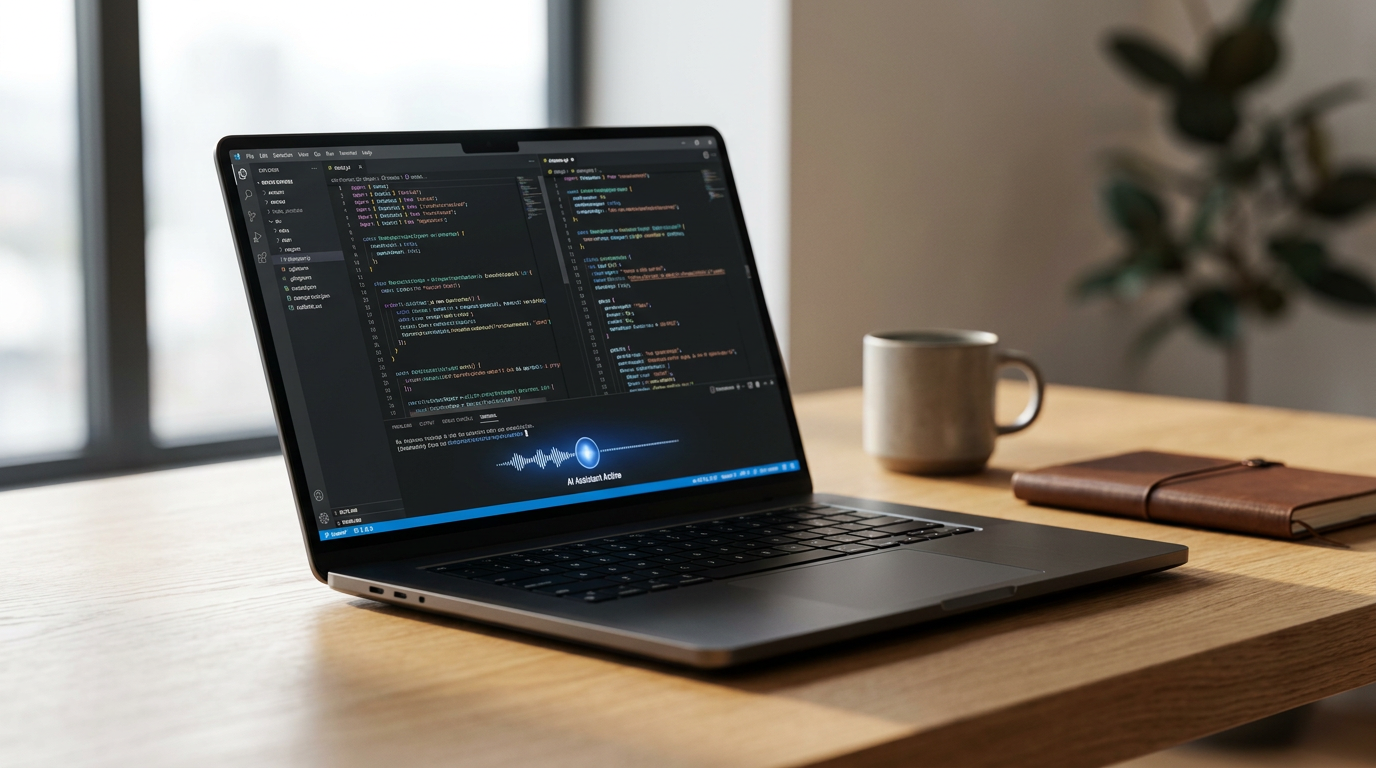
For the past three years, interacting with artificial intelligence meant sending your thoughts, code, and private data to a distant server farm. Every prompt required an internet connection, incurred a slight delay, and raised quiet questions about data privacy. But in 2026, the architecture of AI is undergoing a radical decentralization. The most significant breakthroughs are no longer just happening in massive data centers; they are happening on the laptop sitting on your desk and the smartphone in your pocket. This shift toward "on-device AI" is transforming how we interact with machine learning, prioritizing privacy, speed, and accessibility over sheer scale.[7][8]
The catalyst for this transition is the realization that cloud-based Large Language Models (LLMs) are often overkill for everyday tasks. While frontier models like GPT-5 and Gemini are unparalleled at complex reasoning, using them to summarize an email or draft a text message is computationally wasteful. Furthermore, enterprise users and privacy-conscious consumers are increasingly wary of transmitting sensitive information—such as financial records, proprietary code, or personal health data—to third-party servers.[2][3]
Enter the Small Language Model (SLM). If LLMs are the sprawling generalists of the AI world, SLMs are the highly trained specialists. Typically containing between 1 billion and 10 billion parameters, these compact models are engineered to operate efficiently within the resource constraints of consumer hardware. By utilizing techniques like knowledge distillation—where a smaller model is trained to mimic the behavior of a larger one—and training on highly curated datasets, SLMs achieve remarkable accuracy for specific tasks without the massive computational overhead.[2][3]

The benefits of running these models locally are immediate and tangible. First is the elimination of latency. Cloud API calls inherently add hundreds of milliseconds of network delay before the first word appears on screen. On-device inference removes this bottleneck entirely, enabling real-time applications like instant voice translation and seamless code completion. Second is offline capability. A local SLM functions perfectly on an airplane, in a remote field location, or during a network outage, making AI a reliable utility rather than a web-dependent service.[3]
However, running complex neural networks locally demands serious hardware. Historically, CPUs were too slow for efficient AI inference, and discrete GPUs—while incredibly fast—consumed massive amounts of power, draining laptop batteries in under an hour and generating significant heat. To solve this, the semiconductor industry has universally adopted a new piece of silicon: the Neural Processing Unit (NPU).[4][7]
An NPU is a specialized circuit designed exclusively for the complex matrix multiplication operations that define machine learning. Unlike a GPU, which is built for brute-force parallelism to render millions of pixels, an NPU is hard-coded for efficiency. It crunches tensors at a fraction of the power cost. In benchmark tests from early 2026, running a local model on a laptop GPU might yield a blistering 85 tokens per second but draw 110 watts of power. The same model on an NPU might run at a conversational 25 tokens per second while drawing just 15 watts, running silently and preserving all-day battery life.[7]

An NPU is a specialized circuit designed exclusively for the complex matrix multiplication operations that define machine learning.
This hardware revolution has birthed the era of the "AI PC." In 2026, chipmakers like Intel, AMD, and Qualcomm have made the NPU a standard component. Microsoft's Copilot+ certification now requires an NPU capable of at least 40 Trillions of Operations Per Second (TOPS). For power users and developers running multiple local models simultaneously, hardware recommendations have pushed even higher, often targeting 45 to 50 TOPS paired with a minimum of 32 gigabytes of system RAM, as memory bandwidth remains a critical bottleneck for AI workloads.[4][7]
Apple has taken this hardware-software integration a step further with its 2026 rollout of Apple Intelligence. Announced at the Worldwide Developers Conference (WWDC), Apple's approach deeply embeds on-device processing into the core of iOS, iPadOS, and macOS. The redesigned Siri AI and system-wide writing tools rely heavily on Apple's proprietary Foundation Models running directly on the device's Neural Engine, ensuring that personal context—like reading a user's screen or parsing local messages—never leaves the hardware.[1][5]
Recognizing that some requests are too complex for a mobile processor, Apple introduced "Private Cloud Compute." When a task requires more computational muscle, the device encrypts the data and sends it to specialized Apple Silicon servers. Crucially, this architecture is designed so that the data is never stored, nor is it accessible to Apple itself. Independent security experts are permitted to audit the server code to verify these privacy claims, establishing a new industry standard for hybrid AI deployment.[1][5]

Beyond the proprietary ecosystems of Apple and Microsoft, the open-source community is thriving in the on-device era. Tools like Ollama and LM Studio have democratized access to local AI, allowing developers and hobbyists to download and run highly optimized models—such as Meta's Llama 3.2, Microsoft's Phi-4, or Google's Gemma 3—with a single command. These platforms handle the complex backend configurations, making local inference as simple as installing a standard desktop application.[3][7]
To further bridge the gap between fragmented hardware architectures, companies are releasing unified development frameworks. For instance, AMD's Lemonade API provides a lightweight, open-source layer that automatically routes AI workloads to the most efficient processor—whether that is the CPU, GPU, or NPU—across different operating systems. This allows developers to build an application once and deploy it seamlessly across the diverse landscape of 2026 AI PCs without writing hardware-specific code.[6]
Despite the rapid advancement of NPUs, they are not replacing GPUs entirely. The relationship is complementary. GPUs remain the undisputed champions for model training, heavy batch processing, and high-end creative workloads like rapid image generation. The NPU, conversely, is designed for "always-on" background intelligence. Features like live video transcription, background blur, and continuous screen analysis rely on the NPU to operate perpetually without degrading the system's overall performance or thermal envelope.[7]

The environmental implications of this shift are also profound. The AI boom of the early 2020s led to a massive surge in data center energy consumption and cooling requirements. By offloading routine inference tasks to billions of highly efficient edge devices, the industry can significantly reduce the aggregate carbon footprint of artificial intelligence. Small language models running on low-power NPUs represent a more sustainable path forward for scaling AI globally.[3]
Ultimately, the transition to on-device AI in 2026 is about returning control to the user. It transforms artificial intelligence from an opaque, cloud-hosted oracle into a transparent, localized tool. By combining the privacy of local processing with the targeted efficiency of small language models, the tech industry is ensuring that the next generation of computing is not only more intelligent, but fundamentally more secure and personal.[7][8]
How we got here
Late 2022
Cloud-based Large Language Models like ChatGPT launch, requiring massive server farms for every user interaction.
Mid 2024
The open-source community begins heavily optimizing models like Llama to run on consumer GPUs.
Early 2025
Chipmakers introduce the first generation of mainstream Neural Processing Units (NPUs) to handle AI math efficiently.
June 2026
Apple unveils Apple Intelligence at WWDC, deeply integrating on-device AI processing across its entire ecosystem.
Late 2026
The 'AI PC' becomes the industry standard, with 40+ TOPS NPUs required for flagship operating system features.
Viewpoints in depth
Privacy Advocates
Focuses on data sovereignty and the elimination of cloud-based data harvesting.
For years, privacy advocates have warned about the dangers of sending personal data, proprietary code, and intimate queries to centralized corporate servers. This camp views on-device AI not just as a technological upgrade, but as a fundamental restoration of digital rights. By processing data locally, users eliminate the risk of server breaches, shadow profiling, and unauthorized model training on their personal information.
Hardware Manufacturers
Views the shift to local AI as the catalyst for a massive hardware upgrade cycle.
Chipmakers and PC builders are aggressively pushing the 'AI PC' narrative, emphasizing the necessity of Neural Processing Units (NPUs). For this camp, the transition is an opportunity to revitalize a stagnant PC market. They argue that as operating systems deeply integrate always-on AI features, legacy hardware will become obsolete, making high-TOPS NPUs and expanded system RAM mandatory for a modern computing experience.
Open-Source Developers
Champions the democratization of AI through accessible, community-driven tools.
The open-source community sees local AI as a way to break the monopoly of massive tech conglomerates. By building tools like Ollama and optimizing models to run on consumer hardware, this camp ensures that powerful AI capabilities remain accessible to independent developers, researchers, and hobbyists. They prioritize flexibility, transparency, and the ability to tinker with models without paying API fees or facing corporate censorship.
Enterprise Strategists
Prioritizes cost reduction, targeted efficiency, and secure deployment.
For corporate IT leaders, the appeal of Small Language Models is largely financial and operational. Paying per-token for cloud API calls becomes prohibitively expensive at scale. This camp argues that deploying highly specialized SLMs on company-owned edge devices reduces recurring cloud costs, minimizes latency for critical applications, and ensures compliance with strict data residency regulations like the EU's AI Act.
What we don't know
- How quickly software developers will universally adopt NPU optimization, as many legacy applications still rely heavily on CPU or GPU processing.
- Whether the 40 TOPS standard set by Microsoft for Copilot+ PCs will remain sufficient as local models grow slightly more complex over the next few years.
- The long-term impact of on-device AI on the battery degradation of ultra-thin laptops running continuous background inference.
Key terms
- Small Language Model (SLM)
- A compact artificial intelligence model designed to run efficiently on consumer hardware rather than massive cloud servers.
- Neural Processing Unit (NPU)
- A specialized computer chip built specifically to handle the complex math required for machine learning while using very little battery power.
- TOPS (Trillions of Operations Per Second)
- A metric used to measure the processing speed of an NPU; higher TOPS indicate faster AI performance.
- Inference
- The process of a trained AI model generating a response or making a decision based on new data.
- Knowledge Distillation
- A training technique where a smaller, efficient AI model is taught to replicate the behavior and accuracy of a much larger, complex model.
Frequently asked
Can my current laptop run local AI models?
If your computer was built before 2024, it likely lacks an NPU. While you can run small models on your CPU, it will be slow and drain your battery quickly. Modern 'AI PCs' are specifically designed for this task.
Are Small Language Models as smart as ChatGPT?
For general knowledge and complex reasoning, massive cloud models still win. However, for specific tasks like summarizing documents, writing code, or drafting emails, SLMs are highly accurate and much faster.
Does on-device AI mean my data is completely safe?
Yes, when running a model entirely locally, your prompts and data never leave your physical device, making it impossible for third parties to intercept or log your information.
Sources
Source coverage
8 outlets
4 viewpoints surfaced








[1]Apple NewsroomPrivacy Advocates
Apple Intelligence brings powerful AI capabilities into everyday experiences
Read on Apple Newsroom →[2]OracleEnterprise Strategists
What Are Small Language Models (SLMs)?
Read on Oracle →[3]Hugging FaceOpen-Source Developers
Small Language Models (SLM): A Comprehensive Overview
Read on Hugging Face →[4]Vision ComputersHardware Manufacturers
AI PC Requirements 2026: What You Need to Run AI Locally
Read on Vision Computers →[5]MashablePrivacy Advocates
Apple finally unveils long-awaited Apple Intelligence updates at WWDC 2026
Read on Mashable →[6]AMD Developer CentralHardware Manufacturers
Lemonade by AMD: A Unified API for Local AI Developers
Read on AMD Developer Central →[7]DEV CommunityOpen-Source Developers
The Best AI PCs and NPU Laptops For Engineers
Read on DEV Community →[8]Factlen Editorial TeamEnterprise Strategists
Synthesis by Factlen editorial team
Read on Factlen Editorial Team →

More in ai
See all 68 stories →Agentic AI
The Rise of Agentic Workflows: How Autonomous AI is Redefining Enterprise Automation
8 sources

AI Architecture
How RAG Works: The Architecture Giving AI Chatbots Memory and Facts
6 sources

Small Language Models
The Enterprise AI Shift: Why Small Language Models Are Replacing Massive Cloud AI
8 sources

Local AI
The Quiet Revolution of Local AI: Why Small Language Models Are Taking Over
7 sources
Every angle. Every day.
Get ai stories with full source coverage and perspective breakdowns delivered to your inbox.