
Bitcoin's price is stabilizing—and economists say that's exactly what it needs to become a true currency
As Bitcoin's historical volatility cools to historic lows, financial analysts suggest the cryptocurrency is finally transitioning from a speculative gamble into a functional medium of exchange.
By Factlen Editorial Team

- Utility Advocates
- Argue that price stability is the catalyst needed to unlock Bitcoin's true potential as a global payment network.
- Traditional Economists
- View the flattening of returns as the natural, inevitable maturation of a formerly speculative asset.
- Retail Speculators
- Express frustration over the lack of volatility and the end of outsized, rapid investment returns.
What's not represented
- · Central Bank Regulators
- · Unbanked populations in developing nations
Why this matters
A stable Bitcoin means everyday consumers and merchants can finally use the cryptocurrency for regular purchases and cross-border remittances without fearing sudden, double-digit price drops overnight.
Key points
- Bitcoin's price volatility has dropped to historic lows in 2026, mirroring traditional fiat currencies.
- Economists argue this stability is necessary for Bitcoin to function as a true medium of exchange.
- Institutional liquidity from ETFs has acted as a shock absorber against massive price swings.
- Merchants are increasingly willing to hold Bitcoin on their balance sheets rather than instantly converting it.
- The shift is driving out short-term speculators in favor of long-term utility and infrastructure development.
For over a decade, Bitcoin has been synonymous with wild, unpredictable price swings, a digital asset capable of minting millionaires overnight while wiping out leveraged traders just as quickly. The cryptocurrency's reputation was built on this extreme volatility, attracting a global army of speculators hoping to catch the next massive wave. But a distinctly different trend is cementing itself across financial markets in 2026: the world's largest cryptocurrency is becoming remarkably boring. Instead of dominating headlines with double-digit daily percentage moves, Bitcoin's price action has settled into a tight, predictable range. Market observers and institutional investors are watching this shift closely, noting that the era of astronomical, lottery-ticket returns may be permanently closing. Yet, rather than mourning the end of the crypto casino, a growing consensus of economists and financial analysts suggests this newfound stability is exactly what the digital asset needs to survive and thrive in the long term.[1][2]
Financial analysts are increasingly noting that Bitcoin's long-term speculative returns are flattening, approaching what some economists describe as a "zero-premium" state relative to traditional risk assets. In a widely circulated analysis, researchers pointed out that a predictable price trajectory is the foundational requirement for any asset attempting to function as a viable currency. When an asset's primary appeal is the expectation that it will exponentially increase in fiat value, it inherently fails as a medium of exchange. People hoard it rather than spend it. By shedding its speculative premium, Bitcoin is signaling to the broader market that it is transitioning out of its volatile adolescence. Market watchers argue this stabilization is not a symptom of declining interest, but rather the critical milestone required for Bitcoin to fulfill its original, white-paper promise as a functional, decentralized global currency.[1][4]
The core structural issue with using historically volatile cryptocurrencies for daily transactions has always been the unmanageable price risk assumed by both buyers and sellers. A consumer is naturally hesitant to spend a digital coin on a cup of coffee or a piece of software if that same fraction of a coin might double in purchasing power by the following week—a phenomenon famously illustrated by the early adopter who spent thousands of Bitcoin on two pizzas. Conversely, a merchant operating on thin profit margins cannot safely accept a currency that might crash by twenty percent before they can convert it to pay their suppliers or cover their rent. This two-sided friction effectively walled Bitcoin off from the real economy, relegating it to the balance sheets of risk-tolerant hedge funds and retail day traders. Stability fundamentally alters this equation, removing the psychological and financial barriers to everyday commerce.[3][5]

The mechanics behind this stabilization are largely driven by the massive influx of institutional capital that has flooded the market over the past few years. Following the widespread approval and adoption of spot exchange-traded funds (ETFs) and the integration of digital assets into corporate treasury strategies, the sheer depth and liquidity of the Bitcoin market have expanded exponentially. This deep liquidity acts as a massive shock absorber. In the past, a single large sell order from a "whale" could trigger cascading liquidations and crash the price across major exchanges. Today, the market is robust enough to absorb those shocks without significant disruption. Bloomberg data indicates that Bitcoin's 30-day volatility index has reached historic lows in 2026, mirroring the behavior of traditional fiat currencies and large-cap blue-chip equities far more closely than the speculative tech stocks it used to track.[2]
The mechanics behind this stabilization are largely driven by the massive influx of institutional capital that has flooded the market over the past few years.
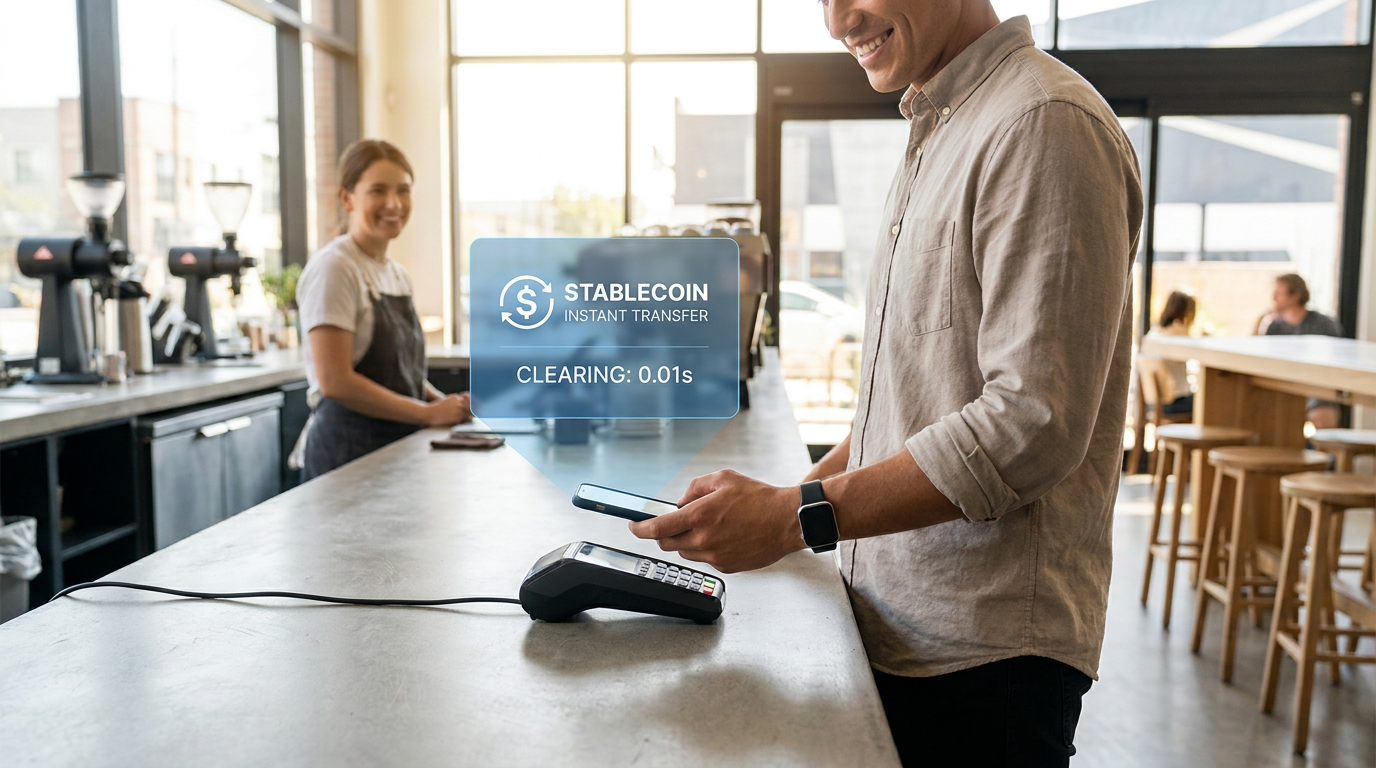
This newfound market stability is already translating into tangible, real-world utility across the retail and commercial sectors. Payment processors and point-of-sale software providers are reporting a significant surge in the number of merchants who are not only willing to accept Bitcoin, but are actively choosing to hold the digital currency on their balance sheets rather than instantly converting it to dollars or euros. When the threat of a sudden, catastrophic devaluation is removed, businesses can begin to appreciate the inherent advantages of blockchain-based settlements, such as the elimination of traditional credit card chargebacks and the reduction of processing fees. Major retail chains and independent e-commerce platforms alike are quietly upgrading their payment infrastructure to natively support stable Bitcoin transactions, signaling a quiet but profound shift in how corporate finance departments view digital assets.[5]

Beyond domestic retail, the shift toward a stable Bitcoin is proving particularly impactful for the multi-billion-dollar cross-border remittance industry. In regions grappling with high local inflation, strict capital controls, or prohibitively expensive legacy banking infrastructure, a stable digital currency offers a frictionless way to transfer value internationally. Migrant workers sending money home to their families have historically lost significant percentages of their earnings to the steep fees charged by traditional wire services and currency exchange houses. With Bitcoin's price volatility no longer threatening to wipe out the value of a transfer while it is in transit, users can leverage the network's speed and low transaction costs to move money globally. On-chain data analysis confirms this trend, showing a marked increase in smaller, peer-to-peer transaction volumes that align with remittance patterns rather than speculative trading.[3][6]
Naturally, the cooling of Bitcoin's explosive growth has disappointed a specific vocal subset of the cryptocurrency community: the day traders, leveraged speculators, and early adopters who relied on its historical volatility for outsized, rapid profits. For years, the crypto ecosystem was heavily subsidized by this speculative fervor, with entire sub-industries built around trading tools, leverage platforms, and market-timing newsletters. Financial analysts note that the "crypto casino" era is decisively giving way to a utility-driven phase, effectively shaking out short-term gamblers in favor of long-term infrastructure builders. While social media sentiment among retail traders may reflect frustration over the lack of dramatic price pumps, industry executives and institutional managers view this exodus of speculative capital as a healthy, necessary cleansing that allows the technology's actual utility to take center stage.[4][7]

If the current trend of macroeconomic stabilization holds, economists project that Bitcoin will increasingly function as a standard, boring settlement layer for global finance over the coming decade. The transition from a highly speculative digital commodity to a reliable medium of exchange represents one of the most significant financial evolutions of the modern era. While it may no longer offer the lottery-ticket returns that defined its first fifteen years of existence, its maturation into a predictable, decentralized currency could ultimately prove far more valuable to the global economy. By providing a secure, borderless, and stable network for transferring value, Bitcoin is finally stepping into the role it was originally designed to play, empowering consumers and businesses alike with a viable alternative to legacy financial systems.[1][6]
How we got here
2010-2017
Bitcoin experiences massive volatility, establishing its reputation as a highly speculative digital asset.
2021-2022
Institutional interest begins to grow, though the market remains susceptible to massive boom-and-bust cycles.
Jan 2024
The approval of US spot Bitcoin ETFs opens the floodgates for deep institutional liquidity.
Mid-2026
Volatility indexes hit historic lows, prompting economists to declare Bitcoin's transition into a stable currency.
Viewpoints in depth
Utility Advocates
Argue that price stability is the catalyst needed to unlock Bitcoin's true potential as a global payment network.
This camp, largely composed of payment processors and blockchain developers, believes that volatility was the single biggest barrier to mainstream adoption. They point to the surge in merchant acceptance and cross-border remittance usage as proof that a 'boring' Bitcoin is a highly functional one. In their view, the loss of speculative traders is a net positive that clears the way for real-world economic activity.
Traditional Economists
View the flattening of returns as the natural, inevitable maturation of a formerly speculative asset.
Macroeconomic analysts and traditional financial institutions argue that no asset can indefinitely sustain the exponential growth rates seen in Bitcoin's early years. They view the current stabilization as a sign that the market has finally priced in the asset's value accurately. By reaching a 'zero-premium' state relative to risk-free rates, they argue Bitcoin is behaving exactly as a maturing currency should, transitioning from a growth asset to a stable store of value.
Retail Speculators
Express frustration over the lack of volatility and the end of outsized, rapid investment returns.
A vocal contingent of early adopters and day traders lament the institutionalization of the market. They argue that the influx of Wall Street capital and ETF products has suppressed the wild price swings that originally made the crypto market attractive to retail investors. For this group, the transition to a stable currency represents a loss of financial opportunity, prompting many to migrate to smaller, riskier alternative cryptocurrencies in search of volatility.
What we don't know
- Whether this period of low volatility is a permanent structural shift or just a prolonged cyclical lull in the broader crypto market.
- How central banks will respond to a stabilized, highly functional decentralized currency competing directly with fiat systems.
Key terms
- Volatility Index
- A statistical measure of the dispersion of returns for a given security or market index, indicating how much the price fluctuates.
- Zero-Premium State
- An economic condition where an asset's expected return does not significantly exceed the risk-free rate or inflation, indicating stability.
- Spot ETF
- An exchange-traded fund that tracks the real-time market price of an underlying asset, allowing investors to gain exposure without holding the asset directly.
- On-Chain Data
- Information regarding all transactions that have occurred on a specific blockchain network, visible on a public ledger.
Frequently asked
Why is Bitcoin's price no longer jumping like it used to?
The influx of massive institutional capital and ETF liquidity has deepened the market, acting as a shock absorber that prevents large trades from causing wild price swings.
Is a stable Bitcoin a bad thing for investors?
It depends on the investor. While day traders seeking rapid returns may be disappointed, long-term holders and economists view stability as a positive sign of the asset maturing into a reliable currency.
How does this affect everyday purchases?
Price stability removes the risk for both buyers and merchants. Consumers don't have to worry about spending an asset that might skyrocket tomorrow, and merchants can accept it without fear of a sudden crash.
Sources
Source coverage
7 outlets
3 viewpoints surfaced







[1]MarketWatchTraditional Economists
Bitcoin’s long-term return may actually be close to zero — and that could be just what it needs
Read on MarketWatch →[2]BloombergTraditional Economists
Bitcoin Volatility Hits Historic Lows as Institutional Adoption Matures
Read on Bloomberg →[3]CoinDeskUtility Advocates
Why a 'Boring' Bitcoin is Bullish for Global Payments
Read on CoinDesk →[4]Financial TimesTraditional Economists
The End of the Crypto Casino: Bitcoin's Shift to Utility
Read on Financial Times →[5]CNBCUtility Advocates
Stable Bitcoin Prices Open Doors for Retail Merchants
Read on CNBC →[6]The BlockUtility Advocates
On-Chain Data Shows Shift from Speculation to Settlement
Read on The Block →[7]CoinTelegraphRetail Speculators
Retail Traders Seek Volatility Elsewhere as Bitcoin Flattens
Read on CoinTelegraph →

More in finance
See all 55 stories →Mega-IPOs
The Mechanics of Mega-IPOs: What the Historic SpaceX Debut Means for Everyday Investors
5 sources

Mega-Cap IPOs
SpaceX Prices Historic $75 Billion IPO, Shattering Records and Rewriting Market Rules
8 sources

Space Economy
SpaceX Goes Public: Inside the $1.75 Trillion IPO Reshaping the Stock Market
6 sources

Digital Payments
Crypto Enters Its 'Boring' Era as Volatility Drops and Stablecoins Power Global Payments
8 sources
Every angle. Every day.
Get finance stories with full source coverage and perspective breakdowns delivered to your inbox.