
The Mechanics of Mega-IPOs: What the Historic SpaceX Debut Means for Everyday Investors
As SpaceX prepares for the largest initial public offering in history, retail investors are being granted unprecedented access. Here is how the IPO machinery works, what the data says about long-term returns, and how to navigate the hype.
By Factlen Editorial Team
- Retail Advocates
- Arguing that everyday investors deserve early access to generational wealth creation.
- Valuation Skeptics
- Warning that the massive IPO pricing is detached from current financial fundamentals.
- Academic Researchers
- Highlighting the historical data on IPO underpricing and long-term performance.
What's not represented
- · Retail investors who lack access to participating brokerages
Why this matters
Understanding the mechanics of an IPO empowers everyday investors to participate in generational wealth creation while avoiding the emotional pitfalls of market hype.
Key points
- SpaceX is executing the largest IPO in history, raising $75 billion at a $1.8 trillion valuation.
- Unlike traditional IPOs that reserve 95% of shares for institutions, SpaceX is allocating up to 30% to retail investors.
- Underwriters intentionally underprice IPOs to ensure strong demand, leading to the famous first-day 'pop' in share value.
- Academic data shows that while IPOs often surge on their first day, they frequently underperform the broader market over a three-year horizon.
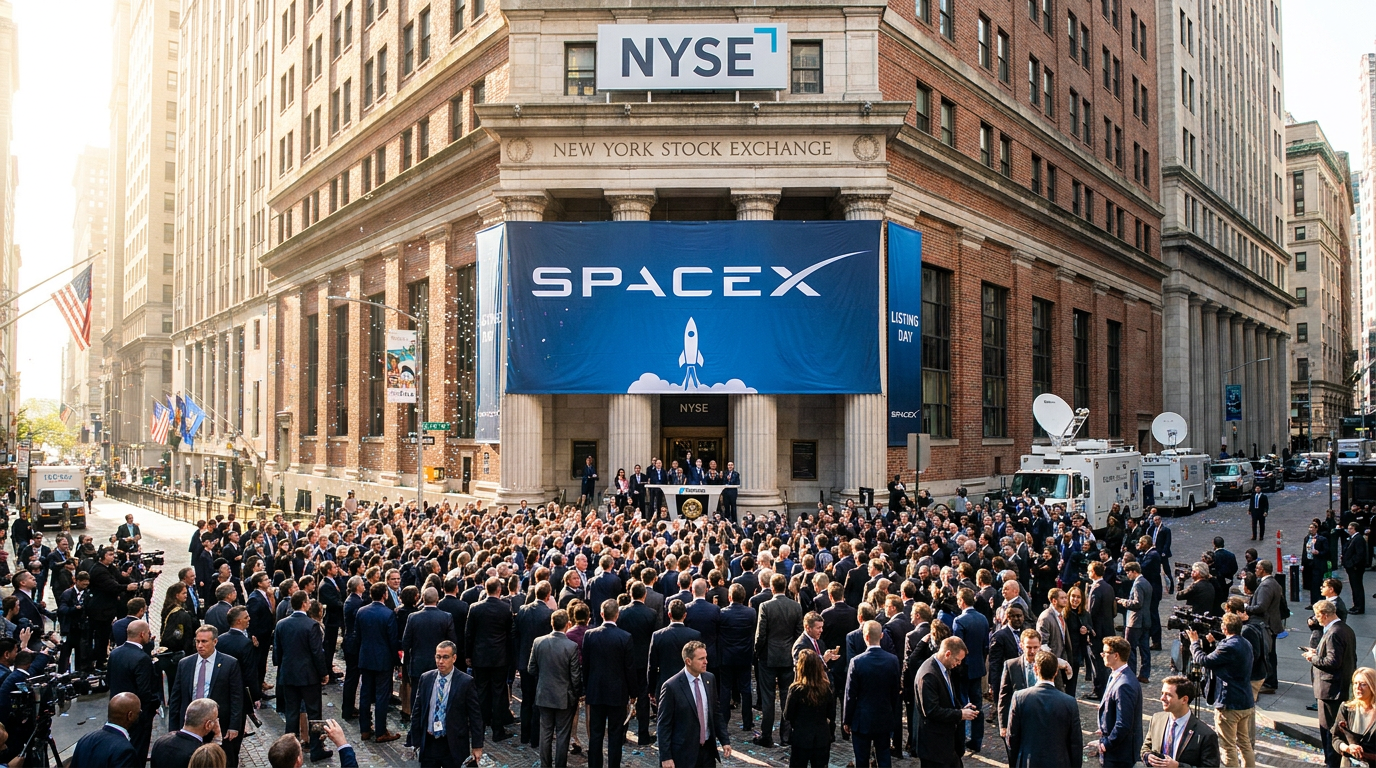
The financial world is currently witnessing a watershed moment as SpaceX executes the largest initial public offering (IPO) in history. Pricing its shares at $135, the aerospace giant is raising a staggering $75 billion, instantly commanding an implied valuation of roughly $1.8 trillion. For everyday investors, the sheer scale of the offering is captivating, but the true milestone lies in the unprecedented access being granted to the retail public.[2]
Historically, the most lucrative phases of a company's growth were locked behind the closed doors of venture capital and private equity. By the time a marquee technology firm went public, the lion's share of the wealth creation had already occurred, and the IPO itself was heavily gated. The SpaceX debut is actively challenging this paradigm, offering a rare window into the mechanics of mega-IPOs and how retail participants can navigate them.[5]
To understand the significance of this moment, one must first understand the machinery of an IPO. An Initial Public Offering is the complex process through which a private corporation offers its shares to the general public for the first time. This transition requires the company to open its books, filing a detailed prospectus—known as an S-1—with the U.S. Securities and Exchange Commission (SEC).[3]

The SEC's role is not to judge whether the investment is a good idea, but to ensure that the company has disclosed all material facts, risks, and financial data required for the public to make an informed decision. Once the SEC clears the paperwork, the company embarks on a "roadshow," pitching the business to large institutional investors to gauge interest and determine a fair price.[3]
This pricing phase is managed by underwriters—typically a syndicate of major investment banks. These banks act as the bridge between the company and the market, building a "book" of orders from mutual funds, pension funds, and sovereign wealth entities. In the case of SpaceX, institutional demand was voracious, with total orders across all categories exceeding $250 billion.[2]
It is at this juncture that the traditional IPO model usually sidelines the everyday investor. In a standard offering, underwriters allocate roughly 90% to 95% of the available shares to their preferred institutional clients. Retail investors are typically left fighting over a meager 5% to 10% sliver, forcing most to wait until the stock begins trading on the open market—often at a significantly higher price.[2]
The SpaceX offering, however, has rewritten the playbook. Driven by a deliberate corporate strategy to include smaller shareholders, the company has reserved between 20% and 30% of its IPO allocation specifically for retail buyers. This structural shift has triggered a historic response, with individual investors submitting more than $100 billion in purchase orders through participating brokerages.[2]

For retail investors navigating this new landscape, securing an allocation requires understanding brokerage rules. Participating platforms often utilize a lottery or pro-rata system to distribute shares fairly when demand outstrips supply. Because the SpaceX offering is heavily oversubscribed, most retail applicants will only receive a fraction of the shares they requested, a standard reality in highly anticipated public debuts.[5]
For retail investors navigating this new landscape, securing an allocation requires understanding brokerage rules.
Once the shares are allocated and the opening bell rings, the psychological test for investors begins. The most famous phenomenon in the IPO world is the first-day "pop"—a sudden surge in the stock price the moment it hits the secondary market. This occurs because underwriters intentionally engage in "underpricing," setting the initial share price slightly below what they believe the open market will bear.[3]
Underpricing serves multiple purposes: it rewards the early institutional investors who committed capital, generates positive media coverage, and ensures that the entire block of shares is sold without a hitch. According to decades of data compiled by University of Florida finance professor Jay Ritter, the average first-day return for U.S. operating companies historically hovers around 19%, though recent years have seen averages push closer to 29%.[3][4]
While a first-day pop is exhilarating for those who secured shares at the offering price, it presents a dangerous temptation known as FOMO—the fear of missing out. Retail investors who did not receive an IPO allocation often rush to buy shares on the open market during the chaotic first hours of trading. This buying frenzy can drive the price to unsustainable heights, completely detached from the company's underlying financial reality.[1]

Financial analysts frequently warn against this emotional investing. While the market eagerly priced SpaceX at a valuation approaching $1.8 trillion, fundamental analysts caution that paying a massive premium on day one means investors are heavily subsidizing unproven future growth. When stock prices detach from current revenues, the risk profile for retail buyers increases exponentially.[1]
Another critical mechanism retail investors must understand is "flipping." Flipping refers to the practice of buying shares in an IPO and selling them within the first 30 days to lock in a quick profit. While entirely legal, underwriters and brokerages strongly discourage the practice because it creates downward pressure on the stock price during its most vulnerable early days.[3]
To combat flipping, brokerages often implement strict penalty systems. If a retail investor sells their IPO allocation within the restricted window, the brokerage may ban them from participating in any future IPOs for 60 to 90 days. This policy is designed to attract long-term shareholders rather than short-term speculators, aligning the investor base with the company's multi-year vision.[5]
Taking a long-term view is particularly vital when examining the historical performance of IPOs. While the first-day pop dominates the headlines, academic research paints a more sobering picture of the years that follow. Professor Ritter's extensive data sets reveal that, on average, IPOs tend to underperform the broader market—such as the S&P 500—over a three-year horizon.[4]

This long-term underperformance often occurs because the initial hype eventually fades, forcing the newly public company to meet rigorous quarterly earnings expectations. If a company fails to deliver the aggressive growth rates promised during its roadshow, institutional investors will quickly rotate their capital elsewhere, leaving retail shareholders holding the bag.[1]
The democratization of mega-IPOs is undeniably a positive development for financial inclusion. By opening the doors to offerings like SpaceX, everyday investors are finally being granted a seat at the table alongside Wall Street's heaviest hitters. It represents a shift toward a more equitable market where wealth creation is not exclusively reserved for the ultra-wealthy.[5]
However, this access demands a higher level of financial literacy. Navigating an IPO requires distinguishing between a company's visionary potential and its present-day valuation, understanding the mechanics of allocation, and resisting the urge to chase momentum. For the empowered retail investor, the SpaceX debut is not just a chance to own a piece of the future—it is a masterclass in how the modern financial markets operate.[1][5]
How we got here
1980–2019
The traditional IPO era sees retail investors largely locked out, receiving only 5% to 10% of share allocations.
2019
Saudi Aramco sets the previous global record for an IPO, raising $29.4 billion.
Late 2025
SpaceX begins formal preparations for a public listing, signaling a massive shift in retail access.
June 2026
SpaceX prices its IPO at $135 per share, raising $75 billion and shattering all previous records.
Viewpoints in depth
Retail Advocates
Arguing that everyday investors deserve early access to generational wealth creation.
For decades, the most explosive growth of technology companies occurred in private markets, accessible only to venture capitalists and accredited investors. Advocates view the 20% to 30% retail allocation in the SpaceX IPO as a necessary democratization of finance. They argue that giving the public direct access at the offering price levels the playing field, allowing everyday individuals to participate in the upside before the secondary market inflates the valuation.
Valuation Skeptics
Warning that the massive IPO pricing is detached from current financial fundamentals.
Financial analysts and fundamental investors caution that the hype surrounding mega-IPOs often obscures the underlying math. With SpaceX priced at a valuation approaching $1.8 trillion, skeptics argue that buyers are paying an extreme premium for unproven future technologies. They emphasize that intrinsic valuations should anchor investment decisions rather than market momentum, warning that buying into a hype cycle can severely damage long-term portfolio health.
Academic Researchers
Highlighting the historical data on IPO underpricing and long-term performance.
Financial economists focus on the empirical track record of public debuts. While the first-day "pop" is a well-documented phenomenon driven by intentional underpricing to ensure a successful launch, researchers note that this short-term excitement rarely translates into sustained outperformance. Long-term data sets consistently show that, on average, IPOs tend to lag behind broader market indices over a three-to-five-year horizon, suggesting that early momentum is often followed by a sobering reversion to the mean.
What we don't know
- How the massive influx of retail capital will affect the long-term volatility of SpaceX shares once they begin trading.
- Whether other major private technology companies will follow SpaceX's lead in offering larger retail allocations in future IPOs.
Key terms
- Initial Public Offering (IPO)
- The first time a private company issues shares of stock to the public to raise capital.
- Underwriter
- A financial institution, typically an investment bank, that manages the IPO process, sets the initial price, and distributes the shares.
- Prospectus (S-1)
- A detailed formal document filed with the SEC that discloses a company's financial data, business model, and risks to potential investors.
- Underpricing
- The strategy of listing an IPO at a price slightly below its expected market value to ensure strong demand and a successful launch.
- Flipping
- The act of selling IPO shares shortly after they begin trading on the secondary market to lock in a rapid profit.
Frequently asked
What exactly is an IPO?
An Initial Public Offering (IPO) is the process by which a private company offers its shares to the general public for the first time, transitioning into a publicly traded entity.
Why is the SpaceX IPO considered historic?
It is raising $75 billion, nearly triple the previous record held by Saudi Aramco, and is allocating an unprecedented 20% to 30% of its shares directly to retail investors.
Can anyone buy shares at the offering price?
Only investors who secure an allocation through a participating brokerage before the stock begins trading. Otherwise, investors must buy shares on the open market, often at a higher price.
What does 'flipping' mean in an IPO?
Flipping is the practice of buying IPO shares and selling them within the first 30 days for a quick profit. Brokerages often penalize this by restricting future IPO access.
Sources
Source coverage
5 outlets
3 viewpoints surfaced





[1]MarketWatchValuation Skeptics
SpaceX IPO hype is massive — and the FOMO can ruin your retirement
Read on MarketWatch →[2]BloombergRetail Advocates
SpaceX IPO Demand Tops $100 Billion From Retail Investors
Read on Bloomberg →[3]U.S. Securities and Exchange CommissionAcademic Researchers
Investor Bulletin: Investing in an IPO
Read on U.S. Securities and Exchange Commission →[4]University of FloridaAcademic Researchers
Initial Public Offerings: Updated Statistics
Read on University of Florida →[5]Factlen Editorial TeamRetail Advocates
Synthesis by Factlen editorial team
Read on Factlen Editorial Team →

More in finance
See all 57 stories →Mainstream Adoption
Crypto Reaches Mainstream Milestone as 1 in 4 Americans Now Hold Digital Assets
7 sources

Foster Youth
How 'Fostering the Future' Accounts Aim to Build Wealth for 330,000 Foster Youth
8 sources

Mega-Cap IPOs
SpaceX Prices Historic $75 Billion IPO, Shattering Records and Rewriting Market Rules
8 sources
Bitcoin Maturation
Bitcoin's price is stabilizing—and economists say that's exactly what it needs to become a true currency
7 sources
Every angle. Every day.
Get finance stories with full source coverage and perspective breakdowns delivered to your inbox.