
SpaceX Prices Historic $75 Billion IPO, Shattering Records and Rewriting Market Rules
Elon Musk's aerospace giant has locked in a $1.75 trillion valuation in the largest public offering in history. The massive debut features an unprecedented 30% allocation for retail investors and is forcing major index providers to rewrite their inclusion rules.
By Factlen Editorial Team
- Institutional & Passive Funds
- Focuses on the mechanical liquidity demands and forced-buying pressure created by Nasdaq's accelerated index inclusion rules.
- Retail Investors & Enthusiasts
- Views the 30% allocation as a historic democratization of access to a generational technology company.
- Governance Skeptics
- Warns that the $1.75 trillion valuation masks heavy net losses and an unequal voting structure that strips public shareholders of influence.
What's not represented
- · Traditional aerospace competitors
- · Early private-market venture backers
Why this matters
This is the largest wealth-creation event in public market history, fundamentally altering the composition of major index funds. Even investors who don't actively buy SpaceX stock will likely gain exposure through passive retirement accounts tracking the Nasdaq 100.
Key points
- SpaceX priced its IPO at $135 per share, raising $75 billion at a $1.75 trillion valuation.
- The offering is the largest in history, easily surpassing Saudi Aramco's $29.4 billion debut.
- SpaceX allocated 30% of its float to retail investors, drawing over $70 billion in individual bids.
- Nasdaq changed its rules to allow SpaceX to enter the Nasdaq 100 index in just 15 trading days.
- The S&P 500 declined to alter its rules, meaning SpaceX will not join the index for at least a year.
- The company generated $18.7 billion in revenue in 2025 but posted a $4.28 billion net loss in Q1 2026.
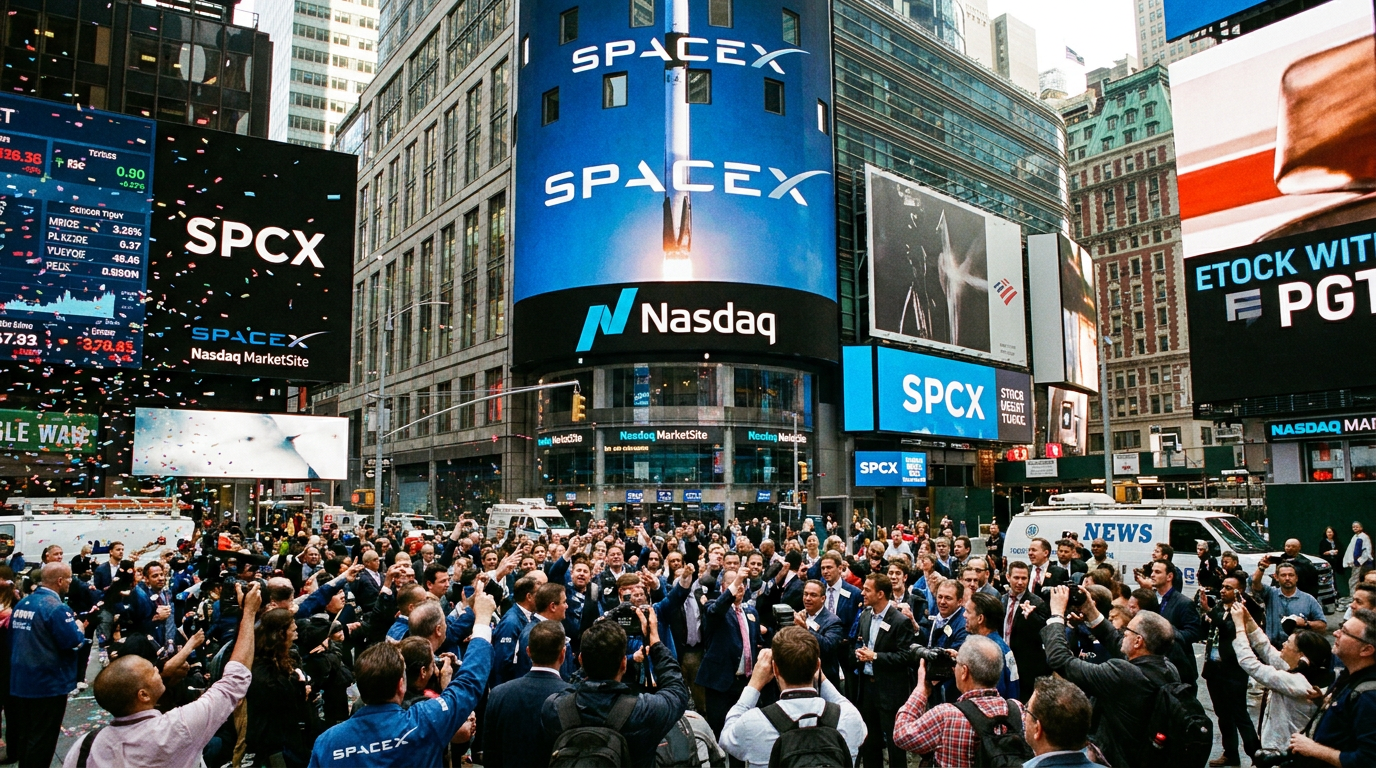
The largest initial public offering in the history of human capital markets has officially arrived. On Thursday evening, SpaceX priced its highly anticipated IPO at a fixed $135 per share, locking in a staggering $1.75 trillion valuation.[1][2]
By raising $75 billion, Elon Musk's aerospace and satellite giant has shattered the previous global record set by Saudi Aramco's $29.4 billion debut in 2019. The stock will begin trading on the Nasdaq exchange on Friday morning under the ticker symbol SPCX.[2][5][7]
Demand for the offering has been unprecedented, completely overwhelming the available supply of 555.6 million shares. Institutional and retail investors submitted a combined $250 billion in orders, leaving the massive offering more than three times oversubscribed before the final pricing was even announced.[1][7]

What makes this IPO structurally unique is the company's deliberate pivot toward everyday investors. SpaceX has earmarked a full 30% of its public float for retail buyers—roughly three times the standard allocation for a mega-cap technology listing.[4][8]
That retail allocation sparked a frenzy, with individual investors placing over $70 billion in bids through brokerages worldwide. Because the total offering size is $75 billion, the sheer volume of retail demand guarantees that millions of prospective buyers will be left empty-handed, potentially fueling aggressive buying pressure when the stock hits the open market.[3][7]
Beyond the retail phenomenon, the SpaceX listing is forcing a tectonic shift in the mechanics of passive investing. Because of its sheer size, SpaceX will immediately rank among the most valuable companies on Earth, trailing only tech giants like Apple, Microsoft, and Nvidia.[2][5]

Beyond the retail phenomenon, the SpaceX listing is forcing a tectonic shift in the mechanics of passive investing.
To accommodate this behemoth, index providers have rewritten their own rulebooks. Effective May 1, Nasdaq implemented a "Fast Track" mechanism that allows top-tier newly listed companies to enter the Nasdaq 100 index in just 15 trading days, down from the previous three-month waiting period.[5][6]
This accelerated timeline means that funds tracking the Nasdaq 100—which hold over $1.4 trillion in assets—will be mechanically forced to buy billions of dollars of SpaceX stock by early July. To fund these mandatory purchases, passive funds will have to sell off fractional shares of existing index heavyweights.[4][5]
However, not all index providers are bending the knee. S&P Dow Jones Indices explicitly declined to amend its inclusion rules for the S&P 500. As a result, SpaceX will not be eligible for the S&P 500 until it completes 12 months of public trading and demonstrates four consecutive quarters of GAAP profitability—a high bar given the company's heavy capital expenditures.[2][4]

Financially, SpaceX presents a complex picture of massive revenue growth paired with aggressive spending. The company generated $18.7 billion in revenue in 2025, driven largely by its Starlink satellite internet constellation, which accounted for 61% of total sales.[8]
Yet, the company remains deeply unprofitable on a net basis, posting a $4.28 billion net loss in the first quarter of 2026 alone. These losses are primarily attributed to heavy investments in artificial intelligence infrastructure following its merger with xAI, as well as the ongoing development of its next-generation Starship rocket.[6][8]

The sheer scale and unconventional structure of the offering have also drawn regulatory scrutiny. Senator Elizabeth Warren recently petitioned the Securities and Exchange Commission to delay the IPO, citing concerns over corporate governance. Specifically, critics point to a dual-class share structure that grants Musk 85% of the shareholder voting power, leaving public investors with minimal influence over corporate direction.[1][7]
Despite the governance concerns and steep valuation, the market's appetite remains insatiable. As the first of several anticipated 2026 mega-IPOs—with AI titans Anthropic and OpenAI potentially waiting in the wings—SpaceX has effectively written a new blueprint for how generational technology companies transition to the public markets.[2]
How we got here
Dec 2025
A private tender offer values SpaceX at approximately $800 billion.
Feb 2026
SpaceX absorbs Elon Musk's xAI in an all-stock transaction, pushing the combined valuation to $1.25 trillion.
May 1, 2026
Nasdaq implements a rule change allowing mega-cap IPOs to enter the Nasdaq 100 in just 15 trading days.
Jun 3, 2026
SpaceX bypasses the traditional bookbuilding range, setting a fixed IPO target price of $135 per share.
Jun 11, 2026
SpaceX officially prices its IPO, raising $75 billion and locking in a $1.75 trillion valuation.
Jun 12, 2026
SpaceX begins trading on the Nasdaq exchange under the ticker SPCX.
Viewpoints in depth
Retail Investors & Enthusiasts
Views the 30% allocation as a historic democratization of access to a generational technology company.
For years, everyday investors have watched from the sidelines as SpaceX's private valuation skyrocketed. By allocating 30% of the public float to retail buyers, the company is rewarding the massive, loyal following Elon Musk has cultivated. Proponents argue this unprecedented allocation validates the demand-driven pricing model and ensures that the wealth generated by humanity's expansion into space isn't exclusively captured by institutional venture capital.
Institutional & Passive Funds
Focuses on the mechanical liquidity demands and forced-buying pressure created by Nasdaq's accelerated index inclusion rules.
Professional traders and passive fund managers are less focused on rockets and more focused on market mechanics. Because Nasdaq rewrote its inclusion rules to fast-track SpaceX into the Nasdaq 100 within 15 days, passive funds are staring down an estimated $22 billion to $27 billion in forced buying. To fund these mandatory purchases, index trackers will have to systematically sell off portions of existing mega-cap stocks like Apple and Nvidia, creating a massive, mechanical liquidity event that could drive short-term volatility across the broader tech sector.
Governance Skeptics
Warns that the $1.75 trillion valuation masks heavy net losses and an unequal voting structure that strips public shareholders of influence.
Critics, including lawmakers and corporate governance watchdogs, point out that public investors are taking on immense financial risk with virtually no oversight power. Elon Musk retains 85% of the shareholder voting power, effectively insulating the company from activist investors or board challenges. Furthermore, despite generating $18.7 billion in revenue in 2025, the company's aggressive spending on AI infrastructure and the Starship program resulted in a $4.28 billion net loss in just the first quarter of 2026, raising questions about the sustainability of a $1.75 trillion valuation.
What we don't know
- How the stock will perform on its first day of trading given the massive imbalance between retail demand and available shares.
- Whether the mechanical selling of other tech stocks by passive index funds will trigger broader market volatility in July.
- When SpaceX will achieve the consistent GAAP profitability required for inclusion in the S&P 500.
Key terms
- Initial Public Offering (IPO)
- The process by which a private company offers shares to the public in a new stock issuance, allowing it to raise capital from public investors.
- Float
- The number of shares that are actually available for trading by the public, excluding closely held shares owned by insiders or early investors.
- Passive Index Fund
- An investment fund designed to mechanically track the performance of a specific market benchmark, like the Nasdaq 100, rather than having a manager pick individual stocks.
- GAAP Profitability
- A measure of a company's profit calculated according to Generally Accepted Accounting Principles, which is a strict requirement for entry into the S&P 500.
Frequently asked
Can retail investors buy SpaceX shares?
Yes. SpaceX has allocated an unprecedented 30% of its public float to retail investors, though demand has far outstripped supply. Shares will also be available on the open market once trading begins.
What is SpaceX's stock ticker symbol?
SpaceX will trade on the Nasdaq exchange under the ticker symbol SPCX.
When will SpaceX be added to the S&P 500?
Not until at least mid-2027. The S&P 500 requires companies to trade publicly for 12 months and demonstrate four consecutive quarters of GAAP profitability before inclusion.
Why is the Nasdaq 100 inclusion happening so fast?
Nasdaq changed its index rules on May 1, 2026, creating a 'Fast Track' that allows top-tier newly listed companies to join the index in just 15 trading days.
Sources
Source coverage
8 outlets
3 viewpoints surfaced








[1]ForbesGovernance Skeptics
SpaceX Files For What Could Be Largest IPO In History
Read on Forbes →[2]Business InsiderGovernance Skeptics
SpaceX prices $75 billion IPO, making history as the largest public offering of all time
Read on Business Insider →[3]The Times of IndiaRetail Investors & Enthusiasts
Biggest-ever IPO: Retail investors line up, bid over $70 billion for SpaceX
Read on The Times of India →[4]SpotGammaInstitutional & Passive Funds
SpaceX IPO Index Inclusion: How Rule Changes Force Index Funds to Sell Stocks and Buy SpaceX
Read on SpotGamma →[5]CME GroupInstitutional & Passive Funds
The SpaceX Mega-IPO: Why Index Choice Matters
Read on CME Group →[6]TradingKeyInstitutional & Passive Funds
SpaceX 1.75 Trillion IPO Deep Dive: When the Largest Listing in History Is Automatically Stuffed Into Your Index Fund
Read on TradingKey →[7]Capital.comRetail Investors & Enthusiasts
SpaceX IPO targets 12 June 2026 Nasdaq listing
Read on Capital.com →[8]BitMEXGovernance Skeptics
SpaceX IPO Date, Price, and Trading Strategy: What the S-1 Actually Tells You
Read on BitMEX →

More in finance
See all 55 stories →Mega-IPOs
The Mechanics of Mega-IPOs: What the Historic SpaceX Debut Means for Everyday Investors
5 sources
Bitcoin Maturation
Bitcoin's price is stabilizing—and economists say that's exactly what it needs to become a true currency
7 sources
Space Economy
SpaceX Goes Public: Inside the $1.75 Trillion IPO Reshaping the Stock Market
6 sources

Digital Payments
Crypto Enters Its 'Boring' Era as Volatility Drops and Stablecoins Power Global Payments
8 sources
Every angle. Every day.
Get finance stories with full source coverage and perspective breakdowns delivered to your inbox.