
The Science Behind Badminton's Shift to Synthetic Shuttlecocks
The Badminton World Federation has approved synthetic shuttlecocks for international tournaments, marking a historic shift away from traditional goose feathers. Driven by sustainability goals and supply chain shortages, new hybrid designs use carbon fiber and porous nylon to replicate the sport's unique aerodynamics.
By Factlen Editorial Team
- Badminton World Federation
- Focuses on standardizing equipment and transitioning the sport toward sustainable alternatives without losing elite performance.
- Equipment Manufacturers
- Prioritizes materials science, durability, and replicating the exact aerodynamic drag of natural feathers through engineering.
- Professional Players
- Highly sensitive to the tactile feel, net-spin capabilities, and steep deceleration trajectory that traditional feathers provide.
- Recreational Clubs
- Values the increased durability and lower recurring costs of synthetic shuttlecocks, making the sport more accessible.
What's not represented
- · Traditional shuttlecock craftsmen and feather suppliers
Why this matters
For centuries, badminton's blistering speed relied entirely on the specific aerodynamic drag of goose feathers, making the sport expensive and ecologically taxing. The successful engineering of synthetic alternatives promises to drastically lower the cost of play globally while solving a looming raw-material crisis.
Key points
- The BWF has approved synthetic shuttlecocks for Grade 3 and Junior International tournaments.
- A decline in duck meat consumption has caused a shortage of natural feathers, doubling shuttlecock prices.
- New hybrid models use carbon graphite stems and porous nylon to replicate feather aerodynamics.
- A shuttlecock decelerates from 400 km/h to 100 km/h over the net due to massive aerodynamic drag.
- The shift promises to make badminton more sustainable and affordable for recreational players.
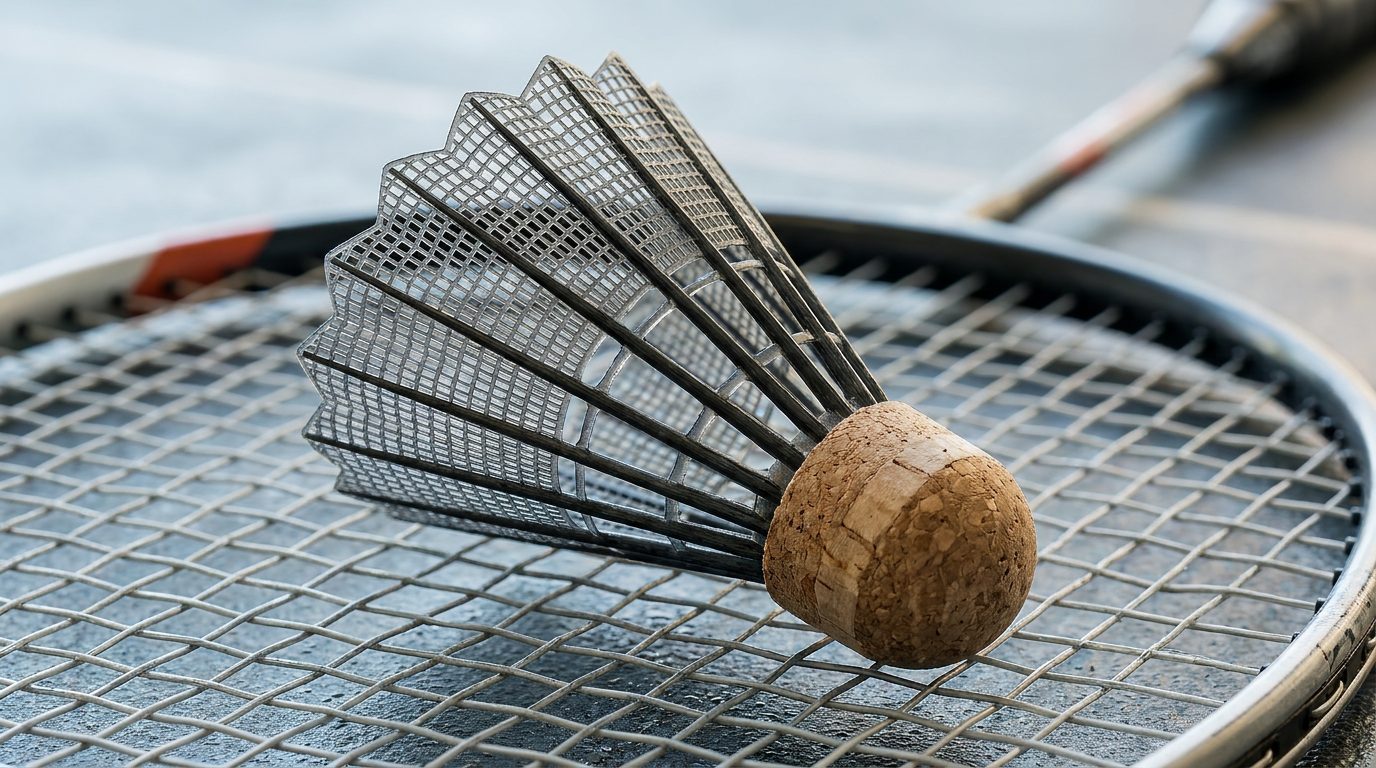
The fastest racket sport in the world relies on a 5-gram projectile made of cork and exactly 16 feathers plucked from a goose. For centuries, this delicate construction has been the non-negotiable standard for professional badminton, dictating the pace, strategy, and physics of the game.[3]
But in a landmark shift, the Badminton World Federation (BWF) has officially approved the use of synthetic shuttlecocks for Grade 3 and Junior International tournaments. The decision marks the beginning of the end for the traditional feather shuttlecock's absolute monopoly on the sport.[1]
Two specific models—the Victor Carbon Sonic Max and the Yonex Crosswind 70—have been cleared for competitive trial. This regulatory green light signals that materials science has finally caught up to nature, solving an engineering problem that has stumped equipment manufacturers for decades.[1][2]
The push toward synthetics is not merely a technological flex; it is an economic and ecological necessity. Traditional shuttlecocks are notoriously fragile. A single professional match can burn through dozens of them, as the sheer force of modern smashes splinters the delicate feather shafts upon impact.[4][6]
Furthermore, the sport has been quietly battling a severe supply chain crisis. The premium goose and duck feathers required for tournament-grade shuttles are a byproduct of the poultry industry. As global dietary habits shift and duck meat consumption falls in key manufacturing regions like China, the raw materials for shuttlecocks have become scarce, driving prices up twofold in recent years.[4]

Replacing the feather, however, is an immense physics challenge. Unlike a tennis ball or a squash ball, a shuttlecock is aerodynamically unstable and does not follow a standard parabolic trajectory. Its flight path is entirely unique to the sport.[3][5]
Instead of an arc, a shuttlecock behaves more like a parachute. When a professional player unleashes a smash, the shuttlecock leaves the racket face at blistering speeds exceeding 400 kilometers per hour—faster than a Formula 1 car.[5]
Within milliseconds, the overlapping feathers generate massive aerodynamic drag. This drag forces the shuttlecock to decelerate violently, dropping to roughly 100 kilometers per hour by the time it crosses the net, before falling steeply and vertically toward the court floor.[3][5]

Within milliseconds, the overlapping feathers generate massive aerodynamic drag.
Early attempts at plastic or nylon shuttlecocks failed to replicate this "turnaround" and steep deceleration. Solid plastic skirts lack the microscopic porosity of natural feathers, causing them to fly too fast, too far, and with a heavier, less responsive feel upon racket impact.[6]
To bridge this gap, engineers had to completely rethink the architecture of the synthetic shuttlecock. Yonex, for instance, spent nearly 15 years developing the Crosswind 70, eventually realizing that a one-to-one visual replica of a feather was impossible and counterproductive.[2]
Instead, they focused on mimicking the physical properties. The new generation of hybrid shuttlecocks abandons the solid plastic skirt in favor of a highly engineered multi-material approach designed to trick the air into reacting as if it were hitting feathers.[2][6]
The stems—which endure the brunt of the 400 km/h impact—are now constructed from carbon graphite. This provides the exact stiffness and rapid structural recovery of a natural feather quill, preventing the shuttlecock from warping mid-flight.[2]
Attached to these carbon stems are porous nylon wings, engineered with specific microscopic gaps to perfectly match the drag coefficient and Reynolds number of overlapping goose feathers. This ensures the steep deceleration curve remains intact.[2][3]

Crucially, manufacturers have retained the traditional natural cork base. This ensures that the tactile feedback—the crisp sound and vibration when the racket strings strike the base—remains identical to what professional athletes have trained with their entire lives.[2]
The BWF's trial phase will collect extensive performance data and player feedback from the Grade 3 and Junior circuits. If the flight characteristics hold up under tournament pressure, the federation plans to expand synthetic approval to top-tier Super 1000 events and eventually the World Championships.[1]
Beyond the elite circuit, the breakthrough has massive implications for grassroots badminton. High-quality hybrid shuttlecocks offer significantly greater durability than their feathered counterparts, drastically reducing the recurring equipment costs that often burden amateur clubs and recreational players.[6]
Equipment manufacturers are also designing these new shuttles with circularity in mind. Yonex has stated that the materials in the Crosswind 70 were selected specifically for future recyclability, aiming to transform the shuttlecock from a disposable consumable into a sustainable product.[2]
As the sport prepares for this transition, the synthetic shuttlecock represents a rare intersection of tradition and innovation. By engineering a solution that respects the unique physics of the game, badminton is securing its ecological future without compromising the blistering speed that defines it.[6]
How we got here
Pre-2020s
Professional badminton relies exclusively on fragile shuttlecocks made from 16 goose or duck feathers.
Early 2020s
A decline in global duck meat consumption leads to a shortage of premium feathers, doubling the cost of traditional shuttlecocks.
March 2026
Yonex unveils the Crosswind 70, a hybrid synthetic shuttlecock developed over 15 years using carbon graphite and porous nylon.
April 2026
The Badminton World Federation officially approves synthetic shuttlecocks from Victor and Yonex for use in Grade 3 and Junior International tournaments.
Viewpoints in depth
The Governing Body's View
The BWF is focused on sustainability and standardizing equipment for the future.
The Badminton World Federation recognizes that the sport's reliance on animal byproducts is increasingly unsustainable. By introducing synthetic shuttlecocks at the Grade 3 and Junior levels, the BWF aims to gather empirical data on flight consistency and durability. Their ultimate goal is to future-proof the sport against supply chain shocks while maintaining the rigorous aerodynamic standards required for elite competition.
Equipment Manufacturers' View
Brands view synthetic shuttlecocks as a triumph of materials science and engineering.
For companies like Yonex and Victor, cracking the code of the synthetic shuttlecock represents over a decade of R&D. They argue that by utilizing carbon graphite stems and porous nylon wings, they have successfully replicated the complex drag coefficient of natural feathers. Manufacturers emphasize that these hybrid models offer superior durability and consistency, eliminating the natural variations found in goose feathers.
Professional Players' View
Elite athletes remain cautious, prioritizing tactile feedback and precise flight trajectories.
While acknowledging the environmental and economic benefits, professional players are highly sensitive to microscopic changes in equipment. The primary concern among athletes is how synthetic shuttlecocks respond during delicate net play and whether they decelerate with the exact same 'parachute' trajectory as feathers. Many are willing to adapt, provided the new materials do not alter the fundamental speed and strategy of the game.
What we don't know
- Whether top-tier professional players will fully accept the tactile feel of synthetic shuttlecocks during Super 1000 events.
- How quickly the manufacturing scale of hybrid shuttlecocks will bring their retail price down for amateur clubs.
Key terms
- Aerodynamic Drag
- The air resistance that opposes the motion of the shuttlecock, causing it to decelerate rapidly after being hit.
- Reynolds Number
- A dimensionless quantity in fluid mechanics used to predict flow patterns; crucial for engineering synthetic feathers that fly like natural ones.
- Parachute Trajectory
- The unique flight path of a shuttlecock, which starts with extreme velocity but drops steeply due to high drag, unlike the parabolic arc of a tennis ball.
- Grade 3 Tournaments
- Lower-tier international badminton competitions sanctioned by the BWF, currently serving as the testing ground for synthetic shuttlecocks.
Frequently asked
Why is badminton moving away from feather shuttlecocks?
Traditional shuttlecocks rely on goose and duck feathers, which are becoming more expensive and scarce due to shifts in the global poultry industry. Synthetics offer a more durable and sustainable alternative.
How fast does a shuttlecock travel?
A professional badminton smash can send the shuttlecock off the racket at speeds exceeding 400 kilometers per hour, making it the fastest projectile in racket sports.
What are the new synthetic shuttlecocks made of?
The latest BWF-approved models, like the Yonex Crosswind 70, use a natural cork base, carbon graphite stems for stiffness, and porous nylon wings to mimic the drag of natural feathers.
Will professional players use synthetic shuttlecocks?
The BWF is currently trialing them at Grade 3 and Junior International tournaments. If the trial is successful, they will eventually be introduced to top-tier elite competitions.
Sources
Source coverage
6 outlets
4 viewpoints surfaced





[1]Badminton World FederationBadminton World Federation
BWF Approves Use of Synthetic Shuttlecocks at Selected Tournaments
Read on Badminton World Federation →[2]YonexEquipment Manufacturers
Introducing a new chapter in the future of badminton with CROSSWIND 70
Read on Yonex →[3]World Badminton
The Aerodynamics of Badminton Shuttlecocks
Read on World Badminton →[4]The Indian Express
Badminton trials synthetic shuttlecocks amid feather shortage
Read on The Indian Express →[5]Selenite Sports
The Unique Aerodynamics of a Shuttlecock
Read on Selenite Sports →[6]Factlen Editorial Team
Synthesis by Factlen editorial team
Read on Factlen Editorial Team →
More in sports
See all 329 stories →USWNT
USWNT Grinds Out 1-0 Victory Over Brazil in Chaotic, Character-Building Friendly
6 sources

2026 Regulations
Formula 1's 2026 Revolution: How Active Aero and Sustainable Fuels Will Change Racing
9 sources

Gymnastics Longevity
The Longevity Revolution: How Older Athletes and NIL Are Reshaping Elite Gymnastics
7 sources
NFL Champions
Seattle Seahawks Unveil Super Bowl LX Championship Rings Featuring Tributes to Fans and City History
8 sources

Every angle. Every day.
Get sports stories with full source coverage and perspective breakdowns delivered to your inbox.