
AI and Smart Recycling Tech Propel the Restaurant Industry Toward a Zero-Waste Future
Advanced AI tracking systems and commercial-scale food recyclers are helping global restaurant groups and Michelin-starred chefs eliminate food waste, saving the industry over $100 million annually.
By Factlen Editorial Team
- Corporate Hospitality Operators
- Global hotel and catering groups are driven by the massive cost savings and operational efficiencies of AI tracking.
- Culinary Innovators
- Michelin-starred chefs view zero-waste technology as a tool to deepen their connection to local agriculture.
- Environmental Regulators
- Policymakers view commercial kitchen technology as essential for meeting international climate targets.
What's not represented
- · Small independent operators facing high initial tech costs
- · Municipal waste management facilities
Why this matters
Food waste accounts for an estimated $1 trillion in global economic loss and up to 10% of greenhouse gas emissions. By proving that zero-waste operations are both scalable and profitable, the restaurant industry is establishing a blueprint that could dramatically reduce the environmental footprint of the global food supply chain.
Key points
- Advanced AI systems are now tracking food waste in over 3,000 commercial kitchens globally, saving operators $100 million annually.
- New commercial-scale recycling hardware reduces the volume of food scraps by 80%, turning them into nutrient-rich grounds.
- Michelin-starred chefs are using these technologies to return processed food scraps directly to the farms that grow their ingredients.
- New legislation in Europe is making food waste tracking a mandatory compliance requirement for the hospitality sector.
The restaurant industry's battle against food waste has quietly shifted from a niche sustainability initiative to a highly profitable operational standard. In 2026, advanced artificial intelligence and commercial-scale recycling technologies have reached a tipping point, allowing both global hospitality conglomerates and independent fine-dining establishments to close the loop on kitchen waste. For decades, the sector accepted a certain degree of spoilage and plate waste as an unavoidable cost of doing business. However, as ingredient prices remain elevated and environmental regulations tighten globally, operators are discovering that the most effective way to protect their profit margins is to fundamentally change how they handle the food they do not serve. This technological awakening is transforming back-of-house operations, replacing guesswork with granular data and turning disposal liabilities into agricultural assets.[1][3]
The financial impact of this operational shift is staggering. Major hospitality groups—including Hilton, Accor, Marriott, Mandarin Oriental, and IKEA—are now collectively saving more than $100 million annually in food costs by deploying AI-powered tracking systems across their global portfolios. These savings are not derived from serving smaller portions, but rather from identifying systemic inefficiencies in purchasing and preparation that previously went unnoticed. By treating food waste as a measurable metric rather than an invisible byproduct, these corporations are demonstrating that environmental stewardship and fiduciary responsibility are no longer mutually exclusive concepts in the commercial kitchen.[1][3]
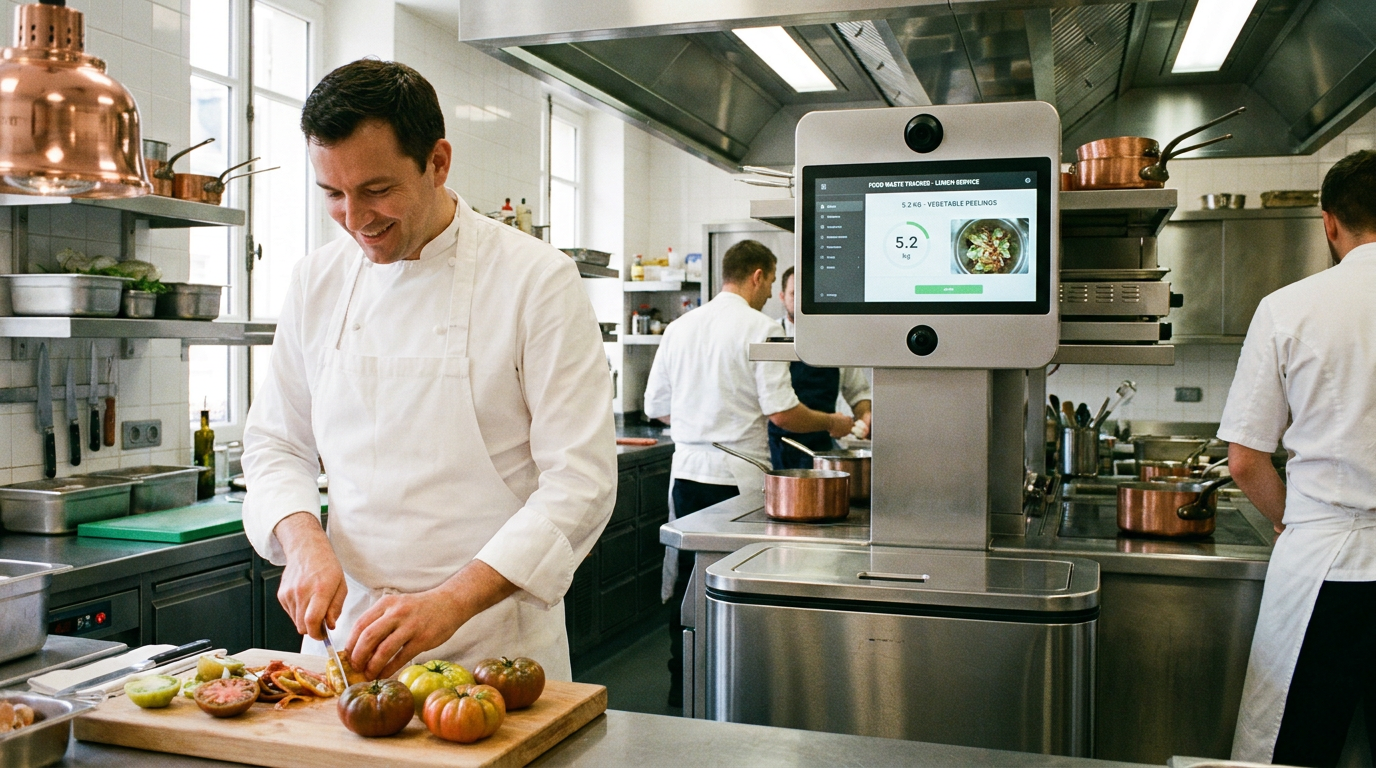
Leading the charge in this data-driven revolution is Winnow, a United Kingdom-based technology company whose "Throw and Go" artificial intelligence system is now installed in over 3,000 commercial kitchens across nearly 100 countries. The system utilizes computer vision cameras and connected scales positioned directly above kitchen disposal bins. As staff throw away scraps or unserved portions, the AI automatically identifies the specific type of food, records its exact weight, calculates its financial cost, and categorizes the reason for its disposal. Crucially, this touchless capture occurs in real-time without requiring any manual data entry or workflow disruption from the culinary team.[1][2][4]

Armed with this granular, daily data, executive chefs and procurement teams can make immediate adjustments to their operations. They can refine their menu planning, scale back over-ordering of specific ingredients, and identify stations where prep waste is unusually high. Across all kitchens currently utilizing the platform, an estimated 28,000 tonnes of food waste are being prevented each year. This volume is the equivalent of saving two meals every second, while simultaneously avoiding more than 122,000 tonnes of carbon dioxide equivalent emissions annually.[1][3][8]
While artificial intelligence is highly effective at preventing waste at the source, new hardware innovations are transforming how unavoidable scraps—such as eggshells, bones, and fruit peels—are physically handled. Mill, a company initially recognized for its residential food recyclers, has introduced "Mill Commercial," a high-capacity infrastructure designed specifically for the rigorous demands of back-of-house restaurant operations. Rather than relying on traditional, odor-heavy municipal composting pickups, these on-site units process the organic material immediately.[4][5]
Rather than relying on traditional, odor-heavy municipal composting pickups, these on-site units process the organic material immediately.
In April 2026, Mill announced a massive strategic partnership with Compass Group, the world's leading foodservice and facilities management company. Beginning in 2027, the commercial recycling technology will be deployed across corporate dining campuses, universities, hospitals, and stadiums throughout North America. The system uses advanced heating, drying, and grinding technology to reduce the overall volume of food waste by 80 percent overnight. The output is a dry, shelf-stable material that resembles coffee grounds, retains the food's full nutritional value, and can be seamlessly repurposed as animal feed or compost feedstock.[4]

Beyond corporate cafeterias, this technology is capturing the attention of the world's most decorated culinary figures. At San Francisco's two-Michelin-starred Saison, executive chef Richard Lee has integrated Mill bins into the restaurant's volume-heavy preparation areas. The processed food scraps, including the spent tea leaves from the restaurant's signature welcome ritual, are returned directly to local growers. This allows the restaurant to nourish the exact soil that will produce their future harvests, creating a highly visible, closed-loop system that resonates deeply with environmentally conscious diners.[2]
Similarly, at SingleThread in California's wine country, chefs Kyle and Katina Connaughton feed daily vegetable trimmings, fruit peels, and floral byproducts directly into their on-site recycling units. The resulting nutrient-rich grounds are moved straight into the farm rows that produce the ingredients for their nightly tasting menus. For these elite chefs, the technology is not merely a waste-reduction tool; it is a mechanism for deepening their connection to local agriculture and taking direct responsibility for the lifecycle of their ingredients.[2]
This operational evolution is being heavily rewarded by the industry's highest arbiters of taste. The Michelin Guide has significantly expanded its emphasis on sustainable gastronomy, awarding a record number of Green Stars in 2026. In the United Kingdom and Ireland alone, 37 restaurants now hold the distinction, with seven new additions recognized this year for their outstanding eco-friendly commitments. The Green Star has quickly become one of the most coveted accolades in the culinary world, signaling to diners that a restaurant is at the absolute forefront of environmental responsibility.[6]

The movement is inherently global, reaching markets far beyond North America and Europe. In Vietnam, Tales by Chapter recently made headlines by becoming the country's first zero-waste, plant-based dining destination to receive a Michelin Green Star. The restaurant utilizes seasonal produce from local farms, native fruits, and fermented ingredients while maintaining a strict zero-waste philosophy. This milestone reflects a broader international consensus that exceptional dining experiences can, and should, coexist with rigorous environmental responsibility.[7]
Regulatory pressures are also accelerating this technological adoption, ensuring that zero-waste practices move from voluntary to mandatory. In Spain, legislation passed in 2025 requiring all hospitality businesses to implement formal food waste prevention plans has officially entered its enforcement phase in 2026. With the European Union proposing binding targets to halve per-capita food waste by 2030, digital measurement and tracking are rapidly transitioning from optional sustainability perks to baseline compliance requirements for operators of all sizes.[1][3][8]
Industry analysts note that the zero-waste movement has fundamentally evolved. It has shifted from focusing merely on compostable packaging to embracing what experts call "upcycled functionalism." Industrial leftovers and restaurant surplus are increasingly viewed as valuable commodities rather than disposal liabilities. As artificial intelligence and smart recycling hardware become standard kitchen equipment, the restaurant industry is proving that sustainability is not just an ethical imperative, but a highly scalable blueprint for future profitability.[5]
How we got here
2013
Winnow is founded in the UK to develop AI-powered food waste tracking for commercial kitchens.
2020
Mill is founded by Nest alumni to reimagine food waste as a recoverable resource.
April 2025
Spain passes legislation requiring hospitality businesses to implement formal food waste prevention plans.
January 2026
Major hospitality groups announce they have collectively saved over $100 million annually using Winnow's AI.
April 2026
Mill announces a strategic partnership with Compass Group to deploy commercial-scale food recyclers across North America.
June 2026
The Michelin Guide expands its Green Star program, recognizing a record number of zero-waste pioneers globally.
Viewpoints in depth
Culinary Innovators
Michelin-starred chefs view zero-waste technology as a tool to deepen their connection to local agriculture.
For elite chefs, the adoption of advanced recycling hardware is less about corporate cost-saving and more about taking direct responsibility for the lifecycle of their ingredients. By processing scraps on-site and returning the nutrient-rich grounds to their partner farms, they are actively improving the soil quality for their future harvests. This closed-loop philosophy is increasingly recognized by bodies like the Michelin Guide as the pinnacle of modern, sustainable gastronomy.
Corporate Hospitality Operators
Global hotel and catering groups are driven by the massive cost savings and operational efficiencies of AI tracking.
At the enterprise scale, food waste represents a multi-million dollar liability. Corporate operators emphasize that AI tracking systems provide unprecedented visibility into purchasing inefficiencies and over-production. By treating waste as a measurable, correctable metric, these groups are proving that aggressive environmental sustainability directly correlates with improved profit margins, making the technology an easy sell to shareholders.
Environmental Regulators
Policymakers view commercial kitchen technology as essential for meeting international climate targets.
With food waste accounting for up to 10% of global greenhouse gas emissions, environmental authorities are moving from voluntary guidelines to strict enforcement. Regulators argue that the hospitality sector must adopt digital measurement tools to comply with new laws, such as Spain's 2026 waste prevention mandates and the EU's 2030 reduction targets. For these bodies, AI tracking is the only reliable way to verify that the industry is actually reducing its footprint.
What we don't know
- How quickly small, independent restaurants will be able to afford the upfront hardware costs of commercial AI tracking systems.
- Whether the nutrient-rich output from commercial food recyclers will face regulatory hurdles when sold as commercial animal feed at scale.
- How municipal composting facilities will adapt if large corporate campuses begin processing the majority of their organic waste on-site.
Key terms
- Computer Vision
- A field of artificial intelligence that enables computers to derive meaningful information from digital images, used here to automatically identify discarded food.
- Michelin Green Star
- An annual award given by the Michelin Guide to restaurants that demonstrate industry-leading sustainable practices and environmental responsibility.
- Upcycled Functionalism
- The practice of transforming food byproducts and scraps into high-value, functional ingredients rather than discarding them.
- Circular Food System
- An economic model aimed at eliminating waste and the continual use of resources within the food supply chain.
Frequently asked
How does AI track food waste in restaurants?
Systems like Winnow use computer vision cameras and connected scales placed over trash bins to automatically identify, weigh, and calculate the cost of discarded food without manual data entry.
What happens to the food scraps processed by commercial recyclers?
Technologies like Mill dehydrate and grind food scraps on-site, reducing their volume by 80% and turning them into dry, nutrient-rich grounds that can be used for compost or animal feed.
Are these technologies only for large corporate hotels?
While major chains like Hilton and Marriott use them at scale, independent Michelin-starred restaurants are also adopting these systems to close the loop with their local partner farms.
Sources
Source coverage
8 outlets
3 viewpoints surfaced








[1]GlobeTrenderCorporate Hospitality Operators
Winnow saving US$100 million in food waste per year for hotels
Read on GlobeTrender →[2]Fine Dining LoversCulinary Innovators
The Unsexy Tool Top Chefs Are Using to Cut Food Waste
Read on Fine Dining Lovers →[3]Green Lodging NewsCorporate Hospitality Operators
Hospitality Groups Saving More Than $100 Million Annually by Reducing Food Waste
Read on Green Lodging News →[4]PR NewswireCorporate Hospitality Operators
Mill and Compass Group Announce Strategic Partnership to Accelerate Deployment of Mill Commercial
Read on PR Newswire →[5]TastewiseCorporate Hospitality Operators
Zero-waste food trends 2026: what is actually scaling
Read on Tastewise →[6]The CatererCulinary Innovators
New Michelin green stars: All the restaurants awarded in the 2026 guide
Read on The Caterer →[7]Tales by ChapterCulinary Innovators
A Michelin Green Star recognition for purpose-driven dining
Read on Tales by Chapter →[8]UNEPEnvironmental Regulators
Using AI to keep food out of landfills
Read on UNEP →
More in food drink
See all 23 stories →Rare Sugars
The Science of Allulose: How a 'Rare Sugar' is Rewriting the Rules of Baking
6 sources

Precision Fermentation
How Precision Fermentation is Brewing the Future of Animal-Free Dairy
8 sources

Flavor Science
The Science of Umami: How Glutamate Synergy Transforms Everyday Home Cooking
8 sources

Caffeine Science
The Science of Caffeine: Why Timing, Genetics, and Metabolism Dictate Coffee's Health Impact
6 sources

Every angle. Every day.
Get food drink stories with full source coverage and perspective breakdowns delivered to your inbox.