
The Science of Umami: How Glutamate Synergy Transforms Everyday Home Cooking
Understanding the biological mechanisms behind the 'fifth taste' allows home cooks to multiply flavor and reduce sodium without relying on extra fat.
By Factlen Editorial Team
- Culinary Scientists
- Focusing on the chemical reactions and receptor mechanics that create flavor.
- Public Health Dietitians
- Advocating for umami as a tool for sodium reduction and healthier eating.
- Home Cooking Educators
- Translating flavor science into accessible pantry strategies for everyday meals.
What's not represented
- · Food historians studying the cultural impact of the MSG panic
- · Commercial food manufacturers who rely on umami for processed snacks
Why this matters
By mastering the chemical synergy of umami, home cooks can elevate everyday meals to restaurant quality while simultaneously reducing their sodium intake by up to 30 percent.
Key points
- Umami is a biological taste response triggered by glutamic acid, an amino acid found in protein-rich foods.
- Combining glutamates with nucleotides (found in meat and mushrooms) multiplies savory flavor by up to eight times.
- Cooking techniques like slow-roasting and fermentation break down proteins, naturally increasing a food's umami potential.
- MSG is a safe, naturally derived seasoning that contains one-third the sodium of standard table salt.
- Using umami-rich ingredients allows home cooks to reduce overall recipe sodium by up to 30 percent.
For decades, home cooks have chased the elusive secret to restaurant-quality meals, often relying heavily on extra butter, heavy cream, or excessive salt to build flavor. But the true foundation of deeply satisfying, crave-worthy food is entirely invisible to the naked eye. It is umami, the widely celebrated 'fifth taste,' which serves as a fundamental biological pathway signaling the presence of essential proteins to our brains. Often described as savory, meaty, or mouth-filling, umami is not just a trendy culinary buzzword tossed around by professional chefs; it is a highly specific, quantifiable chemical interaction happening on the human tongue every time we eat.[6][1]
The formal science of umami began in 1908 when Japanese chemist Kikunae Ikeda sought to understand the unique, savory taste of dashi, a traditional Japanese broth made from kombu, a type of kelp. Through rigorous laboratory analysis, Ikeda successfully isolated glutamic acid—a naturally occurring amino acid—as the active flavor compound and coined the term 'umami,' which translates roughly from Japanese to 'pleasant savory taste.' Today, modern scientists know that the human tongue features highly specialized receptors, known specifically as T1R1 and T1R3, which are uniquely tuned by evolution to detect these free glutamates in our food.[7][3]
But the real magic of umami—and the ultimate secret weapon for ambitious home cooks—lies in a well-documented chemical phenomenon known as 'glutamate synergy.' While glutamate alone provides a pleasant baseline savory taste, its impact on the palate is exponentially magnified when it is paired with specific nucleotides. The two most important nucleotides for cooking are inosinate (IMP), which is abundantly found in meats and fish, and guanylate (GMP), which is heavily concentrated in mushrooms and yeast. When these compounds meet, the flavor profile of a dish fundamentally transforms.[2]
Food scientists and sensory researchers have demonstrated that this synergy creates a fundamentally non-linear effect on human taste perception. When glutamate and nucleotides meet on the palate, they do not simply add together in a one-plus-one-equals-two equation; they multiply dramatically. The presence of IMP or GMP can amplify the perceived intensity of umami by up to eight times. This powerful chemical synergy explains why certain classic culinary pairings—like beef and tomatoes in a rich Italian ragù, or kombu and bonito flakes in a traditional Japanese dashi—are universally beloved across vastly different global cultures.[2][8]

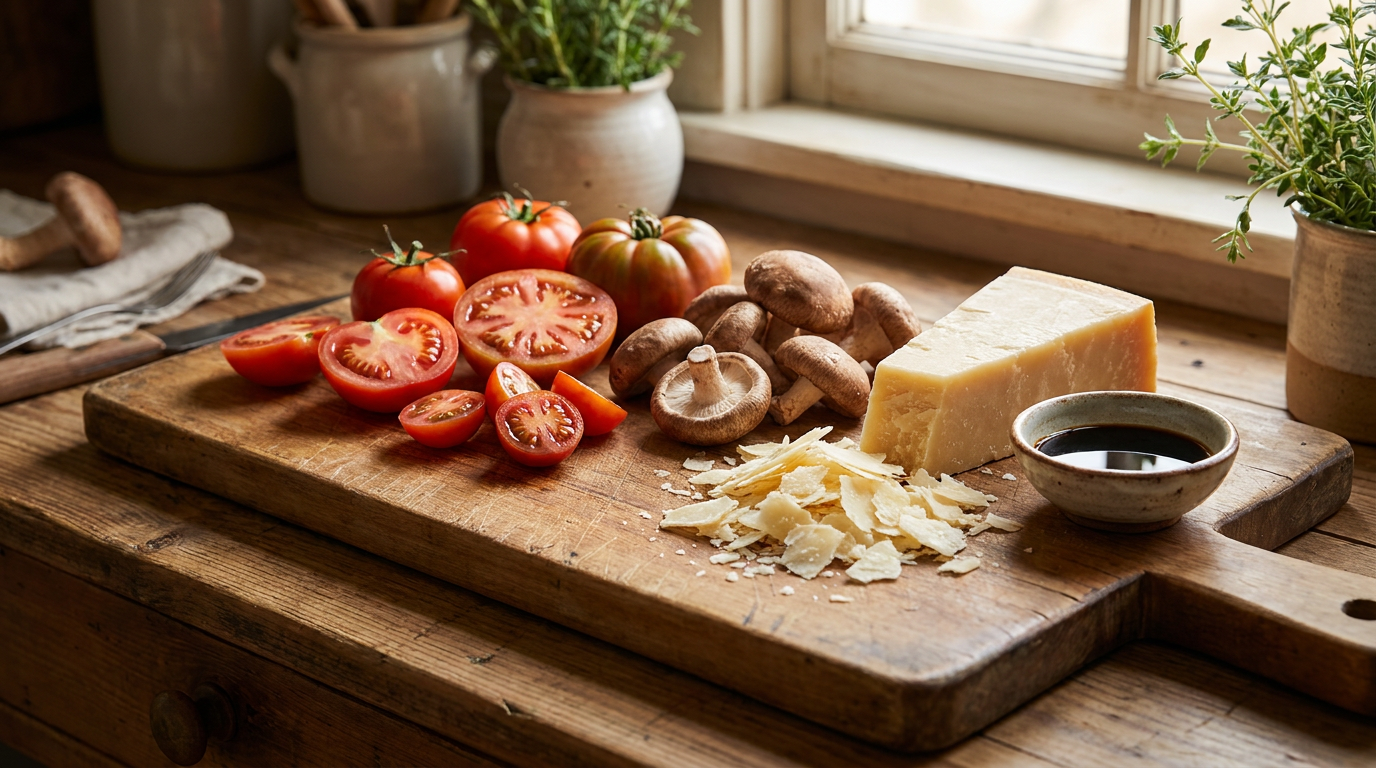
Harnessing this powerful synergy at home does not require a chemistry degree or expensive laboratory equipment. It simply requires stocking a standard kitchen pantry with glutamate-rich anchor ingredients and nucleotide-heavy flavor boosters. Everyday items like ripe tomatoes, aged cheeses such as Parmesan or Pecorino, traditional soy sauce, and fermented miso paste are incredibly dense with free glutamates. Meanwhile, ingredients like dried shiitake mushrooms, anchovies, and rich meat broths provide the necessary nucleotides to trigger the eight-fold multiplier effect when combined in a single recipe.[1][7]
For those practicing plant-based and vegetarian cooking, mastering the science of umami is particularly crucial for culinary success. Without the naturally occurring inosinate found abundantly in animal meats, vegetarian dishes can sometimes taste flat, thin, or lacking in satisfying depth. Home cooks can easily bridge this flavor gap by leaning heavily on guanylate-rich ingredients like dried shiitake mushrooms, pairing them strategically with glutamate powerhouses like nutritional yeast, dark soy sauce, or concentrated tomato paste to build a robust, deeply satisfying flavor profile without relying on any animal products.[1]
The specific way that raw ingredients are processed in the kitchen also heavily dictates their ultimate umami potential. Raw foods often contain bound proteins that are too large to register on our microscopic taste receptors. However, applying heat through techniques like slow-roasting, simmering, or caramelizing induces proteolysis—the physical breaking down of complex proteins into free, taste-active amino acids. Slow-roasting tomatoes in the oven, for instance, evaporates their excess water and concentrates the newly freed glutamates, transforming a simple, watery vegetable into an intense, savory flavor bomb.[2][1]
The specific way that raw ingredients are processed in the kitchen also heavily dictates their ultimate umami potential.
Similarly, the ancient practice of fermentation relies on natural enzymes and beneficial bacteria to break down complex proteins over a period of months or even years. This biological breakdown is precisely why aged Parmesan cheese, traditional soy sauce, and fermented miso paste possess such a profound, lingering savoriness that fresh ingredients simply cannot match. The extended aging process does all the chemical heavy lifting in advance, leaving behind a dense, ready-to-use concentration of free glutamates that can instantly elevate a quick weeknight soup or a simple salad dressing.[8][1]

Any comprehensive discussion of umami inevitably leads to its most famous, and historically controversial, crystallized form: monosodium glutamate, universally known as MSG. From a chemical perspective, MSG is simply the sodium salt of glutamic acid, stabilized with a single sodium molecule to create a highly versatile, shaker-ready seasoning for the kitchen. Despite its profound chemical simplicity and natural origins, MSG became the subject of intense public panic starting in the late 1960s, leading to the widespread, racially tinged myth of 'Chinese Restaurant Syndrome' that dominated food culture for decades.[5]
Modern nutritional science and rigorous clinical trials have thoroughly debunked these historical fears. The U.S. Food and Drug Administration (FDA) has officially classified MSG as 'Generally Recognized as Safe' (GRAS) since 1958, placing it in the same safety category as basic table salt and black pepper. Over the past three decades, numerous double-blind, placebo-controlled trials have consistently failed to find any causal link between MSG consumption and the myriad symptoms historically attributed to it. The human body metabolizes the glutamate found in a shaker of MSG exactly the same way it metabolizes the glutamate naturally present in a homegrown heirloom tomato.[3][5]
In fact, modern public health dietitians and cardiovascular experts are increasingly viewing umami in general, and MSG specifically, as a highly powerful tool for improving overall dietary health. Because umami naturally enhances the overall palatability and the perceived saltiness of food on the palate, it allows home cooks and commercial chefs alike to dramatically reduce their reliance on pure sodium. MSG contains roughly one-third the sodium of standard table salt—measuring at just 640 milligrams per teaspoon compared to a staggering 2,300 milligrams in regular salt.[5]

Clinical dietary studies indicate that strategically replacing a portion of table salt with MSG or other umami-rich ingredients can reduce the overall sodium content of a recipe by up to 30 percent without sacrificing any flavor or consumer palatability. In a modern culinary landscape where excessive sodium intake remains a leading risk factor for hypertension and cardiovascular disease, this simple flavor-boosting substitution offers a highly practical, accessible intervention for healthier everyday home cooking, allowing families to protect their heart health while still enjoying deeply savory meals.[5][4]
Beyond the clear benefits of sodium reduction, emerging nutritional research suggests that umami plays a highly significant role in human satiety and healthy digestion. Leading researchers have demonstrated that umami-rich foods actively promote a lasting feeling of fullness and satisfaction after a meal, which can help regulate appetite, prevent overeating, and support healthier aging. By making vegetable-heavy, lower-salt diets genuinely joyful and satisfying to eat, umami helps bridge the difficult gap between strict nutritional needs and pure culinary pleasure.[4]
To apply these scientific principles tonight, home cooks can start with a few incredibly simple additions to their standard routines. Drop a leftover, hardened Parmesan rind into a simmering pot of minestrone or chicken soup to slowly release trapped glutamates into the broth as it cooks. Whisk a single teaspoon of white miso paste into a standard olive oil vinaigrette to give a simple green salad an unexpected, savory depth. Or add a quick dash of fish sauce to a homemade marinara sauce that tastes slightly flat; the nucleotides in the fish sauce will immediately synergize with the tomatoes.[1]
Ultimately, understanding the underlying science of umami empowers home cooks to stop guessing at the stove and start building complex flavor with deliberate intention. By combining the right chemical compounds through thoughtful ingredient pairings and targeted cooking techniques, absolutely anyone can transform ordinary, inexpensive groceries into extraordinary, restaurant-quality meals. Harnessing glutamate synergy proves once and for all that the very best home cooking is equal parts creative art and fundamental biology, offering a lifetime of better, healthier, and more satisfying dinners.[6]
How we got here
1908
Japanese chemist Kikunae Ikeda identifies glutamate as the source of the savory taste in kombu broth and coins the term 'umami'.
1913
Scientist Shintaro Kodama discovers that the nucleotide IMP in dried bonito flakes also contributes to umami.
1958
The U.S. FDA classifies monosodium glutamate (MSG) as 'Generally Recognized as Safe' (GRAS).
1968
A letter to a medical journal sparks the unfounded panic over 'Chinese Restaurant Syndrome', leading to decades of MSG stigma.
2000
Researchers definitively identify the specific T1R1 and T1R3 taste receptors on the human tongue responsible for detecting umami.
Viewpoints in depth
Culinary Scientists
Focusing on the chemical reactions and receptor mechanics that create flavor.
Food scientists and chemists view umami as a quantifiable biological mechanism. They focus on how free glutamates bind to the T1R1 and T1R3 receptors on the tongue, and how cooking techniques like proteolysis and the Maillard reaction physically alter the molecular structure of food. For this camp, the 'magic' of cooking is entirely rooted in the non-linear synergy between amino acids and nucleotides.
Public Health Dietitians
Advocating for umami as a tool for sodium reduction and healthier eating.
Nutritionists and public health experts emphasize the practical health benefits of umami. Because glutamate enhances the perception of saltiness and overall palatability, it offers a viable strategy for reducing dietary sodium by up to 30 percent. Furthermore, this camp highlights emerging research showing that umami promotes satiety, making it easier for patients to adhere to vegetable-rich, lower-calorie diets without feeling deprived.
Home Cooking Educators
Translating flavor science into accessible pantry strategies for everyday meals.
Culinary instructors and recipe developers care less about the molecular formulas and more about the practical application. They advocate for stocking pantries with umami-rich staples—like miso, soy sauce, tomato paste, and Parmesan—to easily elevate weeknight dinners. Their goal is to teach home cooks how to layer these ingredients to build depth and satisfaction, especially in plant-based cooking where traditional meat-based nucleotides are absent.
What we don't know
- While MSG is proven safe for the general population, scientists are still studying whether a very small subset of individuals might have mild, sulfite-like sensitivities to concentrated glutamates.
- The exact evolutionary reason why humans developed specific receptors for umami is still debated, though it is widely believed to be a mechanism for detecting essential proteins.
Key terms
- Glutamate
- An amino acid found in all protein-containing foods that binds to specific receptors on the tongue to trigger the umami taste.
- Nucleotides (IMP/GMP)
- Compounds found in meats (IMP) and mushrooms (GMP) that synergize with glutamate to multiply savory flavors.
- Proteolysis
- The chemical breakdown of proteins into smaller amino acids, which occurs naturally during aging, cooking, or fermentation.
- Glutamate Synergy
- A biological phenomenon where the combination of glutamates and nucleotides amplifies the perceived intensity of umami by up to eight times.
Frequently asked
What exactly is umami?
Umami is the fifth basic taste, alongside sweet, sour, salty, and bitter. It is a savory, meaty flavor triggered by glutamic acid, an amino acid found in protein-rich foods.
Is MSG safe to use in home cooking?
Yes. The FDA has classified MSG as 'Generally Recognized as Safe' since 1958, and decades of scientific studies have debunked the myth that it causes adverse health effects.
How can I add umami to vegetarian dishes?
Vegetarian cooks can build umami by using ingredients rich in free glutamates and guanylate, such as dried shiitake mushrooms, tomato paste, miso, soy sauce, and nutritional yeast.
Why do roasted tomatoes taste better than raw ones?
Slow-roasting evaporates water and breaks down the tomato's proteins into free amino acids, concentrating the naturally occurring glutamates and intensifying the savory flavor.
Sources
Source coverage
8 outlets
3 viewpoints surfaced








[1]Savory KitchinHome Cooking Educators
The Umami Code (Part 3): Every Day Cooking
Read on Savory Kitchin →[2]arXivCulinary Scientists
Chemistry-informed hybrid model for taste prediction
Read on arXiv →[3]National Institutes of HealthPublic Health Dietitians
Monosodium glutamate (MSG): A comprehensive review of the literature on its safety
Read on National Institutes of Health →[4]Umami Information CenterPublic Health Dietitians
Springer issued 'Umami - Taste for Health'
Read on Umami Information Center →[5]Kara Lydon NutritionPublic Health Dietitians
Is MSG Safe? The Science Behind Umami
Read on Kara Lydon Nutrition →[6]Factlen Editorial TeamHome Cooking Educators
Synthesis by Factlen editorial team
Read on Factlen Editorial Team →[7]Science of CookingCulinary Scientists
The Science of Umami
Read on Science of Cooking →[8]Rockefeller UniversityCulinary Scientists
Kitchen Lab: Science Through the Lens of Food
Read on Rockefeller University →

More in food drink
See all 19 stories →Gut Microbiome
The Science of Psychobiotics: How Your Gut Microbiome Shapes Your Mental Health
7 sources
Culinary Science
The Ancient Chemistry That Makes Corn Digestible, Nutritious, and Delicious
8 sources
Food Tech
How Precision Fermentation is Engineering the Future of Animal-Free Dairy
8 sources
Food Science
The Science of Produce Storage: How to Make Your Groceries Last Longer
6 sources
Every angle. Every day.
Get food drink stories with full source coverage and perspective breakdowns delivered to your inbox.