
'Bangtan-nomics': How the BTS Reunion Tour is Supercharging South Korea's Economy
The K-pop supergroup's 82-show global comeback tour is driving record tourism and retail spending, demonstrating how the passion economy has matured into a macroeconomic pillar.
By Factlen Editorial Team
- Macroeconomic Analysts
- Focuses on the long-term structural integration of pop culture into national GDP.
- Local Government & Tourism
- Views mega-concerts as opportunities to revitalize regional economies and small businesses.
- Entertainment Industry
- Highlights the extreme corporate reliance and financial leverage tied to flagship intellectual properties.
What's not represented
- · Small business owners displaced by rising commercial rents
- · Non-fans dealing with extreme city congestion
Why this matters
The staggering financial footprint of the reunion tour demonstrates how the 'passion economy' has evolved into a macroeconomic pillar. For South Korea, cultural exports are no longer just soft power—they are a primary driver of retail, tourism, and corporate growth capable of moving national GDP.
Key points
- BTS's 82-show comeback tour is driving unprecedented economic activity across South Korea.
- Analysts project the group's fanbase could contribute up to 0.35% to South Korea's GDP by 2040.
- South Korea recorded a record 4.76 million foreign tourist arrivals in the first quarter of 2026.
- Busan launched a coordinated digital currency and discount campaign to capture concert tourist spending.
- Entertainment conglomerate HYBE is seeing a massive financial rebound after an 83% profit drop during the group's hiatus.
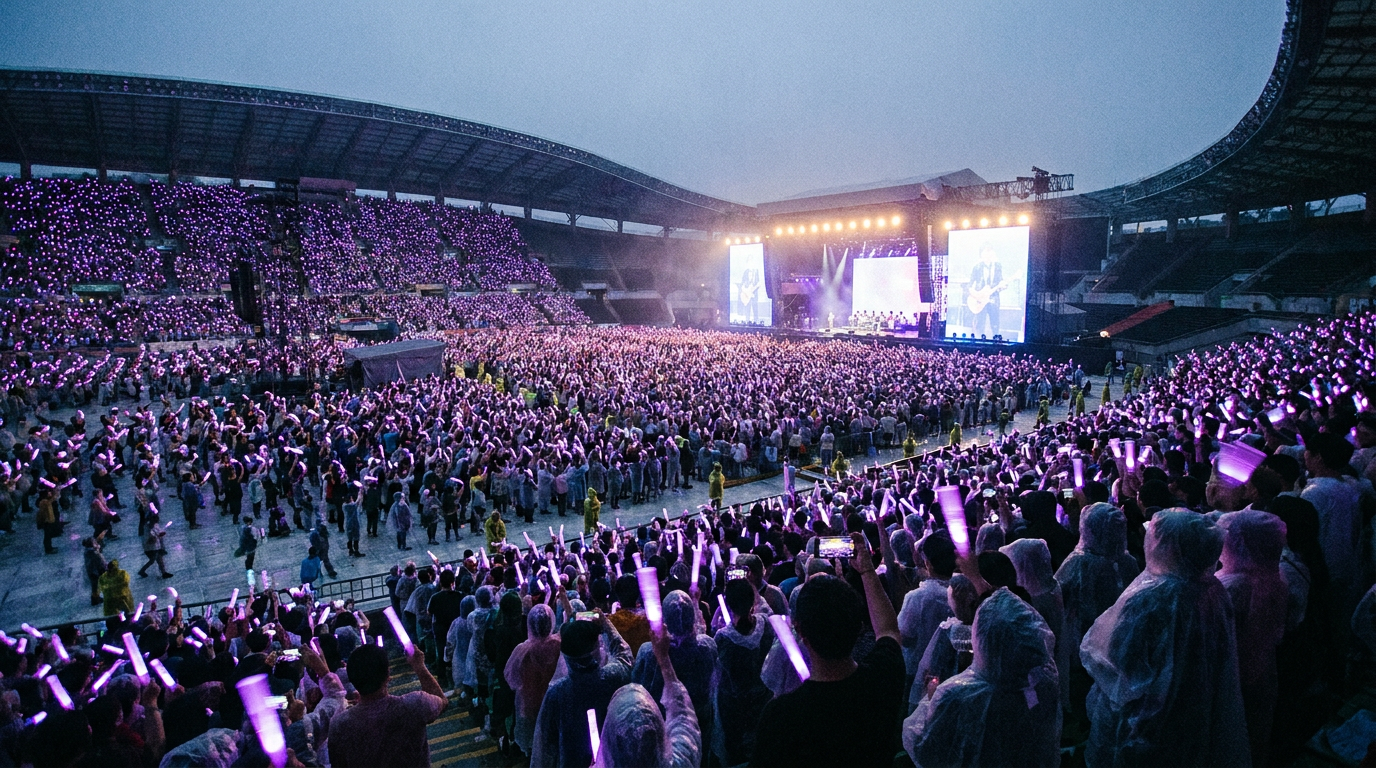
The purple wave has returned, and it is bringing billions of dollars with it. As K-pop supergroup BTS descends on Busan this weekend for the latest stop of their 82-show 'ARIRANG' World Tour, South Korea is experiencing an unprecedented macroeconomic surge.[1][4]
Following a nearly four-year hiatus while members completed mandatory military service, the seven-member group launched their comeback with a massive free concert in Seoul in March, followed by stadium shows in Goyang and Mexico City.[5][6]
Analysts are comparing the financial windfall to 'Swiftnomics,' the massive consumer spending generated by Taylor Swift's Eras Tour. However, the structural integration of BTS into South Korea's economy makes this phenomenon unique, earning the moniker 'Bangtan-nomics.'[1][3]
NH Investment & Securities projects that by 2040, spending by the group's fiercely loyal global fanbase—known as ARMY—could contribute up to 0.35 percentage points annually to South Korea's nominal GDP.[1]

The immediate numbers are staggering. In the first quarter of 2026, South Korea recorded 4.76 million foreign tourist arrivals, a 23% year-over-year jump and the highest first-quarter total in the nation's history.[6]
March alone saw 2.06 million foreign visitors, a spike directly attributed to the group's comeback activities in Seoul, where fans flooded hotels and retail districts.[5][6]
The Korea Culture and Tourism Institute estimates that each stop on the 34-city global tour will yield approximately 1.2 trillion won ($840 million to $920 million) in direct and indirect economic impact.[5][6]
This includes not just ticket sales, but a massive halo effect on airlines, hotels, restaurants, and retail, as fans turn concert dates into extended vacations.[1][5]
This includes not just ticket sales, but a massive halo effect on airlines, hotels, restaurants, and retail, as fans turn concert dates into extended vacations.
In Busan, where the group is performing on June 12 and 13, accommodation bookings surged 218% compared to the same period last year, with demand spilling over into neighboring regions.[4]

To capture this influx of capital, the Busan Metropolitan Government launched 'Busan Big Sale Week,' coordinating discount agreements with over 550 local mom-and-pop shops and major department stores.[2]
The city is offering a 2% cash-back bonus on its proprietary digital currency, Dongbaekjeon, and selling subsidized prepaid cards to foreign tourists at airport kiosks to encourage local spending.[2]
"Global cities hosting stadium-sized concerts face a familiar dilemma: Massive crowds arrive, spend money exclusively at the venue and depart," notes The Korea Times. Busan's aggressive strategy aims to channel that purchasing power directly into local alleyway commercial districts.[2]
The corporate impact is most acutely felt by HYBE, the entertainment conglomerate behind BTS.[5]
During the group's military hiatus, HYBE's operating profit collapsed by 83%, dropping from $210 million to $35 million, despite the company's aggressive efforts to debut new artist groups and diversify its revenue streams.[6]

With the group's return, HYBE's stock has rebounded toward four-year highs, and analysts project operating profits could jump exponentially as the tour progresses through 2026 and 2027.[5][6]
The economic ripples extend far beyond Asia. Economists anticipate the North American leg of the tour will generate tens of billions of dollars in economic activity, potentially surpassing the $5 billion direct consumer spending sparked by the Eras Tour.[3]
Fans are traveling internationally even without concert tickets, spending thousands of dollars on 'BTS pilgrimages' that include Korean beauty treatments, shopping, and visiting locations frequented by the band members.[3]
Ultimately, the 'ARIRANG' tour proves that South Korea's aggressive investment in cultural exports has matured into a highly resilient economic engine.[1][5]
As the global fanbase ages and acquires more disposable income, the intersection of pop culture and macroeconomic policy is poised to drive South Korea's corporate and national growth well into the future.[1]
How we got here
October 2022
BTS announces a hiatus to fulfill South Korea's mandatory military service, causing a sharp drop in HYBE's stock.
March 2026
The seven members reunite for a massive free comeback concert at Gwanghwamun Square in Seoul.
April 2026
The 82-show 'ARIRANG' World Tour officially kicks off with three sold-out nights at Goyang Stadium.
June 2026
The tour arrives in Busan, prompting the city to launch a coordinated economic campaign to capture tourist spending.
Viewpoints in depth
Economic Analysts
Focuses on the long-term macroeconomic integration of pop culture.
Financial analysts view this phenomenon not as a fleeting cultural bubble, but as a structural economic driver. They point to the 'flywheel effect' where fan engagement translates into sustained spending on Korean cosmetics, fashion, food, and tourism. Institutions like NH Investment & Securities argue that as the fanbase ages and gains purchasing power, their contribution to South Korea's GDP will only compound, making cultural exports a pillar of national economic policy.
Local Municipalities
Views mega-concerts as opportunities to revitalize regional economies.
City governments like Busan see stadium tours as a tool for urban economic engineering. Rather than allowing revenue to be captured solely by the concert venue and international hotel chains, municipalities are actively intervening. By deploying local digital currencies, subsidized transit cards, and coordinated discount weeks, they aim to force the 'tourist windfall' into mom-and-pop shops, traditional markets, and local hospitality sectors.
Entertainment Conglomerates
Highlights the extreme corporate reliance on flagship intellectual properties.
For companies like HYBE, the return of their flagship group underscores both the immense power and the inherent vulnerability of the idol-driven business model. The 83% collapse in operating profit during the group's hiatus demonstrated that despite aggressive diversification into new groups and tech platforms, the core financial engine remains tied to a single, irreplaceable IP. The 2026 tour represents a massive corporate resurrection, but also a reminder of the sector's concentration risk.
What we don't know
- Whether the economic momentum can be sustained after the 82-show tour concludes in 2027.
- Exactly how much of the local municipal spending incentives will successfully reach small businesses versus major conglomerates.
- If other entertainment companies can replicate this macroeconomic scale with newer artist groups.
Key terms
- Bangtan-nomics
- A portmanteau of 'Bangtan' (from the group's Korean name) and 'economics,' referring to the massive financial ecosystem driven by the fanbase.
- ARMY
- The official name of the global fanbase, known for their high engagement and coordinated economic support of the group.
- Dongbaekjeon
- A local digital currency issued by the city of Busan, used to incentivize spending at small and medium-sized local businesses.
- Halo Effect
- An economic phenomenon where the success of one event (like a concert) positively influences spending in adjacent sectors like hotels, airlines, and retail.
Frequently asked
How much does a single concert contribute to the economy?
The Korea Culture and Tourism Institute estimates that each stop on the 2026 global tour yields approximately 1.2 trillion won ($840 million to $920 million) in direct and indirect economic impact.
Why did HYBE's profits drop so much before 2026?
During the group's mandatory military service from late 2022 to early 2026, HYBE's operating profit collapsed by 83%, as the company lost its primary driver of touring, merchandise, and album revenue.
How is Busan handling the influx of tourists?
Busan launched 'Busan Big Sale Week,' offering cash-back bonuses on local digital currency and subsidized prepaid cards to channel tourist spending into local mom-and-pop shops rather than just the concert venue.
Sources
Source coverage
6 outlets
3 viewpoints surfaced






[1]CNBCMacroeconomic Analysts
BTS-mania poised to boost South Korea's economy well into the future
Read on CNBC →[2]The Korea TimesLocal Government & Tourism
Busan reengineers its local economy for BTS windfall
Read on The Korea Times →[3]The GuardianEntertainment Industry
K-pop supergroup BTS set to trigger US economic boom with tour: 'Every stop is going to see a boost'
Read on The Guardian →[4]The Korea HeraldLocal Government & Tourism
BTS concerts drive 218% surge in foreign tourist bookings in Busan
Read on The Korea Herald →[5]Asia News NetworkMacroeconomic Analysts
Inside BTS economics: Will the multibillion-dollar purple power last?
Read on Asia News Network →[6]Asian Entertainment and CultureEntertainment Industry
BTS: UPDATED ECONOMIC IMPACT
Read on Asian Entertainment and Culture →
More in business
See all 37 stories →SpaceX IPO
SpaceX Hits Public Markets in Record-Breaking $1.75 Trillion IPO
7 sources
Skills-Based Hiring
The End of the Job Description: Why Companies Are Shifting to 'Skills-Based' Management
6 sources

Longevity Tech
Longevity Biotech NewLimit Secures $435M Series C to Bring Age-Reversing Medicine to Human Trials
6 sources

Hiring Trends
The Paper Ceiling Cracks: Why Skills-Based Hiring is Replacing the Bachelor's Degree
7 sources

Every angle. Every day.
Get business stories with full source coverage and perspective breakdowns delivered to your inbox.