
Why Global Oil Could Hit $150 a Barrel—and What It Means for the Economy
The effective closure of the Strait of Hormuz is draining global oil inventories, prompting analysts to warn of $150 crude and forcing central banks to hike interest rates.
By Factlen Editorial Team
- Energy Analysts
- Forecasters focused on the physical destruction of supply and the mathematical certainty of price spikes if the blockade continues.
- Central Bankers
- Policymakers prioritizing the containment of the second-round inflationary effects of the energy shock.
- US Administration
- Emphasizing the imminence of a diplomatic breakthrough and the resulting relief for global markets.
- Iranian Leadership
- Leveraging the chokepoint to demand sanctions relief and asset unfreezing before committing to any final agreement.
What's not represented
- · Developing nations disproportionately affected by energy costs
- · Shipping and logistics companies facing the blockade
Why this matters
A spike to $150 a barrel would drastically increase the cost of gasoline, manufacturing, and global shipping. This energy shock is already forcing central banks to raise interest rates, increasing the cost of borrowing for consumers and raising the risk of a global recession.
Key points
- The effective closure of the Strait of Hormuz is blocking roughly 100 million barrels of oil per week from reaching global markets.
- Energy analysts warn that if the disruption lasts another six to eight weeks, crude oil could spike to between $150 and $200 a barrel.
- The European Central Bank raised interest rates to 2.25%, citing the conflict's inflationary impact on energy and goods.
- US President Donald Trump claims a diplomatic deal is imminent, which briefly cooled markets, but Iranian officials deny a final agreement.
- The crisis places central banks in a difficult position, forcing them to tighten policy even as economies like the UK show signs of contraction.
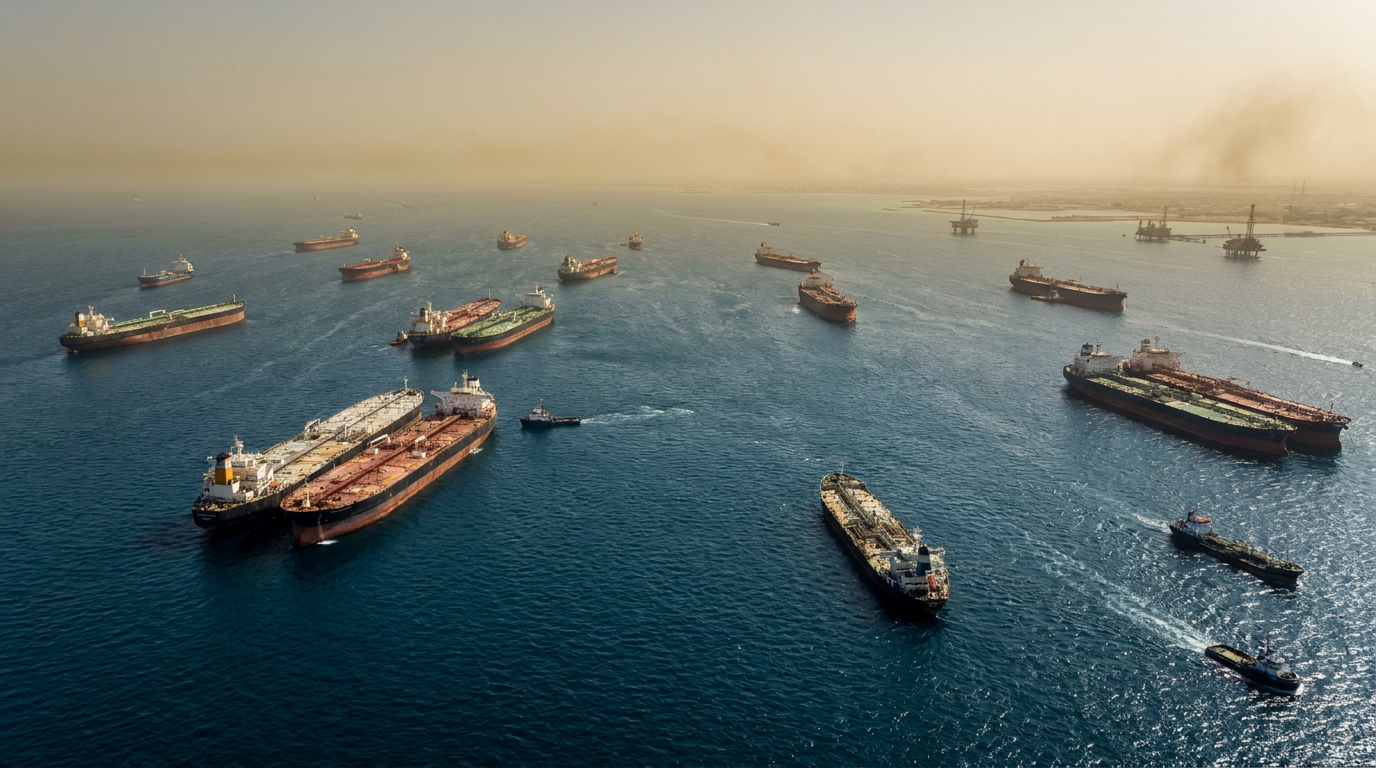
The global economy is bracing for a historic energy shock as the effective closure of the Strait of Hormuz threatens to sever a fifth of the world's oil supply. With tanker traffic through the vital Middle Eastern chokepoint reduced to a trickle amid the ongoing conflict between the United States and Iran, energy markets are flashing severe warning signs.[1][2]
The physical reality of the blockade is staggering. Approximately 17 to 21 million barrels of crude oil, condensates, and refined petroleum products typically pass through the 33-kilometer-wide strait every day, making it the single most consequential energy corridor on earth.[2][3]
Energy analysts warn that the sheer volume of stranded crude is rapidly depleting global inventories. Fereidun Fesharaki, chairman emeritus of the energy consultancy FGE NexantECA, noted that the market is losing roughly 100 million barrels of oil per week to the disruption.[1][2]
If the disruption persists for another six to eight weeks, forecasters project that the compounding shortfall could drive Brent crude prices to between $150 and $200 a barrel.[1][2]

Major financial institutions echo this alarm. JPMorgan analysts cautioned that a de facto blockade lasting another full month would be consistent with Brent crude climbing toward $150, while Citi outlined a scenario where sustained outages push prices to $130 by late summer.[3]
The crisis has already begun to bleed into the broader global economy, forcing central banks to abandon their hopes for a smooth disinflationary glide path. On Thursday, the European Central Bank raised its key interest rates by 0.25 percentage points, bringing its deposit facility rate to 2.25%.[4][5]
The ECB explicitly cited the Middle East conflict as the catalyst for the hike, marking its first rate increase since 2023. ECB President Christine Lagarde emphasized that prolonged disruptions to energy supplies could keep prices elevated for longer than previously expected.[4][5]
The ECB explicitly cited the Middle East conflict as the catalyst for the hike, marking its first rate increase since 2023.
Consequently, the ECB revised its eurozone inflation projections upward, forecasting headline inflation to average 3.0% in 2026. The central bank warned that higher energy costs are already beginning to feed into the prices of food, goods, and services, creating a dangerous ripple effect.[4][5]

This inflationary resurgence places global policymakers in a perilous bind. Central banks are being forced to tighten monetary policy just as economic growth shows signs of faltering. In the United Kingdom, for instance, the economy unexpectedly shrank by 0.1% in April, highlighting the fragility of the recovery.[6]
Against this backdrop of mounting economic anxiety, diplomatic efforts to reopen the strait have injected extreme volatility into the markets. US President Donald Trump has repeatedly claimed that a memorandum of understanding with Iran is imminent, predicting that a finalized deal would lead to a sharp decline in global oil prices.[7]
Following Trump's assertions that he had canceled planned military strikes and that the strait would open as soon as an agreement is signed, oil prices temporarily retreated from their recent highs, and global equities rallied.[7]
However, the diplomatic reality remains murky. Iranian officials, including Foreign Ministry spokesperson Esmaeil Baghaei, have pushed back against the narrative of an immediate breakthrough, stating that Tehran has not reached a final conclusion and will not compromise on its core demands.[8]

Iran's stipulations reportedly include the lifting of international sanctions, the unfreezing of billions of dollars in assets, and formal recognition of its control over the Strait of Hormuz. Until these demands are reconciled with Washington's insistence on strict nuclear limits, the physical blockade remains largely intact.[8]
For energy markets, the disconnect between political rhetoric and physical supply is a growing source of anxiety. Analysts point out that while diplomatic optimism can trigger short-term price dips, the underlying arithmetic of the oil market is deteriorating daily.[1][3]
The United States has attempted to mitigate the shortfall through record releases from its Strategic Petroleum Reserve, while China has reportedly stepped back from some Iranian oil purchases. Yet, these measures are widely viewed as temporary buffers rather than structural solutions.[2][3]
If a diplomatic resolution is not reached by mid-summer, the global economy faces a dual threat: an energy-driven inflation spike that forces further interest rate hikes, and a severe contraction in industrial activity as energy costs become prohibitive. The next few weeks will determine whether the world can step back from the brink of a $150-a-barrel reality.[3][4]
How we got here
Feb 2026
Escalating conflict between the US and Iran leads to severe disruptions in commercial shipping through the Strait of Hormuz.
Mar 2026
Brent crude posts a record 60% monthly gain as the physical blockade of the strait solidifies.
May 2026
US crude inventories drop sharply as the global market loses an estimated 100 million barrels of oil per week.
Jun 11, 2026
The European Central Bank raises interest rates to 2.25%, explicitly citing the inflationary impact of the Middle East war.
Jun 12, 2026
US President Donald Trump claims a diplomatic deal is imminent, though Iranian officials state no final agreement has been reached.
Viewpoints in depth
Energy Analysts
Forecasters focused on the mathematical reality of supply destruction.
For energy market analysts, the political rhetoric surrounding the conflict is secondary to the physical reality of the blockade. Consultancies like FGE NexantECA and banks like JPMorgan emphasize that the market is currently losing roughly 100 million barrels of oil per week. They argue that global inventories are draining at an unsustainable rate, and if the strait remains closed for another six to eight weeks, the sheer lack of physical supply will inevitably force prices to the $150-$200 range, regardless of diplomatic optimism.
Central Bankers
Policymakers prioritizing the containment of inflation over short-term economic growth.
Central banks, led by the ECB, view the energy shock through the lens of macroeconomic stability. Their primary fear is 'second-round effects'—the scenario where sustained high energy costs force manufacturers and retailers to permanently raise prices on everyday goods. To prevent this inflationary psychology from taking root, central bankers are willing to hike interest rates and deliberately cool their economies, even as indicators like the UK's shrinking GDP suggest that a broader slowdown is already underway.
The US Administration
The perspective emphasizing imminent diplomatic success and market relief.
The US administration is projecting confidence that the crisis is nearing a resolution. President Trump has repeatedly assured markets that a memorandum of understanding is close to being signed, which would immediately reopen the Strait of Hormuz and bring oil prices down sharply. From this viewpoint, the current price spikes are temporary risk premiums that will evaporate once the diplomatic framework is formalized and military de-escalation is confirmed.
Iranian Leadership
The perspective prioritizing strategic leverage and the fulfillment of core demands.
Iranian officials view the closure of the strait as their primary source of leverage in negotiations. They have consistently pushed back against US claims that a deal is already finalized, emphasizing that Tehran will not compromise on its 'red lines.' For Iran, any agreement to reopen the waterway is contingent upon the lifting of international sanctions and the unfreezing of assets, ensuring they extract maximum economic concessions before relinquishing their grip on the global energy chokepoint.
What we don't know
- Whether the US and Iran will finalize the memorandum of understanding before global inventories reach critical lows.
- How much further central banks will hike interest rates if energy prices remain elevated through the end of the year.
Key terms
- Strait of Hormuz
- A narrow waterway between the Persian Gulf and the Gulf of Oman, serving as the only sea passage for oil exported from several major Middle Eastern producers.
- Brent Crude
- A major trading classification of sweet light crude oil that serves as a benchmark price for purchases of oil worldwide.
- Deposit Facility Rate
- The interest rate the European Central Bank pays to commercial banks for depositing money overnight, used as a primary tool to steer monetary policy.
- Second-round Effects
- When an initial price shock, such as a spike in oil prices, causes businesses to raise the prices of other goods and services to cover their increased costs.
Frequently asked
Why is the Strait of Hormuz so important?
The strait is a critical maritime chokepoint connecting the Persian Gulf to the open ocean. Approximately 20% of the world's total oil supply and a significant portion of liquefied natural gas pass through it daily.
How high could oil prices go?
Major energy consultancies and banks, including FGE NexantECA and JPMorgan, warn that Brent crude could reach $150 to $200 a barrel if the blockade persists for another month or two.
Why did the ECB raise interest rates?
The European Central Bank raised rates to combat inflation driven by the Middle East conflict. They warned that higher energy costs are already feeding into the prices of everyday goods and services.
Is a peace deal between the US and Iran close?
US President Donald Trump has stated that an agreement is near and that the strait will reopen soon. However, Iranian officials maintain that no final decision has been reached and that their core demands must be met first.
Sources
Source coverage
8 outlets
4 viewpoints surfaced








[1]BloombergEnergy Analysts
Oil Seen Rising Past $150 If Hormuz Still Closed
Read on Bloomberg →[2]The NationalEnergy Analysts
Analysts say continued closure of Strait of Hormuz will push crude to $150 to $200 a barrel this year
Read on The National →[3]TheStreetEnergy Analysts
JPMorgan updated its blunt Strait of Hormuz warning as tanker traffic hits 15% of normal
Read on TheStreet →[4]MorningstarCentral Bankers
The European Central Bank increased rates for the first time since 2023 and now sees inflation hitting 3% in 2026
Read on Morningstar →[5]The GuardianCentral Bankers
ECB raises interest rates for first time since 2023 as Middle East war fuels inflation
Read on The Guardian →[6]BBCCentral Bankers
UK economy shrank by 0.1% in April
Read on BBC →[7]Gulf NewsUS Administration
Trump predicts sharp fall in global oil prices if Iran deal signed
Read on Gulf News →[8]Global Banking & FinanceIranian Leadership
Prospects for a Diplomatic Breakthrough
Read on Global Banking & Finance →

More in business
See all 39 stories →Energy Shock
The Global Economic Shock of the Hormuz Closure: How $128 Oil is Rewriting 2026
9 sources
SpaceX IPO
SpaceX Hits Public Markets in Record-Breaking $1.75 Trillion IPO
7 sources

Skills-Based Hiring
The End of the Job Description: Why Companies Are Shifting to 'Skills-Based' Management
6 sources

Longevity Tech
Longevity Biotech NewLimit Secures $435M Series C to Bring Age-Reversing Medicine to Human Trials
6 sources

Every angle. Every day.
Get business stories with full source coverage and perspective breakdowns delivered to your inbox.