
The Global Economic Shock of the Hormuz Closure: How $128 Oil is Rewriting 2026
With the Strait of Hormuz effectively closed since February, the disruption of 20 million barrels of daily oil has drained global reserves at a record pace. Now, as crude prices flirt with $130 a barrel, central banks are being forced to reconsider rate hikes to combat a massive new wave of inflation.
By Factlen Editorial Team
- Energy Market Analysts
- Focused on the mathematical reality of the supply deficit and the rapid depletion of global inventories.
- Central Bankers & Policymakers
- Grappling with the secondary effects of the energy shock on inflation and broader economic growth.
- Geopolitical Observers
- Monitoring the diplomatic backchannels and the domestic political calculations of the US and Iran.
What's not represented
- · Consumers in developing nations facing the most severe impacts of the energy inflation.
- · Shipping companies and mariners stranded or forced to take massive detours.
Why this matters
The energy shock is no longer just a geopolitical crisis—it is directly hitting consumer wallets, threatening to drive up mortgage rates, and forcing businesses to pass on soaring transportation costs. If the blockade continues, the resulting inflation could trigger a global recession.
Key points
- The effective closure of the Strait of Hormuz has trapped 20 million barrels of daily oil production.
- Global oil inventories depleted at a record pace of 129 million barrels in March and 117 million in April.
- Brent crude prices are hovering near $128 per barrel, with analysts warning of a potential surge to $150.
- Central banks, including the Fed and ECB, are facing intense pressure to raise interest rates to combat renewed inflation.
- Rumors of a US-Iran Memorandum of Understanding have sparked hope for a diplomatic resolution, though no deal is confirmed.
The global economy is facing its most severe energy shock in decades. Since the outbreak of the 2026 Iran war in late February, the Strait of Hormuz has been effectively closed to commercial shipping, severing the world's most critical energy artery.[5][7]
The sheer scale of the disruption is unprecedented. The strait, a narrow 29-nautical-mile-wide passage between Iran and Oman, normally facilitates the transit of 20 million barrels of oil per day. This represents roughly 20 percent of the world's seaborne oil trade, primarily originating from Saudi Arabia, Iraq, the United Arab Emirates, and Kuwait.[5][6]
The immediate consequence has been a violent repricing of global energy. Brent crude, the international benchmark, is currently trading near $128 per barrel. Energy market analysts warn that the ceiling could be much higher; Fereidun Fesharaki, Chairman Emeritus of FGE NexantECA, projects that if the strait remains effectively closed through August, oil could breach $150 a barrel, and potentially approach $200 by the end of the year.[2]

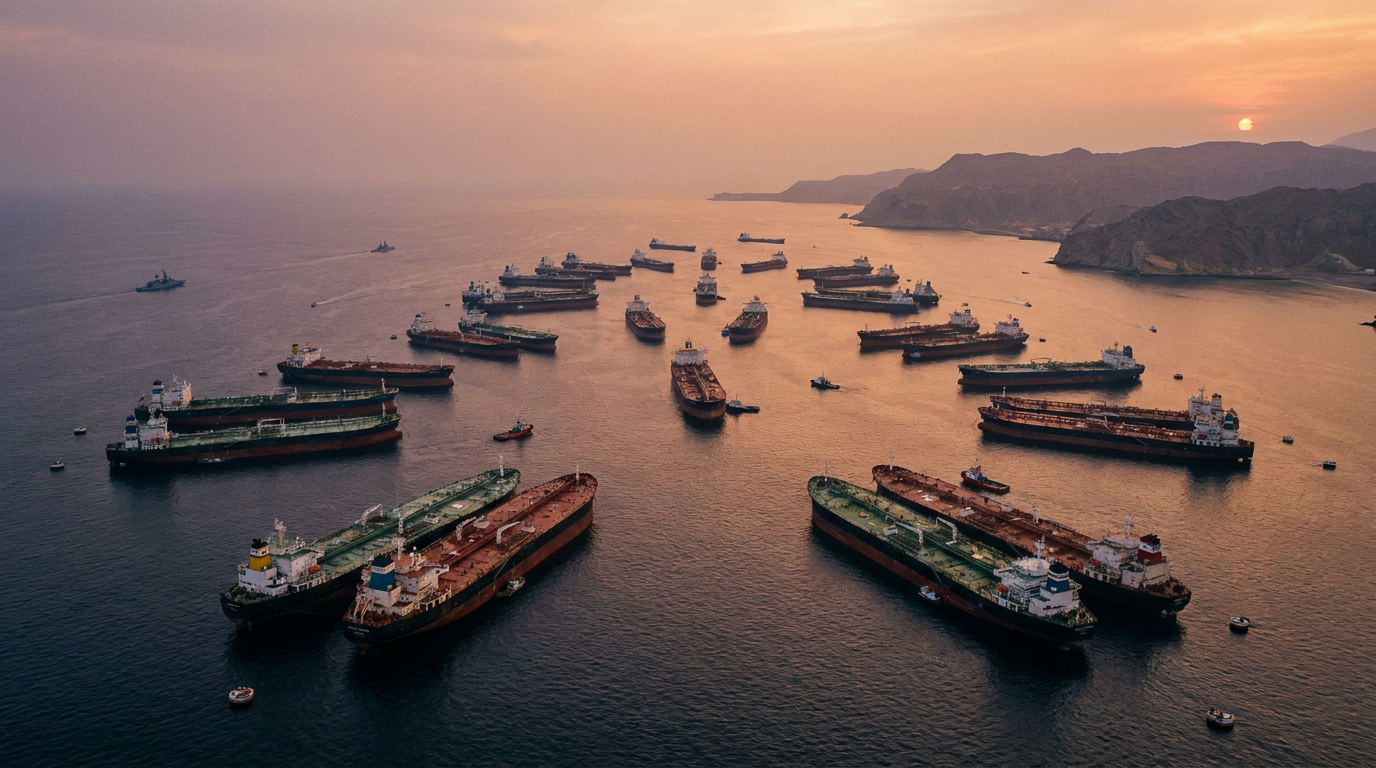
Initially, the global market absorbed the shock without widespread physical shortages because hundreds of fully loaded supertankers were already at sea when the blockade began. However, that buffer has now evaporated. According to the International Energy Agency (IEA), global oil inventories plummeted by 129 million barrels in March and a further 117 million barrels in April—the fastest rate of depletion since records began.[7]
The crisis extends far beyond crude oil. The closure has also stranded immense volumes of liquefied natural gas (LNG). Approximately 20 percent of the world's LNG supply—primarily from Qatar's massive Ras Laffan complex and the UAE—is trapped behind the blockade, sending European and Asian natural gas benchmarks soaring and threatening power generation across multiple continents.[5][6]

This dual energy shock is now bleeding into the broader macroeconomic landscape, creating a nightmare scenario for central banks. Just as policymakers believed they had tamed the post-pandemic inflation surge, the skyrocketing cost of fuel and transportation is driving a massive new wave of price increases across the global supply chain.[1]
This dual energy shock is now bleeding into the broader macroeconomic landscape, creating a nightmare scenario for central banks.
In the United States, incoming Federal Reserve Chair Kevin Warsh faces a brutal policy dilemma. The US labor market remains surprisingly resilient, but higher energy prices are acting as a regressive tax on consumers. The Fed must now decide whether to hold interest rates steady to protect economic growth or resume hiking rates to crush demand and prevent inflation expectations from unanchoring.[1]
Europe's vulnerability is arguably even more acute, given its heavier reliance on imported energy. The European Central Bank (ECB) is already signaling a hawkish pivot. ECB Governing Council member Joachim Nagel has explicitly stated that the bank is prepared to raise interest rates for a second straight meeting in July if the secondary effects of the Middle East conflict require a forceful monetary response.[3]

The pain of these compounding pressures is already showing up in hard economic data. The UK economy shrank by 0.1 percent in April, reversing the stronger-than-expected growth seen in March. Businesses are grappling with a toxic combination of higher input costs, delayed shipments, and squeezed consumer spending.[8]
A common question is why the trapped oil cannot simply be rerouted. The geographic reality is unforgiving. While Saudi Arabia and the UAE possess some pipeline capacity to bypass the strait—such as the East-West Pipeline to the Red Sea and the ADCOP line to Fujairah—these alternatives can only handle 3.5 to 5.5 million barrels per day. The remaining 15 million barrels have no viable alternative route to market.[5]

With supply rigidly constrained, the market's only remaining balancing mechanism is demand destruction. The sheer cost of fuel is forcing industries to scale back operations. The IEA now forecasts global oil demand to contract by 420,000 barrels per day in 2026, a sharp reversal from pre-war growth projections. The aviation and petrochemical sectors in Asia are already reporting significant drops in activity.[7]
Amid the economic gloom, financial markets saw a brief, volatile reprieve following rumors of a potential Memorandum of Understanding (MOU) between the United States and Iran. President Donald Trump recently pulled back on threats of further military strikes against the Islamic Republic, hinting at a diplomatic off-ramp, though Tehran has yet to officially confirm any agreement.[4]
Diplomatic experts suggest that the immense economic pressure is forcing both sides to the negotiating table. Aniseh Bassiri Tabrizi, an Associate Fellow at Chatham House, notes that any resulting MOU will likely be framed as a decisive victory by both Washington and Tehran for their respective domestic audiences, allowing them to de-escalate without appearing to capitulate.[4][9]
Even if the strait reopens in the coming weeks, the 2026 crisis will leave permanent scars on the global economy. Just as the oil shocks of the 1970s permanently altered the trajectory of fossil fuel consumption and spurred the development of new technologies, the current blockade is forcing a radical, accelerated reassessment of supply chain resilience and global energy security.[6]
How we got here
Late Feb 2026
Conflict erupts, effectively closing the Strait of Hormuz to commercial shipping.
March 2026
Global oil inventories plunge by a record 129 million barrels as the supply buffer evaporates.
April 2026
The UK economy shrinks by 0.1% as energy costs begin to bite into macroeconomic growth.
June 2026
Oil prices hold near $128 per barrel amid rumors of a potential US-Iran Memorandum of Understanding.
Viewpoints in depth
Energy Market Analysts
Focused on the mathematical reality of the supply deficit and the rapid depletion of global inventories.
Analysts argue that the market is currently running on borrowed time. The initial shock was masked by oil already in transit and massive emergency releases from the IEA. However, with inventories draining at a record pace of over 100 million barrels per month, these experts warn that physical shortages are imminent. They contend that demand destruction—where prices rise so high that consumers simply stop buying—is the only mechanism left to balance the market if the strait remains closed.
Central Bankers
Grappling with the secondary effects of the energy shock on inflation and broader economic growth.
Policymakers are caught in a stagflationary trap. On one hand, soaring energy costs are acting as a tax on consumers and businesses, slowing down economic growth—evidenced by the UK's recent economic contraction. On the other hand, this same energy shock is driving headline inflation back up. Central bankers argue they cannot look past this inflation, leading figures like the ECB's Joachim Nagel to signal readiness for further rate hikes, even at the risk of inducing a deeper recession.
Geopolitical Observers
Monitoring the diplomatic backchannels and the domestic political calculations of the US and Iran.
Foreign policy experts view the current standoff as a high-stakes negotiation where both sides need an off-ramp that saves face. Analysts note that the economic pain of the blockade is unsustainable for the global economy, creating immense pressure for a resolution. They argue that any resulting Memorandum of Understanding will be framed as a decisive victory by both Washington and Tehran for domestic audiences, regardless of the actual concessions made behind closed doors.
What we don't know
- Whether the rumored US-Iran Memorandum of Understanding will materialize into a binding agreement that reopens the strait.
- Exactly how high central banks will be forced to push interest rates if oil prices remain above $120 a barrel through the end of the year.
- The long-term impact on global supply chains as companies accelerate their transition away from Middle Eastern energy dependence.
Key terms
- Strait of Hormuz
- A narrow waterway between Iran and Oman that serves as the only sea passage from the Persian Gulf to the open ocean.
- Liquefied Natural Gas (LNG)
- Natural gas that has been cooled to a liquid state for easier and safer non-pipeline storage and transport.
- Demand Destruction
- An economic phenomenon where a prolonged period of high prices causes consumers to permanently reduce their use of a product.
- Brent Crude
- A major trading classification of sweet light crude oil that serves as a benchmark price for purchases of oil worldwide.
Frequently asked
Why can't the oil be shipped by truck or pipeline instead?
The volume is simply too massive. While Saudi Arabia and the UAE have some bypass pipelines, they can only handle about a quarter of the normal flow. Moving the rest by truck is logistically impossible.
How does the Hormuz closure affect natural gas prices?
The strait is the primary exit route for LNG from Qatar and the UAE, which together account for roughly 20% of the global LNG trade. Blocking this route strands the gas, driving up prices in Europe and Asia.
Will central banks raise interest rates because of this?
It is highly possible. The European Central Bank has already signaled it is prepared to hike rates in July to combat the inflation caused by soaring energy and transportation costs.
What is the likelihood of the strait reopening soon?
Rumors of a US-Iran Memorandum of Understanding have provided some hope, but neither side has officially confirmed a deal, leaving the timeline for reopening highly uncertain.
Sources
Source coverage
9 outlets
3 viewpoints surfaced






[1]BloombergCentral Bankers & Policymakers
Central Banks Face Growing Pressures: Markets Snapshot
Read on Bloomberg →Oil Seen Rising Past $150 If Hormuz Still Closed
Read on Bloomberg →ECB Ready to Hike Again in July If Necessary, Nagel Says
Read on Bloomberg →Bassiri Tabrizi: Both Iran & US Will Claim MOU as a Win
Read on Bloomberg →[5]IEAEnergy Market Analysts
The Middle East and Global Energy Markets
Read on IEA →[6]IEEFAEnergy Market Analysts
Potential implications of the Iran conflict for Canada's fossil fuel sector
Read on IEEFA →[7]Procurement MagazineEnergy Market Analysts
IEA: Oil Supplies Depleting at Record Pace amid Conflict
Read on Procurement Magazine →[8]BBCCentral Bankers & Policymakers
UK economy shrank by 0.1% in April
Read on BBC →[9]Chatham HouseGeopolitical Observers
Assessing the Prospects of a US-Iran Memorandum of Understanding
Read on Chatham House →

More in business
See all 39 stories →Strait of Hormuz
Why Global Oil Could Hit $150 a Barrel—and What It Means for the Economy
8 sources
SpaceX IPO
SpaceX Hits Public Markets in Record-Breaking $1.75 Trillion IPO
7 sources

Skills-Based Hiring
The End of the Job Description: Why Companies Are Shifting to 'Skills-Based' Management
6 sources

Longevity Tech
Longevity Biotech NewLimit Secures $435M Series C to Bring Age-Reversing Medicine to Human Trials
6 sources

Every angle. Every day.
Get business stories with full source coverage and perspective breakdowns delivered to your inbox.