
Meta Quest 3 vs. Apple Vision Pro: Which Mixed Reality Headset Fits Your Needs?
The Meta Quest 3 and Apple Vision Pro represent two entirely different philosophies for the future of face-worn computing. This side-by-side comparison breaks down the trade-offs between Meta's accessible gaming console and Apple's premium productivity workstation.
By Factlen Editorial Team
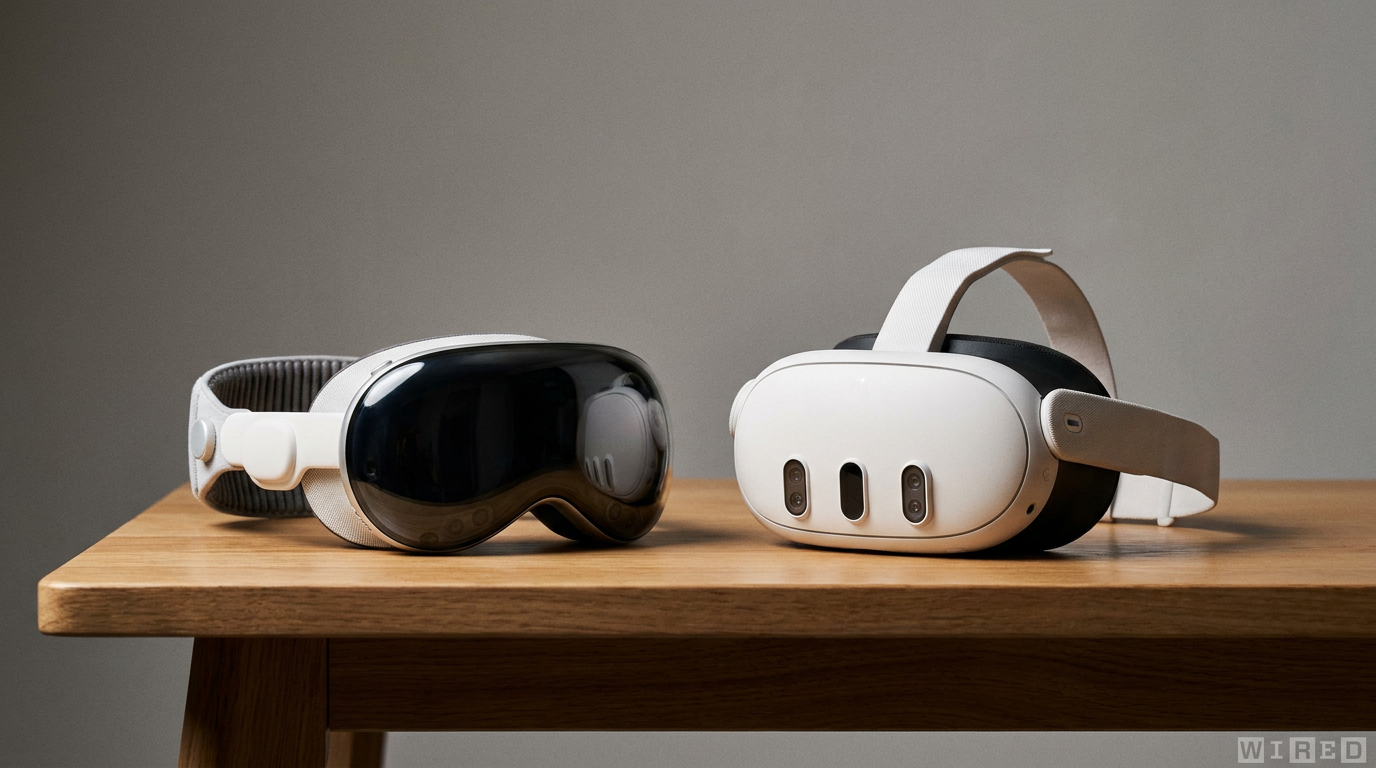
- Spatial Computing Professionals
- Users who view headsets as the next evolution of the multi-monitor workstation and prioritize display clarity.
- VR Gaming Enthusiasts
- Gamers who prioritize interactive immersion, tactile feedback, and a vast software library.
- Enterprise Adopters
- Businesses evaluating mixed reality for training, simulation, and remote collaboration at scale.
What's not represented
- · Budget-constrained students
- · Fitness and wellness app developers
Why this matters
Choosing the right mixed reality headset dictates whether you are investing in a high-end productivity workstation or an accessible gaming console. Understanding these trade-offs prevents buyers from spending thousands of dollars on a device that doesn't fit their actual daily workflow.
Key points
- The Meta Quest 3 costs $499 and focuses on accessible, controller-based gaming.
- The Apple Vision Pro starts at $3,499 and functions as a premium productivity workstation.
- Apple's Micro-OLED displays offer unmatched text clarity and photorealistic passthrough.
- Meta's inclusion of physical controllers makes it vastly superior for interactive VR gaming.
- The Vision Pro's heavier build and tethered battery can cause discomfort during long sessions.
- The Quest 3 is the preferred choice for scalable enterprise training and fitness applications.
The mixed reality landscape in 2026 has bifurcated into two distinct philosophies, embodied perfectly by the market's two most prominent headsets: the Meta Quest 3 and the Apple Vision Pro. Rather than competing directly for the exact same consumer, these devices represent entirely different visions for the future of face-worn computing. One aims to democratize virtual reality gaming by making it wireless and accessible, while the other seeks to completely replace the traditional desktop workstation with a spatial computing environment. Understanding this fundamental divide is the first step in determining which device actually belongs in your home or office.[1][8]
The most immediate and unavoidable divergence between the two platforms is the massive price gap. At a starting price of $499, the Meta Quest 3 is positioned firmly as an accessible consumer electronic, priced competitively alongside traditional gaming consoles. In stark contrast, the Apple Vision Pro commands a premium starting at $3,499, placing it in the realm of high-end professional hardware. This staggering seven-fold price difference means this is not a traditional apples-to-apples hardware comparison, but rather a complex decision between an affordable gaming powerhouse and a luxury spatial computing platform designed for early adopters and professionals.[1][2]
The case for the Apple Vision Pro centers entirely on its unparalleled display fidelity and its seamless integration into the broader Apple ecosystem. Apple designed the headset from the ground up to serve as a high-end personal theater and a multi-monitor workstation replacement. For users deeply entrenched in macOS and iOS, the ability to summon massive, crystal-clear virtual screens simply by looking at a MacBook is a transformative workflow upgrade that no other headset on the market can currently replicate with the same level of frictionless polish.[4][5]
The evidence for Apple's visual dominance is easily quantified in its internal hardware specifications. The Vision Pro utilizes dual Micro-OLED displays pushing roughly 23 million pixels—effectively delivering a 4K resolution image to each eye. Because of this immense pixel density, text appears as sharp as printed paper, eliminating the screen-door effect that has plagued older VR headsets. Furthermore, the passthrough camera latency operates at a mere 6.5 milliseconds, allowing the physical world to look almost entirely natural and undistorted when viewed through the headset's lenses.[5][6]

The argument against the Apple Vision Pro focuses heavily on its ergonomics, overall weight, and restrictive battery design. Constructed from premium materials like aluminum and glass, the headset weighs between 600 and 650 grams. Even with Apple's decision to use an external battery pack tethered by a cable to reduce the weight resting directly on the head, users frequently report significant neck fatigue and facial discomfort during productivity or entertainment sessions lasting longer than an hour, making it difficult to use for a full workday.[2][5]
Further evidence against the Vision Pro's versatility is its complete lack of dedicated motion controllers. Apple relies entirely on advanced eye tracking and hand gestures for all user input. While this controller-free approach feels magical for navigating user interfaces, browsing the web, and selecting media, it severely limits the device's viability for precision gaming. The absence of tactile haptic feedback makes fast-paced virtual interactions feel hollow, and many popular VR game developers have simply opted not to port their titles to the platform as a result.[4][8]
Conversely, the case for the Meta Quest 3 is built on its unmatched overall value, superior comfort for active movement, and a vast, mature software library that has been curated over several years. It is widely considered the undisputed champion of standalone virtual reality gaming, offering a highly capable mixed reality experience at a fraction of Apple's exorbitant price. For the vast majority of general consumers, the Quest 3 delivers the core promises of virtual reality without requiring a massive financial investment or a tethered battery pack.[3][8]
The evidence for the Quest 3's supremacy in interactive entertainment lies in its inclusion of physical motion controllers and its massive catalog of native VR titles. The tactile feedback of a physical controller remains absolutely essential for swinging a virtual golf club, aiming in first-person shooters, and timing hits in rhythm games. Additionally, its lighter 515-gram plastic chassis and built-in battery make it far more suitable for physical, sweat-inducing fitness applications where freedom of movement is the primary requirement for a good experience.[2][4]

The evidence for the Quest 3's supremacy in interactive entertainment lies in its inclusion of physical motion controllers and its massive catalog of native VR titles.
The argument against the Meta Quest 3 highlights its lower-resolution displays and less convincing mixed reality passthrough capabilities. When compared directly to Apple's premium offering, the Quest 3's visual fidelity reveals its budget-friendly compromises, making it significantly less ideal for tasks that require staring at fine details, reading small text, or color-grading media for extended periods. The headset is undeniably a gaming device first, and its attempts to function as a productivity workstation often feel like secondary, less polished features.[1][6]
The evidence of this limitation is most apparent when examining the Quest 3's optical stack. Utilizing LCD pancake lenses with roughly 4.5 million pixels per eye, the Quest 3 exhibits visible pixel structure and slightly washed-out black levels compared to OLED panels. Its color passthrough cameras, while highly functional for basic spatial awareness, suffer from noticeable noise and depth distortion in lower light environments, making it incredibly difficult to read a physical smartphone screen or a computer monitor while wearing the headset.[1][5]
Under the hood, the processing paradigms of the two headsets also highlight their distinct trade-offs. Apple equips the Vision Pro with laptop-class M2 and R1 chips, enabling instantaneous multitasking and the ability to run multiple floating 4K windows simultaneously without a hint of stuttering. The Quest 3 utilizes the Snapdragon XR2 Gen 2 mobile processor, which is highly capable for rendering standalone games at 90Hz or 120Hz, but simply cannot match Apple's raw computational horsepower for heavy, multi-application multitasking.[2][5]
Enterprise and commercial applications further illustrate how these hardware trade-offs play out in the real world. In high-end real estate or architectural visualization, the Vision Pro's photographic passthrough justifies its high cost, allowing clients to view marble veining and luxury finishes in photorealistic detail. Meanwhile, the Quest 3 dominates corporate training and simulation sectors, where the ability to deploy dozens of headsets cost-effectively to train employees on warehouse safety or equipment operation is the primary goal for corporate IT departments.[6][7]

Ultimately, the Apple Vision Pro fits well when a user requires a portable, ultra-high-resolution productivity workstation and is already deeply entrenched in the Apple hardware ecosystem. It is the definitive choice for creative professionals who want to replace physical monitors, developers building spatial applications, and enthusiasts who prioritize premium, theater-quality media consumption over interactive, controller-based gaming.[1][4]
The Apple Vision Pro does not fit when the primary goal is playing active VR games, when budget is a strict constraint, or when the user plans to wear the device for highly physical, movement-heavy activities. Its heavy build, delicate glass front, and tethered external battery make it cumbersome and impractical for anything other than seated, stationary use in a controlled indoor environment.[2][4]
The Meta Quest 3 fits well when a buyer wants the best overall value in mixed reality, demands precise motion controllers for a vast library of interactive games, and prefers a lighter, completely untethered headset. It is the perfect entry point for anyone looking to experience the full spectrum of virtual reality entertainment, fitness applications, and casual social experiences without breaking the bank.[3][8]

The Meta Quest 3 does not fit when the user needs to read fine text for eight hours a day on virtual monitors, requires seamless native integration with macOS, or demands the absolute highest visual fidelity available on the consumer market. It remains a gaming console at heart, and power users looking for a true laptop replacement will find its resolution and multitasking capabilities lacking.[1][5]
How we got here
June 2023
Meta officially announces the Quest 3, and Apple unveils the Vision Pro days later.
October 2023
Meta Quest 3 launches globally at $499, setting a new baseline for consumer mixed reality.
February 2024
Apple Vision Pro releases in the US at $3,499, introducing high-end spatial computing.
Mid-2026
Both platforms mature with significant OS updates, solidifying their distinct use cases in productivity and gaming.
Viewpoints in depth
Spatial Computing Professionals
Users who view headsets as the next evolution of the multi-monitor workstation.
For this camp, the Apple Vision Pro is a revelation. They argue that the $3,499 price tag is justified when compared to the cost of purchasing multiple 4K physical monitors, a high-end television, and a premium surround-sound system. By integrating flawlessly with macOS and providing text clarity that rivals printed paper, professionals see the Vision Pro not as a gaming console, but as an indispensable tool for deep work, architectural visualization, and distraction-free productivity.
VR Gaming Enthusiasts
Gamers who prioritize interactive immersion, tactile feedback, and a vast software library.
This group views the Meta Quest 3 as the undisputed champion of the medium. They point out that virtual reality's primary strength is active, physical interaction, which requires the precise tracking and haptic feedback of physical controllers. For these users, Apple's reliance on hand and eye tracking feels limiting and imprecise for fast-paced gaming. Furthermore, the Quest 3's $499 price point and massive catalog of native titles make it the only logical choice for anyone looking to actually play in VR.
Enterprise Adopters
Businesses evaluating mixed reality for training, simulation, and remote collaboration.
Enterprise buyers look at the return on investment. While some high-end architectural firms favor the Vision Pro for its photorealistic passthrough when showing properties to clients, the vast majority of corporate training programs lean toward the Quest 3. The ability to deploy seven Quest 3 headsets for the price of a single Vision Pro makes Meta's device the standard for scalable employee onboarding, safety simulations, and remote team meetings.
What we don't know
- Whether Apple will eventually release dedicated motion controllers for the Vision Pro to support traditional VR gaming.
- How Meta's upcoming hardware iterations will bridge the gap in display resolution without drastically increasing the price.
Key terms
- Passthrough
- The ability of a VR headset to use external cameras to display the real physical world inside the screens.
- Micro-OLED
- An advanced display technology that provides extremely high pixel density and true black levels, used in the Vision Pro.
- Pancake Lenses
- A type of optical lens that folds light multiple times, allowing VR headsets to be significantly thinner and lighter.
- Spatial Computing
- Apple's preferred term for mixed reality, emphasizing the blending of digital interfaces with the physical environment.
Frequently asked
Can I play Meta Quest 3 games on the Apple Vision Pro?
No. The headsets use entirely different operating systems and app stores. The Vision Pro does not support Meta's library of VR games.
Do I need a Mac to use the Apple Vision Pro?
While it operates as a standalone device, its most powerful productivity feature is seamlessly mirroring a Mac's display.
Does the Meta Quest 3 require a PC?
No, the Quest 3 is a standalone console that runs games directly on the headset, though it can connect to a PC wirelessly for high-end PC VR gaming.
Which headset is better for wearing glasses?
The Meta Quest 3 has an adjustable facial interface to accommodate glasses, whereas the Vision Pro requires purchasing custom Zeiss optical inserts.
Sources
Source coverage
8 outlets
3 viewpoints surfaced







[1]Reality AtlasEnterprise Adopters
Meta Quest 3 vs Apple Vision Pro: 2026 Comparison
Read on Reality Atlas →[2]Laptop MagVR Gaming Enthusiasts
Meta Quest 3 vs Apple Vision Pro: Mismatch or close fight?
Read on Laptop Mag →[3]VR EddieVR Gaming Enthusiasts
Apple Vision Pro (M5) vs Meta Quest 3 (2026): Specs, Price & Verdict
Read on VR Eddie →[4]Tom's GuideSpatial Computing Professionals
I put the Apple Vision Pro vs Meta Quest 3 to the test for a month
Read on Tom's Guide →[5]Mark Ellis ReviewsSpatial Computing Professionals
Apple Vision Pro vs Meta Quest 3: Which one should you buy?
Read on Mark Ellis Reviews →[6]R2USpatial Computing Professionals
Apple Vision Pro vs Meta Quest for Real Estate (2026)
Read on R2U →[7]AutoVRseEnterprise Adopters
Meta Quest 3 vs Apple Vision Pro: Which is Better in 2025?
Read on AutoVRse →[8]PCMagVR Gaming Enthusiasts
The Best VR Headsets We've Tested for 2026
Read on PCMag →
More in meta
See all 29 stories →Media Trends
How Newsrooms Are Rewiring for 'Constructive Journalism' to Cure Doomscrolling
7 sources

Sunscreen Tech
FDA Approves First New Sunscreen Ingredient in 27 Years, Closing the US Protection Gap
7 sources

Search Tech
Open-Source vs. Closed-Source AI Models: Which Should You Choose for Your Project?
7 sources
Decentralized Moderation
How 'Bridging Algorithms' Replaced Traditional Fact-Checking on Social Media
8 sources

Every angle. Every day.
Get meta stories with full source coverage and perspective breakdowns delivered to your inbox.