
JUNO Observatory's First Data Achieves Unprecedented Precision in Neutrino Physics
In just 59 days of operation, the Jiangmen Underground Neutrino Observatory has measured key neutrino oscillation parameters with 1.6 times greater precision than all previous global experiments combined.
By Factlen Editorial Team
- Experimental Physicists
- Focuses on the engineering triumph of the detector and the unprecedented precision of the measurements.
- Theoretical Physicists
- Views the data as a crucial step toward solving the mass ordering problem and probing for new physics beyond the Standard Model.
- International Collaborators
- Emphasizes the global cooperation required to build and analyze data from a mega-science facility.
What's not represented
- · Astrophysicists studying supernova neutrinos
- · Engineers who designed the photomultiplier tubes
Why this matters
Neutrinos are the most abundant matter particles in the universe, yet the least understood. Pinning down their exact masses and behaviors is the final missing piece of the Standard Model, potentially unlocking new physics that explain how the universe evolved.
Key points
- The Jiangmen Underground Neutrino Observatory (JUNO) published its first physics results in Nature, based on 59 days of data.
- The facility measured key neutrino oscillation parameters with 1.6 times greater precision than all previous global experiments combined.
- The 20,000-ton underground liquid scintillator detector achieved an unprecedented energy resolution of 3% at 1 MeV.
- The data lays the groundwork for JUNO's ultimate goal: determining the 'mass ordering' of the three neutrino flavors.
Trillions of neutrinos pass through your body every second, traveling at nearly the speed of light. They are the universe's most elusive fundamental particles, carrying no electric charge and possessing a mass so infinitesimally small that physicists long assumed it was exactly zero.[8]
Because they interact so weakly with normal matter, studying these "ghost particles" requires gargantuan instruments buried deep underground to shield them from the noisy interference of cosmic rays. For decades, physicists have painstakingly pieced together the properties of neutrinos using a patchwork of global experiments, slowly refining the mathematical boundaries of how they behave.[2][4]
Now, a single facility has dramatically accelerated that timeline. The Jiangmen Underground Neutrino Observatory (JUNO) in southern China has released its first physics results in the journal Nature, achieving in just 59 days a level of precision that surpasses the combined global efforts of the past twenty years.[1][5]
The primary claim of the new Nature paper is the unprecedented accuracy of JUNO's initial measurements. By analyzing data collected between August 26 and November 2, 2025, the international collaboration reduced the uncertainties in two critical neutrino oscillation parameters by a staggering factor of 1.6.[1][4]

"With our first sixty days of data, we achieved a precision surpassing that achieved over two decades of previous measurements," noted Pedro Ochoa-Ricoux, a particle physicist at UC Irvine and co-lead of the study. The detector measured neutrino energies with an accuracy of around 3 percent at 1 MeV, establishing an unparalleled benchmark in experimental particle physics.[2][3]
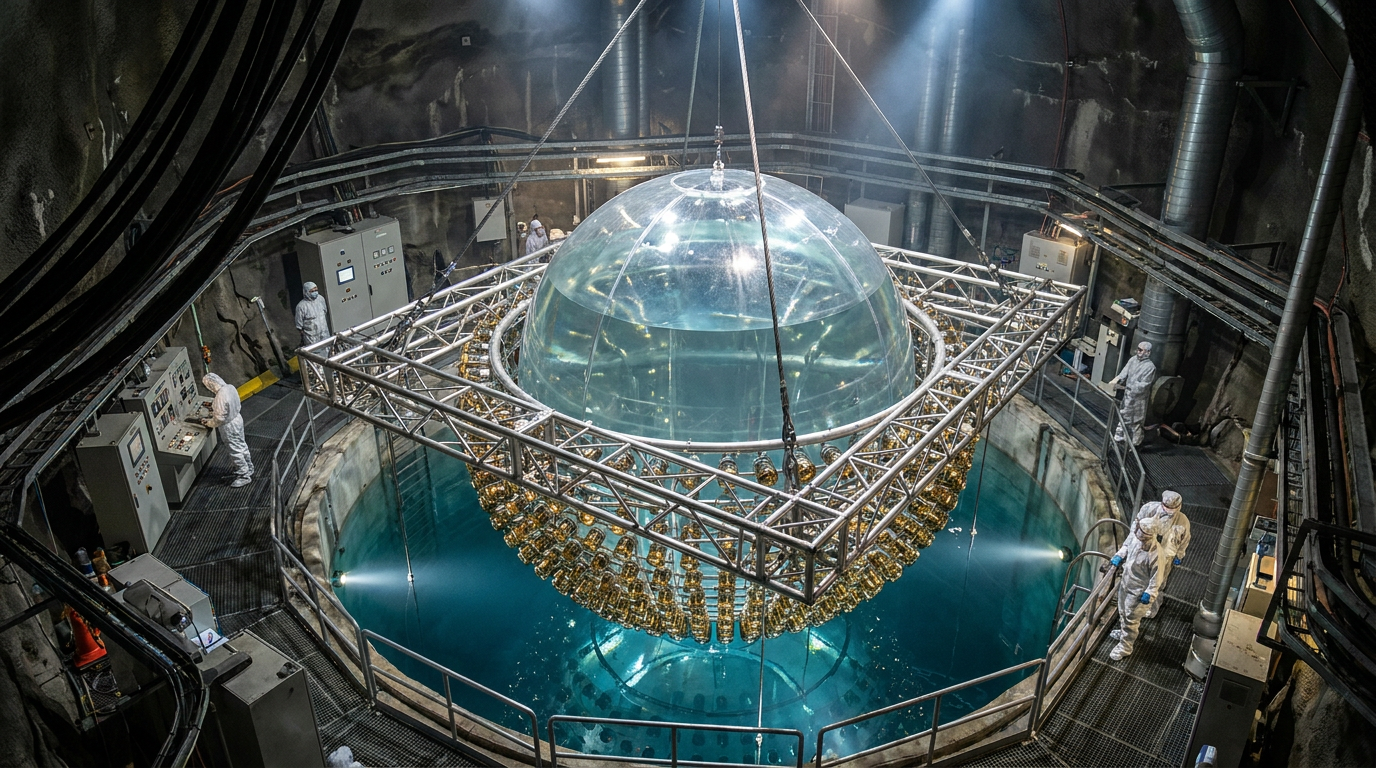
This precision is a direct result of JUNO's staggering scale and engineering. Situated 700 meters beneath Guangdong Province, the detector consists of a 35.4-meter-diameter acrylic sphere filled with 20,000 tonnes of ultra-pure liquid scintillator. When a neutrino occasionally interacts with the liquid, it produces a microscopic flash of light, which is captured by an array of 45,000 photomultiplier tubes lining the cavern.[5][8]
To understand exactly what JUNO is measuring, one must look at the quantum behavior of the particles themselves. Neutrinos come in three distinct "flavors": electron, muon, and tau. As they travel through space, they do not remain in a fixed state; instead, they morph from one flavor to another in a quantum phenomenon known as neutrino oscillation.[2][6]
To understand exactly what JUNO is measuring, one must look at the quantum behavior of the particles themselves.
JUNO is strategically located 52.5 kilometers away from the Yangjiang and Taishan nuclear power plants. These reactors emit a massive, steady stream of electron antineutrinos. By the time these particles travel through the Earth's crust and reach the underground detector, a predictable fraction of them have oscillated into different flavors.[7][8]

The exact rate and pattern of this shape-shifting depend on two fundamental parameters: the mixing angle and the mass-squared difference. JUNO's first data release provides the most precise simultaneous measurement of these two variables ever recorded, firmly anchoring the mathematical framework used to describe neutrino behavior.[1][7]
The fact that neutrinos oscillate at all is definitive proof that they possess mass—a revelation that previously forced physicists to update the Standard Model of particle physics. However, a glaring mystery remains: physicists know the differences between the masses of the three neutrino states, but they do not know which one is the heaviest and which is the lightest.[3][6]
This puzzle is known as the "neutrino mass ordering." In the "normal" hierarchy, the two neutrino states most closely associated with the electron flavor are lighter than the third. In the "inverted" hierarchy, they are heavier.[3][8]
Determining this order is JUNO's ultimate scientific objective. While the initial 59-day dataset is not large enough to definitively solve the mass ordering problem, the flawless performance of the detector proves that JUNO has the sensitivity required to do so as more data accumulates over the coming years.[2][4]

Beyond completing the Standard Model, the extreme precision of JUNO opens the door to discovering entirely new physics. Theoretical physicists are already using the first data release to probe for exotic phenomena that deviate from standard predictions.[6]
For instance, independent researchers have analyzed the JUNO results to search for "damping effects" in neutrino oscillations, which could be caused by quantum wave packet separation or even the invisible decay of neutrinos as they travel. While the current data strongly supports the standard three-flavor model, any future deviations could hint at the existence of sterile neutrinos or non-standard interactions.[6][7]
The scientific community now awaits the next phases of JUNO's operation. According to the JUNO team, more results will be released as data continues to be gathered at the observatory, gradually unlocking new mysteries of the universe's fundamental building blocks. The facility is designed for a 30-year lifespan, during which it will also capture neutrinos emitted by the sun, the Earth's core, and distant supernova explosions.[4][9]
For now, the first Nature paper serves as a triumphant proof of concept. It confirms that the world's largest transparent spherical detector works exactly as designed, ushering in a new era of high-precision neutrino astronomy that will eventually complete our understanding of the universe's most abundant matter particles.[1][5]
How we got here
2014
The JUNO international collaboration is officially formed.
2015
Construction begins on the massive underground facility in Guangdong, China.
August 2025
JUNO completes construction and officially begins its first physics data collection.
June 2026
The collaboration publishes its first high-precision oscillation measurements in Nature.
Viewpoints in depth
Experimental physics view
Views the first data release as a profound validation of a decade of engineering and detector design.
For the experimental teams that designed and built JUNO, the first data release is a profound validation of a decade of engineering. Constructing a 20,000-ton liquid scintillator sphere 700 meters underground and outfitting it with 45,000 photomultiplier tubes was an unprecedented technical gamble. The fact that the detector achieved its designed energy resolution of 3% at 1 MeV immediately upon activation proves that mega-scale liquid scintillator technology is viable for the next generation of precision particle physics.
Theoretical physics view
Views the JUNO results as the foundation for the next era of the Standard Model.
Theorists view the JUNO results as the foundation for the next era of the Standard Model. By drastically shrinking the error bars on the mixing angle and mass-squared difference, the data restricts the mathematical space where exotic physics can hide. Theorists are now eagerly awaiting the larger datasets needed to solve the mass ordering problem, which will dictate how mathematical models describe the early universe's evolution and the fundamental nature of matter.
International collaboration view
Emphasizes that breakthroughs of this magnitude require cross-border scientific cooperation.
While the facility is located in China and spearheaded by the Chinese Academy of Sciences, the project is heavily reliant on a global consortium of researchers. Scientists from institutions like UC Irvine emphasize that breakthroughs of this magnitude require cross-border cooperation. The rapid analysis and publication of the first 59 days of data highlight the efficiency of this international framework, setting a collaborative standard for future mega-science projects.
What we don't know
- The exact mass ordering of neutrinos (whether the 'normal' or 'inverted' hierarchy is correct) remains unsolved, pending larger datasets.
- It is still unknown if 'sterile neutrinos' or other exotic physics beyond the Standard Model exist, though JUNO's precision will help test for them.
- The precise mass of the lightest neutrino state has yet to be determined by any experiment.
Key terms
- Neutrino
- An elementary particle with no electric charge and a tiny mass that interacts very weakly with normal matter.
- Neutrino Oscillation
- A quantum phenomenon where a neutrino changes from one 'flavor' (type) to another as it travels through space.
- Mass Ordering
- The unsolved puzzle of which of the three neutrino mass states is the heaviest and which is the lightest.
- Liquid Scintillator
- A specialized fluid that emits a tiny flash of light when struck by a particle, used to detect neutrino interactions.
- Standard Model
- The prevailing theoretical framework in physics that describes all known fundamental particles and forces in the universe.
Frequently asked
What is the JUNO experiment?
The Jiangmen Underground Neutrino Observatory is a massive underground particle detector in China designed to study neutrinos emitted by nearby nuclear reactors.
Why are neutrinos called ghost particles?
They have no electric charge and almost zero mass, allowing them to pass straight through planets and people without interacting with normal matter.
What did JUNO discover in its first data release?
In just 59 days, JUNO measured two key neutrino oscillation parameters with 1.6 times more precision than all previous global experiments combined.
What is the ultimate goal of the observatory?
Its primary objective is to determine the 'neutrino mass ordering'—figuring out which of the three types of neutrinos is the heaviest.
Sources
Source coverage
9 outlets
3 viewpoints surfaced









[1]NatureExperimental Physicists
Measurement of reactor neutrino oscillation with the first JUNO data
Read on Nature →[2]Nature AsiaTheoretical Physicists
Physics: JUNO's first data advance neutrino physics
Read on Nature Asia →[3]UC IrvineInternational Collaborators
UC Irvine scientists co-lead first results from JUNO neutrino detector
Read on UC Irvine →[4]Chinese Academy of SciencesExperimental Physicists
First Physics Result of Jiangmen Underground Neutrino Observatory Published in Nature
Read on Chinese Academy of Sciences →[5]CGTNInternational Collaborators
China's JUNO publishes first physics result in Nature
Read on CGTN →[6]ScienmagTheoretical Physicists
JUNO's First Data Probes Reactor Neutrino Oscillations
Read on Scienmag →[7]arXivTheoretical Physicists
Probing damping effects in neutrino oscillations with the first JUNO data
Read on arXiv →[8]WikipediaExperimental Physicists
Jiangmen Underground Neutrino Observatory
Read on Wikipedia →[9]XinhuaInternational Collaborators
China's JUNO team releases first physics result about neutrino in Nature
Read on Xinhua →
More in science
See all 47 stories →Climate Data
Human-Induced Warming Reaches 1.37°C as Earth's Energy Imbalance Doubles
7 sources

Cardiovascular Health
How Sleep and Exercise Reprogram Mutant Blood Cells to Prevent Heart Disease
6 sources
Green Chemistry
Scientists Convert Plant Waste Into Nylon Precursor, Bypassing a Major Greenhouse Gas
7 sources

Cellular Biology
Sleep and Exercise Can Reprogram Mutant Blood Cells to Prevent Heart Disease, Study Finds
6 sources
Every angle. Every day.
Get science stories with full source coverage and perspective breakdowns delivered to your inbox.