
Scientists Convert Plant Waste Into Nylon Precursor, Bypassing a Major Greenhouse Gas
A new hybrid chemical and biological process successfully converts lignin, a tough plant waste product, into adipic acid at high yields. The breakthrough could decarbonize the production of nylon and eliminate massive industrial emissions of nitrous oxide.
By Factlen Editorial Team
- Green Chemists
- Advocating for the replacement of petrochemical processes with bio-catalysis.
- Industrial Manufacturers
- Focused on the economic viability and scalability of new production methods.
- Climate Policymakers
- Prioritizing the immediate reduction of super-pollutants like nitrous oxide.
What's not represented
- · Paper and pulp industry operators
- · Agricultural waste suppliers
Why this matters
Adipic acid is essential for making nylon, but its conventional production from petroleum releases nitrous oxide—a greenhouse gas 273 times more potent than carbon dioxide. Replacing this process with plant waste could simultaneously eliminate a massive source of industrial emissions and reduce our reliance on fossil fuels.
Key points
- Adipic acid is a crucial chemical used to manufacture nylon 6,6, but its conventional production relies on petroleum.
- Traditional manufacturing releases nitrous oxide, a greenhouse gas 273 times more potent than carbon dioxide.
- Researchers have developed a high-yield method to produce adipic acid from lignin, a woody plant waste product.
- The hybrid process uses engineered bacteria to 'funnel' complex plant chemicals into a uniform precursor.
- Scaling this technology could decarbonize the nylon industry and provide a sustainable use for paper mill waste.
The modern world is held together by nylon. From the airbags and lightweight components in electric vehicles to the carpets in office buildings and the fibers in our clothing, nylon 6,6 is an invisible structural pillar of the global economy.[6]
But the chemical foundation of this miracle material harbors a dirty secret. To manufacture nylon, the global chemical industry requires millions of tons of a white, crystalline compound called adipic acid.[6]
For decades, the only viable way to produce adipic acid at an industrial scale has been through the oxidation of petroleum-derived chemicals using nitric acid. This conventional process is highly effective, but it vents massive quantities of nitrous oxide (N2O) as an unavoidable byproduct.[5]
Nitrous oxide is a climate super-pollutant. It traps heat in the atmosphere with a global warming potential roughly 273 times greater than that of carbon dioxide, while also acting as a primary driver of ozone depletion.[5]

While many modern chemical plants have installed abatement technologies to capture and destroy these emissions at the smokestack, the sheer scale of global adipic acid production—exceeding 3.2 million metric tons annually—means that even fractional leakage contributes significantly to global greenhouse gas inventories.[5][6]
Now, a major breakthrough published in the journal Nature offers a viable pathway to sever the link between nylon and fossil fuels entirely.[1][2]
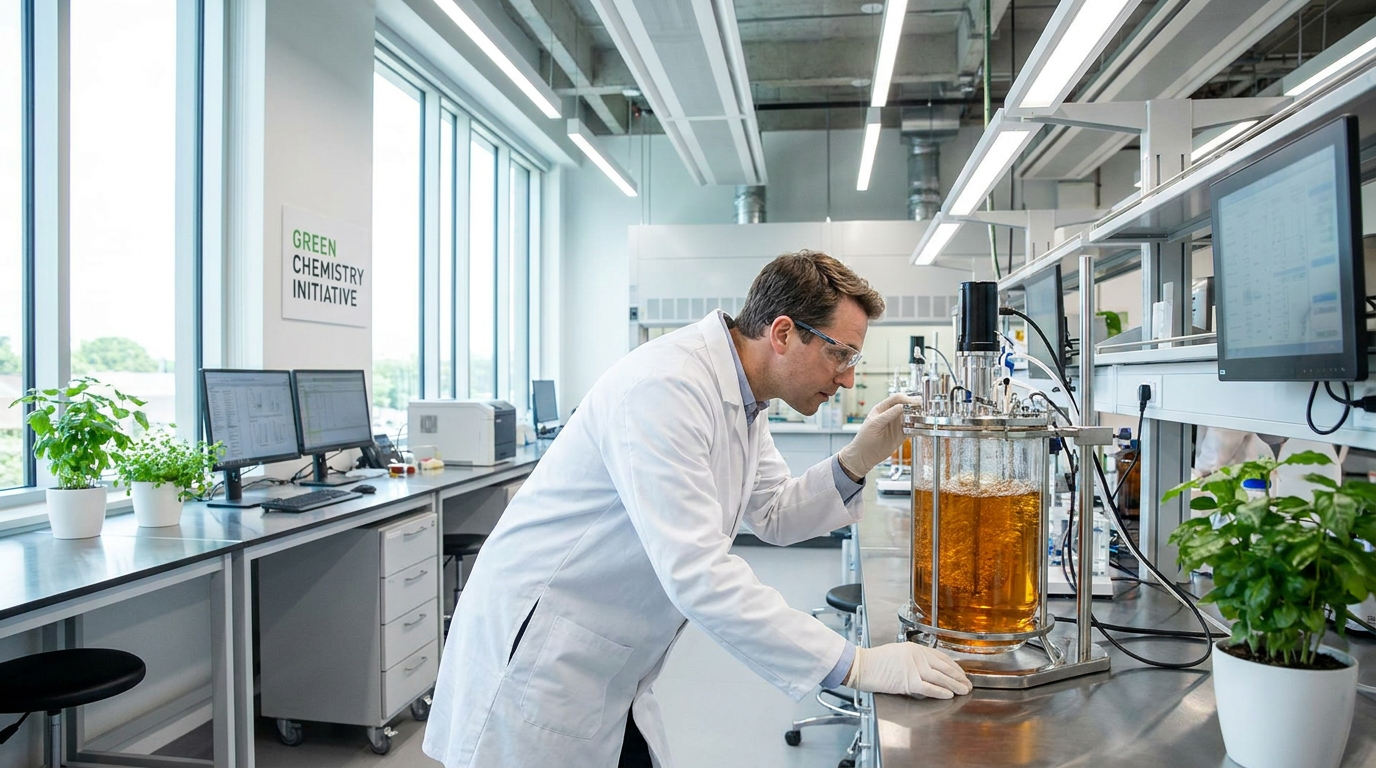
A collaborative team of researchers from the University of Wisconsin–Madison and the National Renewable Energy Laboratory (NREL) has developed a high-yield process to manufacture adipic acid from lignin, a tough, woody byproduct of plant biomass.[1][3]
Lignin is the structural polymer that gives plants and trees their rigidity. It is the most abundant aromatic biopolymer on Earth, and millions of tons of it are generated annually as a waste product by the paper and pulp industries.[1]
Historically, lignin has been notoriously difficult to upcycle. Its complex, heterogeneous chemical structure makes it highly recalcitrant to traditional chemical breakdown, meaning it is usually just burned for low-grade heat at paper mills or discarded.[1][4]
Historically, lignin has been notoriously difficult to upcycle.
To solve this, the researchers designed a hybrid chemical and biological redox process that mimics the efficiency of petrochemical refining but operates entirely on renewable plant matter.[1]
The process relies on an elegant technique known as biological funneling. The team utilized metabolically engineered bacteria—specifically strains of Pseudomonas putida—which act as microscopic refineries.[1][4]
These engineered microbes are capable of consuming the chaotic, diverse mixture of aromatic compounds derived from broken-down lignin and funneling them into a single, uniform intermediate chemical known as muconic acid.[1]

Once the bacteria have done the heavy lifting of standardizing the chemical stream, a highly efficient catalytic hydrogenation step is applied. This final chemical reaction converts the muconic acid directly into pure adipic acid.[1]
The Nature study demonstrates that this hybrid approach achieves exceptionally high yields, proving that bio-based adipic acid can be produced at a purity level required for commercial nylon manufacturing.[1]
The implications for industrial ecology are profound. By shifting the feedstock from petroleum to agricultural and forestry waste, the chemical industry could simultaneously solve a major waste-management problem and eliminate the nitrous oxide emissions inherent to the nitric acid oxidation process.[1][5]
Furthermore, the transition to bio-adipic acid would insulate the nylon supply chain from the volatile price fluctuations of global crude oil markets, offering long-term economic stability to manufacturers.[7]

However, transitioning a laboratory breakthrough into a global industrial standard involves significant engineering hurdles. The next phase of development requires scaling the biological funneling process from laboratory bioreactors to massive, continuous-flow industrial tanks.[7]
Researchers must also optimize the extraction and depolymerization of raw lignin to ensure a steady, cost-effective feedstock supply that can compete with the deeply entrenched economies of scale enjoyed by the petrochemical industry.[7]
The U.S. Department of Energy has already begun funding pilot-scale projects to test the commercial viability of this bio-nylon route, signaling strong institutional support for the technology's potential.[4]
If successfully commercialized, this high-yield redox process could transform one of the chemical industry's most stubborn climate liabilities into a model of circular, sustainable manufacturing.[7]
How we got here
1990s
Adipic acid production is identified as one of the largest industrial sources of nitrous oxide emissions globally.
Late 1990s–2000s
Major chemical manufacturers begin installing abatement technologies to capture and destroy N2O at the smokestack.
2014
Early proof-of-concept studies demonstrate that engineered bacteria can convert lignin derivatives into muconic acid.
2024
The U.S. Department of Energy funds pilot projects to establish commercial routes for bio-nylon production.
June 2026
Researchers publish a breakthrough in Nature detailing a high-yield, scalable hybrid process to convert lignin directly into adipic acid.
Viewpoints in depth
Green Chemists & Researchers
Advocating for the replacement of petrochemical processes with bio-catalysis.
Researchers in this camp argue that the chemical industry must move beyond simply capturing emissions at the smokestack. By redesigning the fundamental chemical pathways—such as swapping petroleum for plant waste—they believe we can create a circular economy that eliminates greenhouse gases like nitrous oxide by design, rather than relying on expensive post-production abatement technologies.
Industrial Chemical Manufacturers
Focused on the economic viability and scalability of new production methods.
While open to sustainable alternatives, incumbent manufacturers emphasize the massive economies of scale that currently make petroleum-derived adipic acid cheap and reliable. They point out that biological processes often struggle to maintain high yields in massive continuous-flow industrial tanks. For bio-nylon to succeed, they argue, the cost of extracting and transporting lignin must drop significantly to compete with existing petrochemical supply chains.
Climate Policymakers
Prioritizing the immediate reduction of super-pollutants like nitrous oxide.
Policymakers view the adipic acid industry as a critical leverage point for climate action. Because a relatively small number of facilities produce the world's supply, regulating or subsidizing the transition to zero-emission technologies in this sector offers an outsized return on investment for reducing global greenhouse gas inventories.
What we don't know
- How quickly the hybrid biological and chemical process can be scaled from laboratory bioreactors to continuous-flow industrial plants.
- Whether the cost of extracting and processing lignin can be driven low enough to compete with deeply entrenched petrochemical supply chains.
- How existing chemical manufacturers will adapt their infrastructure to accommodate bio-based feedstocks instead of petroleum.
Key terms
- Adipic Acid
- An organic compound produced in massive quantities globally, serving as the primary chemical building block for nylon.
- Lignin
- A tough, structural polymer found in plant cell walls that is typically discarded or burned as waste during paper manufacturing.
- Nitrous Oxide (N2O)
- A potent greenhouse gas and ozone-depleting substance released as a byproduct during the conventional manufacturing of adipic acid.
- Biological Funneling
- A process where engineered microbes consume a chaotic mixture of different chemicals and convert them all into one uniform target molecule.
- Redox Process
- A type of chemical reaction involving the transfer of electrons, used here to transform plant-derived intermediates into final industrial chemicals.
Frequently asked
What is adipic acid used for?
Adipic acid is primarily used to manufacture nylon 6,6, a durable plastic and fiber used in everything from automotive parts and airbags to carpets and clothing.
Why is conventional adipic acid production bad for the climate?
The traditional method uses nitric acid to oxidize petroleum derivatives, a reaction that releases large amounts of nitrous oxide (N2O)—a greenhouse gas 273 times more potent than carbon dioxide.
What is lignin?
Lignin is a complex, rigid polymer found in the cell walls of plants and trees. It is currently produced in massive quantities as a waste byproduct of the paper and pulp industries.
How do bacteria help make the new bio-nylon?
Scientists use engineered bacteria to consume the messy, mixed chemical compounds found in broken-down lignin and 'funnel' them into a single, uniform chemical that can be easily converted into adipic acid.
Sources
Source coverage
7 outlets
3 viewpoints surfaced





[1]NatureGreen Chemists
Lignin to adipic acid in a high-yield chemical and biological redox process
Read on Nature →[2]Upbeat Bytes
Lignin to adipic acid in a high-yield chemical and biological redox process
Read on Upbeat Bytes →[3]University of Wisconsin–MadisonGreen Chemists
Publications - Stahl Research Group
Read on University of Wisconsin–Madison →[4]U.S. Department of EnergyClimate Policymakers
Biocatalysis Enabled Conversion of Lignin to Adipic Acid: Establishing a Commercial Route to Bio-Nylon
Read on U.S. Department of Energy →[5]IPCCClimate Policymakers
N2O Emissions from Adipic Acid and Nitric Acid Production
Read on IPCC →[6]Market Reports WorldIndustrial Manufacturers
Adipic Acid Market Size & Forecast
Read on Market Reports World →[7]Factlen Editorial Team
Synthesis by Factlen editorial team
Read on Factlen Editorial Team →
More in science
See all 44 stories →Cellular Biology
Sleep and Exercise Can Reprogram Mutant Blood Cells to Prevent Heart Disease, Study Finds
6 sources
Carbon Budget
Global Carbon Budget for 1.5°C Will Be Exhausted in Three Years, Major Climate Assessment Warns
7 sources

Longevity Science
How Sleep and Exercise Reprogram Aging Blood Cells to Prevent Heart Disease
4 sources

Cellular Aging
Sleep and Exercise Can Reprogram Mutant Blood Cells to Prevent Heart Disease
7 sources

Every angle. Every day.
Get science stories with full source coverage and perspective breakdowns delivered to your inbox.