
SpaceX Completes Record-Breaking $75 Billion IPO, Pushing Valuation Past $2 Trillion
SpaceX has officially transitioned to the public markets in the largest initial public offering in history, raising $75 billion while bucking traditional Wall Street pricing norms. The debut immediately pushed the aerospace giant's valuation over $2 trillion and set a new template for mega-cap technology listings.
By Factlen Editorial Team
- Institutional Optimists
- See the massive valuation as justified by SpaceX's monopoly on launch infrastructure and future orbital AI data centers.
- Retail Investors & Enthusiasts
- View the IPO as a democratization of generational wealth and a chance to back humanity's multi-planetary future.
- Traditional Value Analysts
- Remain highly skeptical of a $1.77 trillion valuation for a company that posted a $4.28 billion net loss in a single quarter.
What's not represented
- · Competitors in the legacy aerospace sector
- · Environmental advocates concerned about launch frequency and orbital debris
Why this matters
The SpaceX IPO proves that public markets can absorb unprecedented amounts of capital for futuristic technology, paving the way for a wave of trillion-dollar artificial intelligence listings. Furthermore, its massive retail allocation democratizes access to generational tech wealth, fundamentally altering how everyday investors participate in mega-cap debuts.
Key points
- SpaceX raised a record-breaking $75 billion in its IPO, surpassing Saudi Aramco's previous record.
- The stock opened at $150 and closed near $161, pushing the company's valuation past $2 trillion.
- SpaceX bypassed traditional Wall Street pricing, dictating a fixed $135 share price.
- An unprecedented 20 to 30 percent of the offering was allocated directly to retail investors.
- Nasdaq altered its fast-track rules to include SpaceX in its indices within 15 days.
- The successful debut paves the way for expected trillion-dollar IPOs from AI firms like OpenAI and Anthropic.
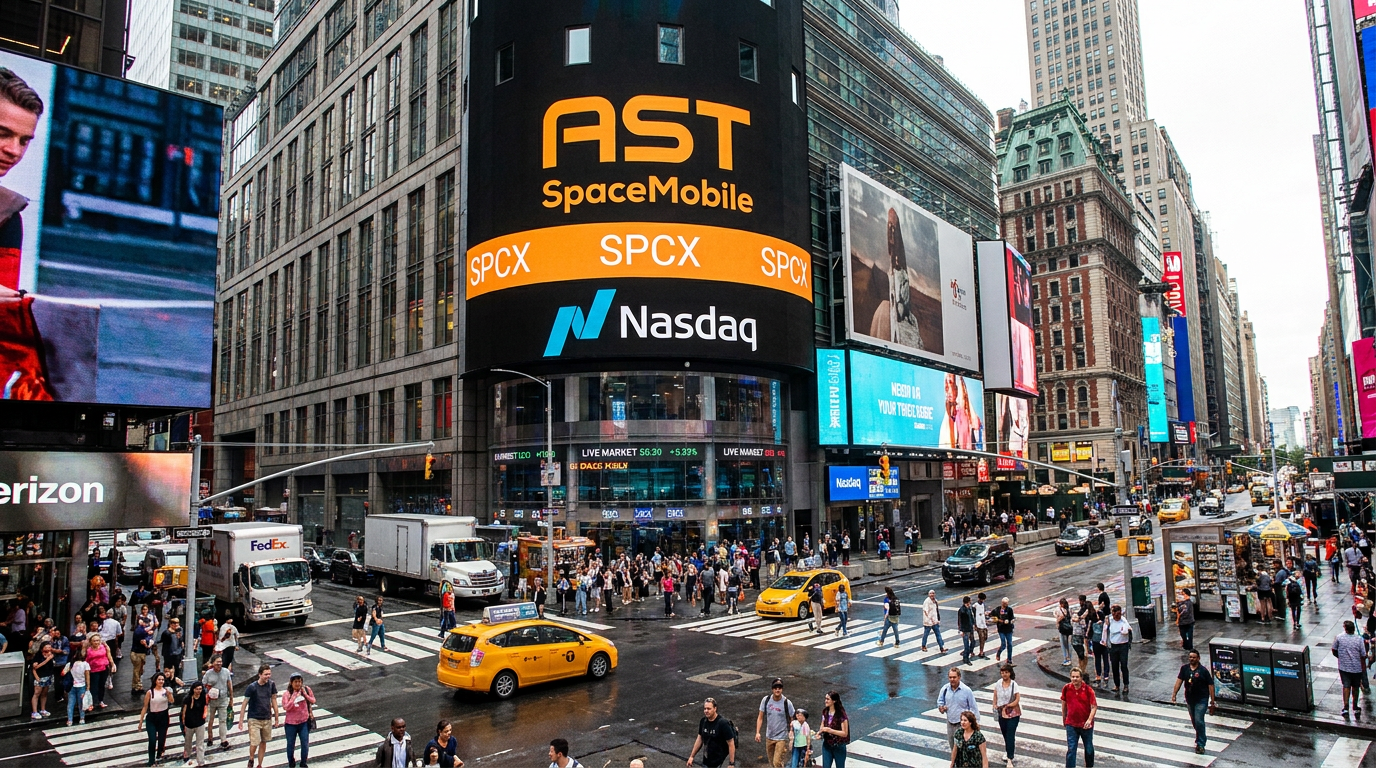
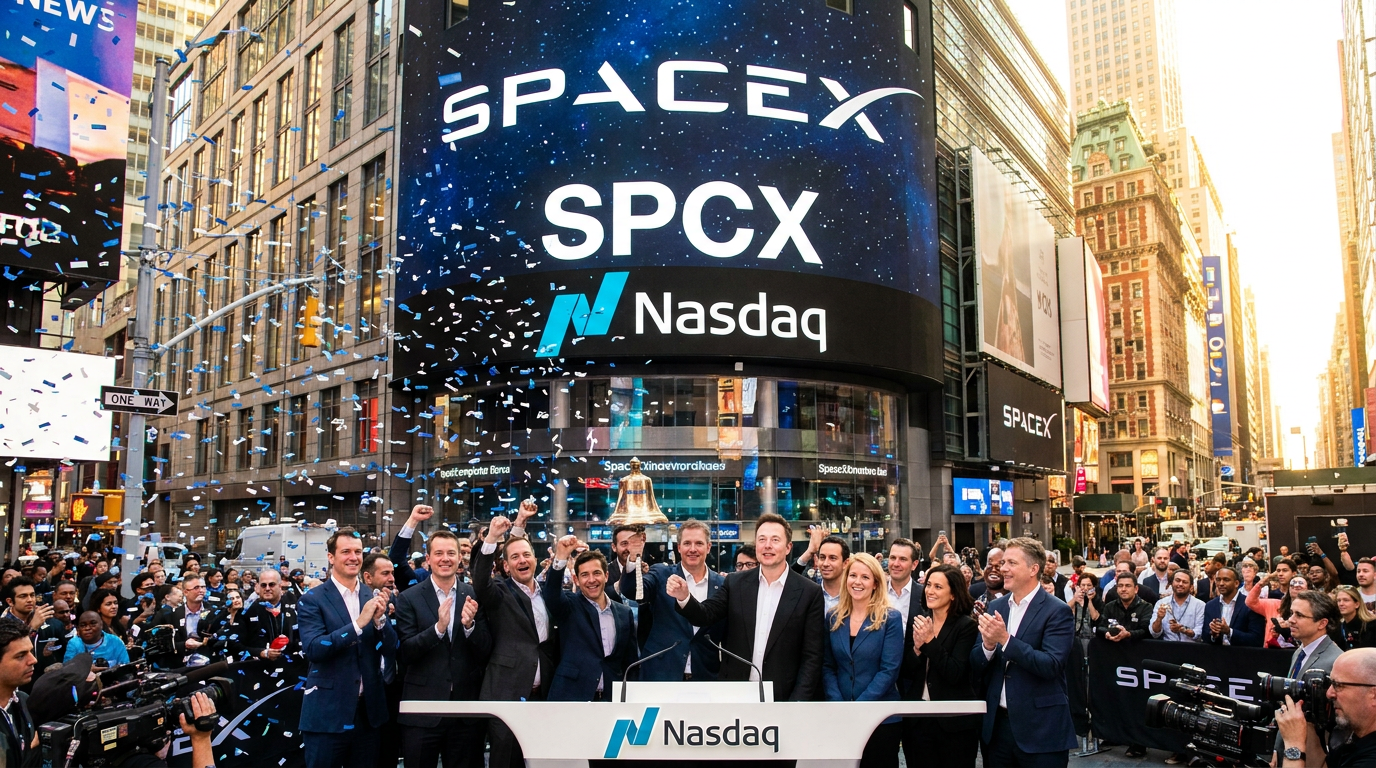
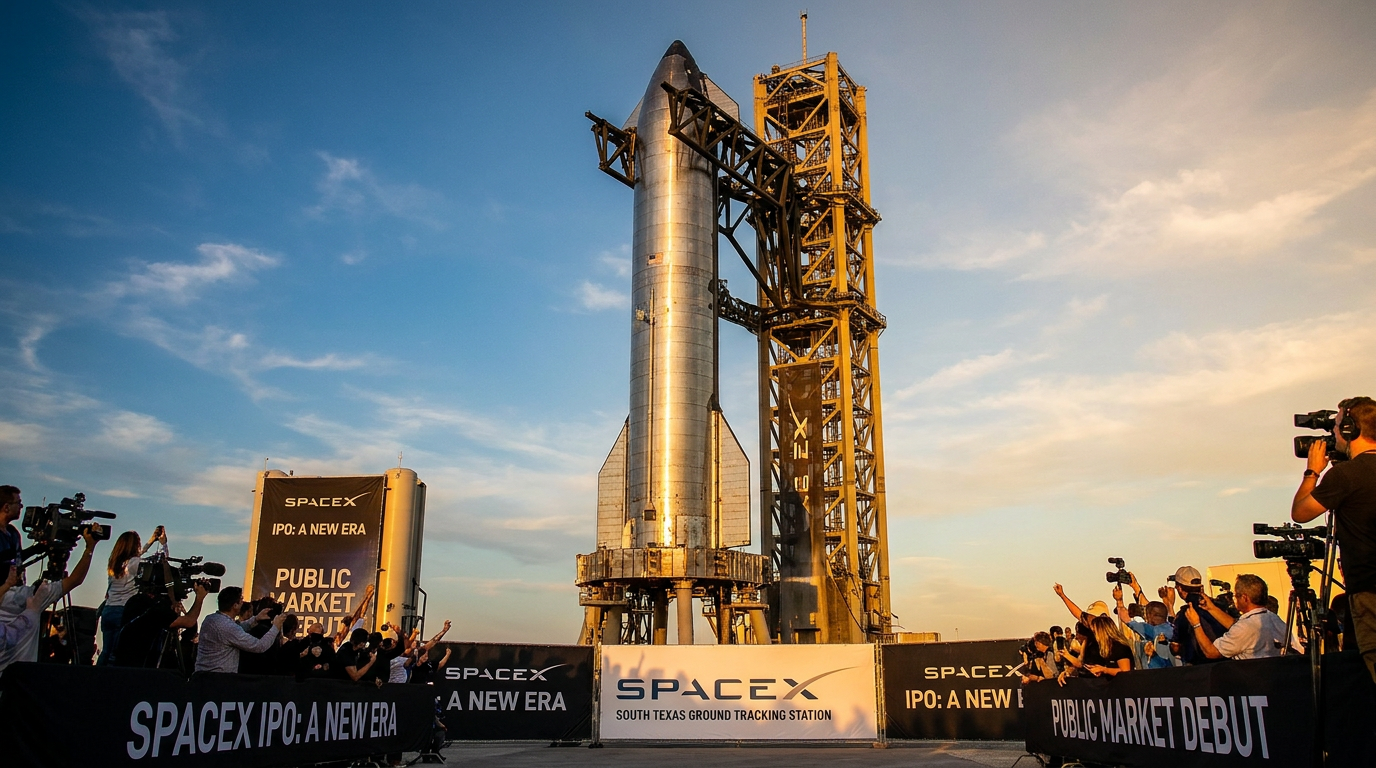
On Friday, June 12, 2026, the financial world witnessed a tectonic shift as Space Exploration Technologies Corp.—better known as SpaceX—made its highly anticipated debut on the Nasdaq under the ticker symbol SPCX. The aerospace and artificial intelligence conglomerate, founded by Elon Musk in 2002, completed the largest initial public offering in the history of global capital markets. As Elton John’s "Rocket Man" echoed across the trading floor, company executives rang the opening bell, culminating a decades-long journey from a scrappy startup with exploding rockets to the most valuable private enterprise on Earth. The sheer gravity of the event immediately reoriented the U.S. stock market, drawing billions of dollars in capital and setting a new benchmark for how mega-cap technology companies transition to public ownership.[1][3]
The numbers behind the offering are staggering. SpaceX raised $75 billion by selling 555.6 million shares, obliterating the previous global record held by Saudi Aramco, which raised $29.4 billion during its 2019 listing. At the offering price, the company was valued at approximately $1.77 trillion, instantly placing it among the seven largest publicly traded companies in the United States, ahead of legacy tech giants and Musk's own electric vehicle manufacturer, Tesla. The capital injection is earmarked for a series of ambitious, capital-intensive projects, including the continued expansion of the Starlink satellite internet constellation, the development of solar-powered data centers in low-Earth orbit, and the ultimate goal of establishing a human colony on Mars.[2][4][8]
When trading officially commenced just before noon Eastern time, the market's appetite proved insatiable. Shares opened at $150—an 11 percent premium over the initial offering price—and climbed as high as $176.52 during intraday trading. By the time the closing bell rang, the stock settled at $161.33, representing a nearly 19 percent jump on its first day. This immediate surge pushed SpaceX's market capitalization past the historic $2 trillion threshold. For Musk, who retains an estimated 82 percent of the company's voting power and a massive equity stake, the day-one pop elevated his personal net worth past $1 trillion, making him the world's first trillionaire on paper.[1][3][4]

Beyond the sheer size of the raise, the SpaceX IPO is fundamentally reshaping how Wall Street operates, beginning with how the shares were priced. Traditionally, investment banks run a weeks-long "roadshow" and book-building process, offering institutional investors a price range that narrows based on demand. SpaceX bypassed this convention entirely. The company dictated a fixed, take-it-or-leave-it price of $135 per share from the outset. Because the deal was heavily oversubscribed—with total investor demand reportedly reaching $250 billion—SpaceX had the leverage to force underwriters to accept its terms, effectively stripping Wall Street syndicates of their usual pricing power.[6][8]
The offering also shattered norms regarding who gets to participate in a blockbuster IPO. Historically, retail investors are locked out of the initial allocation, receiving only 5 to 10 percent of the shares while institutional giants like BlackRock and Vanguard absorb the rest. Everyday traders are usually forced to buy on the open market after the initial price pop. SpaceX, however, explicitly carved out an unprecedented allocation for retail buyers, reserving up to 30 percent of the offering for individuals. Brokerages like Fidelity lowered their minimum account requirements to just $2,000 to accommodate the surge in interest, democratizing access to what is widely viewed as a generational tech asset.[1][7]
The offering also shattered norms regarding who gets to participate in a blockbuster IPO.
This retail-first strategy generated massive grassroots momentum. Everyday investors submitted more than $100 billion in orders for SpaceX stock prior to the debut, creating the highest retail order activity ever recorded for an IPO auction. Citadel Securities, the largest retail wholesaler, reported unprecedented volume, while trading platforms like Robinhood experienced record-breaking traffic as millions of users attempted to secure a piece of the aerospace giant. This dynamic creates a unique shareholder base for a company of this size, blending institutional stability with a highly vocal, cult-like retail following that has previously driven massive valuations in companies like Tesla.[1][2]
The sheer mass of SpaceX has also forced major market indices to bend their own rules. Passive index funds, which automatically buy stocks based on their weighting in benchmarks like the S&P 500 and the Nasdaq-100, represent trillions of dollars in capital. Recognizing that excluding a $2 trillion company would severely track-error their indices, the Nasdaq altered its fast-track entry rules. Under the new guidelines, companies with market caps large enough to rank in the top 40 of the Nasdaq-100 can be included after just 15 days of trading, rather than waiting months. The exchange also adjusted its free-float requirements to accommodate SpaceX's relatively small public share percentage.[5]

Not all index providers capitulated to the company's gravity. The committee overseeing the S&P 500 declined to fast-track the stock, adhering to its strict inclusion criteria regarding sustained profitability and voting structure. Because Musk retains super-voting control and the company's financial history remains volatile, SpaceX will not be eligible for S&P 500 inclusion until mid-2027 at the earliest. This creates a fascinating divergence in the passive investing landscape, where Nasdaq-tracking funds will immediately absorb billions of dollars of SpaceX equity, while S&P 500 funds remain on the sidelines, potentially missing out on early gains or avoiding early volatility.[5]
Despite the euphoric market reception, traditional financial analysts point to a glaring disconnect between SpaceX's valuation and its current balance sheet. The company is not yet a reliable profit engine. According to its public prospectus, SpaceX generated $4.69 billion in revenue during the first quarter of 2026, representing solid year-over-year growth driven largely by Starlink subscriptions and government launch contracts. However, the company simultaneously reported a staggering net loss of $4.28 billion for the same three-month period, adding to an accumulated deficit of over $41 billion. The $1.77 trillion valuation is therefore not anchored to current earnings, but entirely reliant on the successful execution of its futuristic roadmap.[8]
Investors are effectively underwriting a vision that merges aerospace dominance with the next frontier of artificial intelligence. Following its recent integration with Musk's AI startup, xAI, SpaceX is positioning itself as an infrastructure powerhouse for the AI era. The prospectus outlines plans to deploy massive, solar-powered data centers into low-Earth orbit, circumventing the severe energy constraints and grid bottlenecks currently limiting terrestrial AI development. If successful, this orbital compute network could give SpaceX a monopoly on space-based artificial intelligence infrastructure, providing a theoretical justification for a valuation that currently trades at more than 100 times projected 2026 sales.[1][3][4]
The mechanics of the post-IPO lock-up period also introduce a layer of near-term uncertainty. Typically, insiders and early employees are barred from selling their shares for 180 days after a public debut to prevent a sudden flood of supply from crashing the stock price. SpaceX negotiated a highly non-traditional, rolling lock-up schedule. According to the filings, insiders can sell up to 20 percent of their holdings immediately after the company reports its second-quarter earnings in the summer of 2026. If the stock is trading at least 30 percent above the $135 IPO price, they can liquidate an additional 10 percent, creating potential downward pressure on the stock much earlier than Wall Street is accustomed to.[8]

Ultimately, the successful execution of the SpaceX IPO serves as a vital proof of concept for the broader technology sector. The market's willingness to absorb a $75 billion offering and reward it with a 19 percent first-day premium signals deep institutional and retail liquidity for transformative, mega-cap narratives. Financial analysts view this as the starting gun for a wave of massive artificial intelligence listings. Rivals like OpenAI and Anthropic, both of which have filed confidential paperwork for their own public debuts later this year, are now expected to target valuations near or above the $1 trillion mark, fundamentally reorienting the center of gravity in global equities toward the intersection of space and AI.[3][4]
How we got here
May 20, 2026
SpaceX publicly files its S-1 prospectus with the SEC, detailing its financials and plans to go public.
June 3, 2026
The company confirms a fixed IPO price of $135 per share, bypassing traditional Wall Street book-building.
June 11, 2026
SpaceX officially prices the offering, locking in the $75 billion raise and a $1.77 trillion valuation.
June 12, 2026
Shares begin trading on the Nasdaq under the ticker SPCX, closing up nearly 19 percent on the first day.
Viewpoints in depth
Retail Investors & Enthusiasts
View the IPO as a democratization of generational wealth and a chance to back humanity's multi-planetary future.
For retail traders, the SpaceX IPO represents a rare victory over institutional gatekeepers. Historically, everyday investors have been locked out of the most lucrative early gains in mega-cap tech debuts, forced to buy shares only after Wall Street insiders have already driven up the price. By allocating up to 30 percent of the offering to retail accounts and lowering minimum investment thresholds, SpaceX allowed its massive fan base to participate directly in the wealth creation. This camp views the investment not just as a financial play, but as a philosophical endorsement of Elon Musk's vision to colonize Mars and build orbital AI infrastructure.
Institutional Optimists
See the massive valuation as justified by SpaceX's monopoly on launch infrastructure and future orbital AI data centers.
Bullish institutional analysts argue that traditional valuation metrics are insufficient for a company with no true peers. They point to SpaceX's near-monopoly on global launch cadence and the rapidly expanding cash flow from its Starlink satellite internet service. More importantly, this camp believes the recent integration with xAI positions SpaceX to dominate the next era of artificial intelligence by placing solar-powered data centers in orbit, bypassing terrestrial energy constraints. From this perspective, paying 100 times future sales is a necessary premium to own the foundational infrastructure of both the space economy and the AI boom.
Traditional Value Analysts
Remain highly skeptical of a $1.77 trillion valuation for a company that posted a $4.28 billion net loss in a single quarter.
Skeptics within the financial sector warn that the euphoria surrounding SpaceX is masking severe fundamental risks. They highlight the company's Q1 2026 net loss of $4.28 billion and its accumulated deficit of over $41 billion as evidence that the core business remains highly capital-intensive and far from sustained profitability. This camp is also deeply concerned by the company's governance structure, which grants Elon Musk super-voting control, and the non-traditional rolling lock-up period that could allow insiders to dump shares just months after the IPO. For these analysts, the $2 trillion valuation is a speculative bubble reliant on flawless execution of unprecedented engineering feats.
What we don't know
- How the stock will react when the non-traditional rolling lock-up period allows insiders to begin selling shares after Q2 earnings.
- Whether SpaceX can successfully deploy and scale its proposed orbital AI data centers to justify its massive valuation premium.
- How quickly the company can transition its core launch and Starlink businesses from heavy net losses to sustained profitability.
Key terms
- Initial Public Offering (IPO)
- The process by which a private company offers shares of its stock to the public for the first time, allowing it to raise capital from public market investors.
- Book-building
- The traditional process where investment banks generate, capture, and record investor demand for shares to determine an IPO's final offering price.
- Free-float
- The portion of a company's shares that are readily available for trading in the open market, excluding locked-in shares held by insiders or governments.
- Lock-up period
- A predetermined window of time after an IPO during which company insiders and early investors are legally restricted from selling their shares.
- Passive index funds
- Investment funds designed to automatically track the performance of a specific market benchmark, such as the S&P 500 or Nasdaq-100, by purchasing the stocks within that index.
Frequently asked
How much money did SpaceX raise in its IPO?
SpaceX raised $75 billion, making it the largest initial public offering in global history, surpassing Saudi Aramco's $29.4 billion raise in 2019.
What was the starting price of SpaceX stock?
The company priced its shares at a fixed $135 prior to the debut. When trading opened on the Nasdaq, the stock immediately jumped to $150 per share.
Were retail investors able to buy SpaceX stock?
Yes. In an unprecedented move, SpaceX allocated up to 30 percent of its IPO shares to everyday retail investors, generating over $100 billion in retail orders.
Is SpaceX a profitable company?
Not currently. While the company generated $4.69 billion in revenue in the first quarter of 2026, it also reported a net loss of $4.28 billion as it continues to invest heavily in infrastructure.
Sources
Source coverage
8 outlets
3 viewpoints surfaced








[1]MarketWatchRetail Investors & Enthusiasts
How Elon Musk nailed the SpaceX IPO: ‘I’m not sure that this could have gone much better’
Read on MarketWatch →[2]ForbesTraditional Value Analysts
SpaceX Files For What Could Be Largest IPO In History
Read on Forbes →[3]The GuardianInstitutional Optimists
SpaceX made the biggest stock market debut in history
Read on The Guardian →[4]CBS NewsInstitutional Optimists
SpaceX stock soars 19% on first day of trading following record-breaking $75 billion IPO
Read on CBS News →[5]The Washington PostTraditional Value Analysts
SpaceX's IPO shows how major indices are willing to bend the rules for massive companies
Read on The Washington Post →[6]Capital.comTraditional Value Analysts
SpaceX IPO targets 12 June 2026 Nasdaq listing
Read on Capital.com →[7]Fidelity InvestmentsRetail Investors & Enthusiasts
Key dates for the SpaceX Class A IPO
Read on Fidelity Investments →[8]The Next WebInstitutional Optimists
SpaceX raises $75B in largest IPO ever, Japan gets $2.2B
Read on The Next Web →
More in finance
See all 18 stories →Market Rotation
Why Value Stocks Are Outperforming Growth Equities in 2026
0 sources

SpaceX IPO
SpaceX Completes Historic $75 Billion IPO, Pushing Valuation Past $2 Trillion
0 sources
Wealth Management
Robo-Advisors vs. Human Planners: Comparing Financial Guidance Tools in 2026
0 sources
IPO Mechanics
How SpaceX Bypassed Wall Street Norms to Pull Off the Largest IPO in History
0 sources
Every angle. Every day.
Get finance stories with full source coverage and perspective breakdowns delivered to your inbox.