
SpaceX Completes Historic $75 Billion IPO, Shattering Wall Street Records
Elon Musk’s aerospace and satellite company debuted on the Nasdaq in the largest initial public offering in history, reaching a valuation of over $2 trillion on its first day of trading.
By Factlen Editorial Team
- Tech & Market Optimists
- Views the IPO as a historic validation of commercial spaceflight and a necessary capital injection to secure US dominance in orbital infrastructure and AI.
- Valuation Skeptics
- Argues that the $2 trillion market capitalization is detached from the company's current financial reality, pointing to its ongoing multi-billion dollar operating losses.
- Governance & Security Watchdogs
- Expresses deep concern over a single individual retaining absolute voting control over a $2 trillion public utility that serves as the backbone of US national security.
What's not represented
- · Retail investors who were priced out of the initial $135 offering due to heavy institutional rationing.
- · Competitors in the legacy aerospace sector facing a newly capitalized, $2 trillion rival.
Why this matters
The unprecedented capital raise not only cements SpaceX's dominance in the commercial space and satellite internet sectors but also provides a massive war chest for its ambitious AI integration and Mars colonization goals, while making Elon Musk the world's first trillionaire.
Key points
- SpaceX raised a record-breaking $75 billion in its initial public offering, pricing shares at $135.
- The stock closed its first day of trading at $160.95, pushing the company's valuation past $2.1 trillion.
- The offering shattered the previous IPO record of $29 billion set by Saudi Aramco in 2019.
- The massive surge in valuation officially made SpaceX CEO Elon Musk the world's first trillionaire.
- SpaceX plans to use the capital to expand its Starlink network, develop its Starship rocket, and build AI data centers in space.
- Critics have raised concerns over the company's $4.9 billion net loss in 2025 and Musk's retention of 82.4% voting power.
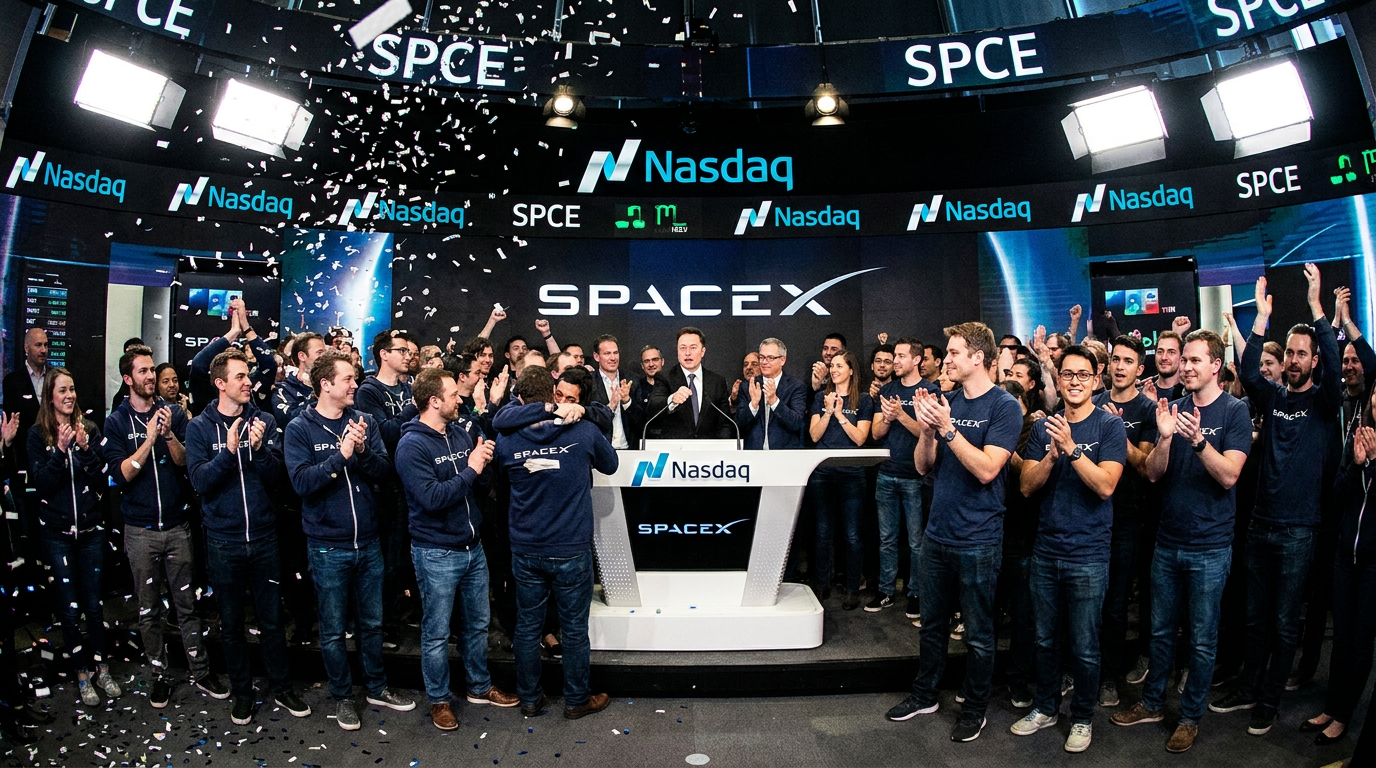
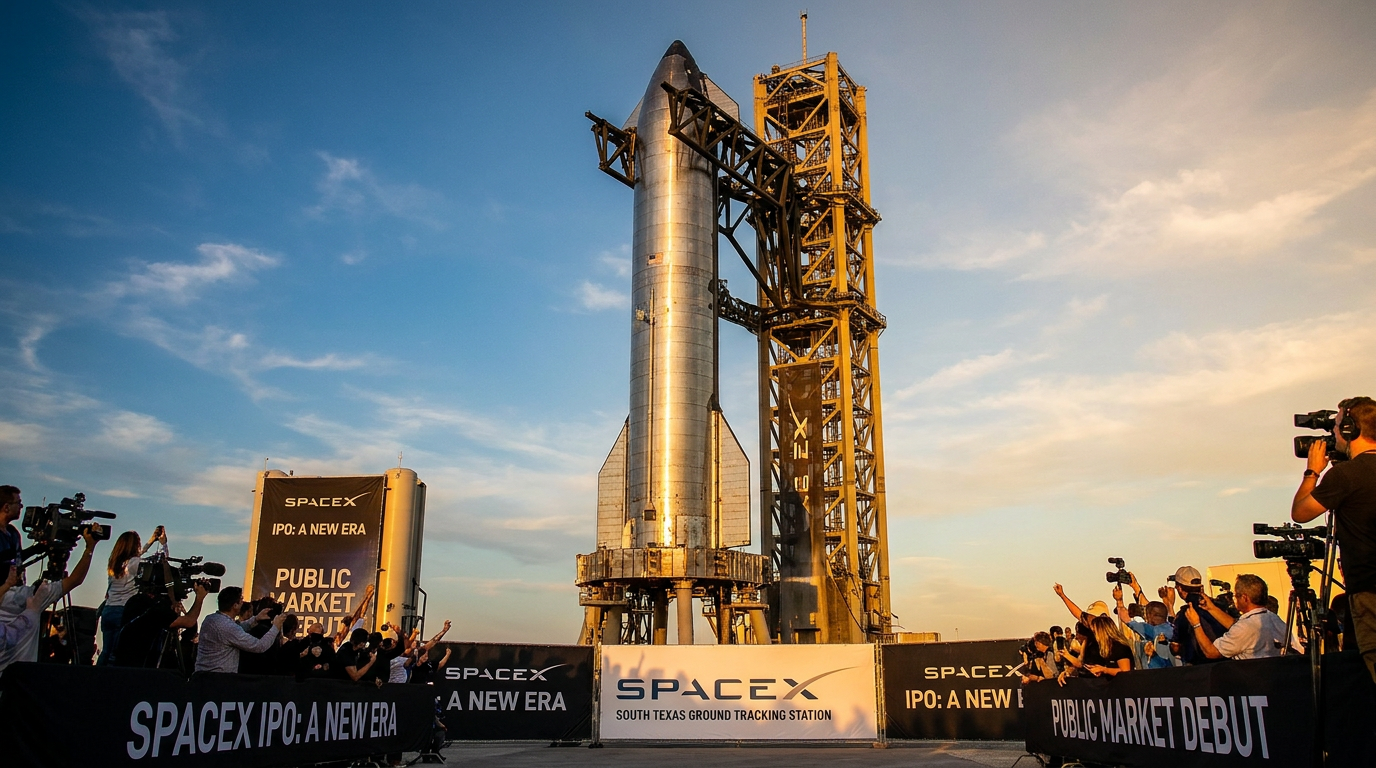
SpaceX officially transitioned from a closely held private enterprise to a publicly traded juggernaut on Friday, executing the most lucrative initial public offering in the history of global financial markets. Trading under the ticker symbol SPCX on the Nasdaq, the aerospace and satellite communications company successfully raised $75 billion by selling 555 million shares. The sheer scale of the offering immediately reshaped the landscape of the US stock market, instantly cementing SpaceX as one of the most valuable entities on the planet. For a company that began in an El Segundo warehouse in 2002 and nearly faced bankruptcy after early rocket failures, the debut represents a monumental validation of its ambitious business model. The capital injection provides a massive war chest for the company's sprawling objectives, which range from deploying thousands of additional broadband satellites to establishing a permanent human presence on Mars.[1][4][5]
The stock’s first-day performance reflected intense investor appetite, defying any lingering skepticism about the company's astronomical asking price. SpaceX shares were initially priced at $135 on Thursday evening, but robust demand drove the opening trade to $150 by midday Friday. The stock continued to climb throughout the session, peaking at $176.52 before settling at a closing price of $160.95—a 19 percent premium over the initial offering. This rapid appreciation pushed the company's market capitalization well past the $2 trillion threshold, ending the day at approximately $2.1 trillion. Market analysts noted that while the percentage pop was not a "moonshot" compared to smaller tech debuts, the absolute dollar value generated for early investors in a single trading session was unprecedented in the history of Wall Street.[4][5]
To understand the magnitude of the SpaceX offering, financial historians point to the previous high-water marks of global public markets. Prior to Friday, the record for the largest IPO was held by Saudi Aramco, the state-owned oil behemoth that raised $29.4 billion on the Riyadh exchange in 2019. SpaceX more than doubled that figure, absorbing an astonishing amount of liquidity from institutional and retail investors alike. The offering also dwarfed the largest US tech debuts, such as Alibaba's $25 billion raise in 2014 and Meta's (then Facebook) $16 billion debut in 2012. The underwriters, led by Goldman Sachs and Morgan Stanley, were granted an option to sell an additional 83 million shares due to the overwhelming demand, which could ultimately push the total capital raised to $86 billion once the overallotment is fully exercised.[3][4][5]

The mechanics of the IPO were as unconventional as the company itself, bucking decades of established Wall Street tradition. Rather than publishing a broad indicative price range and spending weeks narrowing it down through institutional bookbuilding, SpaceX presented the market with a fixed, take-it-or-leave-it price of $135 per share. This aggressive strategy relied entirely on the overwhelming baseline demand for the stock, and the gamble paid off spectacularly. Retail investors alone reportedly submitted orders exceeding $100 billion, while institutional giants like BlackRock placed single orders of $5 billion. The massive oversubscription rate—reportedly four times the available shares—forced brokerages to heavily ration allocations, leaving many prospective buyers to purchase shares on the open market at the inflated Friday premium.[6][7]
Beyond the corporate milestones, the IPO triggered a historic shift in global wealth distribution, officially minting CEO Elon Musk as the world's first trillionaire. Musk, who already held the title of the world's richest person, owns approximately 4.8 billion shares of SpaceX, representing roughly 42 percent of the company's equity. When combined with his substantial holdings in Tesla and his other private ventures, the Friday surge pushed his estimated net worth past the $1.1 trillion mark. Speaking to cheering employees at the company's Starbase headquarters in Texas, Musk reflected on the improbable journey of the firm, reiterating his core mission to "take the fiction out of science fiction" and ensure humanity becomes a multiplanetary species.[1][4]
Beyond the corporate milestones, the IPO triggered a historic shift in global wealth distribution, officially minting CEO Elon Musk as the world's first trillionaire.
While the narrative of Mars colonization captures the public imagination, the financial engine driving SpaceX's massive valuation is firmly rooted in low-Earth orbit. The company's Starlink division, a constellation of nearly 10,000 satellites providing high-speed internet to remote and underserved regions, has emerged as a formidable cash cow. In 2025, Starlink generated an estimated $11.4 billion in revenue, accounting for roughly 60 percent of the company's total income. This recurring subscription revenue provides a vital counterbalance to the capital-intensive nature of rocket development. Investors view Starlink not just as a telecommunications disruptor, but as a foundational utility that could eventually dominate global broadband infrastructure, justifying a significant portion of the $2 trillion market capitalization.[2][5]

SpaceX's prospectus also revealed a bold, unexpected pivot that helped fuel the IPO frenzy: a deep integration into the booming artificial intelligence sector. Following the recent acquisition of Musk's AI startup, xAI, SpaceX outlined plans to build solar-powered artificial intelligence data centers directly in space. By moving compute infrastructure into orbit, the company theorizes it can bypass terrestrial constraints related to power grid capacity and cooling requirements. In its filings, SpaceX estimated its total addressable market at a staggering $28.5 trillion, with the vast majority of that figure tied to AI infrastructure rather than traditional launch services. This framing allowed SpaceX to ride the coattails of the broader AI market rally, positioning itself alongside tech giants like Nvidia and Microsoft.[2][3][4]
Despite the euphoric market reception, a chorus of financial analysts and skeptics have raised red flags regarding the company's underlying fundamentals and its eye-watering valuation. Unlike established mega-cap technology firms that generate tens of billions in annual profit, SpaceX remains a deeply unprofitable enterprise. The company reported a net loss of $4.9 billion in 2025, burdened by the immense research and development costs associated with its next-generation Starship rocket and the buildout of its AI capabilities. Critics argue that pricing a loss-making industrial company at $1.77 trillion requires a suspension of traditional valuation metrics. Investment research firms like Morningstar have cautioned retail investors to wait for the post-IPO volatility to settle, warning that the stock is currently priced for absolute perfection across multiple unproven business lines.[2][5]
Corporate governance has emerged as another major flashpoint, drawing scrutiny from regulators and lawmakers. The IPO was structured to ensure that Musk retains an iron grip on the company's strategic direction, holding 82.4 percent of the shareholder voting power through a dual-class stock system. This unprecedented concentration of control in a $2 trillion public entity prompted pushback from figures like Senator Elizabeth Warren, who formally requested that the Securities and Exchange Commission delay the offering to investigate investor protections. Critics argue that public shareholders are effectively subsidizing Musk's personal ambitions without any meaningful ability to hold the board accountable or influence corporate policy, a dynamic that could prove risky if the company's high-stakes bets fail to materialize.[2][6]

The geopolitical implications of SpaceX's public debut are equally profound, highlighting the extent to which national security has become intertwined with a single commercial entity. The United States government, particularly the Department of Defense and NASA, relies almost exclusively on SpaceX's reusable Falcon 9 rockets for orbital access. Furthermore, the Starlink network has become a critical communications backbone in global conflict zones. Defense analysts note that the IPO underscores a reality where US space power is fundamentally built on the back of SpaceX, granting the newly public company extraordinary leverage over federal policy. As entities across the globe vie for control of the cosmos, the capitalization of SpaceX ensures it will remain the dominant force in orbital logistics for the foreseeable future.[2]
Looking ahead, the success of the SpaceX offering is expected to act as a massive catalyst for the broader financial markets, effectively opening the floodgates for a new era of mega-cap technology listings. Wall Street is already preparing for the anticipated public debuts of leading artificial intelligence laboratories, including OpenAI and Anthropic, both of which are projected to seek valuations approaching the $1 trillion mark later this year. The seamless execution of the $75 billion SpaceX raise demonstrates that there is immense, untapped liquidity waiting on the sidelines for generational technology assets. As index funds and retirement accounts begin to automatically accumulate SPCX shares in the coming weeks, the financial futures of millions of everyday investors will become inextricably linked to the success of the commercial space economy.[1][4]
How we got here
2002
Elon Musk founds Space Exploration Technologies Corp. with the goal of reducing space transportation costs.
2008
The Falcon 1 rocket successfully reaches orbit, saving the company from bankruptcy and securing a vital NASA contract.
2019
SpaceX begins launching the first batch of Starlink satellites to build its global broadband network.
Feb 2026
SpaceX acquires Musk's artificial intelligence startup xAI, expanding its ambitions into space-based compute infrastructure.
June 11, 2026
The company officially prices its initial public offering at a fixed $135 per share.
June 12, 2026
SpaceX debuts on the Nasdaq, raising $75 billion and closing its first day of trading with a valuation over $2 trillion.
Viewpoints in depth
Tech & Market Optimists
Views the IPO as a historic validation of commercial spaceflight and a necessary capital injection.
For bullish investors and technology advocates, the $75 billion raise is not just a financial milestone, but a necessary step to secure American dominance in the next frontier of infrastructure. They argue that traditional valuation metrics—which focus on near-term profitability—fail to capture the utility of a company that controls the world's primary orbital logistics network and a rapidly expanding global broadband monopoly in Starlink. From this perspective, the integration of space-based AI data centers justifies the $2 trillion valuation by expanding the company's total addressable market into the tens of trillions.
Valuation Skeptics
Argues that the $2 trillion market capitalization is detached from the company's current financial reality.
Financial purists and short-sellers point to the glaring disconnect between SpaceX's $2 trillion price tag and its balance sheet, which recorded a $4.9 billion net loss in 2025. They caution that the market is pricing the stock for absolute perfection across multiple highly speculative business lines, including the unproven concept of orbital AI data centers and the financially dubious goal of Mars colonization. Skeptics warn that the current frenzy mirrors the peak of the dot-com bubble, where retail enthusiasm and the allure of 'total addressable market' projections temporarily blinded the market to the realities of cash burn and capital expenditure.
Governance & Security Watchdogs
Expresses deep concern over a single individual retaining absolute voting control over a critical public utility.
Policy analysts and governance advocates are alarmed by the unprecedented concentration of power the IPO solidifies. By utilizing a dual-class share structure to retain 82.4% of the voting power, Elon Musk effectively operates a $2 trillion public company as a personal fiefdom, immune to activist investors or board oversight. Because the United States military and NASA rely almost entirely on SpaceX for orbital access and satellite communications, watchdogs argue that this governance structure places critical national security infrastructure at the whims of a single, highly unpredictable CEO, with public shareholders bearing the financial risk.
What we don't know
- Whether the company can achieve profitability in the near term given the massive capital expenditures required for Starship and AI infrastructure.
- How the SEC will respond to ongoing concerns from lawmakers regarding the company's dual-class stock structure and investor protections.
- If the planned space-based AI data centers are technologically and economically viable at scale.
Key terms
- Initial Public Offering (IPO)
- The process by which a private company offers its shares to the public for the first time to raise capital.
- Market Capitalization
- The total dollar market value of a company's outstanding shares of stock, calculated by multiplying the current share price by the total number of shares.
- Dual-Class Stock
- A corporate structure where different classes of shares have different voting rights, often used to allow founders to retain control of a public company.
- Total Addressable Market (TAM)
- The overall revenue opportunity that is available to a product or service if 100% market share is achieved.
- Overallotment (Greenshoe Option)
- A provision in an underwriting agreement that allows the underwriters to sell more shares than originally planned if demand is exceptionally high.
Frequently asked
How much money did SpaceX raise in its IPO?
SpaceX raised a record-breaking $75 billion by selling 555 million shares at $135 each.
Is Elon Musk still in control of SpaceX?
Yes. Despite taking the company public, Musk retains 82.4% of the shareholder voting power through a dual-class stock structure.
What is SpaceX's ticker symbol?
SpaceX trades on the Nasdaq stock exchange under the ticker symbol SPCX.
Why did SpaceX go public?
The company went public to raise the massive amounts of capital required for its Starship development, Starlink expansion, and new plans to build AI data centers in space.
Is SpaceX currently profitable?
No. While its Starlink division generates significant revenue, the company as a whole reported a net loss of $4.9 billion in 2025 due to heavy research and development costs.
Sources
Source coverage
7 outlets
3 viewpoints surfaced







[1]The GuardianGovernance & Security Watchdogs
SpaceX made the biggest stock market debut in history
Read on The Guardian →[2]The Washington PostGovernance & Security Watchdogs
SpaceX's IPO, the largest in history, dramatically increases Musk's personal wealth
Read on The Washington Post →[3]Fox BusinessTech & Market Optimists
SpaceX IPO raises $75B in largest public market debut in history
Read on Fox Business →[4]CBS NewsValuation Skeptics
SpaceX stock soars 19% on first day of trading following record-breaking $75 billion IPO
Read on CBS News →[5]Los Angeles TimesValuation Skeptics
SpaceX shares jumped 19% in its Nasdaq debut, valuing Elon Musk's company at $2.2 trillion
Read on Los Angeles Times →[6]ForbesTech & Market Optimists
SpaceX Files For What Could Be Largest IPO In History
Read on Forbes →[7]MarketWatchTech & Market Optimists
How Elon Musk nailed the SpaceX IPO: ‘I’m not sure that this could have gone much better’
Read on MarketWatch →
More in finance
See all 17 stories →Market Rotation
Why Value Stocks Are Outperforming Growth Equities in 2026
0 sources

SpaceX IPO
SpaceX Completes Historic $75 Billion IPO, Pushing Valuation Past $2 Trillion
0 sources
Wealth Management
Robo-Advisors vs. Human Planners: Comparing Financial Guidance Tools in 2026
0 sources
IPO Mechanics
How SpaceX Bypassed Wall Street Norms to Pull Off the Largest IPO in History
0 sources
Every angle. Every day.
Get finance stories with full source coverage and perspective breakdowns delivered to your inbox.