
SpaceX Completes Historic $75 Billion IPO, Shattering Wall Street Records
Elon Musk's aerospace and AI conglomerate has officially gone public, raising an unprecedented $75 billion at a $1.77 trillion valuation. The landmark offering bypassed traditional Wall Street norms, allocating a massive share to retail investors while sparking fierce debate over the company's profitability.
By Factlen Editorial Team
- Retail & Growth Investors
- Optimistic about the massive total addressable market and Musk's track record.
- Value Analysts & Skeptics
- Concerned by the severe cash burn, unproven technologies, and extreme valuation.
- Institutional Underwriters
- Focused on the historic fee pool and the long-term trading volume the stock will generate.
What's not represented
- · Competitors in the legacy aerospace sector
- · Taxpayers funding NASA contracts
Why this matters
This is the largest public market debut in history, instantly making SpaceX a cornerstone of major index funds and retirement accounts. It fundamentally reshapes the global space economy and tests whether public markets will tolerate massive short-term losses in exchange for a monopoly on orbital infrastructure.
Key points
- SpaceX raised a record $75 billion in its IPO, surpassing Saudi Aramco's 2019 record.
- The offering valued the company at $1.77 trillion, making Elon Musk the world's first paper trillionaire.
- The company bypassed traditional Wall Street pricing models, offering shares at a fixed $135.
- Retail investors received an unprecedented 20% to 30% allocation of the available shares.
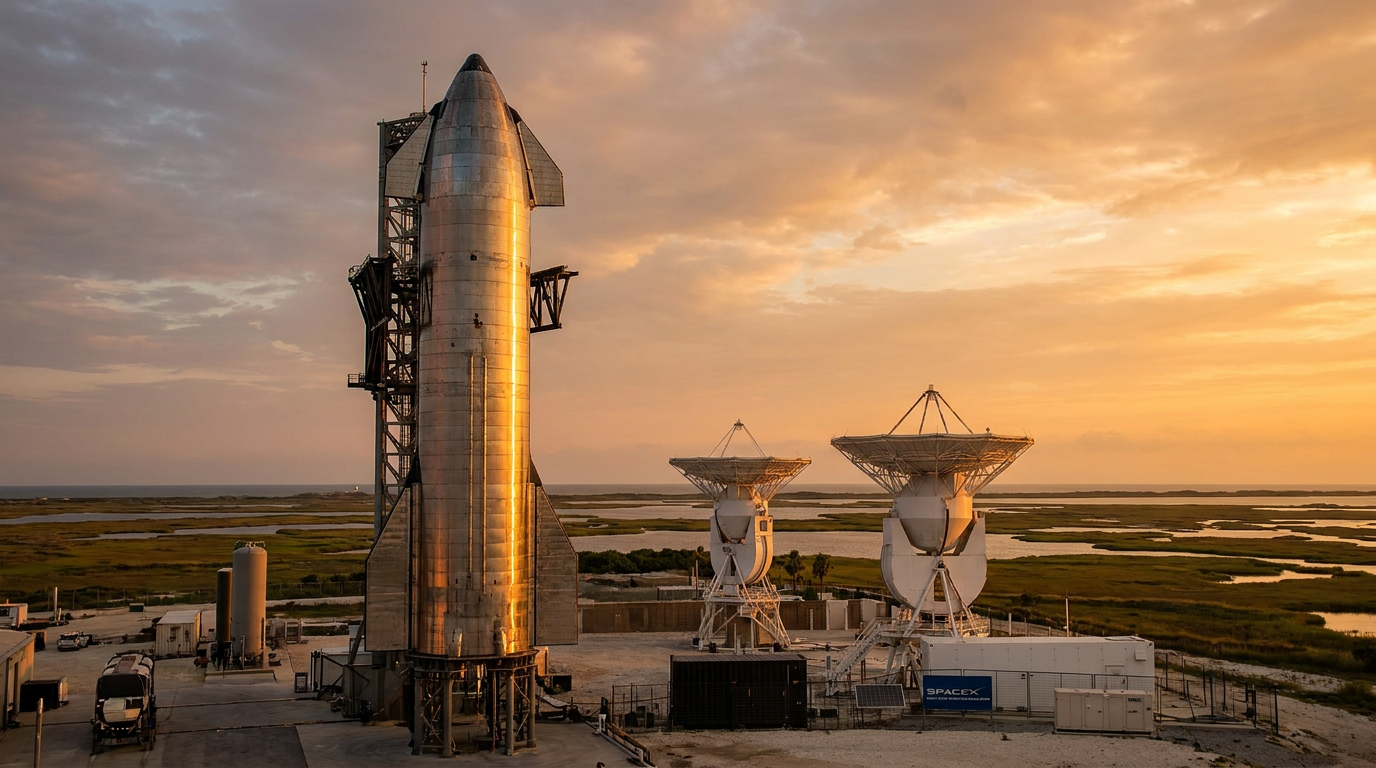
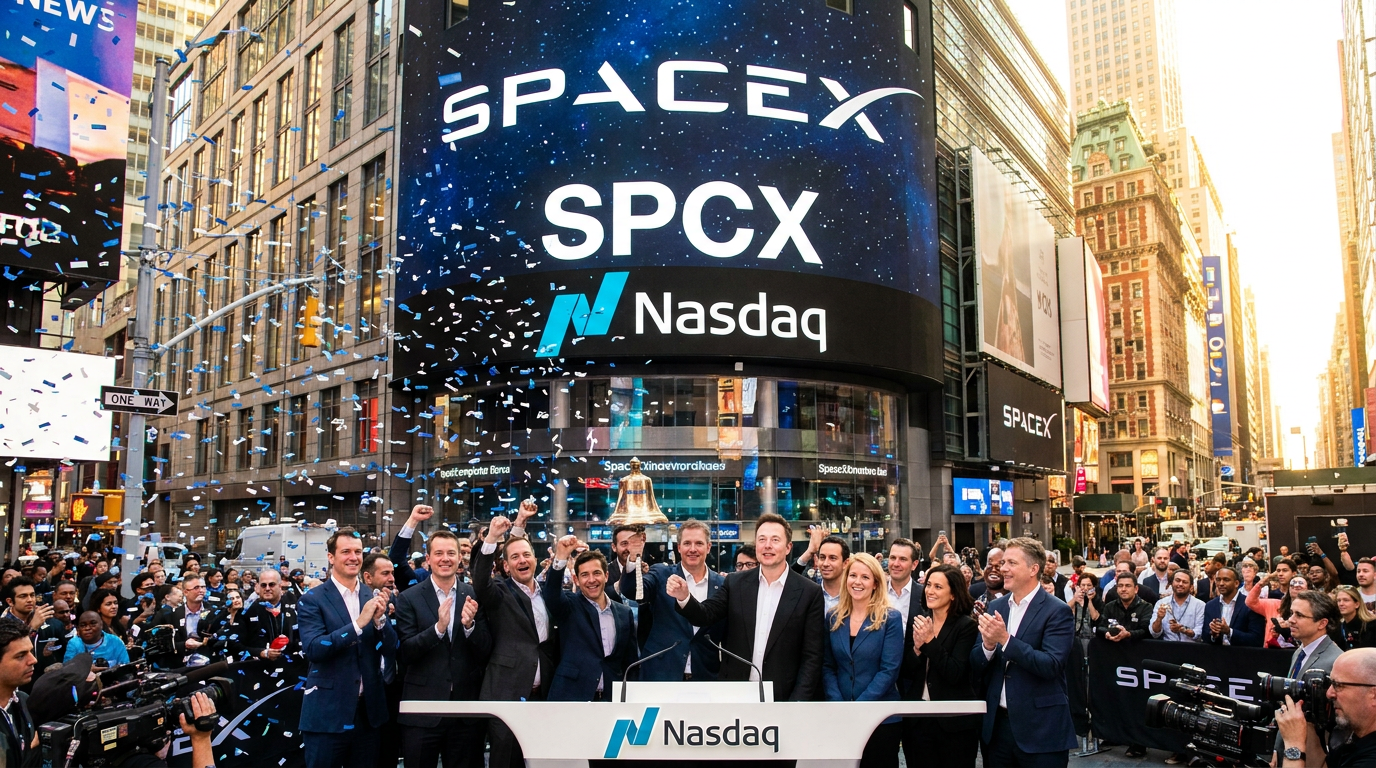
The opening bell at Nasdaq MarketSite in Times Square didn't just mark the start of the trading day on June 12, 2026—it marked the dawn of a new era for the global financial markets. SpaceX, the aerospace behemoth founded by Elon Musk, officially became a public company under the ticker symbol SPCX. By offering 555.6 million shares at a fixed price of $135, the company raised a staggering $75 billion. The transaction instantly valued SpaceX at approximately $1.77 trillion, cementing its status as one of the most valuable corporations on Earth and making Musk the world's first paper trillionaire.[3][4][6]
The sheer scale of the offering shatters every historical precedent. Prior to this week, the record for the largest initial public offering belonged to Saudi Arabia’s state-owned oil giant, Saudi Aramco, which raised $29.4 billion in 2019. SpaceX nearly tripled that figure. Demand was so ferocious that the offering was oversubscribed by more than four times, drawing over $250 billion in bids from institutional heavyweights and sovereign wealth funds, alongside an unprecedented $100 billion in orders from individual retail investors.[3][5][6][9]
But the SpaceX IPO is notable for more than just its record-breaking size; it represents a structural departure from Wall Street norms. Traditionally, companies going public spend weeks on a "roadshow," testing the waters with institutional investors to narrow down an indicative price range. SpaceX bypassed this entirely. The company’s S-1 prospectus launched with blank price fields, and management simply handed the market a fixed $135 price tag. It was a take-it-or-leave-it proposition that underscored the immense leverage Musk holds over the financial establishment.[1][8][10]

Furthermore, the allocation strategy bucked decades of institutional tradition. In a typical mega-cap IPO, retail investors are lucky to receive 5% to 10% of the available shares, with the lion's share reserved for favored hedge funds and mutual funds. SpaceX, however, allocated roughly 20% to 30% of its float directly to everyday investors through brokerages like Robinhood, SoFi, and Fidelity. Placing up to $15 billion of stock directly into the hands of the public reflects the cult-like following Musk commands and the growing structural power of retail capital.[4][5]
To understand why the market is willing to absorb a $1.77 trillion valuation, investors must look beneath the rocket fairings. SpaceX is no longer just a launch provider; it is a sprawling conglomerate composed of three distinct, capital-intensive businesses. The first is the legacy space exploration unit, anchored by the workhorse Falcon 9 rockets and the next-generation Starship vehicle. By mastering reusability, SpaceX has effectively monopolized the commercial launch market, turning one of the hardest jobs in aerospace engineering into a routine industrial process.[3][4][10]
The second, and currently most lucrative, pillar is Starlink. The low-Earth orbit satellite constellation provides high-speed internet access to remote regions and enterprise customers globally. Unlike the episodic revenue of rocket launches, Starlink operates on a subscription model, generating highly prized recurring revenue. In 2025, Starlink accounted for $11.4 billion of the company's $18.7 billion in total revenue, producing a $4.4 billion operating profit. For many institutional backers, Starlink is the financial engine that makes the entire SpaceX ecosystem viable.[4][10]
The third and most speculative pillar is artificial intelligence. Following a February 2026 merger with Musk's AI venture, xAI, SpaceX is now positioning itself as a sovereign AI infrastructure provider. The company's long-term vision includes deploying solar-powered data centers in orbit, effectively controlling the entire AI stack from silicon to space-based compute. Wall Street underwriters have pitched this division aggressively; Goldman Sachs projects that the AI unit alone could generate $322 billion in annual revenue by 2030.[3][8][10]

The third and most speculative pillar is artificial intelligence.
However, those astronomical projections mask a stark financial reality: SpaceX is currently burning through cash at a blistering pace. The company's S-1 filing revealed a net loss of $4.9 billion in 2025. The bleeding accelerated in the first quarter of 2026, with the company posting a $4.28 billion net loss, driven largely by $2.5 billion in quarterly AI-related expenditures and massive capital outlays for Starship development. Unlike highly profitable mega-caps such as Apple or Alphabet, which generate over $100 billion in annual after-tax profits, SpaceX is asking public markets to fund a deeply unprofitable growth phase.[3][4][6][8]
This disconnect between current profitability and market valuation has triggered sharp warnings from value analysts. Investment research firm Morningstar issued a stark assessment ahead of the debut, calculating that SpaceX's underlying fundamentals only support a share price of $63—less than half of the $135 IPO price. Analysts cautioned that while the Starlink business is robust, the valuation relies on untested technologies and highly speculative AI ambitions. They urged disciplined investors to sit out the initial frenzy and wait for a more attractive entry point once the hype subsides.[3][6]
Despite these warnings, Wall Street's premier investment banks fought bitterly for a piece of the historic transaction. A syndicate of more than 20 banks, led by Goldman Sachs and Morgan Stanley, underwrote the deal. The competition for the mandate was so intense that it spilled into public view, with Goldman Sachs plastering its downtown Manhattan lobby with renderings of the Starship rocket, while Morgan Stanley draped its Times Square entrance with SpaceX logos and a giant mural of Mars.[2][8]

For these financial institutions, the stakes are measured in both prestige and a historic payday. Beyond the immediate underwriting fees, banks anticipate a massive multiplier effect. The sheer size of SpaceX means its shares will generate enormous secondary trading volumes, options activity, and financing deals for years to come. JPMorgan analysts recently upgraded their short-term outlook for both Goldman Sachs and Morgan Stanley, explicitly citing the tailwind from the SpaceX IPO as a primary driver for upcoming quarterly earnings.[2][7]
The ripple effects of this listing will also force the hands of passive investors. Because of its $1.77 trillion market capitalization, SpaceX will instantly rank among the largest companies in the S&P 500 and Nasdaq 100 indices. Nasdaq even revised its rules to fast-track SpaceX's inclusion into its index funds within 15 days. This means that millions of everyday workers will soon own a piece of SpaceX through their 401(k) retirement accounts, whether they actively chose to invest in space exploration or not.[6][9]
The inclusion in major indices provides a structural floor for the stock, as passive funds are mandated to buy shares regardless of the underlying fundamentals. Yet, as financial historians note, index demand does not launch satellites or lower rocket costs. SpaceX must still prove that its vertically integrated ecosystem can transition from engineering triumphs to durable, long-term cash flow. The company faces immense execution risks, from regulatory hurdles and launch delays to the sheer physics of building orbital data centers.[10]

Furthermore, the governance structure of the newly public entity remains a point of contention. Musk retains 82.4% of the company's voting power through a dual-class share structure. While his visionary leadership is the primary reason the company reached a trillion-dollar valuation, his near-total control introduces significant key-man risk. Public shareholders will have virtually no say in the company's strategic direction, leaving them entirely dependent on Musk's ability to balance his ambitions for Mars with the quarterly demands of Wall Street.[6][10]
Ultimately, the SpaceX IPO is a defining test for the modern public markets. It asks investors to place a $1.77 trillion wager on a future where humanity is a multi-planetary species powered by space-based artificial intelligence. Whether the stock price holds its altitude or experiences a painful reentry, the capital raised this week guarantees that the commercialization of space will accelerate. For the first time, the financial machinery of Wall Street is directly fueling the journey to the stars.[1][4][6][10]
How we got here
2002
Elon Musk founds Space Exploration Technologies Corp. (SpaceX) with the goal of reducing space transportation costs.
2019
Saudi Aramco sets the record for the world's largest IPO, raising $29.4 billion.
February 2026
SpaceX merges with Musk's artificial intelligence startup, xAI, expanding its focus to space-based compute.
May 20, 2026
SpaceX files its S-1 prospectus, revealing a $4.9 billion net loss for 2025 alongside massive revenue growth.
June 11, 2026
The company officially prices its shares at a fixed $135, bypassing the traditional bookbuilding process.
June 12, 2026
SpaceX begins trading on the Nasdaq under the ticker SPCX, raising a record $75 billion.
Viewpoints in depth
Retail & Growth Investors
Optimistic about the massive total addressable market and Musk's track record.
For growth-focused and retail investors, the $1.77 trillion valuation is justified by SpaceX's potential to monopolize multiple trillion-dollar industries. They point to Starlink's $4.4 billion operating profit in 2025 as proof that the company can generate massive recurring revenue. Furthermore, proponents argue that the integration of xAI positions SpaceX to dominate the future of space-based sovereign AI infrastructure, making current cash burns a necessary investment rather than a structural flaw.
Value Analysts & Skeptics
Concerned by the severe cash burn, unproven technologies, and extreme valuation.
Skeptics, including analysts at Morningstar, argue there is a severe disconnect between the company's fundamentals and its IPO price. They highlight the $4.9 billion net loss in 2025 and the staggering $4.28 billion loss in just the first quarter of 2026 as evidence of an unsustainable cash burn. From this perspective, the $135 share price relies entirely on speculative, untested technologies—like orbital data centers—executing flawlessly, leaving virtually no margin of safety for public shareholders.
Institutional Underwriters
Focused on the historic fee pool and the long-term trading volume the stock will generate.
For the syndicate of over 20 Wall Street banks that brought SpaceX public, the underlying valuation is secondary to the sheer velocity of capital the listing creates. The $75 billion raise generates an unprecedented immediate fee pool. More importantly, banks like Goldman Sachs and Morgan Stanley anticipate a massive 'multiplier effect'—years of lucrative secondary trading, options market making, and future debt financing as SpaceX continues to fund its capital-intensive Mars and AI ambitions.
What we don't know
- Whether the massive capital expenditures required for orbital AI data centers will ever yield profitable returns.
- How the stock will perform once the initial retail enthusiasm subsides and institutional lock-up periods expire.
- The extent to which Elon Musk's near-total voting control will impact public shareholders during future controversies.
Key terms
- Initial Public Offering (IPO)
- The process by which a private company offers shares of its stock to the public for the first time.
- Float
- The total number of shares of a corporation that are available for trading by the general public.
- Bookrunner
- The primary underwriter or lead investment bank coordinating the issuance of new equity in an IPO.
- Dual-class share structure
- A corporate structure where different classes of shares have different voting rights, often used to let founders retain control.
- Sovereign AI
- Artificial intelligence infrastructure and capabilities that are entirely controlled and operated independently, from the silicon chips to the data centers.
Frequently asked
What is the ticker symbol for SpaceX?
SpaceX trades on the Nasdaq and Nasdaq Texas under the ticker symbol SPCX.
How much money did the SpaceX IPO raise?
The company raised $75 billion by selling 555.6 million shares at a fixed price of $135 each.
Is SpaceX a profitable company?
No. While its Starlink division generates operating profit, the overall company reported a net loss of $4.9 billion in 2025 due to heavy investments in AI and rocket development.
Can retail investors buy SpaceX stock?
Yes. In an unusual move, SpaceX allocated 20% to 30% of its initial shares directly to retail investors through major brokerages, and the stock is now available on the open market.
Sources
Source coverage
10 outlets
3 viewpoints surfaced










[1]MarketWatchRetail & Growth Investors
How Elon Musk nailed the SpaceX IPO: ‘I’m not sure that this could have gone much better’
Read on MarketWatch →[2]Business InsiderInstitutional Underwriters
Wall Street's investment banks are prepping for the biggest IPO in history
Read on Business Insider →[3]The GuardianValue Analysts & Skeptics
Analysts say IPO that could make Elon Musk the world's first trillionaire has a 'major disconnect' on price
Read on The Guardian →[4]The Motley FoolRetail & Growth Investors
SpaceX Will Have Its IPO Tomorrow: 12 Things Retail Investors Should Know
Read on The Motley Fool →[5]The Business TimesRetail & Growth Investors
SpaceX's historic US$75 billion IPO drew more than US$350 billion in demand
Read on The Business Times →[6]CBS NewsValue Analysts & Skeptics
SpaceX makes blockbuster stock market debut as shares jump 19%
Read on CBS News →[7]MorningstarInstitutional Underwriters
JPMorgan says investors are overlooking the upside to Wall Street banks that comes from SpaceX
Read on Morningstar →[8]FoundedInstitutional Underwriters
Goldman and Morgan Stanley turned their lobbies into a Starship showroom ahead of SpaceX's recordbreaking $75bn IPO
Read on Founded →[9]PBS NewsHourInstitutional Underwriters
SpaceX plans to raise up to $75 billion in an IPO that would be the largest ever
Read on PBS NewsHour →[10]Saxo BankValue Analysts & Skeptics
The SpaceX IPO is bigger than rockets: a new test for public markets
Read on Saxo Bank →
More in finance
See all 18 stories →Market Rotation
Why Value Stocks Are Outperforming Growth Equities in 2026
0 sources
SpaceX IPO
SpaceX Completes Historic $75 Billion IPO, Pushing Valuation Past $2 Trillion
0 sources
Wealth Management
Robo-Advisors vs. Human Planners: Comparing Financial Guidance Tools in 2026
0 sources
IPO Mechanics
How SpaceX Bypassed Wall Street Norms to Pull Off the Largest IPO in History
0 sources
Every angle. Every day.
Get finance stories with full source coverage and perspective breakdowns delivered to your inbox.