
Penn Physicists Unveil Light-Matter AI Chip That Could Slash Energy Use
Researchers at the University of Pennsylvania have successfully used hybrid light-matter particles to perform computing operations, a breakthrough that could drastically reduce the massive energy footprint of artificial intelligence.
By Factlen Editorial Team
- Photonic Researchers
- Scientists focused on the physics of light-based computing.
- Sustainability Advocates
- Environmental groups monitoring the tech industry's carbon footprint.
- Hardware Industry Analysts
- Market experts tracking the semiconductor and chip manufacturing sector.
What's not represented
- · Traditional Silicon Manufacturers
- · Grid Operators
Why this matters
AI's rapid growth is currently straining global power grids and driving up carbon emissions. If scaled, this ultra-efficient optical computing method could allow AI to advance without the devastating environmental and energy costs of traditional silicon chips.
Key points
- Researchers at the University of Pennsylvania have demonstrated computing logic using hybrid light-matter particles.
- The breakthrough utilizes 'exciton-polaritons' to perform all-optical switching at just four quadrillionths of a joule.
- Traditional electronic chips generate massive heat and resistance, driving up the energy costs of modern AI data centers.
- By allowing light to handle nonlinear decision-making steps, the new architecture could drastically reduce AI's carbon footprint.
- Scaling the atomically thin materials from the lab to mass commercial production remains the next major engineering hurdle.
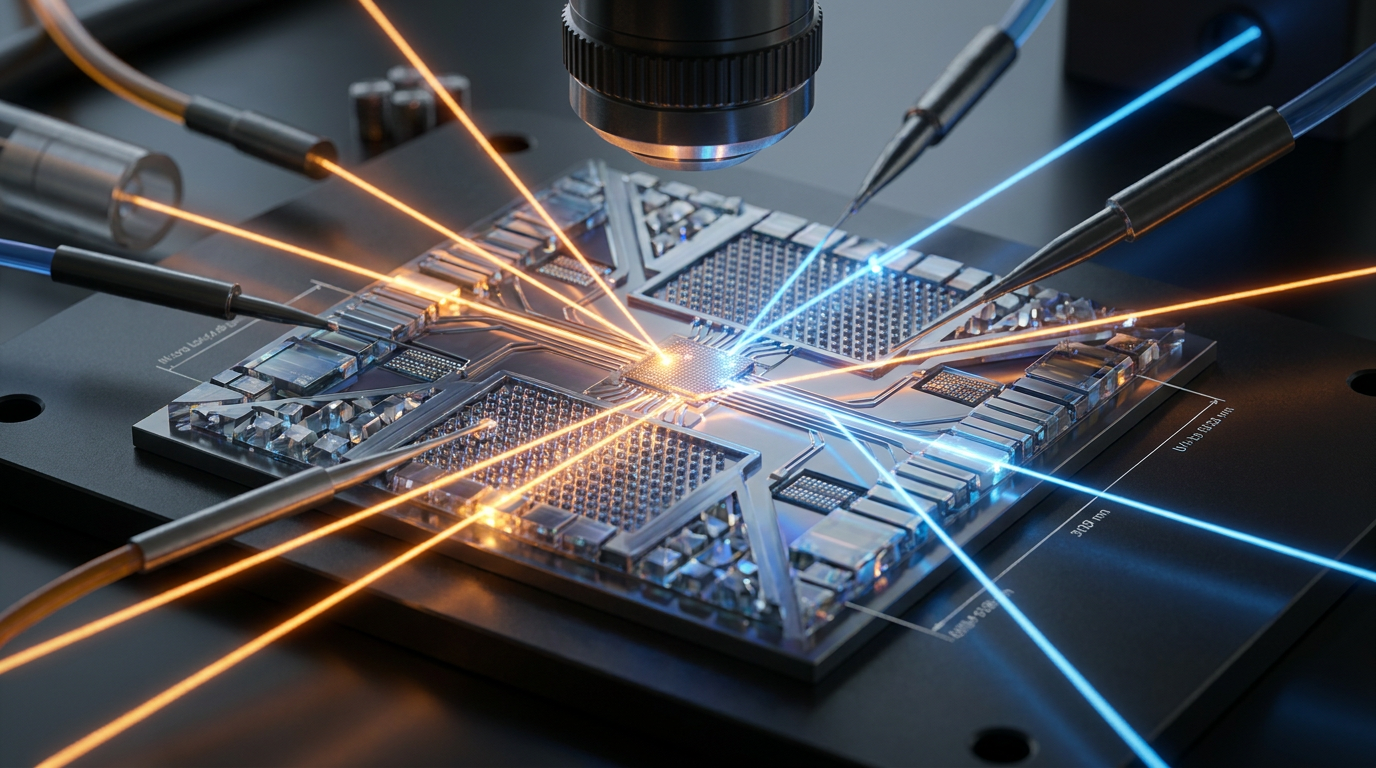
Eighty years after the University of Pennsylvania helped launch the electronic age with the ENIAC computer, researchers at the same institution have demonstrated a radically different way to process information. A team of physicists led by Bo Zhen has successfully performed computing operations using hybrid light-matter particles, pointing toward a future of ultrafast, low-energy optical hardware. The research, published in Physical Review Letters, details how the team achieved all-optical switching—the fundamental logic behavior that computing depends on—using a microscopic fraction of the energy required by traditional silicon chips.[1][6]
The breakthrough arrives at a critical moment for the global technology industry. Artificial intelligence models have grown exponentially in size and capability, and their energy appetite has scaled right alongside them. In 2026, AI workloads are estimated to consume roughly 100 terawatt-hours of electricity annually, representing a massive and rapidly growing share of global data center power. This surging demand is straining municipal power grids, driving up carbon emissions, and forcing tech giants to seek out alternative energy sources just to keep their server farms running.[4][7]
The root of this escalating energy crisis lies in the fundamental physics of modern computer chips. Since the 1940s, computers have relied entirely on electrons to carry and process information. However, electrons carry an electrical charge. As they are pushed through the densely packed microscopic pathways of modern semiconductors, they experience physical resistance and generate heat. When AI systems process billions of calculations per second, that resistance translates into massive energy waste and requires power-hungry cooling systems to prevent the hardware from melting down.[2][3]

For years, hardware engineers have looked to light as a potential alternative. Photons—the fundamental particles that make up light—have zero rest mass and carry no electrical charge, allowing them to transmit information at incredible speeds over long distances with almost zero energy loss. This is exactly why fiber-optic cables dominate global communications today. But the very neutrality that makes photons so efficient also makes them terrible at computing. Because they do not naturally interact with each other, they cannot easily perform the nonlinear signal-switching logic that forms the basis of all computer processing.[1][5]
For years, hardware engineers have looked to light as a potential alternative.
To solve this fundamental limitation, the Penn physics team engineered a specialized quasiparticle known as an exciton-polariton. By trapping light inside a precisely designed nanoscale cavity and forcing it to interact with an atomically thin semiconductor material, the researchers successfully linked the photons with electrons in a state of strong coupling. This resulting hybrid creature is the best of both worlds: it retains the blistering speed and low-loss transmission capabilities of light, but it gains the crucial ability to interact strongly with its environment—a trait inherited entirely from the matter side of the equation.[2][6][8]

The energy efficiency gains demonstrated by the team in the laboratory are nothing short of staggering. The researchers successfully achieved all-light signal switching using approximately four femtojoules of energy—which equates to roughly four quadrillionths of a single joule. To put that microscopic figure into perspective, it is a tiny fraction of the energy required to briefly illuminate a standard LED indicator light. Furthermore, the research team noted that this achievement sets an entirely new benchmark for switching efficiency within two-dimensional polariton systems, proving that ultra-low-power optical logic is physically possible.[3][5]
This capability directly addresses a major bottleneck in existing optical computing architectures. While some experimental photonic AI chips already use light to shuttle data and perform basic linear calculations, they hit a wall when it comes to the "decision-making" steps of AI processing, known as nonlinear activations. Currently, these systems must constantly convert optical signals back into electronic ones to perform these logic steps, a translation process that burns energy and slows down the entire system. Exciton-polaritons could allow the chip to remain entirely optical from start to finish.[1][4]

While the physics have been definitively proven, the technology remains firmly in the laboratory phase. The next major hurdle will be scaling these atomically thin transition metal dichalcogenides into dense, reliable circuits that can be mass-produced. If engineers can successfully commercialize the architecture, the resulting chips could process visual data directly from cameras without electrical conversion, support basic quantum computing functions, and ultimately allow artificial intelligence to scale without breaking the global energy grid.[2][8]
How we got here
1945
Researchers at the University of Pennsylvania complete ENIAC, the world's first general-purpose electronic computer.
2010s
Photonic chips begin to see wider use for rapid data transmission, though they still rely on electrons for logic processing.
2024–2025
The generative AI boom triggers a surge in data center construction, raising global alarms over electricity and water consumption.
April 2026
Penn physicists publish their breakthrough in Physical Review Letters, demonstrating all-optical switching using exciton-polaritons.
Viewpoints in depth
Photonic Researchers
Scientists focused on the physics of light-based computing.
For physicists in the photonics field, the Penn breakthrough solves a decades-old fundamental limitation. Because photons do not naturally interact with one another, optical computing has historically been relegated to data transmission rather than logic processing. By proving that exciton-polaritons can handle nonlinear activation steps without converting signals back to electricity, researchers believe they have unlocked the missing piece required to build end-to-end optical neural networks.
Sustainability Advocates
Environmental groups monitoring the tech industry's carbon footprint.
Climate and sustainability organizations view this hardware shift as an existential necessity rather than just a technical upgrade. With AI data centers currently consuming roughly 100 terawatt-hours annually and straining local power grids, advocates argue that software optimizations are no longer enough. They champion optical computing as a structural fix that could decouple the growth of artificial intelligence from the burning of fossil fuels and the depletion of municipal water supplies used for cooling.
Hardware Industry Analysts
Market experts tracking the semiconductor and chip manufacturing sector.
While acknowledging the brilliance of the physics, industry analysts caution that the road to commercialization is steep. Modern silicon manufacturing benefits from trillions of dollars of entrenched infrastructure and decades of optimization. Transitioning to chips built from atomically thin transition metal dichalcogenides (TMDs) will require entirely new fabrication techniques. Analysts predict it will take years of heavy capital investment before these optical chips can be produced reliably at the scale required by major tech companies.
What we don't know
- How long it will take to develop manufacturing techniques capable of mass-producing these optical chips at scale.
- Whether the cost of fabricating transition metal dichalcogenides (TMDs) can be brought down to compete with traditional silicon.
- How easily existing artificial intelligence software can be ported to run natively on entirely optical hardware architectures.
Key terms
- Exciton-polariton
- A hybrid quasiparticle created by strongly linking a photon (light) with an electron in a semiconductor, combining the speed of light with the interactive properties of matter.
- Photon
- A fundamental particle of visible light and other electromagnetic radiation, which carries no electrical charge and has zero resting mass.
- Nonlinear activation
- The 'decision-making' mathematical step in an artificial intelligence network that allows the system to learn complex patterns, traditionally difficult to perform using only light.
- Femtojoule
- A microscopic unit of energy equal to one quadrillionth of a joule, used to measure the extreme efficiency of nanoscale computing operations.
Frequently asked
Why do current AI chips use so much energy?
Current chips rely on electrons, which have an electrical charge. Pushing billions of electrons through microscopic circuits generates massive amounts of resistance and heat, requiring vast amounts of electricity for both processing and cooling.
Why can't we just use light for all computing today?
While light is incredibly fast and efficient for transmitting data, photons do not naturally interact with each other. This makes it extremely difficult to use them for the 'switching' logic that computers need to process information.
What exactly did the Penn researchers do?
They created a hybrid particle called an exciton-polariton by trapping light in a thin semiconductor. This gave the light the ability to interact strongly enough to perform computing logic while using only a fraction of the energy of traditional chips.
When will these optical chips be in our computers?
The technology is currently in the laboratory phase. It will likely take several years of engineering and investment to figure out how to mass-produce these specialized materials at a commercial scale.
Sources
Source coverage
8 outlets
3 viewpoints surfaced








[1]University of PennsylvaniaPhotonic Researchers
Penn physicists create hybrid light-matter particles for computing
Read on University of Pennsylvania →[2]ScienceDailyPhotonic Researchers
Light-Matter AI Breakthrough
Read on ScienceDaily →[3]SciTechDailyPhotonic Researchers
Light-Matter Particles Could Revolutionize AI Computing
Read on SciTechDaily →[4]DataconomyHardware Industry Analysts
Penn physicists use light-matter particles to boost AI chip speeds
Read on Dataconomy →[5]The Brighter Side of NewsHardware Industry Analysts
A way around light's usual weakness
Read on The Brighter Side of News →[6]Physical Review LettersPhotonic Researchers
Strongly Nonlinear Nanocavity Exciton Polaritons in Gate-Tunable Monolayer Semiconductors
Read on Physical Review Letters →[7]What Happened In AISustainability Advocates
Solving AI Energy Crisis
Read on What Happened In AI →[8]Shuffle CuriosityHardware Industry Analysts
AI has a power problem. Light might fix it.
Read on Shuffle Curiosity →

More in ai
See all 34 stories →Local AI
The Rise of Local AI: How to Run Powerful LLMs on Your Own Laptop
0 sources
Open Source AI
Open-Source AI Reaches Frontier Parity as MiniMax M3 and Local Agents Break the Cloud Monopoly
0 sources
Materials Science
How AI is Compressing Decades of Battery Research into Days
0 sources
AI in Medicine
UK Launches World's First AI Regulatory Sandbox to Transform Medicines Safety and Drug Development
0 sources

Every angle. Every day.
Get ai stories with full source coverage and perspective breakdowns delivered to your inbox.