
Lab-Grown vs. Natural Diamonds: The 2026 Trade-Off Analysis
Lab-grown diamonds now dominate the engagement ring market, but collapsing resale values and hidden carbon footprints complicate the choice.
By Factlen Editorial Team
- Lab-Grown Advocates
- Argues that lab-grown diamonds democratize luxury by offering superior quality and size without the ecological devastation of traditional mining.
- Natural Diamond Traditionalists
- Argues that true value stems from geological rarity, and that natural diamonds are the only stones capable of holding long-term financial and sentimental worth.
- ESG Analysts
- Argues that neither option is perfectly sustainable, framing the choice as a complex trade-off between land destruction and carbon emissions.
What's not represented
- · Diamond Miners in Developing Nations
- · Pawn Shops & Secondary Market Dealers
Why this matters
With lab-grown diamonds now accounting for over half of all engagement ring sales, the traditional rules of jewelry buying have been completely rewritten. Understanding the hidden trade-offs between price, resale value, and environmental impact is essential to avoid buyer's remorse on a major financial and emotional purchase.
Key points
- Lab-grown diamonds now account for over 50% of all US engagement ring purchases.
- Lab-grown stones cost 60-80% less than natural diamonds of the exact same quality.
- Natural diamonds retain 40-60% of their retail value, while lab-grown stones retain only 10-15%.
- The environmental choice is a trade-off between the land destruction of mining and the heavy carbon emissions of lab reactors.
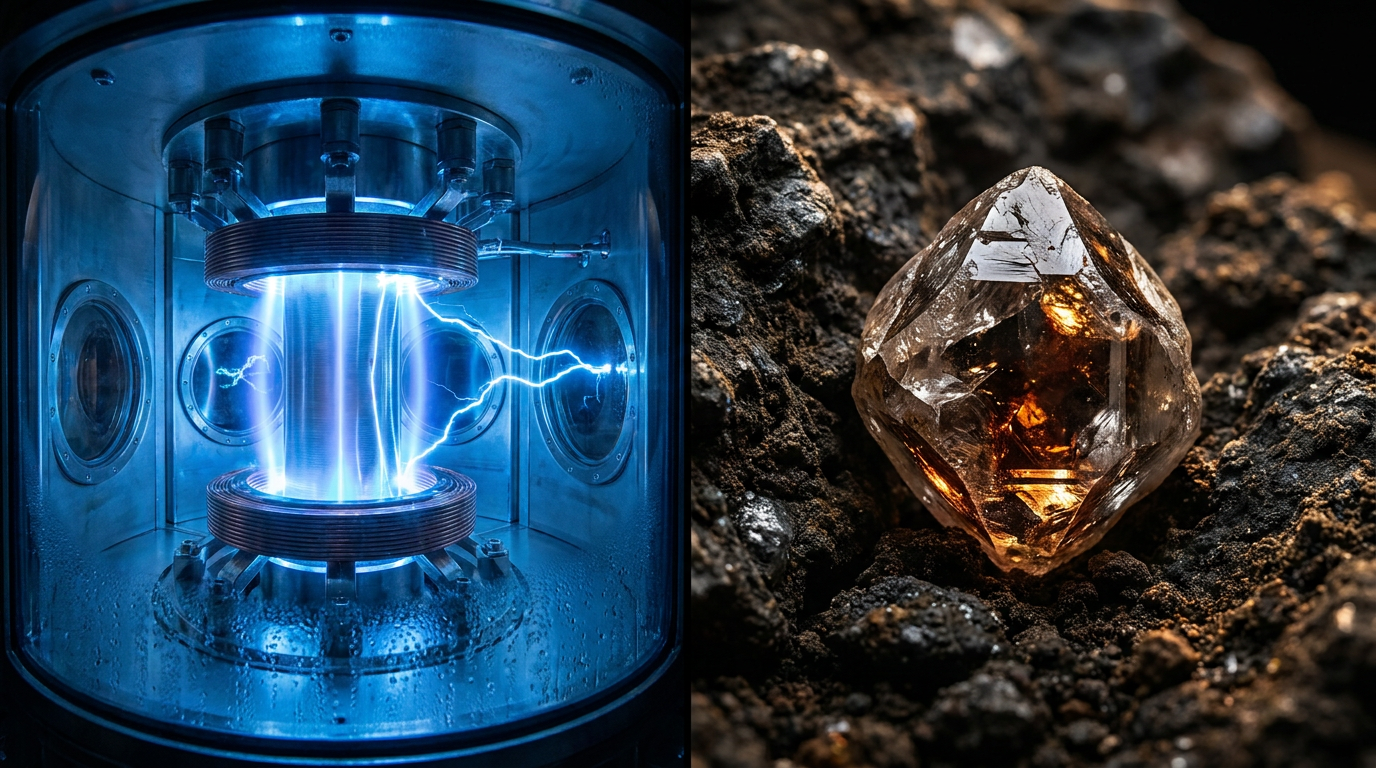
The diamond market has quietly crossed a historic threshold. As of early 2026, lab-grown stones account for more than half of all engagement ring purchases in the United States, fundamentally upending a century-old luxury monopoly. What was once a niche alternative has become the default choice for Gen Z and Millennial buyers, driven by a combination of plunging prices and identical physical properties. Yet, as the market matures, the decision between a stone pulled from the earth and one grown in a plasma reactor has become far more complex than a simple price tag.[6][7]
To the naked eye, and even under a jeweler's loupe, the two products are indistinguishable. Both are pure carbon arranged in a cubic crystal lattice, scoring a perfect ten on the Mohs hardness scale. The sole difference is origin. Natural diamonds were forged billions of years ago under crushing geological pressure deep within the Earth's mantle. Lab-grown diamonds are cultivated in a matter of weeks, typically using Chemical Vapor Deposition (CVD) or High Pressure High Temperature (HPHT) methods that mimic those exact subterranean conditions.[2][4]
The argument for lab-grown diamonds begins and often ends with price, and the cost gap has widened into a chasm. In 2025, a one-carat natural diamond retailed for an average of $4,200. Its lab-grown equivalent, boasting the exact same clarity and color, plummeted to $1,000 or less. This 60 to 80 percent discount has completely rewritten consumer budgets, allowing buyers to dramatically scale up their purchases without spending more money or compromising on the visual brilliance of the stone.[1][7]

Evidence of this shift is visible in the sheer size of the stones now dominating the market. Rather than pocketing the savings, consumers are upgrading. The average center stone for a lab-grown engagement ring ballooned from 1.31 carats in 2019 to nearly 2.5 carats by 2026. Furthermore, buyers are demanding flawless optics; nearly 86 percent of lab-grown diamonds sold last year were graded colorless, a massive leap from just 37 percent five years prior.[1][6]
However, the argument against lab-grown diamonds centers heavily on long-term financial retention. The very technology that makes them affordable also makes them infinitely replicable. As global production capacity has scaled, wholesale prices for lab-grown diamonds have collapsed by roughly 95 percent since 2018. They are no longer scarce, and the luxury market is reacting accordingly. In October 2025, the Gemological Institute of America (GIA) even stopped issuing traditional color and clarity grades for lab-grown stones, shifting instead to broader 'Premium' and 'Standard' categories.[2][4]
However, the argument against lab-grown diamonds centers heavily on long-term financial retention.
The evidence for this depreciation becomes painfully clear at the resale counter. Natural diamonds typically hold between 40 and 60 percent of their original retail value on the secondary market. In stark contrast, lab-grown diamonds currently retain only 10 to 15 percent of their purchase price, and a growing number of jewelers simply refuse to buy them back at all. Industry analysts frequently compare older lab-grown diamonds to last year's smartphone—highly functional, but rapidly losing economic relevance as manufacturing technology improves.[4][5]

The environmental comparison presents an equally complicated trade-off, shattering the myth that lab-grown automatically equals eco-friendly. The argument against natural diamonds is rooted in severe physical degradation. Extracting a single carat of natural diamond requires displacing roughly 250 tons of earth and consuming nearly 480 liters of water. Traditional mining leaves massive scars on the landscape and carries a dark historical legacy of exploitative labor and conflict funding, even with modern Kimberley Process regulations in place.[3]
Yet, the evidence against lab-grown diamonds reveals a massive carbon problem. While they require zero excavation, the plasma reactors used to grow them demand staggering amounts of electricity. Because over 60 percent of global lab-grown production occurs in China and India—countries heavily reliant on coal-powered energy grids—the carbon footprint can be immense. A mined diamond averages 160 kilograms of carbon dioxide emissions per carat; a lab-grown diamond produced on a coal-heavy grid can emit up to 600 kilograms of CO2. For ESG-conscious buyers, it is a direct trade-off between land destruction and atmospheric pollution.[3]

The argument against lab-grown diamonds also includes ongoing market transparency issues. Because the stones are visually and chemically identical to mined gems, consumers must rely entirely on microscopic laser inscriptions and certification paperwork to verify a diamond's origin. This has created industry anxiety around the undisclosed mixing of smaller accent stones, known as 'melee' diamonds, where testing every single tiny gem is often cost-prohibitive for jewelers. While major center stones are strictly tracked and certified, the broader jewelry supply chain is still adapting to a reality where synthetic carbon is ubiquitous.[4]
Heritage luxury brands have firmly planted their flags in the natural camp. Houses like Cartier, Tiffany & Co., and Van Cleef & Arpels exclusively use mined diamonds, arguing that true luxury requires inherent scarcity. They maintain that the billions of years required to form a natural diamond imbue it with a geological romance and historical weight that a factory simply cannot replicate. For these brands, a diamond's value is inextricably linked to its finite supply within the Earth.[3][4]
Ultimately, the lab-grown option fits well when a buyer prioritizes immediate visual impact, budget efficiency, and the strict avoidance of physical mining. It is the undisputed choice for consumers who want a larger, higher-quality stone for a fraction of the cost, provided they view the purchase as a sunk cost rather than a financial asset. It is a product of human ingenuity that democratizes access to a previously exclusive aesthetic.[8]

Conversely, the natural diamond fits well when a buyer values long-term wealth retention, geological rarity, and traditional heirloom status. It remains the necessary choice for those who want their purchase to hold a measurable percentage of its value decades later. While it carries a steep initial premium and a heavier footprint on the physical earth, it offers a permanence and scarcity that technology has yet to mass-produce.[8]
How we got here
2015
Lab-grown diamonds reach gem-quality parity with natural stones, entering the mainstream consumer market.
2018
Wholesale prices for lab-grown diamonds begin a steep decline as global manufacturing capacity scales.
2022
Gen Z adoption pushes lab-grown engagement rings into a major market force, driving down average ring prices.
2024
Lab-grown diamonds surpass 45% of all US engagement ring sales, marking a historic shift in luxury buying.
Oct 2025
The Gemological Institute of America (GIA) stops issuing traditional 4C grades for lab-grown diamonds, shifting to broader categories.
Viewpoints in depth
Lab-Grown Advocates
Argues that lab-grown diamonds democratize luxury by offering superior quality and size without the ecological devastation of traditional mining.
This camp emphasizes that a diamond is defined by its chemical structure, not its origin story. They point to the massive reduction in physical land displacement and the absolute guarantee of conflict-free origins. For these advocates, the collapsing price is a feature, not a bug—it removes the artificial scarcity maintained by mining cartels and allows consumers to purchase based purely on aesthetic beauty rather than inflated investment metrics.
Natural Diamond Traditionalists
Argues that true value stems from geological rarity, and that natural diamonds are the only stones capable of holding long-term financial and sentimental worth.
Traditionalists view lab-grown stones as a depreciating technological commodity, akin to a television or a smartphone. They cite the 95% collapse in lab-grown wholesale prices as proof that infinite supply destroys value. Furthermore, they argue that natural diamond mining, when heavily regulated by frameworks like the Kimberley Process, provides crucial economic infrastructure and employment for developing nations that rely on resource extraction.
ESG Realists
Argues that neither option is perfectly sustainable, framing the choice as a complex trade-off between land destruction and carbon emissions.
This perspective cuts through the marketing of both sides. They highlight that while lab-grown diamonds save the earth from being excavated, the energy-intensive plasma reactors—often powered by coal grids in China and India—can emit nearly three times the carbon dioxide of a traditional mining operation. They argue that until lab-grown facilities transition entirely to renewable energy, consumers are simply choosing which part of the environment they prefer to impact.
What we don't know
- Whether the secondary market will eventually stabilize a price floor for lab-grown diamonds, or if they will continue to depreciate toward the cost of production.
- How quickly major lab-grown manufacturers in Asia will transition their energy grids to renewable sources to lower their carbon footprint.
Key terms
- CVD (Chemical Vapor Deposition)
- A method of growing diamonds by placing a diamond seed in a vacuum chamber filled with carbon-rich gas, which is heated until the carbon bonds to the seed.
- HPHT (High Pressure High Temperature)
- A manufacturing process that mimics the natural formation of diamonds by subjecting carbon to extreme pressure and heat inside a mechanical press.
- Kimberley Process
- An international certification scheme designed to prevent conflict diamonds (blood diamonds) from entering the mainstream rough diamond market.
- Mohs Scale
- A scientific scale used to measure the hardness of minerals, where diamonds score a perfect 10, making them the hardest known natural material.
Frequently asked
Are lab-grown diamonds real diamonds?
Yes. They are chemically, physically, and optically identical to mined diamonds, consisting of pure carbon arranged in a crystal lattice.
Can a jeweler tell the difference?
Not with the naked eye or a standard jeweler's loupe. Differentiating them requires specialized laboratory equipment that detects trace growth patterns.
Will my lab-grown diamond lose its sparkle?
No. Because it is a real diamond, it will never cloud, fade, or change color over time, unlike cubic zirconia or moissanite.
Why do lab-grown diamonds have poor resale value?
Because they can be mass-produced in factories, their supply is infinite. This lack of scarcity drives down their value on the secondary market.
Sources
Source coverage
8 outlets
3 viewpoints surfaced








[1]BriteCoLab-Grown Advocates
The Lab-Grown Vs. Natural Diamond Report
Read on BriteCo →[2]DiamantwerpNatural Diamond Traditionalists
Lab-Grown vs Natural Diamonds: Antwerp Expert Guide (2025)
Read on Diamantwerp →[3]MediumESG Analysts
The ESG trade-off between natural and lab-grown diamond
Read on Medium →[4]MadisonDiaNatural Diamond Traditionalists
Cons of Lab-Grown Diamonds 2026 | What Jewelers Don't Tell You
Read on MadisonDia →[5]Shree Gems & JewelsNatural Diamond Traditionalists
2026 Guide: Lab-Grown vs Natural Diamond Comparison
Read on Shree Gems & Jewels →[6]Tashvi AILab-Grown Advocates
Lab Grown vs Natural Diamonds 2026: What Jewelers Skip
Read on Tashvi AI →[7]Pierce County JournalLab-Grown Advocates
Lab-grown diamonds now cost 73% less than natural diamonds. What that means for buyers in 2026
Read on Pierce County Journal →[8]Factlen Editorial TeamESG Analysts
Synthesis by Factlen editorial team
Read on Factlen Editorial Team →


Every angle. Every day.
Get shopping stories with full source coverage and perspective breakdowns delivered to your inbox.