
How NPUs and Open Models Brought AI Back to the Desktop
The era of paying monthly subscriptions for cloud-based AI is giving way to "Local AI," as dedicated neural processing chips allow users to run powerful models entirely offline, for free, and with absolute privacy.
By Factlen Editorial Team
- Privacy Advocates
- Argue that local AI is essential for protecting sensitive data from corporate surveillance and breaches.
- Open-Source Developers
- Value the democratization of AI, building tools that remove reliance on centralized cloud providers.
- Hardware Manufacturers
- View local AI as the catalyst for a massive hardware upgrade cycle, emphasizing NPU efficiency.
- Cloud AI Providers
- Maintain that while local AI is useful for basic tasks, true frontier intelligence requires massive data center compute.
What's not represented
- · Enterprise IT Administrators managing local AI deployment
- · Cybersecurity researchers analyzing open-weight model vulnerabilities
Why this matters
Running AI locally on your own hardware means zero subscription fees, complete data privacy, and the ability to use powerful language models entirely offline. It represents a massive shift in who controls artificial intelligence, moving power from centralized cloud providers back to the individual user.
Key points
- NPUs (Neural Processing Units) allow laptops to run AI models efficiently without draining battery life.
- Local AI ensures complete data privacy because prompts and documents never leave the user's device.
- Open-weight models like Llama and Gemma 4 offer frontier-level capabilities for free.
- Memory bandwidth and RAM capacity (32GB recommended) are the true bottlenecks for local AI, not just processing speed.
- Tools like Ollama and LM Studio have made downloading and running local models as easy as installing an app.
The cloud AI era is slowly giving way to the local AI era. For the past three years, utilizing a capable large language model meant paying a monthly subscription fee and sending your private prompts to a remote data center. In 2026, that paradigm is shifting rapidly back to the desktop, empowering users to run highly intelligent models on their own hardware without an internet connection.[7]
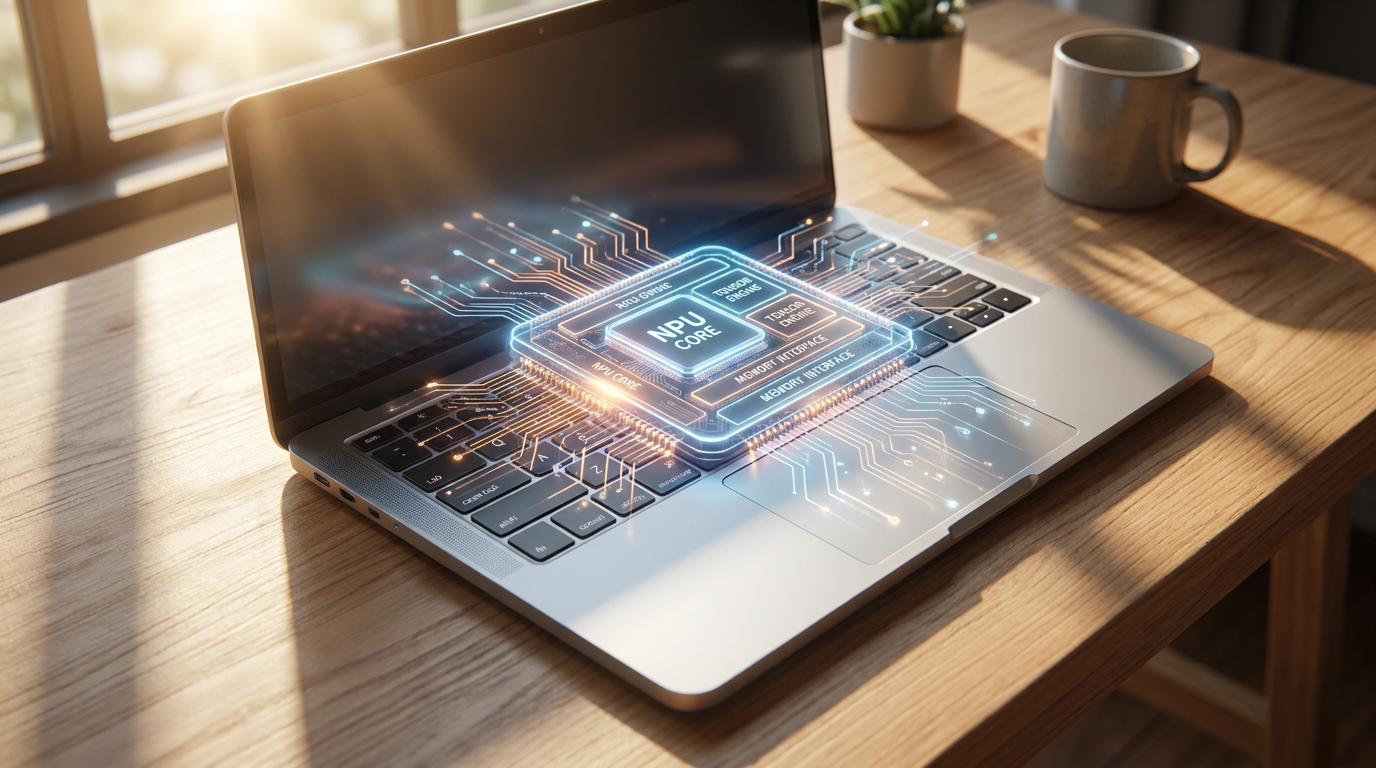
The catalyst for this shift is the "AI PC," a marketing term that has finally materialized into genuinely transformative hardware. Millions of consumer laptops now ship with a dedicated Neural Processing Unit (NPU), a specialized silicon chip that fundamentally alters how personal computers handle machine learning tasks.[5]
To understand why this matters, we have to look at the underlying mechanism of AI inference. Generating text, analyzing documents, or creating images requires billions of simultaneous matrix multiplication operations. Historically, central processing units (CPUs) were far too slow for this kind of parallel math, and graphics processing units (GPUs) were power-hungry beasts that drained laptop batteries in under an hour.[6]
The NPU solves this bottleneck by acting as a highly specialized calculator. It is hard-coded to perform the exact tensor mathematics required by neural networks, stripping away the general-purpose flexibility of a CPU and the graphics-rendering overhead of a GPU. It does one thing, but it does it with astonishing efficiency.[6]

The efficiency gains are staggering when measured in the real world. Running a local language model on a discrete laptop GPU might draw 110 watts of power and spin the cooling fans like a jet engine. Moving that exact same workload to a modern NPU drops the power consumption to roughly 15 watts, allowing for silent, all-day AI execution on battery power.[6]
Hardware manufacturers across the industry, including Intel, AMD, and Qualcomm, have standardized around this new architecture. Microsoft's "Copilot+" certification requires an NPU capable of at least 40 Trillion Operations Per Second (TOPS), though 2026 chips from AMD and Intel are already pushing past 50 TOPS, providing ample headroom for complex local models.[2][5]
But raw processing speed is only half the equation. The hidden bottleneck of local AI is actually memory bandwidth. A language model is essentially a massive file of mathematical weights; a 7-billion parameter model requires roughly 14 gigabytes of memory just to load into the system before it can generate a single word.[6]
Because the NPU must fetch these billions of weights for every single token it generates, the speed of the system's RAM dictates the speed of the AI. This is why unified memory architectures, where the NPU, CPU, and GPU share a massive pool of high-speed RAM without transferring data back and forth, have become the gold standard for local inference.[5][6]

For serious local AI work in 2026, 16 gigabytes of RAM is considered a cramped minimum. Industry experts now recommend 32 gigabytes as the baseline to comfortably hold the AI model, the operating system, and the user's context window simultaneously without slowing down the machine.[6]
For serious local AI work in 2026, 16 gigabytes of RAM is considered a cramped minimum.
Of course, hardware alone is useless without models to run on it. The open-source community has provided a wealth of highly capable "open-weight" models that rival the proprietary cloud giants of a year ago. Meta's Llama family, Mistral's optimized models, and Google's Gemma series are all designed to be downloaded and run locally by anyone.[4][7]
Google's Gemma 4, for instance, comes in a highly optimized 4-billion parameter size designed specifically for mobile phones and lightweight laptops. It proves that frontier-level reasoning, summarization, and coding assistance no longer require a billion-dollar data center to function.[4]
To fit these massive models onto consumer hardware, researchers rely heavily on a technique called quantization. By compressing the mathematical precision of the model's weights—shrinking them from 16-bit floating-point numbers down to 4-bit integers—the memory footprint shrinks drastically with only a negligible drop in the model's intelligence.[6][7]
The final piece of the puzzle is the software layer, which has evolved from complex command-line scripts into seamless, consumer-friendly applications. Tools like Ollama and LM Studio provide a Docker-like experience for AI: users simply select a model from a visual menu, click download, and instantly start chatting in a clean interface.[1]
Hardware vendors are also building their own bridges to make local deployment effortless. AMD's open-source Lemonade server, for example, auto-detects local GPUs and NPUs to serve language and image models through an interface that perfectly mimics cloud APIs, allowing developers to build local-first applications without changing their code.[2]

The shift to local AI brings three profound benefits to users, the first being absolute privacy. When a model runs on an NPU, the data never leaves the device. This is a game-changer for professionals analyzing proprietary corporate code, sensitive legal documents, or confidential patient records, as it entirely eliminates the risk of cloud data breaches.[3][7]
The second major benefit is economic. Cloud AI relies on a subscription model, charging users indefinitely for access to compute. Local AI is a one-time capital expenditure: once the hardware is purchased, generating a million words or a thousand images costs nothing but a fraction of a cent in electricity.[7]
Finally, local AI offers true autonomy. A laptop equipped with an NPU and an open-weight model works perfectly on an airplane, in a remote cabin, or during a massive internet outage. The user is completely insulated from API rate limits, sudden subscription price hikes, or a cloud provider deciding to deprecate a favorite model.[3][7]
There certainly remains a gap between local and cloud capabilities. A consumer laptop NPU cannot run a 1-trillion parameter frontier model, and for the most complex, multi-step reasoning tasks or massive data processing jobs, centralized data centers will continue to hold the crown.[7]

However, the future of personal computing is clearly hybrid. Routine daily tasks—drafting emails, summarizing long documents, and basic coding assistance—will be handled instantly and privately by the local NPU, while only the most demanding queries will be selectively routed to the cloud.[5][7]
By bringing intelligence back to the endpoint, the tech industry is democratizing artificial intelligence. It is transforming AI from a rented utility controlled by a few massive corporations into a permanent, private capability embedded directly into the tools we use every day.[7]
How we got here
Early 2023
The original LLaMA model leaks to the public, sparking the open-source local AI movement.
Late 2023
Tools like Ollama and LM Studio launch, making local deployment user-friendly for non-engineers.
Mid 2024
Microsoft announces 'Copilot+ PCs,' mandating NPUs with at least 40 TOPS for premium Windows laptops.
2025
Google releases Gemma 4, heavily optimizing frontier-level reasoning for mobile and edge devices.
Mid 2026
NPUs become standard in mid-tier and premium laptops, mainstreaming offline, zero-cost AI.
Viewpoints in depth
Privacy Advocates
Argue that local AI is essential for protecting sensitive data from corporate surveillance and breaches.
For privacy advocates, the shift to local AI is a necessary correction to the cloud era. When an AI tool runs locally, the data never leaves the machine. There is no server to breach, no corporate privacy policy to change, and no risk of proprietary code or sensitive personal information being used to train future models. This group views local processing not just as a convenience, but as an ethical default for tools that handle intimate or confidential communications.
Open-Source Developers
Value the democratization of AI, building tools that remove reliance on centralized cloud providers.
The open-source community sees local AI as a democratizing force. By building tools like Ollama and optimizing open-weight models, these developers are breaking the monopoly of massive tech conglomerates. They argue that AI should be a fundamental capability of personal computing, accessible to anyone with a standard laptop, rather than a rented utility hidden behind expensive API paywalls and arbitrary rate limits.
Hardware Manufacturers
View local AI as the catalyst for a massive hardware upgrade cycle, emphasizing NPU efficiency.
For companies like AMD, Intel, and Qualcomm, the rise of the NPU represents the most significant hardware upgrade cycle in a decade. They emphasize the massive efficiency gains of dedicated silicon, pointing out that NPUs allow for 'always-on' background intelligence without draining laptop batteries. This camp is heavily invested in proving that consumer hardware can handle meaningful AI workloads without cloud dependency.
What we don't know
- Whether open-weight models will continue to keep pace with the multi-trillion parameter proprietary models being trained in massive data centers.
- How quickly software developers will fully optimize their everyday applications to take advantage of NPU hardware.
- If Apple will open its highly efficient Neural Engine to broader open-source tooling beyond its proprietary frameworks.
Key terms
- NPU (Neural Processing Unit)
- A specialized computer chip designed exclusively to perform the matrix math required by artificial intelligence efficiently.
- TOPS (Trillions of Operations Per Second)
- A metric used to measure the raw computational speed of an NPU, with 40 TOPS currently serving as the baseline for premium AI PCs.
- Quantization
- A technique that compresses an AI model's file size by reducing the mathematical precision of its data, allowing it to fit into consumer laptop RAM.
- Open-weight model
- An AI model whose underlying architecture and mathematical parameters are publicly available for anyone to download, inspect, and run.
- Inference
- The process of a trained AI model generating a response, prediction, or image based on a user's prompt.
Frequently asked
Can I run ChatGPT locally on my computer?
No, ChatGPT is a proprietary cloud service owned by OpenAI. However, you can run highly capable open-weight alternatives like Meta's Llama 3 or Google's Gemma 4 locally on your machine.
Do I absolutely need an NPU to run local AI?
No. Modern CPUs and especially gaming GPUs can run local AI models very well. However, an NPU performs these tasks with significantly less battery drain and heat generation.
Is local AI completely free to use?
Yes. Once you own the capable hardware and download the open-source software and models, generating text or images costs nothing beyond the electricity required to run your computer.
How much RAM do I need for local AI?
While 16GB is the absolute minimum for running small models, 32GB of unified memory is highly recommended for a smooth experience with capable language models and desktop multitasking.
Sources
Source coverage
7 outlets
4 viewpoints surfaced





[1]GitHubOpen-Source Developers
Open Source AI tools and inference engines
Read on GitHub →[2]AMDHardware Manufacturers
From Cloud to Local: AI Across Every Tier
Read on AMD →[3]HPPrivacy Advocates
The NPU Advantage for Everyday Users
Read on HP →[4]MindStudioOpen-Source Developers
Running Gemma 4 Locally: Google's AI Edge Gallery
Read on MindStudio →[5]Dev.toHardware Manufacturers
The 2026 AI PC Landscape for Developers
Read on Dev.to →[6]MediumCloud AI Providers
Do You Really Need an 'AI PC' for Local LLMs in 2026?
Read on Medium →[7]Factlen Editorial TeamPrivacy Advocates
Synthesis by Factlen editorial team
Read on Factlen Editorial Team →

Every angle. Every day.
Get ai stories with full source coverage and perspective breakdowns delivered to your inbox.