
How Magnetic Sensors Finally Solved the Controller Stick Drift Epidemic
After years of frustrating hardware failures, the gaming industry is rapidly adopting Hall Effect joysticks—a frictionless, magnetic technology that eliminates stick drift at the source.
By Factlen Editorial Team
- Consumer Hardware Advocates
- Focuses on the right to repair, hardware longevity, and ending the cycle of disposable, friction-based controllers.
- Third-Party Manufacturers
- Views magnetic sensor technology as a crucial competitive wedge to steal market share from first-party console makers.
- Competitive Gamers
- Values the sustained precision, zero deadzones, and high polling rates that magnetic sensors provide for high-stakes gameplay.
What's not represented
- · First-Party Console Manufacturers (Sony/Microsoft/Nintendo)
- · Game Developers optimizing for deadzones
Why this matters
For years, gamers have been forced to treat $70 controllers as disposable items due to inevitable hardware degradation. The widespread adoption of magnetic sensors means consumers can finally buy peripherals that last for years without losing precision.
Key points
- Traditional controllers use potentiometers, which inevitably fail due to physical friction wearing away internal carbon tracks.
- Hall Effect joysticks use magnets and sensors to track movement through empty air, eliminating mechanical wear.
- The technology was used in the 1999 Sega Dreamcast but abandoned by the industry to save manufacturing costs.
- Third-party brands like 8BitDo and GameSir have forced a market shift by making drift-proof sticks the new standard.
- Newer TMR (Tunnelling Magnetoresistance) sensors are now emerging, offering even higher precision and lower power draw.
Few things in modern gaming are as universally infuriating as stick drift. You are holding an angle in a tense multiplayer match, your thumbs are completely still, yet your character inexplicably creeps forward into the line of fire. Or you are navigating a precarious platforming section, and the camera slowly pans left all on its own. For the better part of a decade, this hardware failure has ruined matches, spawned class-action lawsuits, and forced consumers to treat expensive gamepads as temporary rentals.[1][6]
The epidemic spanned the entire industry. Nintendo's Switch Joy-Cons became infamous for it, but Sony's DualSense and Microsoft's Xbox Wireless Controllers suffered from the exact same underlying vulnerability. The root of the problem was not a software bug or a manufacturing defect, but the fundamental physics of the technology used inside almost every major controller since the PlayStation 2 era: the potentiometer.[1][2]
To understand why controllers fail, you have to understand how a potentiometer works. Inside a traditional analog stick module, there is a small metal wiper that physically drags across a curved strip of carbon to measure resistance. As you tilt the stick, the wiper changes its position on the track, altering the electrical resistance, which the controller's processor translates into an X/Y coordinate on your screen.[1][2]
The fatal flaw of the potentiometer is friction. Every single time you move the joystick—whether you are gently steering a car or frantically clicking the stick to sprint—that metal wiper scrapes against the carbon track. Over hundreds of hours of gameplay, this constant rubbing physically wears away the conductive material. It leaves behind microscopic debris and creates uneven grooves in the track. Eventually, the sensor can no longer read a clean signal, resulting in the phantom inputs known as stick drift. It is a consumable part by design; failure is not a possibility, but a mathematical certainty.[2][3]

Enter the Hall Effect sensor. Over the last two years, this alternative technology has rapidly transitioned from a niche enthusiast upgrade to the baseline expectation for any serious gaming controller. Instead of relying on physical contact and friction to measure movement, Hall Effect joysticks use the magic of magnets.[3][4]
The technology is named after American physicist Edwin Hall, who discovered the underlying principle in 1879. The Hall Effect dictates that when a magnetic field is applied perpendicular to an electrical conductor, it creates a measurable voltage difference across that conductor. By measuring that voltage, you can determine exactly how close or far away the magnet is.[3][6]
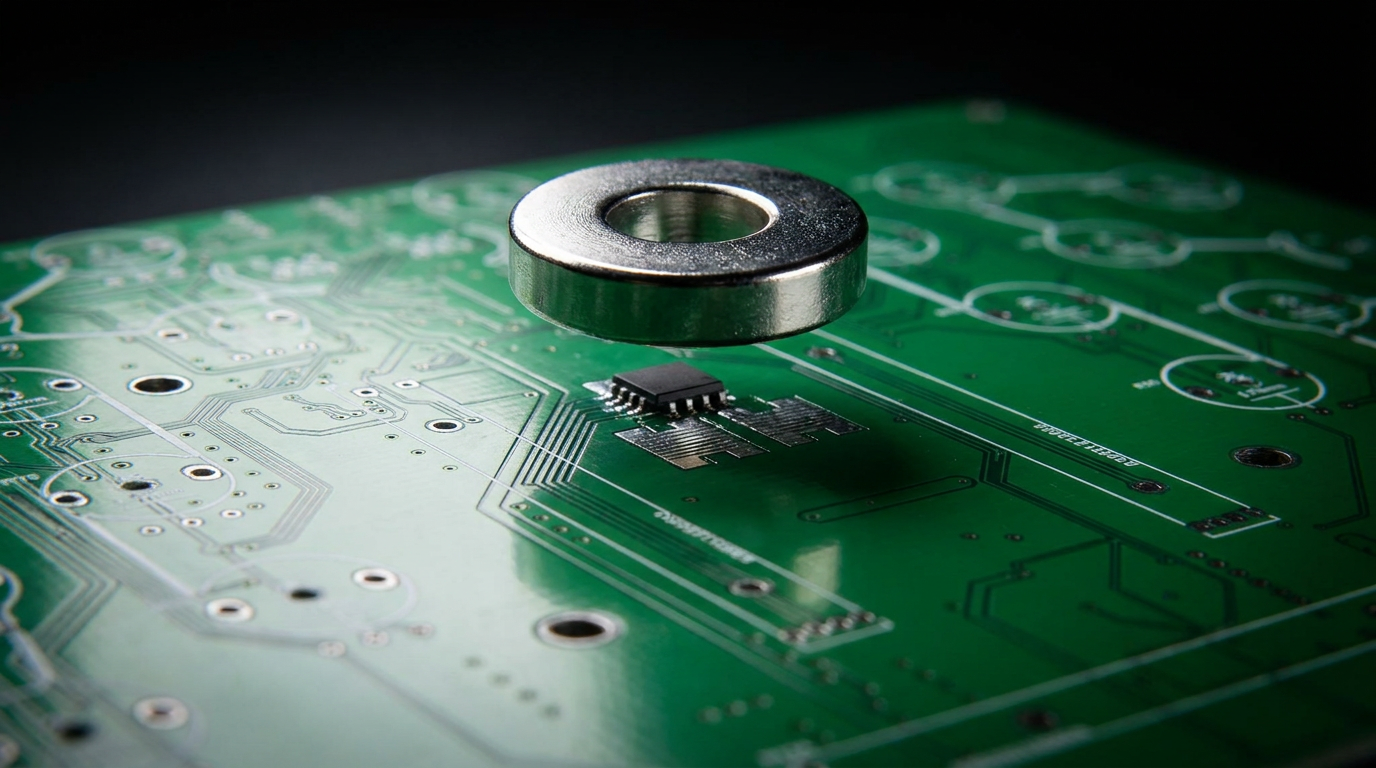
In a modern Hall Effect joystick, a tiny magnet is mounted directly to the bottom of the stick shaft. Sitting just below it on the circuit board is a Hall sensor. When you tilt the joystick, the magnet shifts its position in the air above the sensor. The sensor detects the minute changes in the magnetic field's strength and direction, instantly converting that data into a voltage signal that the controller reads as movement.[1][3]
In a modern Hall Effect joystick, a tiny magnet is mounted directly to the bottom of the stick shaft.
Because the magnet and the sensor never actually touch, there is zero physical friction involved in the measurement process. No parts rub together, no carbon tracks are scraped away, and no conductive dust is left behind. The sensor measures a magnetic field through empty air—a process that works identically whether the controller is fresh out of the box or has been used for five years. The primary mechanical wear mechanism behind stick drift is eliminated entirely.[1][2][3]
The irony of the current hardware revolution is that Hall Effect joysticks are not a new invention. Sega famously utilized Hall Effect sensors in the Dreamcast controller way back in 1999. However, as the industry standardized in the early 2000s, manufacturers shifted to potentiometers to shave pennies off the manufacturing cost of each unit. For decades, the cheaper, friction-based modules were deemed "good enough"—until the precision demands of modern competitive shooters and the sheer volume of consumer complaints forced a reckoning.[2][6]
The modern resurgence was not led by the big three console makers, but by agile third-party hardware manufacturers. Brands like GuliKit, 8BitDo, and GameSir saw an opening in the market and began aggressively marketing "drift-proof" controllers. By offering premium features and Hall Effect sticks at prices that often undercut standard first-party gamepads, these disruptors forced a massive shift in consumer expectations.[4][5]

By 2026, the landscape has completely transformed. Reviews for PC and console controllers now routinely penalize any premium gamepad that still relies on potentiometers. Devices like the GameSir G7 Pro and the Flydigi Vader 4 Pro have proven that Hall Effect technology can be implemented affordably while delivering polling rates of 1000Hz, making them the top choices for competitive players who demand instantaneous, reliable inputs.[4][6]
However, the transition to frictionless sticks does come with a slight learning curve. Because there is no physical wiper dragging against a track, Hall Effect joysticks can initially feel "loose" or "slippery" to players who have spent years unconsciously relying on the subtle mechanical resistance of a potentiometer. High-end controllers have solved this by introducing adjustable tension rings, allowing players to dial in the exact physical resistance they prefer using adjustable springs.[6]
Engineers also had to solve the problem of "centering jitter." Because magnetic sensors are incredibly sensitive and completely frictionless, the stick's physical spring mechanism sometimes struggles to return the magnet to a perfect mathematical zero when released. It might rest at 0.0002 instead of 0.0000. Modern Hall Effect controllers utilize smart firmware algorithms to filter out these microscopic resting variances without creating the massive, clunky "deadzones" required by older controllers.[6]
The technology is already evolving further. In late 2025 and 2026, manufacturers began introducing TMR (Tunnelling Magnetoresistance) thumbsticks. TMR is an advanced evolution of magnetic sensing that offers even higher resolution tracking than standard Hall Effect sensors while consuming significantly less battery power. Controllers like the 8BitDo Ultimate 2 have adopted TMR to provide sublimely smooth inputs that represent the absolute bleeding edge of consumer hardware.[4][5]

How we got here
1879
Physicist Edwin Hall discovers the Hall Effect, proving magnetic fields can induce voltage in conductors.
1999
Sega releases the Dreamcast, featuring a controller that utilizes early Hall Effect sensors for its analog stick.
2000–2022
The gaming industry standardizes on cheaper, friction-based potentiometer joysticks, leading to widespread stick drift issues.
2023–2024
Third-party manufacturers begin aggressively marketing affordable Hall Effect controllers as the permanent solution to drift.
2025–2026
Magnetic sensors become the baseline expectation for premium controllers, with advanced TMR sensors entering the market.
Viewpoints in depth
Consumer Hardware Advocates
Focuses on repairability, longevity, and ending the cycle of disposable hardware.
For repair communities like iFixit and consumer advocates, the transition to Hall Effect sensors is a long-overdue correction to a massive industry failure. They argue that first-party manufacturers knowingly continued to use consumable, friction-based potentiometers for years despite mounting evidence of widespread failure. To this camp, a $70 controller should be an investment that lasts the lifespan of the console, not a subscription fee paid every time the carbon tracks wear out. They view magnetic sensors as a victory for the right-to-repair movement and sustainable consumer electronics.
Third-Party Manufacturers
Views magnetic sensor technology as a crucial competitive wedge to steal market share.
Brands like GuliKit, GameSir, and 8BitDo recognized that stick drift was the single biggest pain point for modern gamers. By integrating Hall Effect sensors into their designs, they created a powerful marketing narrative: their controllers were fundamentally more reliable than the official gamepads sold by Sony, Microsoft, and Nintendo. This camp focuses heavily on the technical superiority of frictionless tracking, using it to justify their place in the premium peripheral market and forcing the broader industry to adapt to the new standard they set.
Competitive Gamers
Values the sustained precision, zero deadzones, and high polling rates that magnetic sensors provide.
For esports professionals and highly competitive players, longevity is secondary to raw performance. Traditional potentiometers require software 'deadzones' to hide minor centering inaccuracies, which inherently reduces a player's fine aiming control in shooters. Because Hall Effect and TMR sensors do not degrade, competitive players can set their deadzones to absolute zero, ensuring that every microscopic twitch of the thumb translates instantly to the screen. This camp evaluates controllers based on polling rates, tension adjustability, and the firmware's ability to deliver raw, unfiltered input data.
What we don't know
- Whether first-party console makers will fully adopt Hall Effect or TMR sensors for the default pack-in controllers of their next-generation consoles.
- How long the physical centering springs inside modern magnetic joysticks will last before losing tension under heavy competitive use.
Key terms
- Stick Drift
- A hardware failure where a controller registers movement even when the joystick is not being touched, usually caused by internal wear and tear.
- Potentiometer
- A variable resistor that measures position using a physical metal wiper sliding across a conductive carbon track.
- Hall Effect
- A physical phenomenon where a magnetic field induces a measurable voltage change in a nearby conductor, allowing for contactless position tracking.
- Polling Rate
- How many times per second a controller reports its inputs to the console or PC, measured in Hertz (Hz).
- Deadzone
- A small area around the center of a joystick's range where physical movement is ignored by the software, often used to hide the early stages of stick drift.
Frequently asked
Can I upgrade my current controller to Hall Effect?
Yes, but it is not plug-and-play. Upgrading a standard Xbox or PlayStation controller requires desoldering the old potentiometer modules from the circuit board, soldering on new Hall Effect modules, and performing software calibration.
Do Hall Effect controllers ever break?
While the magnetic sensor itself will not wear out from friction, other parts of the controller can still fail. The plastic thumbstick caps can wear down, and the internal metal centering springs can eventually lose tension or snap after years of heavy use.
Why didn't Sony and Microsoft use this originally?
Potentiometer modules are slightly cheaper to manufacture at scale. The industry standardized around them in the early 2000s, and major console makers were slow to change their massive supply chains until stick drift became a widespread public relations issue.
What is TMR technology?
Tunnelling Magnetoresistance (TMR) is an advanced evolution of magnetic sensing introduced to controllers in 2025 and 2026. It offers even higher resolution tracking and consumes less battery power than standard Hall Effect sensors.
Sources
Source coverage
6 outlets
3 viewpoints surfaced






[1]Gamepad TesterConsumer Hardware Advocates
How magnetic sensors eliminated stick drift — and why it matters for your controller buying decision in 2026
Read on Gamepad Tester →[2]Controller RepairsConsumer Hardware Advocates
Potentiometer vs. Hall Effect: The Permanent Solution to Drift
Read on Controller Repairs →[3]ELO EsportsThird-Party Manufacturers
What Are Hall Effect Joysticks and Why Are They Important for Gaming?
Read on ELO Esports →[4]PC GamerCompetitive Gamers
The best PC controller in 2026
Read on PC Gamer →[5]TechRadarCompetitive Gamers
The best PC controllers 2026: top gamepads from Valve, 8BitDo, and more
Read on TechRadar →[6]Factlen Editorial TeamThird-Party Manufacturers
Synthesis by Factlen editorial team
Read on Factlen Editorial Team →
Every angle. Every day.
Get gaming esports stories with full source coverage and perspective breakdowns delivered to your inbox.