
How an 'Immune Reset' Therapy is Putting Severe Lupus into Remission
A revolutionary cell therapy originally developed for cancer is effectively curing severe lupus in early trials by wiping out rogue immune cells and allowing the body to reboot.
By Factlen Editorial Team
- Clinical Investigators
- Focus on trial data, safety profiles, and the biological mechanism of the immune reset.
- Patient Community
- Emphasize the dramatic quality-of-life improvements and the end of lifelong immunosuppression.
- Medical Optimists
- Look at the broader implications for treating other autoimmune diseases and the eventual challenge of scaling bespoke therapies.
What's not represented
- · Health Insurance Providers
- · Patients in Developing Nations
Why this matters
Lupus disproportionately affects women, often requiring a lifetime of heavy immunosuppressive drugs that only manage symptoms. If this single-infusion 'immune reset' proves durable, it could shift the medical paradigm from managing autoimmune diseases to effectively curing them.
Key points
- CAR-T cell therapy is effectively curing severe lupus in early clinical trials by resetting the immune system.
- The treatment involves genetically modifying a patient's own T-cells to hunt down and destroy rogue B-cells.
- Once the malfunctioning B-cells are eliminated, the body repopulates with healthy, naive cells that do not attack tissues.
- Five out of six patients in a UK trial achieved deep remission, allowing them to stop lifelong immunosuppressive medications.
- While long-term durability is still being studied, the breakthrough offers immense hope for treating multiple autoimmune diseases.
Systemic lupus erythematosus is a chronic, often devastating autoimmune disease that turns the body’s defense mechanisms against itself. Affecting an estimated five million people worldwide, the condition disproportionately impacts women, who make up roughly 90 percent of all cases. For decades, the standard of care has relied on a heavy, lifelong regimen of steroids and broad immunosuppressants. These drugs blunt the immune system's attack on the kidneys, heart, and joints, but they also leave patients vulnerable to infections and carry severe long-term side effects.[5][6]
In the field of rheumatology, the word "cure" is rarely spoken. The goal has historically been disease management—keeping flares at bay and minimizing organ damage. However, a revolutionary approach to cellular medicine is beginning to rewrite those expectations. By borrowing a cutting-edge technique originally developed to eradicate blood cancers, scientists are now achieving what was once thought impossible: deep, drug-free remission for patients with the most severe, treatment-resistant forms of lupus.[1][5]
The breakthrough centers on chimeric antigen receptor T-cell therapy, widely known as CAR-T. In oncology, CAR-T has transformed the prognosis for certain leukemias and lymphomas by turning the patient's own immune cells into a targeted strike force. Now, researchers are deploying that same biological weaponry against autoimmune diseases. Early clinical trials in the United Kingdom, Germany, and the United States are demonstrating that a single infusion of engineered cells can effectively halt lupus in its tracks.[1][2][6]
The most recent and striking evidence comes from the CARLYSLE trial, spearheaded by University College London Hospitals (UCLH) and University College London. The trial enrolled nine adults with highly active, severe lupus that had failed to respond to multiple conventional therapies. Most of the participants suffered from lupus nephritis, a dangerous complication that severely damages the kidneys. The medical team sought to determine if a specialized CAR-T therapy, originally designed for cancer, could safely eliminate the root cause of their autoimmune attacks.[4]

The human impact of the trial has been profound. Katie Tinkler, one of the first patients treated, had lived with severe lupus for 30 years. The debilitating pain and chronic fatigue forced her to abandon her career as a fitness instructor, and she frequently struggled simply to walk. Following the CAR-T infusion, Tinkler reported that she had "never been this good" since her diagnosis. Today, she is entirely off her lupus medication, has returned to skiing, and recently danced at her daughter's wedding.[1][2][3]
To understand why this therapy is so effective, it is necessary to look at the underlying mechanics of lupus. The disease is primarily driven by malfunctioning B cells—a type of white blood cell that normally produces antibodies to neutralize viruses and bacteria. In lupus patients, these B cells lose their tolerance for the body's own tissues. They begin churning out autoantibodies that mistakenly identify the kidneys, skin, and joints as foreign invaders, triggering a relentless inflammatory attack.[5][6]
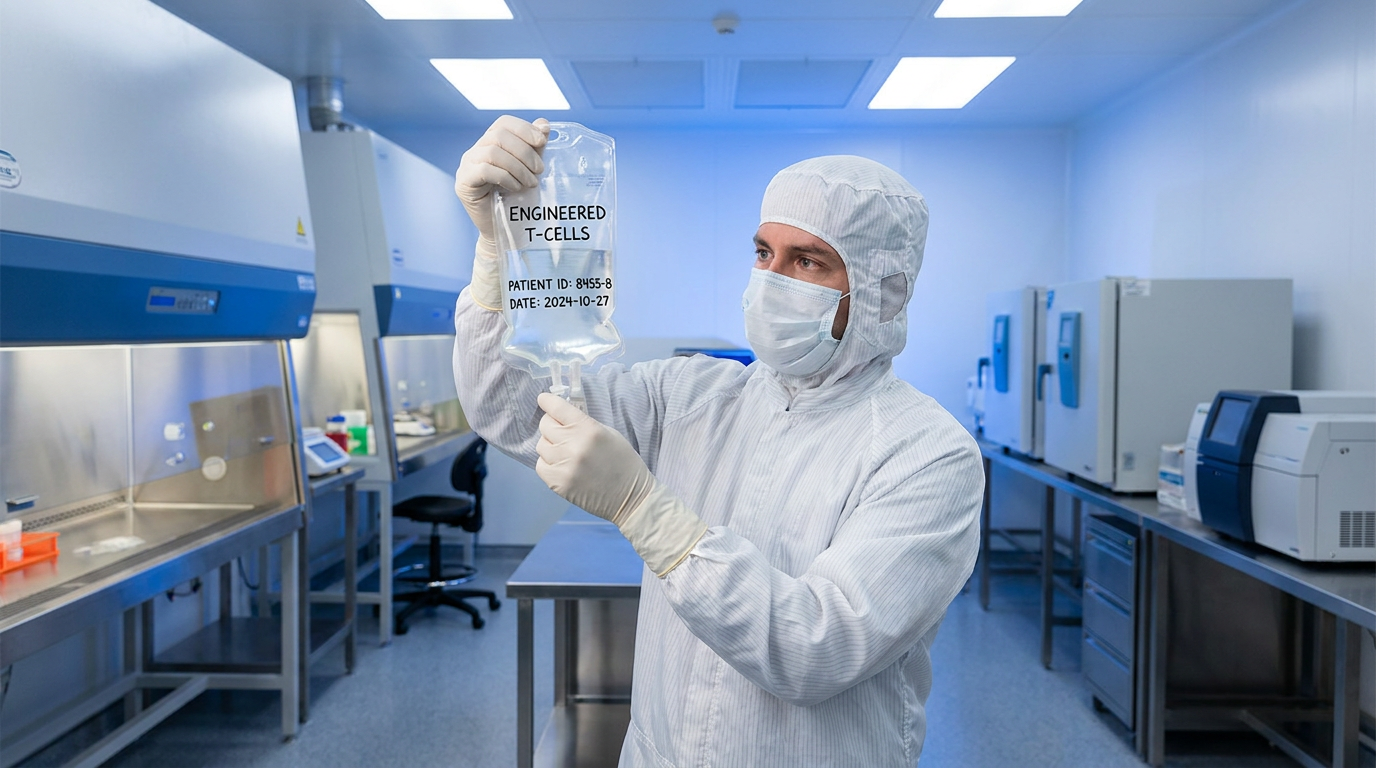
CAR-T therapy intervenes by physically removing the patient's T cells—another type of immune cell—through a blood filtration process called apheresis. These extracted T cells are sent to a specialized laboratory, where scientists genetically modify them. They insert a new piece of genetic code that instructs the T cells to produce chimeric antigen receptors on their surface. These synthetic receptors act like homing beacons, designed to seek out and lock onto a specific protein.[2][6]
CAR-T therapy intervenes by physically removing the patient's T cells—another type of immune cell—through a blood filtration process called apheresis.
In the case of the UCLH trial and similar studies, the engineered receptors are programmed to target CD19, a protein found almost exclusively on the surface of B cells. Once the T cells have been successfully modified and multiplied in the lab, the patient undergoes a brief course of chemotherapy. This "conditioning" step clears out existing immune cells to make room for the new arrivals. Finally, the engineered CAR-T cells are infused back into the patient's bloodstream.[4][5][6]
Upon re-entering the body, the CAR-T cells act as a highly precise biological smart bomb. They hunt down every cell expressing the CD19 protein and destroy it. Within weeks, the patient's entire B cell compartment—including the rogue cells responsible for producing the destructive autoantibodies—is completely wiped out. With the source of the autoantibodies eliminated, the relentless autoimmune attack on the patient's organs abruptly ceases, allowing the body to begin healing.[3][4]

The most remarkable phase of the treatment occurs in the months following the infusion. The human body naturally regenerates B cells from stem cells in the bone marrow. When these new B cells eventually repopulate the patient's immune system—typically three to six months after the treatment—they emerge as "naive" or immature cells. Crucially, they do not carry the autoimmune memory that caused the original disease.[1][3][4]
This phenomenon is what researchers refer to as an "immune reset." By completely clearing the board of malfunctioning cells, the therapy allows the immune system to reboot itself from scratch. The newly generated B cells function normally, providing protection against infections without turning their weapons on the host. It is the biological equivalent of turning a frozen, glitching computer off and on again, restoring it to its factory settings.[1][4]
The clinical data backing this mechanism is highly encouraging. In the UCLH trial, five of the first six patients who received a lower dose of the CAR-T therapy achieved clinical remission within months. Researchers observed rapid reductions in disease activity and significant improvements in laboratory markers. For those suffering from lupus nephritis, kidney function stabilized or improved, demonstrating that the therapy can halt and potentially reverse severe organ damage.[2][4]

These UK findings build upon pioneering work conducted internationally. In 2022, researchers at Friedrich-Alexander University in Germany published landmark case reports detailing the first lupus patients to achieve sustained, drug-free remission following CAR-T therapy. Meanwhile, multiple institutions in the United States, including UC Davis Health, are actively enrolling patients in trials to evaluate similar CD19-targeted therapies, signaling a massive global shift in autoimmune research.[5][6]
Despite the immense promise, specialists emphasize that the therapy is not without risks and limitations. The chemotherapy conditioning required before the infusion is physically taxing. Furthermore, CAR-T therapy is known to cause severe side effects in cancer patients, such as cytokine release syndrome—a dangerous inflammatory response—and neurotoxicity. Fortunately, early data suggests that lupus patients tolerate the treatment much better than oncology patients, likely because their overall burden of target B cells is much lower than in leukemia.[4][5]

The most pressing question facing researchers today is the long-term durability of the immune reset. While patients have remained in deep remission for months—and in the earliest German cases, for several years—it is not yet known if the newly generated B cells will eventually revert to their autoimmune behavior decades down the line. Larger Phase II studies, such as the upcoming LUMINA trial in the UK, are currently recruiting patients to track these outcomes over extended periods.[4][5]
If the remissions prove to be permanent, the implications for modern medicine are staggering. The ability to reset a malfunctioning immune system could extend far beyond lupus. Researchers are already exploring the potential of CAR-T cell therapy to treat a wide array of other debilitating autoimmune conditions, including multiple sclerosis, rheumatoid arthritis, and systemic sclerosis. For millions of patients—and particularly for women, who bear the overwhelming brunt of autoimmune diseases—the prospect of a definitive cure may finally be within reach.[1][3]
How we got here
2021-2022
German researchers publish first case reports of CAR-T therapy inducing remission in severe lupus.
2024
US institutions like UC Davis begin enrolling patients in trials for CD19-targeted CAR-T therapies.
Nov 2025
UCLH administers CAR-T therapy to nine adults with treatment-resistant lupus in the CARLYSLE trial.
Jun 2026
UCLH announces five of the first six patients achieved deep remission, effectively resetting their immune systems.
Viewpoints in depth
Clinical Researchers
Cautiously optimistic about a potential cure but focused on long-term data.
While the immediate clinical results are staggering, researchers emphasize that the scientific community must remain patient. The primary concern is whether the newly generated B cells will eventually "re-learn" their autoimmune behavior years or decades after the initial infusion. Investigators are pushing for larger, multi-center Phase II trials—such as the LUMINA study—to gather robust, long-term data on durability and to ensure the intensive chemotherapy conditioning required does not introduce unforeseen secondary risks.
Patient Advocates
Celebrating a life-changing milestone while highlighting accessibility concerns.
For the patient community, the prospect of an "immune reset" is nothing short of miraculous. Advocates highlight the profound physical and psychological toll of living with a disease that disproportionately targets young women and requires a lifetime of toxic immunosuppressants. However, they also caution that CAR-T is currently a bespoke, highly expensive therapy. There is growing concern that without significant manufacturing advancements and healthcare subsidies, this cure could remain out of reach for the vast majority of the five million people living with lupus worldwide.
Immunologists
Fascinated by the mechanics of the immune reboot.
From a purely biological standpoint, immunologists are captivated by the "blank slate" phenomenon observed in these trials. Previously, it was widely assumed that the body's autoimmune memory might be too deeply entrenched to simply wipe away. The discovery that repopulating B cells emerge as "naive" and do not immediately resume attacking the host's tissues challenges old paradigms. This mechanism suggests that the fundamental flaw in lupus may not be permanently hardwired into the stem cells, opening entirely new avenues for treating other autoimmune conditions.
What we don't know
- Whether the newly generated B-cells will eventually revert to autoimmune behavior years or decades after the treatment.
- How the therapy will perform in larger, diverse patient populations during upcoming Phase II trials.
- When the treatment might become widely accessible outside of strict clinical trial settings.
Key terms
- Systemic Lupus Erythematosus (SLE)
- A chronic autoimmune disease where the body's immune system mistakenly attacks healthy tissue, including skin, joints, and internal organs.
- CAR-T Cell Therapy
- A treatment that genetically engineers a patient's own T-cells to hunt down and destroy specific target cells.
- B Cells
- A type of white blood cell that normally produces antibodies to fight infections, but in lupus, produces autoantibodies that attack the body.
- CD19
- A protein found on the surface of B cells, used as a target for the engineered CAR-T cells to lock onto.
- Immune Reset
- The process of wiping out the body's existing, malfunctioning B cells so that new, healthy B cells can grow in their place without the autoimmune defect.
Frequently asked
Is CAR-T therapy a permanent cure for lupus?
It is too early to call it a permanent cure. While patients have achieved deep, drug-free remission, researchers are still tracking them to see if the disease returns years later.
How is this different from standard lupus treatments?
Standard treatments use daily drugs to suppress the immune system and manage symptoms. CAR-T is a one-time infusion designed to eliminate the root cause by wiping out the rogue cells.
Can anyone with lupus get this treatment right now?
No. Currently, it is only available through clinical trials for patients with severe, treatment-resistant lupus.
Will this work for other autoimmune diseases?
Researchers are highly optimistic. Trials are already exploring CAR-T therapy for multiple sclerosis, rheumatoid arthritis, and systemic sclerosis.
Sources
Source coverage
6 outlets
3 viewpoints surfaced





[1]BBCPatient Community
'I've never been this good' – revolutionary immune reset puts lupus in remission
Read on BBC →[2]The GuardianPatient Community
Five lupus patients in England in remission after revolutionary therapy
Read on The Guardian →[3]The IndependentMedical Optimists
Patients with severe lupus achieve remission following groundbreaking 'immune reset'
Read on The Independent →[4]University College London HospitalsClinical Investigators
CAR T‑cell therapy offers new hope for severe lupus as a UCLH trial helps patient achieve remission
Read on University College London Hospitals →[5]National Institutes of HealthClinical Investigators
Chimeric antigen receptor T cell (CAR-T) therapy in systemic lupus erythematosus
Read on National Institutes of Health →[6]UC Davis HealthClinical Investigators
Using CAR T cells to treat lupus
Read on UC Davis Health →

More in health
See all 24 stories →Type 1 Diabetes
FDA Approves First Therapy to Preserve Insulin Production in Newly Diagnosed Type 1 Diabetes
0 sources
Nutrition Science
The Food Matrix: Why Nutrition Science is Moving Beyond Calories and Macros
0 sources

Food Policy
How Chile’s Black Octagon Warning Labels Are Reshaping Global Nutrition
0 sources

Pediatric Diabetes
FDA Approves First Disease-Modifying Therapy for Children Newly Diagnosed With Stage 3 Type 1 Diabetes
0 sources
Every angle. Every day.
Get health stories with full source coverage and perspective breakdowns delivered to your inbox.