
Bilingual Brains Use a Single 'Grammatical Engine' for All Languages, Study Finds
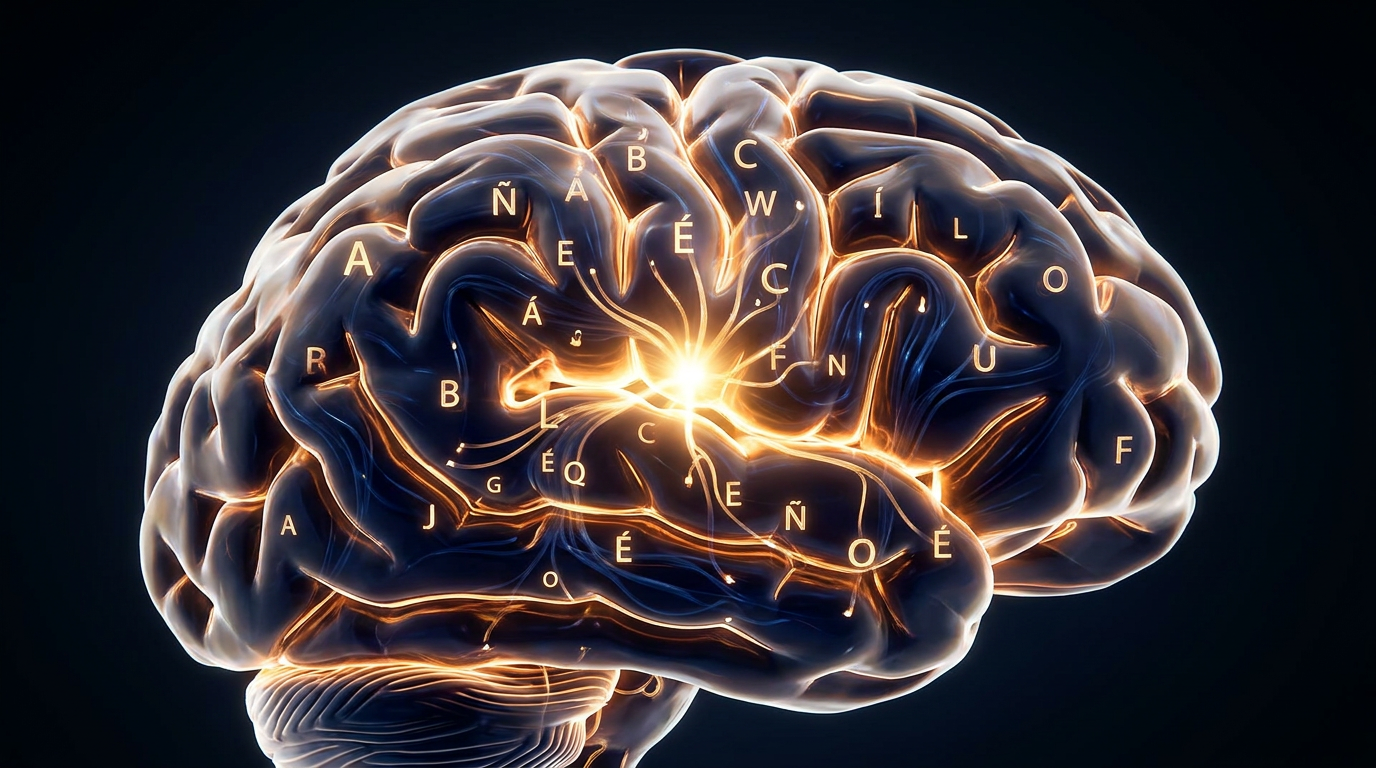
A landmark neuroimaging study reveals that the human brain does not build separate grammatical rulebooks for different languages, but instead relies on a single, shared neural engine.
By Factlen Editorial Team
- Cognitive Neuroscientists
- Focus on the biological efficiency and shared architecture of the brain.
- Language Educators
- Focus on how this discovery could revolutionize language teaching and adult learning.
- Factlen Editorial
- Focus on synthesizing the evidence and highlighting the evolutionary efficiency of human language.
What's not represented
- · Linguists specializing in non-Indo-European languages
- · Adults currently struggling to acquire a second language
Why this matters
This discovery fundamentally changes our understanding of how the human brain processes language, proving that we use a single, highly efficient system for every tongue we speak. For the millions of adults struggling to learn a new language, it offers hope that teaching methods could soon be optimized to plug new vocabulary directly into the brain's existing grammatical engine.
Key points
- A new NYU study proves bilingual brains use a single, shared neural engine for grammar, rather than separate systems for each language.
- Researchers used MEG imaging to track brain activity millisecond-by-millisecond as participants transformed words from singular to plural.
- The exact same neural template fired when participants processed English, Spanish, and completely fabricated pseudowords.
- The findings suggest that learning a new language involves utilizing an existing grammatical framework rather than building a new one from scratch.
For anyone who speaks more than one language, the occasional grammatical slip-up is a familiar experience. A native Spanish speaker conversing in English might accidentally say "I have 20 years" instead of "I am 20," applying the structural rules of one tongue to the vocabulary of another. For decades, these mashups led some cognitive scientists to wonder if the brain housed separate, language-specific "rulebooks" that occasionally collided in real-time speech.[1][5]
A landmark study has fundamentally redrawn that map of the bilingual mind. According to new research from New York University, the human brain does not build separate grammatical engines for each language a person learns. Instead, it relies on a single, highly reusable neural system that processes the structural rules of every language a person speaks.[1][2][4][5][6]
The findings, published in the Journal of Neuroscience, provide some of the clearest empirical evidence to date that human grammar is executed as a universal computational loop. By tracking the brain activity of Spanish-English bilinguals down to the millisecond, researchers demonstrated that the exact same neural template fires regardless of which language is being spoken.[2][3][4]
"Our research suggests that brains have a single grammatical engine that fuels all of the languages we speak—rather than separate engines for each one," explained Esti Blanco-Elorrieta, an assistant professor of psychology and neural science at NYU and the study's senior author.[5]

To prove this, the research team had to capture the lightning-fast speed of human speech processing. They utilized magnetoencephalography (MEG), an advanced, noninvasive neuroimaging tool that maps the exact magnetic fields generated by electrical currents in the brain. Unlike standard fMRI scans, which track slower changes in blood flow, MEG allows scientists to watch grammatical computations unfold millisecond by millisecond.[2][3][6]
The core of the experiment was a "morphological stress test." The bilingual participants were asked to instantly transform singular nouns into their correct plural forms across both English and Spanish. For example, they had to mentally shift the English word "boat" to "boats," and the Spanish word "barco" to "barcos," while the MEG scanner recorded their neural firing patterns.[2][3]
If the dual-engine theory were correct, applying English pluralization rules would light up one specific neural pathway, while applying Spanish rules would activate a different, parallel circuit. Instead, the MEG data unmasked an identical, language-transcendent neural template firing across both tongues. The brain used the exact same group of areas to adjust words to their grammatical context, regardless of the language.[2][3][4][5][6]

Instead, the MEG data unmasked an identical, language-transcendent neural template firing across both tongues.
But the researchers needed to be certain the brain was actually computing a grammatical rule, rather than simply pulling pre-memorized plural words from a mental dictionary. To test this, they introduced completely fabricated "pseudowords"—made-up terms like "paple"—that the participants had never seen before.[2][5]
When participants were asked to pluralize these fake words, the exact same grammatical network lit up. Because the words did not exist, the brain could not rely on memory; it had to actively apply an abstract grammatical rule. The fact that the neural circuitry remained consistent across English, Spanish, and pseudowords proved that the brain's grammar-processing circuits operate on abstract principles transferable across linguistic boundaries.[3][4][5]
This discovery has profound implications for how we understand language acquisition, particularly for adults trying to learn a new tongue. If the brain implements grammar as a reusable computation rather than deploying multiple language-specific rulebooks, learning a third or fourth language might be more about plugging new vocabulary into an existing engine rather than building a new engine from scratch.[2][4][6]

"From the perspective of language learning, if it is true that there is one universal mechanism for language then it follows that it may be easier for you to learn new languages if you already know one," Blanco-Elorrieta noted.[4]
The study also highlights the remarkable metabolic efficiency of the human brain. Maintaining separate neural networks for different languages would require significant cognitive overhead. By routing all structural language tasks through a single, unified hub, the brain conserves energy and maximizes its processing speed, allowing for the seamless, rapid-fire communication that defines human interaction.[3][6]
While the findings are definitive for the languages tested, transparent uncertainty remains regarding how far this universal mechanism stretches. English and Spanish, despite their differences, both belong to the broader Indo-European language family and share many structural similarities. It remains an open question whether the exact same neural template would fire with identical precision for a bilingual speaker navigating vastly different grammatical architectures, such as English and Mandarin, or English and Arabic.[6]

Furthermore, the participants in this study were highly proficient bilinguals. Neuroscientists have yet to determine if a person who begins learning a second language late in adulthood relies on this same shared engine immediately, or if the brain initially attempts to process the new grammar through different, less efficient pathways before eventually merging them into the central hub.[4][6]
Despite these open questions, the NYU study marks a historic milestone in cognitive neuroscience. It dismantles the myth of the divided bilingual brain, replacing it with a model of elegant, unified efficiency. The research proves that beneath the diverse sounds and vocabularies of human speech, our minds are all running on the same fundamental operating system.[2][3][5][6]
How we got here
1990s-2010s
Early fMRI studies suggest overlapping but distinct brain regions for different languages, leading to the dual-engine theory.
2020s
Advances in MEG technology allow researchers to track brain activity at the millisecond level, capturing the true speed of speech.
June 15, 2026
NYU researchers publish definitive evidence of a single grammatical engine in the Journal of Neuroscience.
Viewpoints in depth
Cognitive Neuroscientists
Focus on the biological efficiency and shared architecture of the brain.
For neuroscientists, the discovery of a single grammatical engine solves a long-standing puzzle about brain metabolism. Maintaining separate neural networks for different languages would require immense cognitive overhead. By proving that the brain uses a universal computational loop for grammar, researchers have highlighted the evolutionary efficiency of human language processing. This perspective views language not as a collection of separate skills, but as a single, unified biological function.
Language Educators
Focus on how this discovery could revolutionize language teaching.
Educators and applied linguists see this research as a potential paradigm shift for language instruction. If the brain doesn't need to build a new grammatical engine for a second language, teaching methods could pivot away from rote memorization of separate grammar rules. Instead, curricula might focus on mapping new vocabulary onto the student's existing, native grammatical framework, potentially accelerating adult language acquisition and reducing the friction of learning.
What we don't know
- Whether the exact same neural template fires for languages with vastly different grammatical structures, such as English and Mandarin.
- If adults learning a second language late in life immediately use this shared engine, or if it takes time to merge into the central hub.
Key terms
- Magnetoencephalography (MEG)
- A noninvasive brain imaging technique that maps brain activity by recording magnetic fields produced by electrical currents, allowing for millisecond-level tracking.
- Morphology
- The study of how words are formed and structured, such as adding an 's' to make a noun plural.
- Pseudoword
- A fabricated word that follows the phonetic rules of a language but has no actual meaning, used to test abstract rule application.
- Cognate
- Words in different languages that share a similar meaning, spelling, and pronunciation due to common linguistic roots.
Frequently asked
Does this mean bilinguals get confused easily?
No. While occasional grammatical mix-ups happen, this study proves they are not caused by separate grammar engines colliding, but rather by the brain's single, highly efficient system processing multiple inputs.
Will this discovery help adults learn new languages?
Potentially. The findings suggest that learning a new language involves plugging new vocabulary into an existing grammatical engine, which could lead to more effective teaching methods.
Did the study test people who speak more than two languages?
This specific study focused on Spanish-English bilinguals, but the researchers hypothesize that the single grammatical engine fuels all languages a person speaks, regardless of the number.
Sources
Source coverage
6 outlets
3 viewpoints surfaced






[1]The New York TimesLanguage Educators
How Does One Brain Speak Two Languages?
Read on The New York Times →[2]Neuroscience NewsCognitive Neuroscientists
Bilingual Brains Use a Single Shared Engine for Grammar
Read on Neuroscience News →[3]ScienmagCognitive Neuroscientists
A Shared Neural Mechanism for Abstract Grammatical Computations
Read on Scienmag →[4]Journal of NeuroscienceCognitive Neuroscientists
A Shared Neural Mechanism for Abstract Grammatical Computations Across Languages in Bilinguals
Read on Journal of Neuroscience →[5]NYU NewsLanguage Educators
Bilingualism is Driven by a Single Neurological “Grammar Engine”
Read on NYU News →[6]Factlen Editorial TeamFactlen Editorial
Synthesis by Factlen editorial team
Read on Factlen Editorial Team →


Every angle. Every day.
Get health stories with full source coverage and perspective breakdowns delivered to your inbox.