
The Science of VO2 Max: Why Cardiorespiratory Fitness is Emerging as the Strongest Predictor of Longevity
Extensive clinical data reveals that cardiorespiratory fitness, specifically measured by VO2 max, outperforms traditional risk factors in predicting a longer, healthier life. Here is the evidence behind the metric and how targeted training alters cellular aging.
By Factlen Editorial Team
- Clinical Researchers
- Focus on the massive observational datasets proving that cardiorespiratory fitness outperforms traditional disease markers in predicting survival.
- Sports Cardiologists
- Emphasize the physiological mechanisms, advocating for specific polarized training protocols (Zone 2 and HIIT) to drive cellular adaptation.
- Public Health Advocates
- Prioritize accessibility, noting that the greatest risk reduction occurs simply by moving from a sedentary lifestyle to moderate daily activity.
- Factlen Analysis
- Synthesizes the clinical data and training protocols to frame VO2 max as an actionable, empowering metric for extending healthspan.
What's not represented
- · Geneticists studying the hard biological limits of trainability
- · Urban planners advocating for walkable cities to passively increase baseline fitness
Why this matters
While genetics and diet play crucial roles in aging, your cardiovascular engine's capacity is both highly measurable and highly malleable. Improving your VO2 max by even a small margin can reduce all-cause mortality risk more effectively than quitting smoking or lowering cholesterol.
Key points
- Cardiorespiratory fitness is a stronger predictor of mortality than smoking, diabetes, or heart disease.
- VO2 max measures the body's maximum capacity to transport and utilize oxygen for cellular energy.
- Zone 2 training builds the aerobic base and stimulates the creation of new, healthy mitochondria.
- High-intensity interval training (HIIT) is required to raise the absolute ceiling of cardiovascular capacity.
- Maintaining a high VO2 max in middle age acts as a buffer against the natural decline of aging, preserving independence.
For decades, preventive medicine has focused heavily on a standard panel of biomarkers to predict lifespan: cholesterol levels, blood pressure, fasting glucose, and body mass index. However, a growing consensus in longevity science points to a different, far more powerful metric. Cardiorespiratory fitness, specifically quantified by VO2 max, is increasingly recognized not just as a measure of athletic performance, but as the ultimate vital sign for human longevity. The shift represents a move from simply treating disease to actively expanding "healthspan"—the period of life spent free from chronic illness and physical decline.[1][7]
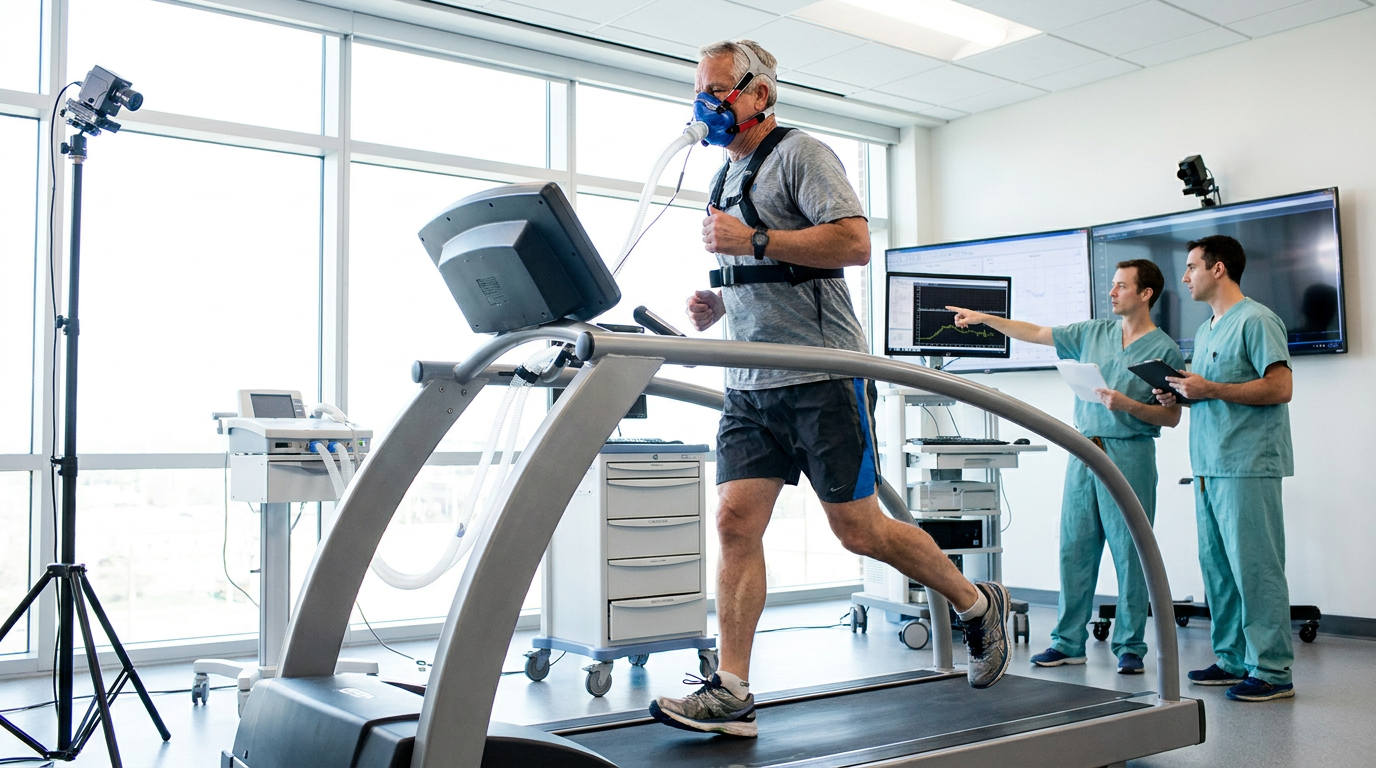
VO2 max measures the maximum volume of oxygen an individual's body can absorb, transport, and utilize during intense exercise. It reflects the combined efficiency of the lungs drawing in oxygen, the heart pumping it through the bloodstream, and the muscles extracting it to generate cellular energy. Measured in milliliters of oxygen per kilogram of body weight per minute (mL/kg/min), the metric provides a comprehensive snapshot of the body's internal engine. While elite endurance athletes can score in the 70s or 80s, the clinical focus is on the profound health differences observed within the normal population ranges.[1][5]
The statistical evidence linking cardiorespiratory fitness to survival is staggering. In a landmark retrospective study analyzing over 122,000 patients who underwent treadmill testing, researchers found that the risk of all-cause mortality was inversely proportional to aerobic fitness. The data revealed no upper limit to the benefits of aerobic fitness; the highest performers had the lowest mortality rates. Most strikingly, the gap in survival between the lowest performing quartile and the highest performing quartile was immense, dwarfing the risk ratios associated with traditional health hazards.[2]
To put the numbers in perspective, being in the bottom 25% of cardiorespiratory fitness carries a relative mortality risk nearly 500% higher than being in the top 2%. By comparison, the mortality risk associated with smoking, coronary artery disease, or diabetes typically ranges from a 30% to 50% increase. The data suggests that poor cardiorespiratory fitness is a more significant threat to long-term survival than many of the chronic conditions that dominate modern medical interventions. Moving from the lowest fitness category to just the "below average" category yields the steepest drop in mortality risk, indicating that even modest improvements save lives.[1][2]

The physiological mechanism behind this correlation centers on cellular energy production. High cardiorespiratory fitness is a proxy for mitochondrial density and efficiency. Mitochondria, the powerhouses of the cell, are responsible for converting oxygen and nutrients into ATP, the energy currency of the body. As we age, mitochondrial function naturally declines, leading to cellular senescence, metabolic dysfunction, and a host of age-related diseases. Regular aerobic exercise acts as a powerful stressor that triggers mitochondrial biogenesis—the creation of new, healthy mitochondria—while clearing out damaged ones through a process called mitophagy.[4]
To optimize this cellular machinery, sports cardiologists and longevity researchers advocate for a specific training protocol known as "Zone 2" cardio. Zone 2 refers to a steady, moderate intensity of exercise where the body relies almost exclusively on fat oxidation for fuel, rather than carbohydrates. Practically, this is an effort level where an individual is working hard but can still comfortably hold a conversation without gasping for breath. Spending extended periods in this zone builds the aerobic base, increasing the capillary density in muscle tissue and expanding the mitochondrial network without overtaxing the central nervous system.[3][7]
To optimize this cellular machinery, sports cardiologists and longevity researchers advocate for a specific training protocol known as "Zone 2" cardio.
While Zone 2 training builds the foundation, raising the absolute ceiling of a person's VO2 max requires high-intensity interval training (HIIT). Pushing the cardiovascular system to its absolute limit—often referred to as Zone 5—forces the heart to adapt by increasing its stroke volume, the amount of blood pumped with each beat. This intense stimulus is necessary to prevent the natural decline in maximum heart rate and oxygen utilization that accompanies aging. The combination of low-intensity volume and high-intensity stimulus creates a comprehensive defense against cardiovascular decay.[3][5]
This dual approach is formalized in the "80/20" polarized training model, widely used by elite athletes and now being adapted for longevity protocols. The evidence suggests that spending roughly 80% of exercise time in low-intensity Zone 2, and 20% in high-intensity intervals, yields the most profound physiological adaptations. This ratio allows for sufficient volume to drive mitochondrial growth while providing enough recovery time to execute the high-intensity sessions effectively. Public health guidelines are increasingly reflecting this nuance, moving beyond simple step counts to recommend specific intensities of cardiovascular work.[3][6]

The urgency of this training becomes clear when examining the natural aging curve. Without targeted intervention, VO2 max declines by approximately 10% per decade after the age of 30, and this rate of decline accelerates after age 60. This biological decay is not merely a loss of athletic ability; it is a loss of functional independence. A high VO2 max in middle age acts as a physiological buffer. If an individual enters their 60s with a robust cardiovascular engine, the inevitable age-related decline will not push them below the threshold required for basic daily activities until much later in life.[5][7]
Longevity physicians often refer to this as preparing for the "marginal decade"—the final ten years of life. The goal is to maintain a high enough VO2 max so that in one's 80s, activities like climbing a flight of stairs, carrying groceries, or recovering from a minor illness do not require maximum exertion. An individual with a VO2 max of 18 mL/kg/min will find walking up a slight incline exhausting, whereas someone who has maintained a VO2 max of 25 mL/kg/min through their 80s will retain their mobility and independence.[5][7]

Despite the overwhelming data, researchers maintain transparent uncertainty regarding the limits of these findings. The majority of the massive cohort studies linking VO2 max to mortality are observational. While the hazard ratios are massive, proving direct causation in human longevity is inherently difficult due to the decades-long timeframes required. However, Mendelian randomization studies—which use genetic variation to investigate causal relations—strongly support the hypothesis that higher cardiorespiratory fitness directly causes a reduction in mortality risk, rather than merely being a byproduct of good health.[1][2][7]
Furthermore, there is a recognized genetic component to trainability. Clinical trials show that while almost everyone improves their VO2 max with exercise, the magnitude of the response varies. Some individuals are "high responders" who see rapid gains, while others are "low responders" who require more volume or intensity to achieve the same adaptations. This genetic variance means that while the metric is a universal predictor of health, the prescription to improve it must be highly individualized.[4][5]
Ultimately, the emergence of VO2 max as a primary longevity biomarker offers a profoundly empowering message. Unlike chronological age, which advances inevitably, biological age as measured by cardiorespiratory fitness is highly malleable. The clinical evidence demonstrates that it is almost never too late to start; individuals who begin structured aerobic training in their 60s and 70s still experience significant improvements in mitochondrial function and a corresponding drop in mortality risk. The human cardiovascular system remains remarkably responsive to the right stimuli, offering a proven, accessible pathway to a longer, healthier life.[6][7]
How we got here
1922
Nobel laureate A.V. Hill first introduces the concept of maximal oxygen uptake (VO2 max) in human physiology.
1989
The Cooper Institute publishes landmark data linking higher physical fitness to lower all-cause mortality in over 13,000 individuals.
2018
A massive JAMA study of 122,007 patients confirms that the survival benefits of aerobic fitness have no upper limit.
2020
The World Health Organization updates its guidelines to emphasize specific intensities of aerobic activity for longevity.
Present
Longevity medicine widely adopts the 80/20 polarized training model to optimize mitochondrial healthspan.
Viewpoints in depth
Clinical Researchers
Focus on the massive observational datasets proving that cardiorespiratory fitness outperforms traditional disease markers.
For clinical researchers and epidemiologists, the focus is on the sheer scale of the hazard ratios. When analyzing cohorts of over 100,000 patients, they point out that no pharmaceutical intervention exists that can reduce all-cause mortality by the margins seen when moving a patient from the bottom 25% of fitness to the top 25%. They argue that VO2 max should be measured as a standard vital sign in annual physicals, treating low fitness with the same medical urgency as severe hypertension.
Sports Cardiologists
Emphasize the physiological mechanisms and advocate for specific polarized training protocols.
Sports cardiologists look under the hood at the cellular and structural adaptations. They emphasize that not all exercise is created equal for longevity. They advocate heavily for the 80/20 polarized model, arguing that chronic "moderate-to-hard" exercise (the "garbage miles" where people push too hard on every run) fails to build the mitochondrial base of Zone 2 and fails to provide the cardiac stretching stimulus of true Zone 5 intervals. Their focus is on prescribing exercise with the precision of a drug dosage.
Public Health Advocates
Prioritize accessibility, noting that the greatest risk reduction occurs simply by moving from a sedentary lifestyle to moderate activity.
Public health officials often caution against over-complicating the message with talk of VO2 max testing and strict heart rate zones. They point to the data showing that the steepest drop in mortality risk occurs at the very bottom of the curve—simply moving from "sedentary" to "moderately active" yields massive population-level benefits. Their primary concern is that highly technical fitness protocols might alienate the demographics most at risk, arguing that any movement is better than none.
What we don't know
- The exact genetic mechanisms that make some individuals 'high responders' to aerobic training while others see minimal VO2 max gains from the same protocols.
- Whether the extreme volumes of endurance exercise performed by elite ultra-marathoners confer additional longevity benefits or eventually cause cardiac fibrosis.
- The precise threshold at which the benefits of high-intensity interval training (HIIT) are outweighed by the systemic inflammation and recovery cost in older adults.
Key terms
- VO2 Max
- The maximum rate at which the heart, lungs, and muscles can effectively use oxygen during intense exercise, measured in mL/kg/min.
- Healthspan
- The period of a person's life spent in good health, free from chronic diseases and the disabilities of aging.
- Mitochondrial Biogenesis
- The cellular process of producing new, healthy mitochondria, typically stimulated by the energy demands of aerobic exercise.
- All-cause Mortality
- The death rate from all causes of death for a population in a given time period, used as a broad indicator of overall health risk.
- Polarized Training
- An exercise model where the vast majority of training is done at a low intensity (Zone 2), with a small fraction done at a very high intensity, avoiding the "middle" zones.
Frequently asked
How can I measure my VO2 max without a lab?
While lab tests with an oxygen mask are the gold standard, many modern smartwatches provide a highly accurate estimate based on your heart rate and pace during outdoor runs or walks. Alternatively, the Cooper 12-minute run test is a validated field assessment.
What exactly is Zone 2 cardio?
Zone 2 is a moderate exercise intensity where your heart rate is elevated, but you can still comfortably hold a conversation without gasping. For most people, this is a brisk walk, a light jog, or steady cycling.
Is it too late to improve my VO2 max if I am over 60?
No. Clinical studies consistently show that older adults who begin structured aerobic training can significantly improve their VO2 max and mitochondrial function, leading to a rapid decrease in mortality risk.
Do I have to do high-intensity intervals (HIIT)?
While moderate Zone 2 exercise provides the bulk of health benefits and builds the aerobic base, brief sessions of high-intensity intervals are uniquely effective at raising the absolute maximum capacity of your heart and lungs.
Sources
Source coverage
7 outlets
4 viewpoints surfaced







[1]CirculationClinical Researchers
Cardiorespiratory Fitness as a Quantitative Predictor of All-Cause Mortality and Cardiovascular Events
Read on Circulation →[2]JAMA Network OpenClinical Researchers
Association of Cardiorespiratory Fitness With Long-term Mortality Among Adults Undergoing Exercise Treadmill Testing
Read on JAMA Network Open →[3]European Journal of Preventive CardiologySports Cardiologists
Polarized training and endurance performance: A systematic review
Read on European Journal of Preventive Cardiology →[4]Cell MetabolismSports Cardiologists
Exercise-induced mitochondrial biogenesis and cellular longevity
Read on Cell Metabolism →[5]Journal of Applied PhysiologySports Cardiologists
Aging and cardiorespiratory fitness decline: Mechanisms and interventions
Read on Journal of Applied Physiology →[6]World Health OrganizationPublic Health Advocates
WHO guidelines on physical activity and sedentary behaviour
Read on World Health Organization →[7]Factlen Editorial TeamFactlen Analysis
Synthesis by Factlen editorial team
Read on Factlen Editorial Team →

More in health
See all 6 stories →Ecotherapy
The Evidence Behind 'Green Prescriptions': How Doctors Are Using Nature to Treat Anxiety and Depression
0 sources

Vaccine Science
COVID-19 Vaccination Cuts Risk of Major Heart Attacks and Strokes, Landmark Study Finds
0 sources

Precision Nutrition
The End of the Universal Diet: How AI and the Microbiome are Powering Precision Nutrition
0 sources

Movement Therapy
The Evidence Pack: Can Exercise Match Medication for Depression and Anxiety?
0 sources

Every angle. Every day.
Get health stories with full source coverage and perspective breakdowns delivered to your inbox.