
Bilingual Brains Rely on a Single 'Grammatical Engine' for All Languages, Study Finds
A breakthrough neuroimaging study reveals that multilingual speakers do not possess separate grammatical rulebooks for each language, but instead use one shared neural system.
By Factlen Editorial Team
- Cognitive Neuroscientists
- Focus on the neuroimaging data proving that the brain uses an integrated, activation-based mechanism for language.
- Linguistics Researchers
- Emphasize the theoretical implications of the 'pseudoword' tests for understanding universal grammar.
- Bilingual Speakers & Educators
- Value the validation of the bilingual experience, noting how this reframes language learning and grammatical slip-ups.
What's not represented
- · Speakers of non-Indo-European languages
- · Individuals who learned a second language late in life
Why this matters
For the billions of people who speak more than one language, this discovery validates the lived experience of language overlap. It also fundamentally changes how educators approach language learning, suggesting students don't need to build a new cognitive infrastructure from scratch, but rather feed new vocabulary into an existing mental engine.
Key points
- A new study proves bilingual brains use a single, shared grammatical engine for all languages.
- Researchers used MEG scans to track brain activity millisecond-by-millisecond.
- The same neural patterns fired for both English and Spanish grammatical transformations.
- Tests with made-up 'pseudowords' proved the brain uses an abstract, reusable formula.
- The findings explain why bilingual speakers occasionally overlap grammar rules.
- Results suggest language learners feed new vocabulary into an existing cognitive template.
For decades, cognitive scientists have debated a fundamental question about the bilingual mind: when a person speaks two languages, does their brain build two separate grammatical rulebooks, or does it rely on a single, shared system? A new study published in the Journal of Neuroscience has definitively answered this question, fundamentally redrawing our understanding of human language.[1][4]
The research, led by neuroscientists at New York University, proves that multilingual speakers do not possess separate grammatical engines in their gray matter. Instead, the brain utilizes a single, universal computational loop to process the grammar of every language a person speaks, seamlessly applying the same neural architecture across different vocabularies.[2][3]
Esti Blanco-Elorrieta, an assistant professor of psychology and neural science at NYU and the study's senior author, noted that the findings challenge long-held assumptions. The research suggests that human language is built from neural computations that transcend any one specific tongue, rather than relying on isolated, language-specific modules.[1][3]

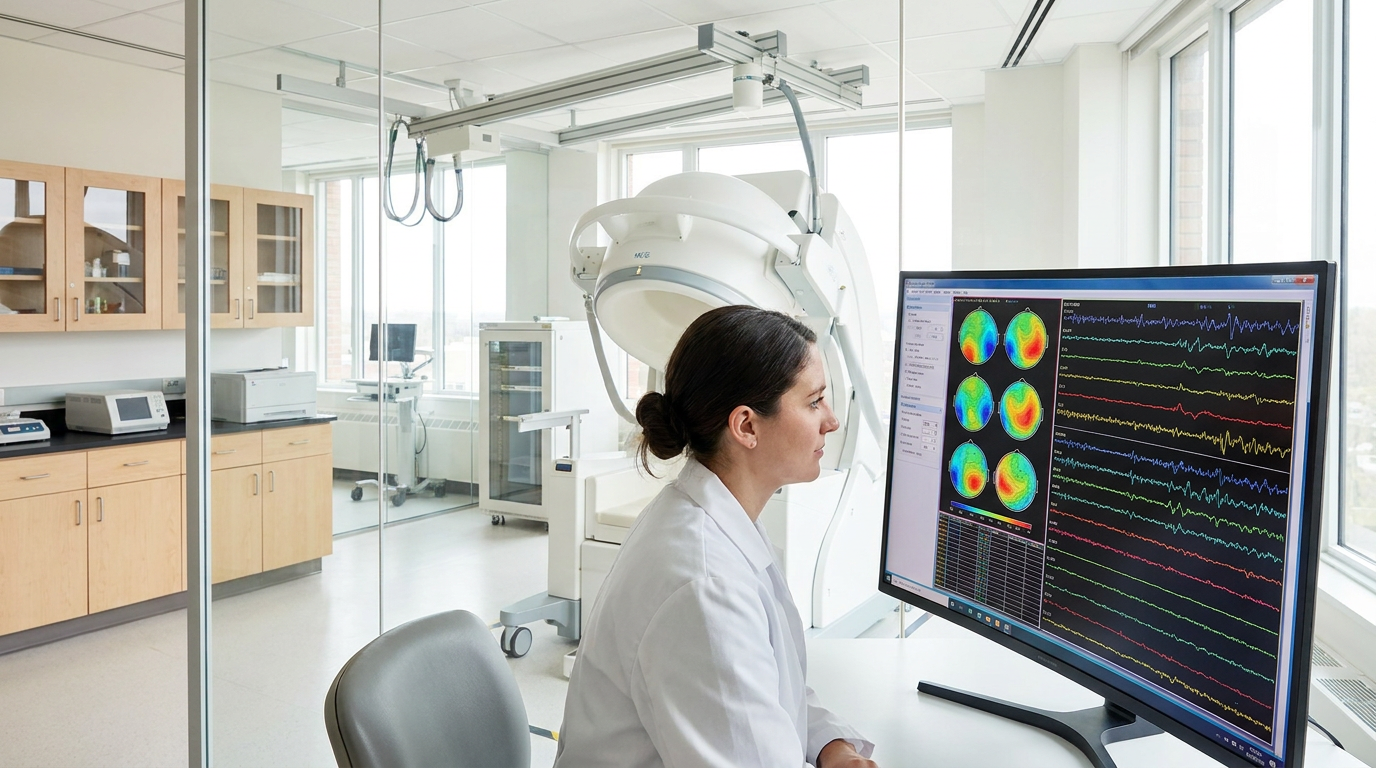
To prove this, the research team utilized magnetoencephalography (MEG), an advanced neuroimaging technique capable of tracking brain activity on a millisecond-by-millisecond basis. They monitored Spanish-English bilingual speakers as they performed real-time grammatical transformations, capturing the exact moment the brain applied a grammatical rule.[3][4]
Participants were asked to listen to singular words in both English and Spanish—such as "boat" and "barco"—and instantly produce the plural versions, "boats" and "barcos." The MEG scans revealed that the exact same neural patterns fired to support grammatical processing in both languages, indicating a deeply shared computational architecture.[3][4]
A critical challenge in linguistics is proving that the brain is actively calculating grammar rules on the fly, rather than simply pulling memorized, pre-pluralized words from a mental storage locker. To bypass this, the researchers introduced "pseudowords"—completely fabricated terms like "paple" that the participants had never encountered before.[2][5]
To bypass this, the researchers introduced "pseudowords"—completely fabricated terms like "paple" that the participants had never encountered before.
When bilingual participants were asked to pluralize these fake words, the MEG scans showed the exact same shared neural engine engaging. Because the participants could not rely on memory for a word that did not exist, the experiment proved that the brain possesses an abstract, reusable grammatical formula that it can instantly stamp onto any new vocabulary.[3][4]

This shared architecture perfectly explains a common phenomenon among multilingual individuals: grammatical overlap. It is not uncommon for a bilingual speaker to mistakenly apply the rules of one language while speaking another—for example, a native Spanish speaker saying "I have 20 years" instead of "I am 20" when speaking English.[1][3]
Previously, some theorized this was a sign of the brain accidentally crossing the wires between two separate language systems. The NYU study proves the opposite is true. These slip-ups happen precisely because the brain runs all vocabulary through the exact same computational loop, occasionally causing a rule from one language to temporarily map onto another.[2][6]
The findings offer profound implications for how humans learn and communicate. By demonstrating that grammar is a reusable computation—a universal language template—the research suggests that learning a second language does not require building a new cognitive infrastructure from scratch.[3][5]

Instead, language learners are simply feeding new vocabulary into an existing, highly efficient engine. This aligns with broader neurobiological theories proposing that language selection operates through activation-based mechanisms without requiring the active suppression of a non-target language.[4][5]
While the current study focused on Spanish and English—two languages that share some structural similarities—the researchers believe this shared neural mechanism likely transcends any specific language pairing. The evidence points toward a universal neurobiology of human communication, where a single engine powers the vast diversity of human speech.[1][6]
How we got here
Early 2000s
Initial fMRI studies suggest bilinguals might use different brain regions for different languages depending on their proficiency level.
2010s
Research shifts to show overlapping neural networks, but the exact mechanism of real-time grammar processing remains heavily debated.
2021
Theoretical models are published proposing an integrated, activation-based system for bilingual minds, challenging the idea of language suppression.
June 2026
NYU researchers publish definitive MEG evidence in the Journal of Neuroscience proving the existence of a single, shared grammatical engine.
Viewpoints in depth
Cognitive Neuroscientists
Focus on the neuroimaging data proving activation-based mechanisms rather than suppression.
For neuroscientists, the most significant aspect of the study is the millisecond-level MEG data. Traditional fMRI scans could show which broad areas of the brain were active, but they lacked the temporal resolution to capture the exact moment a grammatical rule was applied. By tracking the brain's magnetic fields, researchers proved that the neural architecture doesn't just overlap—it is the exact same computational loop firing in the exact same sequence, regardless of the language being spoken. This strongly supports the theory that the brain uses activation-based mechanisms to manage multiple languages, rather than actively suppressing one language to speak another.
Linguistics Researchers
Focus on the 'pseudoword' evidence proving an abstract, reusable grammatical formula.
Linguists have long debated whether humans possess an abstract 'universal grammar' or if we simply memorize massive databases of words and their variations. The introduction of pseudowords like 'paple' in this study provided a crucial breakthrough. Because participants had never heard the word before, they could not rely on rote memory to pluralize it. The fact that the shared grammatical engine engaged instantly to process a fake word proves that the brain possesses a deeply abstract, reusable formula for language structure—one that exists independently of any specific vocabulary.
Bilingual Speakers & Educators
Focus on how this reframes language learning from building a new engine to feeding an existing one.
For language educators and bilingual individuals, the study offers profound practical validation. It reframes the occasional grammatical slip-up—such as applying Spanish sentence structure to English vocabulary—not as a failure of fluency, but as the natural byproduct of a highly efficient, shared neural system. Furthermore, it suggests that teaching a second language shouldn't be approached as building a new cognitive infrastructure from scratch. Instead, educators are simply helping students feed new phonetic and vocabulary inputs into a grammatical engine they already possess and use every day.
What we don't know
- Whether this shared engine operates identically in languages with radically different grammatical structures, such as English and Mandarin.
- If the shared computational loop looks different in individuals who learn a second language late in adulthood compared to those who are bilingual from birth.
Key terms
- Magnetoencephalography (MEG)
- An advanced neuroimaging technique that maps brain activity by recording magnetic fields produced by electrical currents occurring naturally in the brain.
- Pseudoword
- A fabricated word that follows the phonetic rules of a language but has no actual meaning, used by researchers to test abstract grammar processing.
- Cognate
- Words in different languages that share a similar meaning, spelling, and pronunciation due to common linguistic roots.
- Neuroplasticity
- The brain's ability to reorganize itself by forming new neural connections throughout life, particularly when learning new skills like a language.
Frequently asked
What is a grammatical engine?
It is a neural system in the brain that applies structural rules to words, such as turning a singular noun into a plural or conjugating a verb.
Why do bilingual people sometimes mix up grammar rules?
Because all languages share the same computational loop in the brain, causing rules from one language to occasionally overlap onto another during real-time speech.
Did the researchers only test real words?
No, they used made-up "pseudowords" to prove the brain actively calculates grammar on the fly rather than just relying on memorized vocabulary.
Does this mean learning a new language is easier than we thought?
It suggests that learners don't need to build a new grammatical system from scratch, but rather adapt their existing neural template to process new vocabulary.
Sources
Source coverage
6 outlets
3 viewpoints surfaced





[1]The New York TimesBilingual Speakers & Educators
How Does One Brain Speak Two Languages?
Read on The New York Times →[2]Neuroscience NewsLinguistics Researchers
Single Grammatical Engine Powers the Bilingual Brain
Read on Neuroscience News →[3]New York UniversityLinguistics Researchers
Bilingualism is Driven by a Single Neurological “Grammar Engine”
Read on New York University →[4]Journal of NeuroscienceCognitive Neuroscientists
Shared Neural Computations for Grammar Across Languages
Read on Journal of Neuroscience →[5]Cognitive Science SocietyCognitive Neuroscientists
The Neurobiology of the Bilingual Mind: Activation-Based Mechanisms
Read on Cognitive Science Society →[6]Factlen Editorial TeamBilingual Speakers & Educators
Synthesis by Factlen editorial team
Read on Factlen Editorial Team →


Every angle. Every day.
Get health stories with full source coverage and perspective breakdowns delivered to your inbox.