
The Chemistry of Aquafaba: How Bean Water Became the Ultimate Vegan Egg Replacement
Discovered by accident in 2014, the viscous liquid from canned chickpeas has transformed plant-based cooking. Food scientists are now unraveling the complex mix of proteins and saponins that allow aquafaba to mimic the polyfunctional properties of eggs.
By Factlen Editorial Team
- Food Scientists
- Focuses on the molecular mechanisms, saponins, and protein structures that allow a dilute liquid to mimic polyfunctional eggs.
- Culinary Innovators
- Focuses on practical kitchen applications, recipe development, and the grassroots internet origins of the ingredient.
- Factlen Editorial
- Synthesizes the scientific consensus with practical culinary guidance.
What's not represented
- · Industrial Chickpea Farmers
- · Egg Industry Representatives
Why this matters
Understanding the science behind aquafaba empowers home cooks to confidently adapt traditional recipes for vegan or egg-allergic diets. It also highlights a major shift in food science toward sustainable, plant-based ingredients that reduce food waste.
Key points
- Aquafaba, the liquid from cooked chickpeas, can mimic the foaming and emulsifying properties of eggs.
- Its unique capabilities are driven by a combination of low-molecular-weight proteins and natural surfactants called saponins.
- While it excels in meringues and mayonnaise, aquafaba cannot coagulate under heat, making it unsuitable for structural dishes like omelets.
- Food scientists are currently working to commercialize aquafaba as a standardized, sustainable rheological additive for the broader food industry.
For decades, the holy grail of vegan baking was a true substitute for the humble egg. In the culinary world, eggs are considered a "polyfunctional" marvel—a single ingredient capable of emulsifying sauces, foaming into towering meringues, and coagulating to provide structural integrity to cakes. Replacing one of those functions is relatively simple; replacing all three with a single plant-based ingredient seemed chemically impossible.[1][2]
The breakthrough did not come from a corporate food laboratory, but from a French musician named Joël Roessel. In December 2014, Roessel discovered that the viscous liquid left over from canned beans could form a stable foam. A few months later, American software engineer and vegan food enthusiast Goose Wohlt refined the technique, successfully baking egg-free meringues using only chickpea liquid and sugar. Wohlt coined the term "aquafaba"—a portmanteau of the Latin words for water and bean.[5]
Almost overnight, aquafaba transformed vegan cuisine. The cloudy, slightly yellowish brine that millions of home cooks had routinely poured down the drain was suddenly recognized as a complex matrix of starches, proteins, and soluble plant solids.[1][5]
To understand how bean water mimics an egg, food scientists had to break down its chemical composition. Peer-reviewed analyses revealed that aquafaba is remarkably dilute: it consists of roughly 94 percent water, 4 percent carbohydrates, and just 1.5 percent protein. By comparison, a standard egg white is about 10 percent protein.[3][6]

The secret to aquafaba's structural magic lies in a specific combination of low-molecular-weight proteins, primarily albumins, and naturally occurring plant compounds called saponins. Saponins act as powerful surfactants—amphiphilic molecules with both water-loving and fat-loving properties that drastically lower the surface tension of a liquid.[1][3]
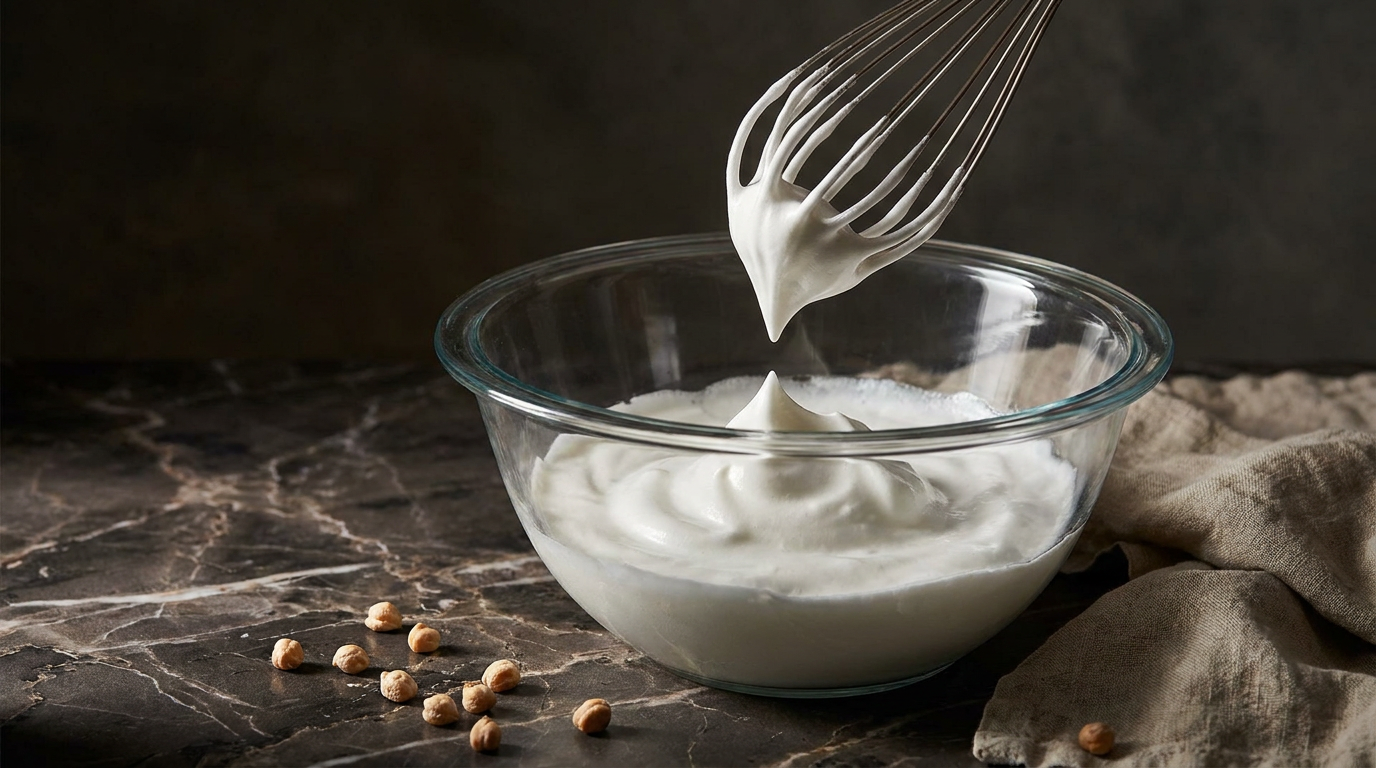
When aquafaba is vigorously whisked, mechanical force causes its tightly coiled proteins to denature, or unfold. This exposes their hydrophobic (water-repelling) regions. To escape the surrounding water, these unraveled proteins link together and form a protective film around the air bubbles introduced by the whisk. The saponins work in tandem to stabilize this newly formed 3D network, preventing the bubbles from popping.[2][3]
The resulting foam is visually and texturally indistinguishable from whipped egg whites. This unique chemical architecture allows aquafaba to replicate the foaming power required for delicate confections like macarons, nougat, marshmallows, and pavlovas. Generally, three tablespoons (45 milliliters) of aquafaba can replace one whole egg, while two tablespoons (30 milliliters) replaces a single egg white.[5][6]

The resulting foam is visually and texturally indistinguishable from whipped egg whites.
Beyond its foaming capabilities, aquafaba is also a highly effective emulsifier. In recipes like mayonnaise or hollandaise, it successfully binds oil and water together into a smooth, stable suspension, mimicking the role traditionally played by the lecithin found in egg yolks.[1][3]
However, aquafaba is not a universal replacement. Because it contains only a fraction of the protein found in a real egg, it fundamentally lacks the ability to coagulate under heat in the same way.[1][2]
When an egg is cooked, its dense protein network solidifies, providing the rigid structural backbone necessary for dishes like omelets, quiches, or angel food cake. Aquafaba cannot replicate this thermal coagulation, meaning it will fail in recipes that rely on eggs primarily for firm, heated structure rather than aeration or emulsification.[1][5]

For home cooks, the primary challenge with aquafaba is consistency. The viscosity of chickpea liquid varies wildly depending on the brand, the canning process, and the specific legume cultivar. If the liquid straight from the can is too watery, culinary experts recommend simmering it on the stovetop until it reduces to the thicker consistency of raw egg whites.[4][5]
Interestingly, the ingredient label on the can often dictates the quality of the foam. Culinary outlets like America's Test Kitchen and Serious Eats have noted that canned chickpeas containing kombu—a type of seaweed added by some manufacturers—yield vastly superior aquafaba. Kombu is rich in carrageenan, a natural carbohydrate that acts as a powerful stabilizing agent.[4]
Even without kombu, home bakers can easily stabilize their aquafaba foams. Adding a small pinch of cream of tartar introduces acidity, which helps strengthen the protein bonds during the whipping process, ensuring the stiff peaks hold their shape in the oven.[4][6]

The success of aquafaba has now captured the attention of the commercial food industry. Food scientists are actively researching ways to extract and dry aquafaba into a standardized powder, transforming it into a reliable, plant-based rheological additive for large-scale manufacturing.[3]
By standardizing the extraction process, the industry hopes to utilize aquafaba to reduce its reliance on animal-based ingredients, thereby lowering the environmental footprint of processed foods and catering to the booming market for allergen-free products.[3][6]
What began as a curious experiment on a vegan internet forum has evolved into a legitimate branch of food science. Aquafaba stands as a testament to the fact that transformative culinary innovation doesn't always require high-tech laboratories—sometimes, it's just waiting to be discovered at the bottom of a can of beans.[5][6]
How we got here
Dec 2014
French musician Joël Roessel discovers that canned bean water can form foams and publishes early recipes.
Mar 2015
Vegan food enthusiast Goose Wohlt creates a stable egg-free meringue and coins the term 'aquafaba'.
2016
Food science journals begin publishing peer-reviewed analyses of aquafaba's unique chemical composition.
2021
Research shifts toward commercializing aquafaba as a sustainable, plant-based additive for the broader food industry.
Viewpoints in depth
Food Scientists
Focuses on the molecular mechanisms that allow a dilute liquid to mimic polyfunctional eggs.
For food scientists, aquafaba represents a fascinating study in molecular efficiency. Researchers note that despite being 94 percent water, the liquid successfully mimics the complex behavior of egg whites through a unique synergy between low-molecular-weight albumins and saponins. By understanding how these amphiphilic molecules lower surface tension and trap air, scientists hope to isolate these properties to create highly efficient, plant-based rheological additives for commercial food manufacturing.
Culinary Innovators
Focuses on the practical kitchen applications and the grassroots internet origins of the ingredient.
Culinary professionals and vegan home bakers view aquafaba as one of the most significant ingredient discoveries of the 21st century. Because it was discovered and refined on internet forums rather than in corporate test kitchens, it carries an open-source ethos. Innovators focus on practical variables—such as reducing the liquid on the stove to achieve the correct viscosity, or seeking out canned chickpeas that contain kombu for added stability—to push the boundaries of what plant-based desserts can achieve.
Commercial Food Industry
Focuses on standardizing aquafaba into a reliable, scalable additive to reduce reliance on animal products.
The commercial food sector sees aquafaba as a sustainable solution to the environmental and ethical concerns surrounding mass egg production. However, their primary hurdle is standardization. Because the protein and starch content of chickpea water varies wildly depending on the legume cultivar and canning process, manufacturers are investing in spray-drying technologies to convert raw aquafaba into a stable, predictable powder that can be reliably used in mass-produced vegan mayonnaises and baked goods.
What we don't know
- The exact molecular interactions between aquafaba's various carbohydrates and proteins that give it such unique stability compared to other legume waters.
- How to perfectly replicate the thermal coagulation of eggs using plant-based waters, which remains a barrier for dishes like angel food cake.
- Whether commercial standardization of aquafaba powder will alter its delicate foaming properties compared to the raw liquid extracted from cans.
Key terms
- Aquafaba
- The viscous water in which legume seeds, such as chickpeas, have been cooked or stored.
- Saponins
- Naturally occurring plant compounds with soap-like properties that act as surfactants to create stable foams.
- Polyfunctional Ingredient
- An ingredient that serves multiple distinct chemical purposes in a recipe, such as foaming, emulsifying, and coagulating.
- Denaturation
- The process where proteins lose their natural coiled structure, usually due to whisking or heat, allowing them to form new bonds.
- Emulsifier
- A substance that stabilizes a mixture of two liquids that normally do not mix, such as oil and water in mayonnaise.
Frequently asked
Can I use the liquid from any canned beans?
Yes, but chickpea and white bean liquid are preferred because they have a neutral flavor and a lighter color that won't alter the appearance of baked goods.
Do I need to whip aquafaba differently than egg whites?
Aquafaba can take slightly longer to whip into stiff peaks than egg whites, and it often benefits from an acidic stabilizer like cream of tartar.
Does aquafaba taste like beans in baked goods?
While it smells like beans straight out of the can, the flavor dissipates entirely when baked or mixed with strong ingredients like chocolate or vanilla.
Can aquafaba replace eggs in a scramble or omelet?
No. Because it lacks the specific proteins that coagulate and solidify under heat, it cannot replicate the firm structure of cooked whole eggs.
Sources
Source coverage
6 outlets
3 viewpoints surfaced





[1]McGill University Office for Science and SocietyFood Scientists
Aquafaba: The Magic Bean Water
Read on McGill University Office for Science and Society →[2]BBC Science FocusFood Scientists
Why are eggs so useful in baking, and are there any substitutes?
Read on BBC Science Focus →[3]Trends in Food Science & TechnologyFood Scientists
Aquafaba, a new plant-based rheological additive for food applications
Read on Trends in Food Science & Technology →[4]Tasting TableCulinary Innovators
The Canned Chickpea Ingredient That Yields Better Aquafaba
Read on Tasting Table →[5]WikipediaCulinary Innovators
Aquafaba
Read on Wikipedia →[6]Factlen Editorial TeamFactlen Editorial
Synthesis by Factlen editorial team
Read on Factlen Editorial Team →
Every angle. Every day.
Get food drink stories with full source coverage and perspective breakdowns delivered to your inbox.