
The Food Science Behind Fast-Food French Fries: How Chains Engineer the Perfect Crunch
The fast-food french fry is a marvel of edible technology, relying on dextrose dips, starch retrogradation, and double-frying to achieve its signature texture.
By Factlen Editorial Team
- Food Scientists & Engineers
- Focus on the thermodynamics, chemical reactions, and industrial consistency required to mass-produce the perfect fry.
- Nutrition Researchers
- Analyze the health impacts of the frying process, particularly the formation of resistant starch during freezing.
- Culinary Enthusiasts
- Examine the sensory experience, flavor profiles, and ordering tricks to maximize the crispiness of the final product.
What's not represented
- · Potato Farmers and Agricultural Suppliers
- · Fast-Food Franchise Operators
Why this matters
Understanding the chemistry behind fast-food fries reveals the staggering level of industrial engineering required to mass-produce consistency, transforming a simple root vegetable into a globally standardized sensory experience.
Key points
- Fast-food chains exclusively use high-starch potatoes like the Russet Burbank to ensure a fluffy interior.
- Raw potato strips are blanched to remove unpredictable natural sugars and deactivate browning enzymes.
- A precise 0.5% dextrose solution is applied to the fries to guarantee uniform golden caramelization.
- Flash-freezing triggers starch retrogradation, crystallizing the potato's interior and increasing resistant starch.
- The signature crunch is achieved through a double-fry method, utilizing aged oil that bonds effectively to the potato.
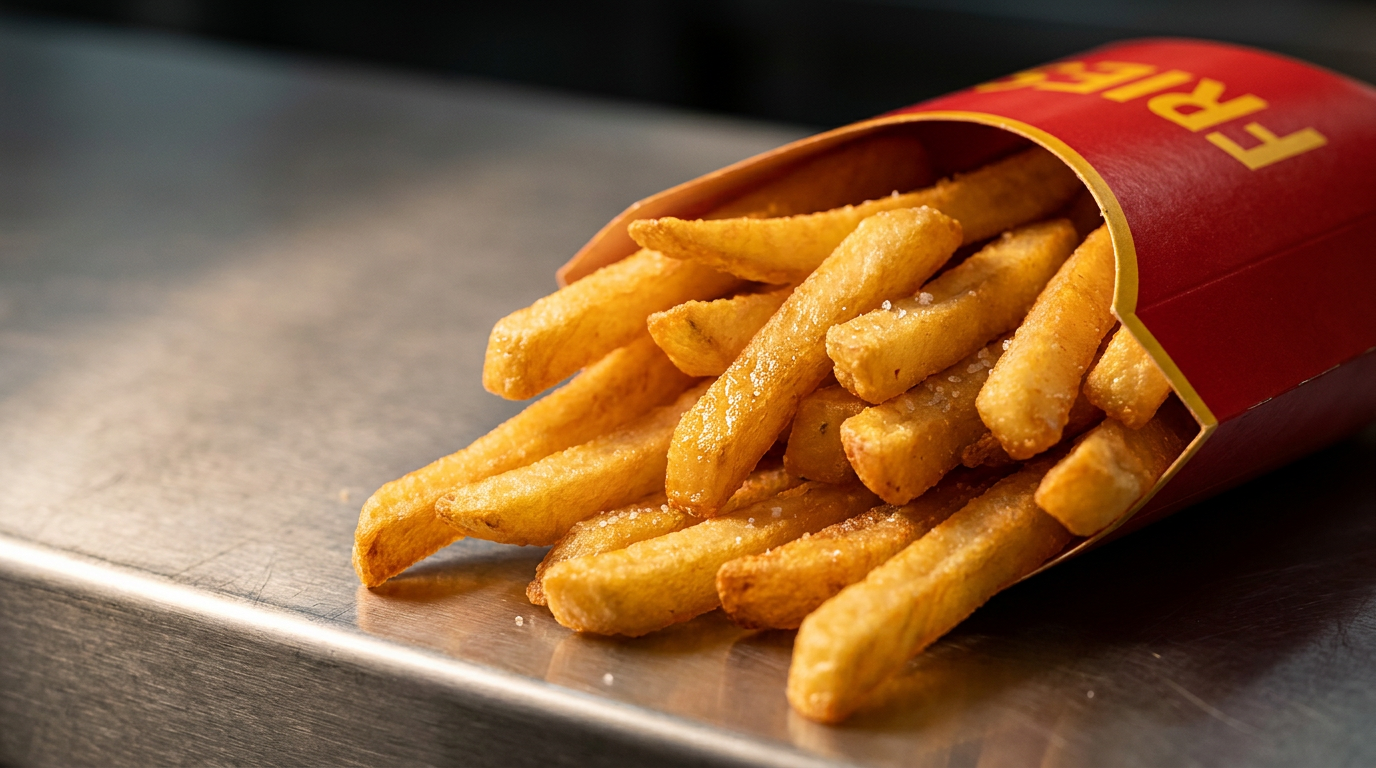
It is arguably the most universally beloved item on any fast-food menu: the humble french fry. To the consumer, it appears to be a triumph of simplicity, requiring nothing more than a potato, hot oil, and a generous dusting of salt. But behind the golden, crispy exterior lies a multi-billion-dollar industrial process that relies more on chemistry and thermodynamics than traditional culinary arts.[6]
The journey to the perfect crunch begins long before the fryer is turned on, starting with the genetic profile of the potato itself. Major fast-food chains overwhelmingly rely on the Russet Burbank variety, a potato prized for its specific structural properties. Unlike waxy potatoes, which retain too much water and turn soggy when cooked, Russets are dense with starch. When these starchy granules hit boiling oil, they expand and burst, creating a fluffy interior while the low moisture content allows the exterior to crisp up rapidly.[3]
Once harvested, the potatoes are transported to massive processing facilities where they are washed, peeled by high-pressure steam, and shot through a grid of razor-sharp knives at speeds exceeding 70 miles per hour. This violent journey produces the uniform 7-millimeter shoestring strips that consumers instantly recognize. But raw potatoes are highly volatile; left to their own devices, they will oxidize, turn gray, and fry to an unappetizing, uneven dark brown.[4]

To strip the potato of its unpredictable nature, factories subject the raw strips to a rigorous blanching process. The fries are submerged in 170-degree Fahrenheit water for approximately 15 minutes. This hot water bath serves multiple chemical purposes: it deactivates polyphenol-oxidase enzymes that cause discoloration, and it begins to dissolve the pectin in the potato's cell walls, slightly softening the structure. Crucially, blanching leaches out the potato's naturally occurring sugars.[2][4]
Removing the natural sugars might seem counterintuitive, but it is the ultimate secret to quality control. Natural sugar levels vary wildly depending on the season and the soil, meaning a batch of fries could burn in the fryer before the inside is fully cooked. By stripping the potato of its own sugars, food engineers create a blank canvas. They then bathe the blanched strips in a precise 0.5% solution of dextrose—a simple corn-based sugar.[4]
This dextrose dip guarantees that every single fry will undergo the exact same Maillard reaction—the chemical process between amino acids and reducing sugars that gives browned food its distinctive flavor and golden color. Alongside the dextrose, the fries are treated with sodium acid pyrophosphate (SAPP), a food-grade additive that stabilizes the color and prevents the potato from turning gray during transit and storage.[4][6]
With the chemical composition locked in, the fries undergo their first round of cooking. They are par-fried in massive vats of vegetable oil at roughly 365 degrees Fahrenheit for just about a minute. This initial fry does not fully cook the potato; instead, it dehydrates the outermost layer, creating a microscopic crust that will act as a moisture barrier. It is the first half of the famous double-fry technique that separates restaurant fries from homemade attempts.[3]
With the chemical composition locked in, the fries undergo their first round of cooking.
Immediately after the par-fry, the potatoes are sent through a freezing tunnel that drops their core temperature to 10 degrees Fahrenheit. While freezing is obviously necessary to ship billions of pounds of fries globally without spoilage, it is also a vital step in the food science of the fry. The rapid drop in temperature triggers a process known as starch retrogradation.[1][2][4]

During retrogradation, the amylose molecules within the gelatinized starch begin to realign and crystallize. This structural shift firms up the potato's interior, ensuring that it will become pillowy rather than mushy when reheated. Fascinatingly, this process also converts a portion of the potato's carbohydrates into resistant starch, a form of starch that bypasses digestion in the small intestine and ferments in the large intestine, functioning similarly to dietary fiber.[1][2]
Months after they were pulled from the ground, the frozen, chemically stabilized, par-fried potatoes finally arrive at the local drive-thru. Here, they undergo their second and final fry. Dropped into oil maintained between 350 and 375 degrees Fahrenheit, the residual moisture inside the fry turns to steam, cooking the fluffy interior, while the dextrose-coated exterior rapidly caramelizes into a rigid, golden crust.[3]
The oil used in this final stage is its own marvel of engineering. Historically, chains like McDonald's fried their potatoes in beef tallow, which imparted a rich, savory umami flavor. When health concerns forced a switch to vegetable oils in the 1990s, food scientists added natural beef flavoring—derived from wheat and milk—to the oil blend to replicate the iconic taste. Furthermore, restaurants rely on slightly aged oil; as fats break down over time from heat exposure, the resulting molecules bond more effectively with the potato, yielding a crispier finish than fresh oil ever could.[3][4]

The final touch is a generous dusting of salt, applied immediately after the fries are pulled from the vat. The residual heat and microscopic droplets of surface oil allow the salt crystals to adhere perfectly, partially dissolving to maximize flavor penetration. For consumers chasing the ultimate crunch, some enthusiasts recommend ordering fries well done, prompting the kitchen to leave the basket in the oil for an extra minute, though success varies widely by franchise.[5][6]
Ultimately, the fast-food french fry is a masterclass in industrial consistency. By breaking the potato down to its molecular components and rebuilding it through blanching, dextrose coating, retrogradation, and double-frying, chains have managed to mass-produce a culinary experience that triggers our deepest savory cravings. It is not just a side dish; it is edible technology, engineered to be perfect every single time.[6]
How we got here
Month 1-6
Russet Burbank potatoes are grown, specifically selected for high starch and low moisture.
Month 7
Potatoes are harvested, washed, peeled, and cut into precise 7-millimeter shoestring strips.
Month 8
Strips are blanched, dipped in dextrose, par-fried, and flash-frozen at the processing plant.
Month 9
Frozen fries are shipped globally to restaurants for their final high-temperature fry.
Viewpoints in depth
The Engineering View
Treating the potato as a structural material rather than a simple ingredient.
For food scientists and industrial engineers, a raw potato is simply a starting material filled with unpredictable variables. Natural sugars, enzyme levels, and water content fluctuate wildly based on the season and soil conditions. To achieve global consistency, engineers must effectively 'erase' the potato's natural state through blanching, and then rebuild it chemically using dextrose and sodium acid pyrophosphate. This ensures that a fry cooked in Tokyo behaves exactly like a fry cooked in New York, caramelizing at the exact same temperature and speed.
The Nutritional View
The complex metabolic effects of industrial frying and freezing.
Nutrition researchers note that the extensive processing of fast-food fries creates a complex metabolic profile. While deep-frying in vegetable oil significantly increases the caloric density and introduces oxidized fats, the mandatory flash-freezing step introduces an unexpected benefit: retrogradation. As the potato cools, a portion of its carbohydrates crystallizes into resistant starch. This specific type of starch bypasses upper digestion and ferments in the gut microbiome, functioning similarly to dietary fiber and slightly lowering the food's overall glycemic impact compared to a freshly baked potato.
What we don't know
- The exact proprietary oil blends and beef-flavoring ratios used by individual fast-food chains remain closely guarded corporate secrets.
- How emerging regulations on ultra-processed foods might force chains to alter their long-standing chemical stabilization processes.
Key terms
- Retrogradation
- A reaction that occurs when gelatinized starch cools, causing amylose molecules to realign into a crystalline structure, improving fry texture.
- Maillard Reaction
- A chemical reaction between amino acids and reducing sugars that gives browned food its distinctive flavor and golden color.
- Resistant Starch
- A type of starch that resists digestion in the small intestine, functioning similarly to dietary fiber.
- Blanching
- A cooking process wherein a food is briefly immersed in boiling water, halting enzyme actions that cause loss of flavor, color, and texture.
- Sodium Acid Pyrophosphate (SAPP)
- A food-grade additive used to prevent cut potatoes from oxidizing and turning gray before they are cooked.
Frequently asked
Why can't I get my homemade fries as crispy as fast-food fries?
Fast-food chains use a double-fry method separated by a flash-freezing process, which alters the potato's starch structure to maximize exterior crunch.
Do fast-food fries contain real beef?
While chains like McDonald's used to fry in beef tallow, they now use vegetable oil infused with natural beef flavoring derived from milk and wheat to replicate the classic taste.
Why do they add sugar to french fries?
Factories strip the potato's unpredictable natural sugars during blanching and replace them with a precise dextrose solution to ensure uniform golden browning.
Sources
Source coverage
6 outlets
3 viewpoints surfaced






[1]Journal of Agricultural and Food SciencesNutrition Researchers
Increasing the resistant starch content of French Fries using dehydration and retrogradation
Read on Journal of Agricultural and Food Sciences →[2]National Library of MedicineFood Scientists & Engineers
Causal factors concerning the texture of French fries manufactured at industrial scale
Read on National Library of Medicine →[3]MashedCulinary Enthusiasts
How Fast Food Restaurants Really Make Their French Fries Crispy
Read on Mashed →[4]Food NetworkFood Scientists & Engineers
How McDonald's Makes Its Fries
Read on Food Network →[5]The TakeoutCulinary Enthusiasts
The Fast Food Ordering Trick You Need For Crispy Fries Every Time
Read on The Takeout →[6]Factlen Editorial TeamCulinary Enthusiasts
Synthesis by Factlen editorial team
Read on Factlen Editorial Team →
Every angle. Every day.
Get food drink stories with full source coverage and perspective breakdowns delivered to your inbox.