
Navigating Kyoto's New Smart Tourism Rules: A Guide for Respectful Travel in 2026
As visitor numbers hit record highs, Kyoto has implemented new taxes, transit overhauls, and luggage rules to balance tourism with local life. Here is what travelers need to know to explore the ancient capital responsibly.
By Factlen Editorial Team
- Local Residents
- Prioritizes neighborhood peace, functional public transit, and the preservation of daily life over maximum tourism revenue.
- Tourism Authorities
- Seeks to balance the economic benefits of inbound travel with environmental sustainability and infrastructure limits.
- International Travelers
- Values authentic cultural experiences but must navigate new logistical hurdles, rising costs, and complex local etiquette.
What's not represented
- · Local Hospitality Businesses
- · Rural Japanese Destinations
Why this matters
Travelers arriving in Japan unaware of these changes face unexpected fees, potential fines, and logistical headaches. Understanding the new framework ensures a smoother trip while actively supporting the preservation of Kyoto's cultural heritage.
Key points
- Kyoto has raised its maximum accommodation tax to ¥10,000 per night for luxury stays to fund city maintenance.
- The popular one-day bus pass has been replaced by a subway-and-bus pass to reduce surface traffic.
- Travelers are strongly urged to use luggage forwarding services rather than bringing suitcases on public transit.
- Strict fines are now enforced for unauthorized photography in Gion's private alleyways.
- Private lodging operators face surprise inspections to ensure compliance with noise and waste rules.
Kyoto's timeless allure has brought the ancient capital to a modern breaking point. With international arrivals surging past pre-pandemic records, the sheer volume of visitors has strained the city's infrastructure and tested the patience of its residents. In response, Kyoto has pioneered a comprehensive "smart tourism" model for 2026, shifting its focus from maximizing raw arrival numbers to carefully managing their impact on the local ecosystem.[3][5]
For travelers planning a trip to Japan's cultural heart, this means navigating a new landscape of taxes, transit rules, and neighborhood etiquette. The goal is not to discourage visitors, but to ensure that tourism revenue directly funds the preservation of the city's heritage and protects the daily lives of the people who call it home.[3][5]
The most immediate change visitors will notice is the cost of staying overnight. In March 2026, the Kyoto municipal government significantly raised its accommodation tax, a measure explicitly designed to combat overtourism and generate revenue for city maintenance.[1]
Under the revised five-tier system, the maximum levy per person per night jumped from ¥1,000 to ¥10,000 for luxury stays costing ¥100,000 or more. The city expects this tax to generate ¥13.2 billion in the current fiscal year alone. These funds are legally earmarked for public services, park maintenance, security patrols, and the preservation of historical buildings.[1]

This local levy is compounded by a broader national policy shift. Beginning in July 2026, Japan is tripling its international departure tax from ¥1,000 to ¥3,000 per person. This revenue is intended to support sustainable destination management across the country, easing the pressure on heavily frequented ecosystems and funding green infrastructure.[4][5]
Beyond taxation, Kyoto has fundamentally overhauled how tourists move around the city. For years, the ¥700 one-day bus pass was the default transit option for visitors. However, this led to severely overcrowded city buses that frequently left local residents unable to commute to work, school, or medical appointments.[3]
To solve this bottleneck, the city permanently discontinued the bus-only pass. In its place, authorities introduced a ¥1,000 combined subway-and-bus pass, heavily incentivizing tourists to use the underground rail network for the bulk of their journeys and relying on buses only for the final mile.[3][5]
To solve this bottleneck, the city permanently discontinued the bus-only pass.
For destinations not easily served by the subway, Kyoto has deployed dedicated "express buses." These specialized routes stop only at major tourist hubs like Kiyomizu-dera and the Arashiyama district, effectively separating sightseers from the local commuter traffic and speeding up travel times for everyone.[3]

Accompanying the transit overhaul is a strict, city-wide push for "empty-handed tourism." Dragging large suitcases onto crowded city buses is now heavily discouraged, and in some specific instances, actively restricted by transit operators.[3]
The Kyoto City Tourism Association is aggressively promoting luggage forwarding services to solve this issue. Travelers are urged to drop their bags at dedicated counters inside Kyoto Station upon arrival. Courier services then deliver the luggage directly to hotels, keeping the transit network clear and improving the pedestrian experience on the city's narrow historic streets.[3]

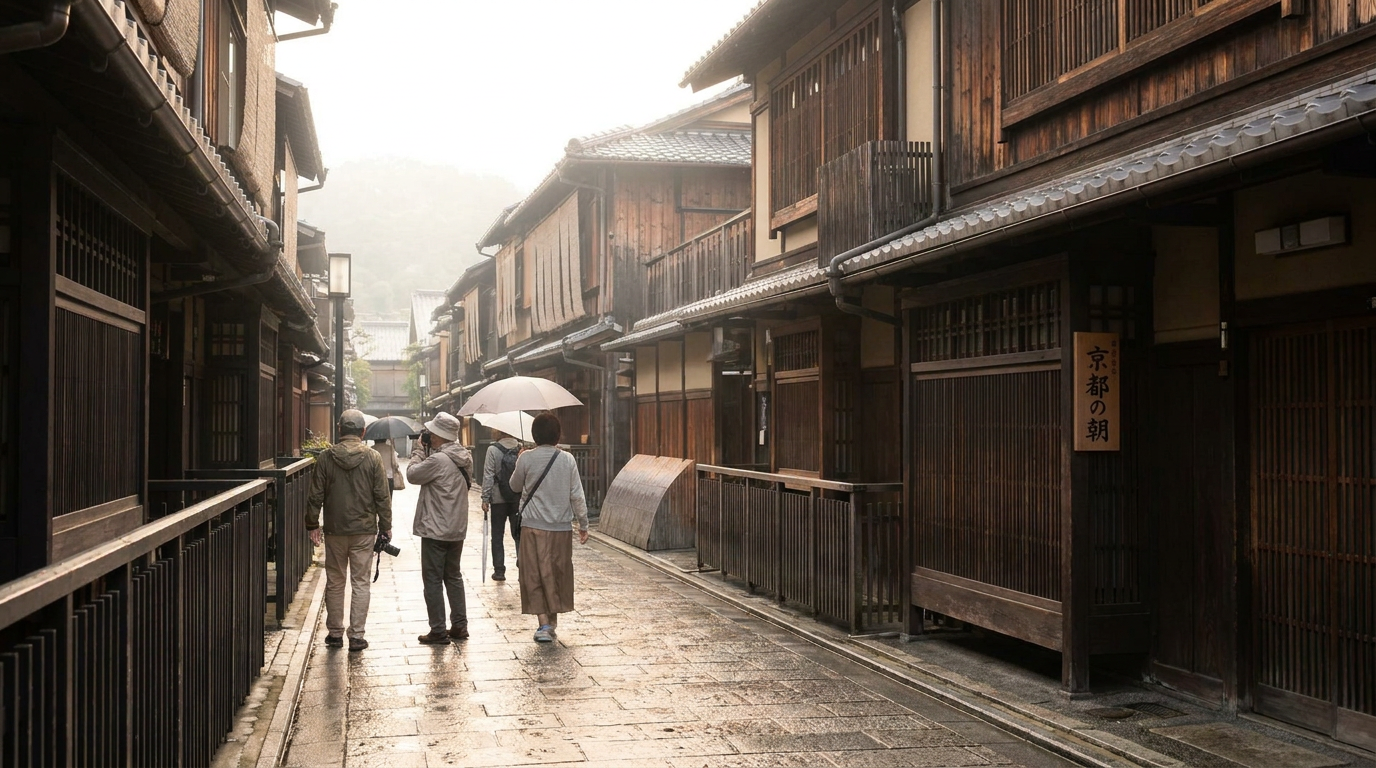
Behavior and etiquette have also been codified into enforceable rules, particularly in sensitive historic districts. In Gion, the famous geisha district, local councils have banned photography in private alleyways to protect the privacy of residents and traditional entertainers.[3][5]
Fines are now levied for trespassing or harassing geisha and maiko, marking a hard line against the paparazzi-style behavior that plagued the area in previous years. The city has deployed multilingual signs and digital geofencing alerts to ensure tourists are fully aware of the boundaries before they raise a camera.[3]

The regulatory crackdown extends to the accommodations themselves. In early 2026, Kyoto Mayor Koji Matsui announced stricter regulations on private lodging operators, commonly known as minpaku or Airbnbs, which have proliferated across residential neighborhoods.[2]
Citing a sharp rise in complaints regarding late-night noise and improper garbage disposal, the city initiated surprise inspections in April 2026. Operators who fail to submit required lodging records or fail to manage their guests' behavior now face immediate business suspension or permanent closure.[2]
While early evidence suggests these measures are beginning to ease congestion in specific bottlenecks, uncertainty remains about their long-term efficacy. It is not yet clear if higher taxes will genuinely disperse crowds to lesser-known regions of Japan, or simply make Kyoto an exclusive destination for wealthier travelers.[1][5]
Furthermore, as other Japanese municipalities watch Kyoto's experiment closely, travelers should anticipate a patchwork of local rules and fees emerging across the country. For now, visiting Kyoto requires a new level of intentionality—trading pure convenience for respect, and recognizing that preserving the city's magic requires active participation from those who come to admire it.[1][3][5]
How we got here
Autumn 2023
Kyoto discontinues the popular one-day bus pass to ease transit congestion.
April 2024
Gion district implements strict photography bans in private alleyways.
March 2026
Kyoto raises its maximum accommodation tax to ¥10,000 per night for luxury stays.
April 2026
Surprise inspections begin for private lodging operators to curb noise and garbage violations.
July 2026
Japan triples its national international departure tax to ¥3,000.
Viewpoints in depth
The Local Resident View
Advocating for a livable city where daily routines are not disrupted by mass tourism.
For years, Kyoto residents have borne the brunt of the city's popularity. Commuters routinely found themselves unable to board public buses packed with tourists and oversized luggage, while neighborhoods like Gion suffered from noise and trespassing. From this perspective, the new taxes and strict regulations are long overdue corrections. Local advocacy groups argue that a city must function for its citizens first; if the infrastructure collapses under the weight of visitors, the very culture that tourists come to see will be eroded.
The Tourism Authority View
Using economic levers to manage crowd flow and fund preservation.
Municipal and national tourism boards recognize that simply asking tourists to behave better is insufficient. By implementing steep luxury accommodation taxes and tripling the national departure tax, authorities are shifting to a 'high-value, lower-volume' strategy. They argue that these funds are essential for maintaining the city's pristine condition, upgrading transit networks, and subsidizing the 'empty-handed tourism' logistics that keep the streets clear. The goal is not to close Kyoto's doors, but to make the tourism economy self-sustaining.
The Traveler View
Adapting to a more expensive and highly regulated vacation experience.
For international visitors, Kyoto's new rules represent a paradigm shift in how a Japanese vacation is planned. The spontaneity of wandering into a quiet alley or hopping on a cheap bus is being replaced by mandatory luggage forwarding, geofenced alerts, and higher baseline costs. While many travelers express a strong desire to be respectful and support sustainable initiatives, there is growing concern that the rising fees—particularly the ¥10,000 nightly tax on higher-end stays—may price out average families, turning Kyoto into an exclusive enclave.
What we don't know
- Whether the increased taxes will successfully disperse tourists to lesser-known regions of Japan.
- How strictly the new private lodging regulations will impact the availability of affordable Airbnbs in the city.
- If other major Japanese cities will adopt Kyoto's aggressive taxation and geofencing models in the coming years.
Key terms
- Smart Tourism
- A destination management approach that uses data, taxation, and infrastructure changes to balance visitor numbers with local quality of life.
- Empty-Handed Tourism
- A Kyoto initiative encouraging travelers to use luggage forwarding services rather than carrying large bags on public transit.
- Minpaku
- The Japanese term for private lodging rentals, such as Airbnbs, which are now facing stricter regulations in Kyoto.
- Geofencing
- The use of GPS technology to send automated alerts to tourists' smartphones when they enter restricted or sensitive areas.
Frequently asked
Can I still take my suitcase on the bus in Kyoto?
It is heavily discouraged and practically difficult. Kyoto promotes 'empty-handed tourism' and asks visitors to use luggage forwarding services from the station to their hotels.
Is photography completely banned in Gion?
No, photography is still allowed on the main public streets like Hanamikoji. The ban and associated fines apply specifically to the private, narrow alleyways where residents live.
How much is the new accommodation tax?
As of March 2026, it ranges from ¥200 for budget stays up to ¥10,000 per person per night for luxury accommodations costing over ¥100,000.
What happened to the Kyoto one-day bus pass?
The city discontinued the bus-only pass to reduce overcrowding. It was replaced by a ¥1,000 pass that includes both the subway and buses to encourage underground travel.
Sources
Source coverage
5 outlets
3 viewpoints surfaced




[1]The Yomiuri ShimbunLocal Residents
Kyoto City raises accommodation tax to combat overtourism
Read on The Yomiuri Shimbun →[2]Nippon TVLocal Residents
Kyoto City tightens regulations on private lodging facilities
Read on Nippon TV →[3]Kyoto City Tourism AssociationTourism Authorities
Kyoto Guidelines for Sustainable Tourism
Read on Kyoto City Tourism Association →[4]Japan National Tourism OrganizationTourism Authorities
Japan's 2026 Departure Tax and Sustainable Tourism Initiatives
Read on Japan National Tourism Organization →[5]Factlen Editorial TeamInternational Travelers
Synthesis by Factlen editorial team
Read on Factlen Editorial Team →

Every angle. Every day.
Get travel stories with full source coverage and perspective breakdowns delivered to your inbox.