
How Adaptive Tech is Leveling the Playing Field in Pro Esports
A wave of modular hardware and inclusive tournament structures in 2026 is breaking down physical barriers in competitive gaming. By integrating custom controllers and standardized handicap tiers, the esports industry is allowing disabled athletes to compete at the highest levels.
By Factlen Editorial Team
- Accessibility Nonprofits
- Organizations focused on removing financial and social barriers to gaming.
- Tournament Organizers
- Operators focused on competitive integrity and standardized integration.
- Hardware & Medical Partners
- Engineers and institutions developing the physical tools for adaptive play.
- Industry Observers
- Analysts tracking the evolution of the esports market.
What's not represented
- · Traditional esports purists who may debate the competitive fairness of heavy software assists in professional brackets.
- · Game engine developers responsible for building the underlying code that supports these accessibility features.
Why this matters
For decades, millions of gamers with physical disabilities were locked out of competitive play due to rigid hardware designs. The mainstreaming of adaptive controllers and inclusive tournament structures is finally leveling the playing field, transforming esports into one of the most accessible competitive arenas in the world.
Key points
- Major international esports tournaments in 2026 are fully integrating adaptive gamers into competitive brackets.
- Modular hardware hubs allow players to translate custom physical inputs into standard game commands.
- Standardized handicap tiers ensure fair competition between players using different levels of software assists.
- Nonprofits are combating the high cost of adaptive gear by subsidizing custom hardware for disabled players.
For decades, the archetype of the elite esports athlete has been defined by raw physical dexterity—players executing hundreds of actions per minute on standardized keyboards or tightly gripped controllers. But that rigid physical barrier is rapidly dissolving. In 2026, competitive gaming is undergoing a quiet but profound revolution, driven by a surge in adaptive technology that allows players with physical disabilities to compete at the highest levels.[6]
This shift is moving accessibility from the fringes of the gaming industry to the center stage of international esports. Major tournaments dedicated entirely to, or fully integrating, adaptive gamers are rolling out globally this year. From regional school competitions in Australia to high-stakes international showdowns in Europe, the focus has pivoted from merely allowing disabled players to play, to empowering them to compete and win.[1][6]
A prime example is the 2026 Gippsland Esports Competition in regional Victoria, Australia, scheduled for June. Hosted by the Australian Esports League and the Esports Collective, the event is designed from the ground up to remove physical barriers. Competitive stations are fully equipped with specialized gaming technology, allowing advanced players and adaptive players to race side-by-side in a fully supported environment.[2]
Earlier in the year, the accessibility nonprofit AbleGamers hosted its first international Esports Tournament for players with disabilities in Milan. The March 2026 event featured a hybrid model, welcoming competitors both in-person and remotely, signaling a new era of global connectivity for disabled gamers who might otherwise face travel restrictions.[5]

The momentum for these 2026 milestones was heavily catalyzed by the inaugural Adaptive Esports Summit held in Daejeon, South Korea, in December 2025. That summit brought together global experts to showcase how technology can bridge the accessibility gap. It culminated in a showcase tournament featuring both disabled and non-disabled players using adaptive tech, proving that the hardware could hold up under the intense pressure of professional play.[1][3]
The necessity for this technological intervention is stark. According to research from the UK-based disability equality charity Scope, 66% of gamers with disabilities face significant barriers when trying to play. Standard controllers require a highly specific range of motion, grip strength, and bimanual coordination that excludes millions of potential players.[3]
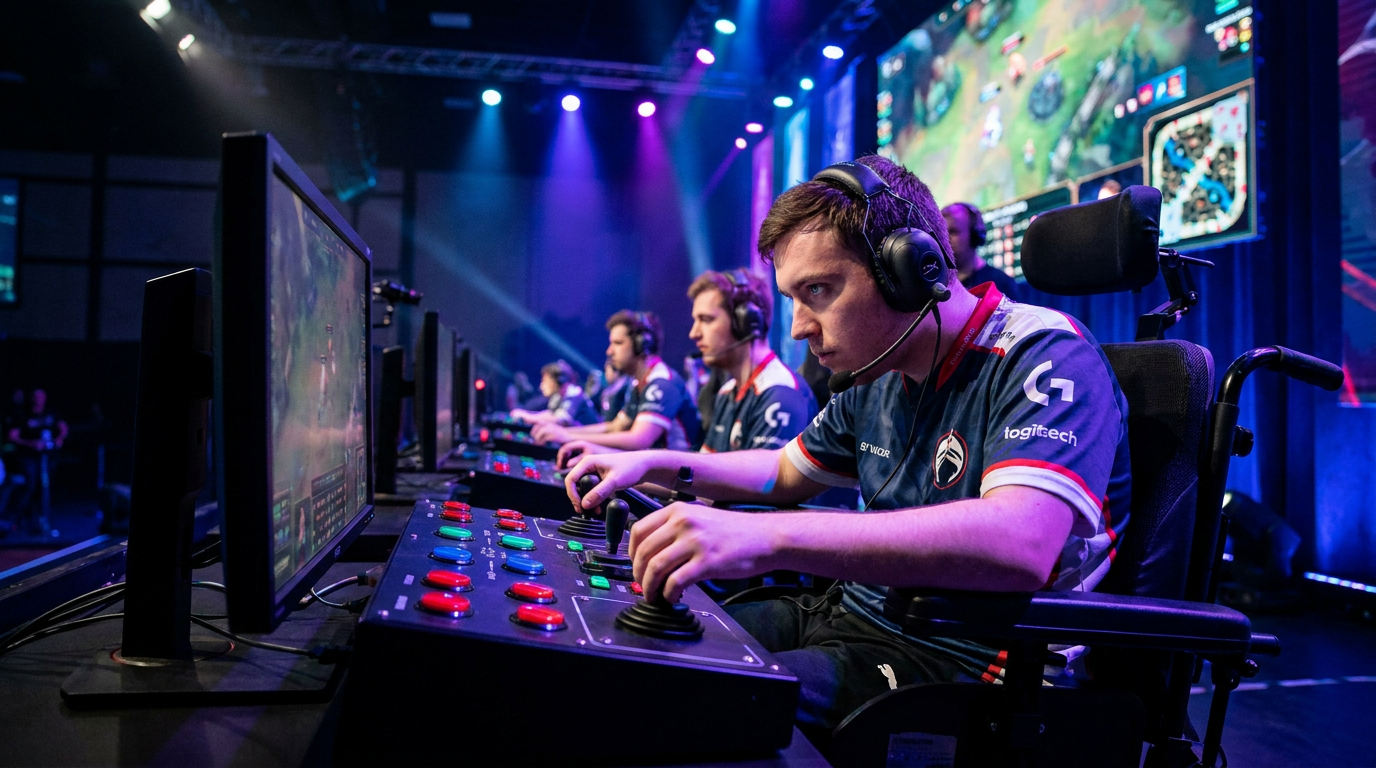
The breakthrough mechanism driving the current era of adaptive esports is modularity. Rather than trying to build a single accessible controller that works for everyone—an impossible task given the vast spectrum of physical disabilities—hardware developers created unified hubs. The pioneer in this space was the Xbox Adaptive Controller, which acts as a central nervous system for customized inputs.[1][6]
Players plug specialized external devices—such as foot pedals, sip-and-puff tubes, or oversized lightweight buttons—into the hub's standard ports. The hub then translates these varied physical inputs into standard controller commands that the console or PC recognizes seamlessly. This allows a player with limited hand mobility to steer a virtual car with their shoulder and accelerate with their foot, all while the game software simply registers standard joystick and trigger inputs.[4][6]

Players plug specialized external devices—such as foot pedals, sip-and-puff tubes, or oversized lightweight buttons—into the hub's standard ports.
The hardware ecosystem has expanded rapidly since those early hub designs. Companies like Logitech have introduced comprehensive Adaptive Kits featuring an array of customizable buttons and triggers that can be mounted anywhere on a player's wheelchair or desk. Meanwhile, newer innovations like the ByoWave Proteus Controller offer a snap-together modular design, allowing users to physically build a custom gamepad shape that perfectly matches their unique range of motion.[2][4]
However, hardware is only half the equation; the software must also accommodate diverse needs. Game developers are increasingly building robust accessibility suites directly into their competitive titles. For example, the racing simulator F1 2025, featured heavily in adaptive tournaments, includes extensive driving assists such as automatic braking and steering support. These features significantly reduce the cognitive and physical load, allowing players to focus on racing strategy rather than fighting the controls.[2][6]
Educating the industry to build these software features has been a massive undertaking. Nonprofits like AbleGamers have trained more than 1,000 video game developers in accessibility best practices. Their Accessible Player Experiences (APX) program offers 22 different design patterns that developers can implement to ensure their games are playable by the widest possible audience from day one.[5]
Despite these technological leaps, cost remains a formidable barrier. Specialized adaptive hardware is often produced in smaller batches than standard controllers, driving up the price. Approximately 30% of disabled gamers cite the affordability of assistive tech as the primary obstacle to their participation.[3]

To combat this, organizations are stepping in to subsidize the gear. AbleGamers' Able Player One program pairs adaptive gaming specialists with players to determine their exact accessibility needs, and then delivers the custom gear entirely free of charge. The specialists maintain ongoing contact to ensure the hardware continues to meet the player's evolving needs, effectively removing the financial barrier to entry.[5]
As the hardware becomes more accessible, tournament organizers are tackling the complex challenge of competitive fairness. How do you create a level playing field when competitors are using vastly different input methods and in-game assists? The solution lies in standardized grading systems, similar to those used in the Paralympic Games.[6]
At events like the Gippsland Esports Competition, official Disability Sport Australia grading and handicap systems are applied to core titles. In racing games, for instance, graded handicap tiers adjust the in-game physics or vehicle performance based on the level of software assists a player requires. This ensures that a player using full manual controls and a player using automatic braking can compete in the same race fairly.[2]
The stakes of this movement extend far beyond prize pools and championship titles. For many individuals with severe physical disabilities, competitive gaming offers a vital lifeline to community and socialization. AbleGamers explicitly states that their mission is to enable play in order to combat social isolation, recognizing that multiplayer environments are often the most accessible public squares available to their community.[5]

Yet, the financial incentives are also beginning to align with the social mission. Mainstream brands are recognizing the value of the adaptive esports market. Logitech recently partnered with Mount Sinai and AbleGamers to sponsor a professional series of adaptive esports tournaments featuring over $30,000 in cash and prizes, elevating the competition from charity showcases to legitimate professional circuits.[4]
As 2026 progresses, the line between adaptive esports and mainstream esports is expected to blur further. With standardized handicap systems proving effective and modular hardware becoming more sophisticated, the ultimate goal of accessibility advocates is a future where disabled and non-disabled athletes routinely compete on the same stages, redefining what it means to be an elite gamer.[1][6]
How we got here
2018
The Xbox Adaptive Controller launches, establishing the first mainstream modular hub for accessible gaming.
Dec 2025
The inaugural Adaptive Esports Summit in South Korea showcases inclusive Tekken 8 and League of Legends tournaments.
Mar 2026
AbleGamers hosts its first international hybrid Esports Tournament for players with disabilities in Milan.
Jun 2026
The Gippsland Esports Competition in Australia integrates adaptive tech and handicap tiers into regional school brackets.
Viewpoints in depth
Accessibility Nonprofits
Organizations focused on removing financial and social barriers to gaming.
Groups like AbleGamers view esports not just as entertainment, but as a vital tool for combating social isolation among people with disabilities. They argue that the primary barriers are no longer strictly technological, but financial, as custom hardware is expensive to produce. By subsidizing gear and training developers in accessible design, these nonprofits aim to make inclusive gaming the default standard rather than a niche charity effort.
Tournament Organizers
Operators focused on competitive integrity and standardized integration.
For tournament hosts, the challenge lies in balancing inclusivity with competitive fairness. Organizers are increasingly adopting official disability sports grading systems to create handicap tiers. This allows players using heavy software assists—like automatic braking—to compete fairly against those using manual controls, ensuring that matches are decided by strategy and timing rather than physical capability or hardware advantages.
Hardware & Medical Partners
Engineers and institutions developing the physical tools for adaptive play.
Hardware developers approach accessibility as an engineering challenge centered on modularity. Recognizing that no single controller can accommodate all physical disabilities, they focus on creating unified hubs that translate highly customized inputs—like sip-and-puff tubes or foot pedals—into standard game commands. Medical institutions often partner in this space to ensure the ergonomics of these custom setups prevent repetitive strain and meet specific therapeutic needs.
What we don't know
- It remains to be seen how quickly major global esports franchises—like the League of Legends World Championship—will fully integrate adaptive handicap tiers into their primary brackets.
- The long-term funding model for subsidizing expensive adaptive hardware for amateur players is still heavily reliant on nonprofit grants and charity.
Key terms
- Adaptive Controller
- A customizable gaming hub that allows players to plug in specialized external switches and joysticks tailored to their physical mobility.
- Handicap Tier
- A competitive grading system that adjusts in-game mechanics to ensure fair play between gamers using different levels of software assists.
- APM (Actions Per Minute)
- A metric used in traditional esports to measure a player's physical dexterity and speed in executing commands.
- Sip-and-Puff
- An assistive technology that allows users to send input signals to a device using their breath.
Frequently asked
What is an adaptive controller?
It is a specialized hardware hub that lets players with limited mobility use custom inputs—like foot pedals or breath-activated switches—to play standard video games.
How do disabled and non-disabled gamers compete fairly?
Tournaments use standardized grading systems and handicap tiers. These systems adjust in-game physics or software assists to ensure matches are decided by skill rather than physical capability.
Are there professional tournaments for adaptive esports?
Yes. In 2026, events like the AbleGamers international tournament in Milan and Logitech's $30,000 adaptive series have established professional circuits for disabled players.
Why is accessible gaming gear so expensive?
Adaptive hardware is highly specialized and often produced in smaller batches than standard controllers, which drives up manufacturing costs and retail prices.
Sources
Source coverage
6 outlets
4 viewpoints surfaced






[1]EsportsRadarTournament Organizers
Adaptive Esports Summit to address accessibility gap
Read on EsportsRadar →[2]Australian Esports LeagueTournament Organizers
2026 Gippsland Esports Competition
Read on Australian Esports League →[3]Adaptive Esports SummitAccessibility Nonprofits
Creating a More Inclusive Gaming Community
Read on Adaptive Esports Summit →[4]Mount SinaiHardware & Medical Partners
Adaptive E-Sports Tournaments and Resources
Read on Mount Sinai →[5]TwoMaverixAccessibility Nonprofits
AbleGamers Executive Director Jordan Kough on the future of accessible gaming
Read on TwoMaverix →[6]Factlen Editorial TeamIndustry Observers
Synthesis by Factlen editorial team
Read on Factlen Editorial Team →
More in sports
See all 10 stories →MLB Milestones
Cubs' Pete Crow-Armstrong Hits First Cycle of the 2026 MLB Season
0 sources

Standings
Midseason Lacrosse Standings: Chaos Lead 'Wild West' as Defending Champion Atlas Stumble
0 sources

Women's Soccer
NWSL Awards 2026 Championship to Audi Field Amid Record Global Call-Ups
0 sources
Injury
World Snooker Tour Injury Report: Carrington's Return, Brecel's Recovery, and Latest Player Updates
0 sources
Every angle. Every day.
Get sports stories with full source coverage and perspective breakdowns delivered to your inbox.