
Steam Deck OLED vs. ROG Ally X: Which Premium Handheld Fits Your Playstyle?
Valve's console-like Steam Deck OLED and ASUS's Windows-powered ROG Ally X represent the two leading philosophies in portable PC gaming. Choosing between them comes down to a trade-off between seamless software efficiency and raw, unrestricted performance.
By Factlen Editorial Team
- Console Purists
- Value seamless software, OLED contrast, and 'it just works' reliability over raw power.
- Performance Enthusiasts
- Prioritize raw framerates, 1080p resolution, and the flexibility to push hardware to its limits.
- Ecosystem Agnostics
- Demand seamless access to Game Pass, Epic Games, and anti-cheat multiplayer titles without Linux workarounds.
What's not represented
- · Budget Gamers
- · Nintendo Switch Loyalists
Why this matters
Handheld PCs have evolved from niche gadgets into primary gaming consoles capable of running blockbuster titles. Deciding which premium device to buy dictates not just how your games look, but which storefronts you can access and how much time you will spend tinkering versus playing.
Key points
- The Steam Deck OLED excels in battery efficiency and offers a frictionless, console-like software experience.
- The ROG Ally X provides superior raw performance, a 120Hz 1080p display, and native Windows 11 compatibility.
- Valve's handheld features dual trackpads, making it the better choice for mouse-heavy strategy games.
- ASUS doubled the Ally X's battery to 80Whr, allowing it to sustain heavy AAA gaming workloads longer than the competition.
The handheld PC gaming market has matured significantly, moving past the experimental phase into a battle of refined, premium hardware. At the top of the stack sit two devices that represent fundamentally different philosophies: Valve’s Steam Deck OLED and the ASUS ROG Ally X.[1][6]
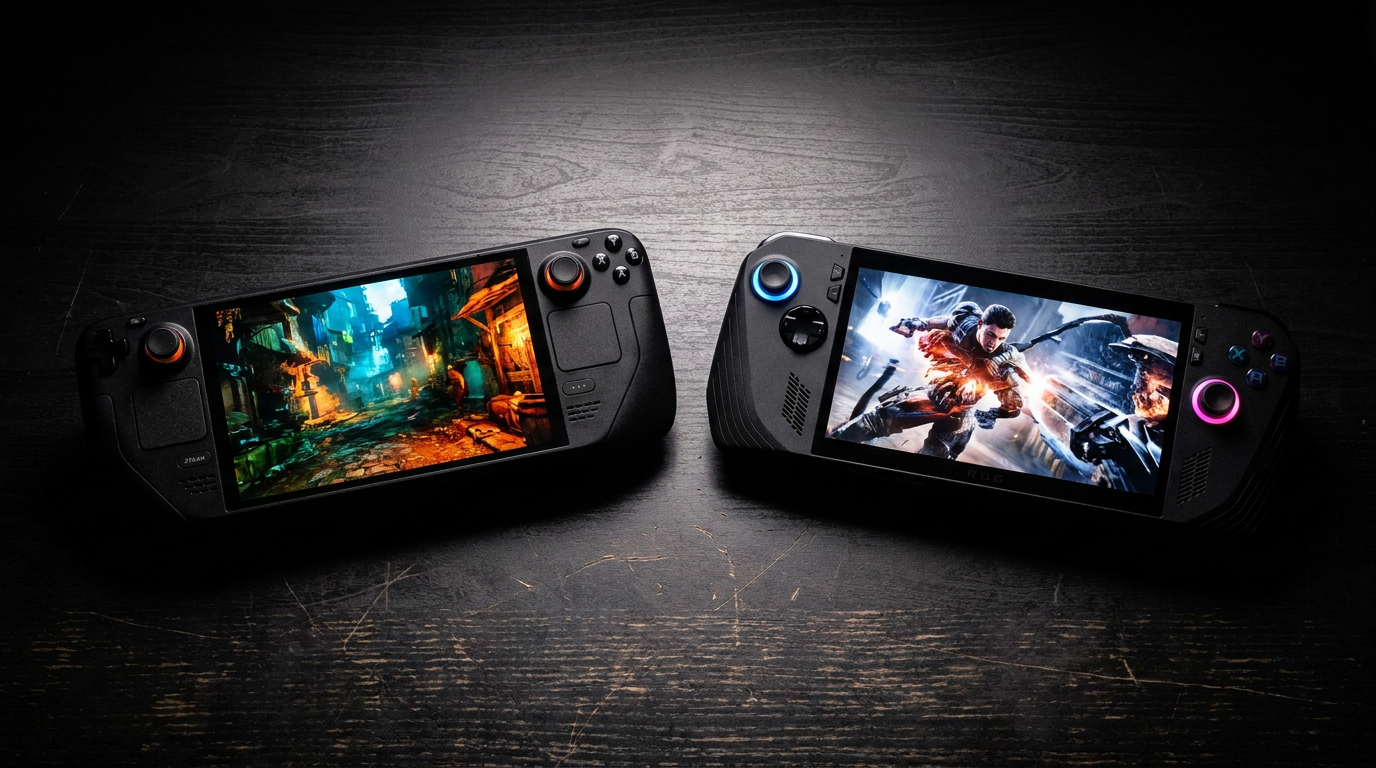
Valve’s approach with the Steam Deck OLED is heavily curated, prioritizing a console-like experience powered by its custom Linux-based SteamOS. ASUS, in contrast, built the ROG Ally X as a brute-force Windows 11 machine, designed to offer the unrestricted freedom of a full desktop PC in a portable form factor.[2][7]
The visual experience highlights the first major divergence. The Steam Deck OLED features a 7.4-inch HDR OLED panel running at a 1280x800 resolution with a 90Hz refresh rate. The OLED technology allows individual pixels to turn off completely, delivering infinite contrast, perfect blacks, and vibrant color reproduction that makes atmospheric games pop.[1][7]
The ROG Ally X takes a different route, utilizing a 7-inch IPS display that pushes a higher 1920x1080 resolution and a faster 120Hz refresh rate. While it lacks the inky blacks of an OLED, the higher pixel density results in noticeably sharper text and UI elements, and the 120Hz ceiling is a massive boon for competitive shooters and lightweight indie titles that can actually hit those higher frame rates.[5][6]

Under the hood, the performance gap is pronounced. The Steam Deck OLED relies on a highly efficient, custom 6-nanometer AMD APU paired with 16GB of LPDDR5 RAM. It is a chip designed to maximize performance-per-watt, ensuring consistent frame pacing at lower power draws rather than chasing maximum graphical fidelity.[1][7]
The ROG Ally X flexes considerably more muscle, powered by the AMD Ryzen Z1 Extreme processor and backed by a massive 24GB of LPDDR5X RAM. This extra memory headroom is crucial for modern, memory-hungry blockbuster titles, allowing the Ally X to run games at higher settings and smoother frame rates than Valve’s handheld can manage.[2][6]
Battery life is perhaps the most fiercely contested battleground. Valve upgraded the Steam Deck OLED to a 50-watt-hour battery, which, combined with the efficient APU and OLED screen, delivers exceptional longevity for indie games and older titles, often stretching past six hours of playtime.[1][4]
Battery life is perhaps the most fiercely contested battleground.
ASUS answered the battery challenge by cramming a massive 80-watt-hour battery into the ROG Ally X—double the capacity of the original Ally. In real-world testing, this allows the Ally X to run demanding AAA games at a 25-watt power draw for nearly two hours, effectively doubling the high-end playtime of its predecessor and edging out the Steam Deck in heavy workloads.[3][4]

Ergonomics and control schemes further separate the two devices. The Steam Deck OLED is wider and features dual trackpads, which are indispensable for playing strategy games or navigating desktop mode. The ROG Ally X adopts a more traditional Xbox-style layout, featuring Hall effect joysticks to prevent drift and a slightly heavier 670-gram chassis that remains comfortable during long sessions.[5][7]
Software friction is the defining experiential difference. SteamOS boots directly into a clean, controller-friendly interface where games simply work without driver updates or background launcher conflicts. However, this Linux environment inherently blocks games with certain anti-cheat software and requires complex workarounds to access non-Steam storefronts.[1][6]
Because the ROG Ally X runs native Windows 11, it effortlessly supports Xbox Game Pass, Epic Games Store, and any anti-cheat software on the market. The trade-off is the inherent clunkiness of navigating a desktop operating system on a 7-inch touchscreen, complete with unexpected updates and occasional software quirks.[2][5]

In a direct trade-off analysis, the arguments for the Steam Deck OLED center on its unmatched ease of use, superior screen contrast, and exceptional low-power battery life. The arguments against it focus on its lower performance ceiling and its inability to natively play Game Pass titles. The evidence consistently shows that for players who want a frictionless, console-like experience, Valve's ecosystem remains undefeated.[1][7]
Conversely, the arguments for the ROG Ally X highlight its raw graphical power, its sharper 120Hz display, and its massive 80-watt-hour battery that sustains heavy workloads. The arguments against it involve the inherent friction of Windows 11 and a higher price point. The evidence points to the Ally X as the ultimate choice for power users who demand desktop-level flexibility and top-tier performance on the go.[2][3][6]

Ultimately, the Steam Deck OLED fits well when a player wants a plug-and-play console experience, values OLED visual fidelity, and primarily plays games within the Steam ecosystem. It does not fit well when a user relies heavily on Xbox Game Pass, plays competitive multiplayer shooters with strict anti-cheat requirements, or demands 1080p resolutions.[1][6]
The ASUS ROG Ally X fits well when a player wants the highest possible portable frame rates, needs native access to multiple PC storefronts, and is willing to occasionally troubleshoot Windows software. It does not fit well when a user wants a purely frictionless interface, prefers the precision of trackpads for strategy games, or prioritizes the absolute lowest entry price.[2][5]
How we got here
Feb 2022
Valve launches the original Steam Deck, proving the viability of the premium handheld PC market.
Jun 2023
ASUS releases the original ROG Ally, introducing a powerful Windows-based alternative with a 120Hz screen.
Nov 2023
Valve releases the Steam Deck OLED, featuring a vastly improved screen, larger battery, and refined thermals.
Jul 2024
ASUS launches the ROG Ally X, doubling the battery capacity and increasing the RAM to dominate the high-performance tier.
Viewpoints in depth
The SteamOS Advocates
Users who believe a handheld should feel like a dedicated console rather than a tiny desktop.
This camp argues that the friction of Windows 11 ruins the portable experience. They point to SteamOS's ability to suspend and resume games instantly, its unified controller profiles, and its highly optimized power profiles. For these users, the fact that the Steam Deck OLED can run an indie game for eight hours on a single charge is far more valuable than the ability to push 60 frames per second in a AAA title.
The Windows Power Users
Gamers who demand unrestricted access to their entire PC library and storefronts.
This perspective champions the ROG Ally X because it refuses to compromise on compatibility. They argue that a PC handheld should actually be a PC, capable of running Xbox Game Pass, the Epic Games Store, and multiplayer games protected by kernel-level anti-cheat software. They view the occasional Windows update or touchscreen quirk as a minor tax to pay for total digital freedom and superior graphical horsepower.
What we don't know
- Whether Valve plans to release a true 'Steam Deck 2' with upgraded processing power in the near future.
- How future Windows updates might further optimize or hinder the handheld touchscreen experience on devices like the Ally X.
Key terms
- APU
- Accelerated Processing Unit, a single chip that combines both the central processor (CPU) and graphics processor (GPU), commonly used in handhelds.
- TDP
- Thermal Design Power, referring to the maximum amount of heat a chip is expected to generate, which directly correlates to how much battery power it draws.
- OLED
- Organic Light-Emitting Diode, a display technology where each pixel emits its own light, allowing for perfect blacks and infinite contrast.
- SteamOS
- Valve's custom, Linux-based operating system designed specifically to provide a console-like, controller-friendly interface for PC games.
- Variable Refresh Rate (VRR)
- A display feature that syncs the screen's refresh rate with the game's frame rate to eliminate screen tearing and stuttering.
Frequently asked
Can the Steam Deck OLED play Xbox Game Pass games?
Not natively. While you can stream Game Pass titles via the cloud, installing them locally requires complex workarounds like dual-booting Windows, which defeats the purpose of SteamOS.
Does the ROG Ally X fix the battery issues of the original Ally?
Yes. ASUS doubled the battery capacity to 80Whr, allowing the Ally X to run demanding AAA games for nearly two hours, a massive improvement over the original model.
Which handheld is better for strategy games?
The Steam Deck OLED is superior for strategy and management games because it features dual trackpads, which perfectly emulate mouse inputs.
Do both devices suffer from joystick drift?
While both use analog sticks that could eventually drift, the ROG Ally X upgraded to more durable components, and the Steam Deck OLED offers highly accessible, user-replaceable thumbstick modules.
Sources
Source coverage
7 outlets
3 viewpoints surfaced







[1]GizmodoConsole Purists
The Steam Deck OLED Is the Handheld You've Always Wanted
Read on Gizmodo →[2]PCMagPerformance Enthusiasts
Asus ROG Ally X Review: Capable Performance, Superior Battery Life
Read on PCMag →[3]XDA DevelopersEcosystem Agnostics
I played GTA Online until the ROG Ally X and ROG Ally died — here's how long they lasted
Read on XDA Developers →[4]Laptop MagEcosystem Agnostics
ROG Ally battery life vs other handhelds: Which gaming device lasts the longest?
Read on Laptop Mag →[5]TechPowerUpPerformance Enthusiasts
ASUS ROG Ally X Review - The Best Windows Handheld
Read on TechPowerUp →[6]Pocket-lintEcosystem Agnostics
ROG Ally X vs Steam Deck OLED: Which premium handheld is right for you?
Read on Pocket-lint →[7]ReviewedConsole Purists
Valve Steam Deck OLED Review
Read on Reviewed →
Every angle. Every day.
Get gaming esports stories with full source coverage and perspective breakdowns delivered to your inbox.