
Smart Ring vs. Smartwatch: The 2026 Evidence-Based Comparison
As smart rings challenge the dominance of smartwatches, choosing the right wearable comes down to a trade-off between passive comfort and active real-time data.
By Factlen Editorial Team
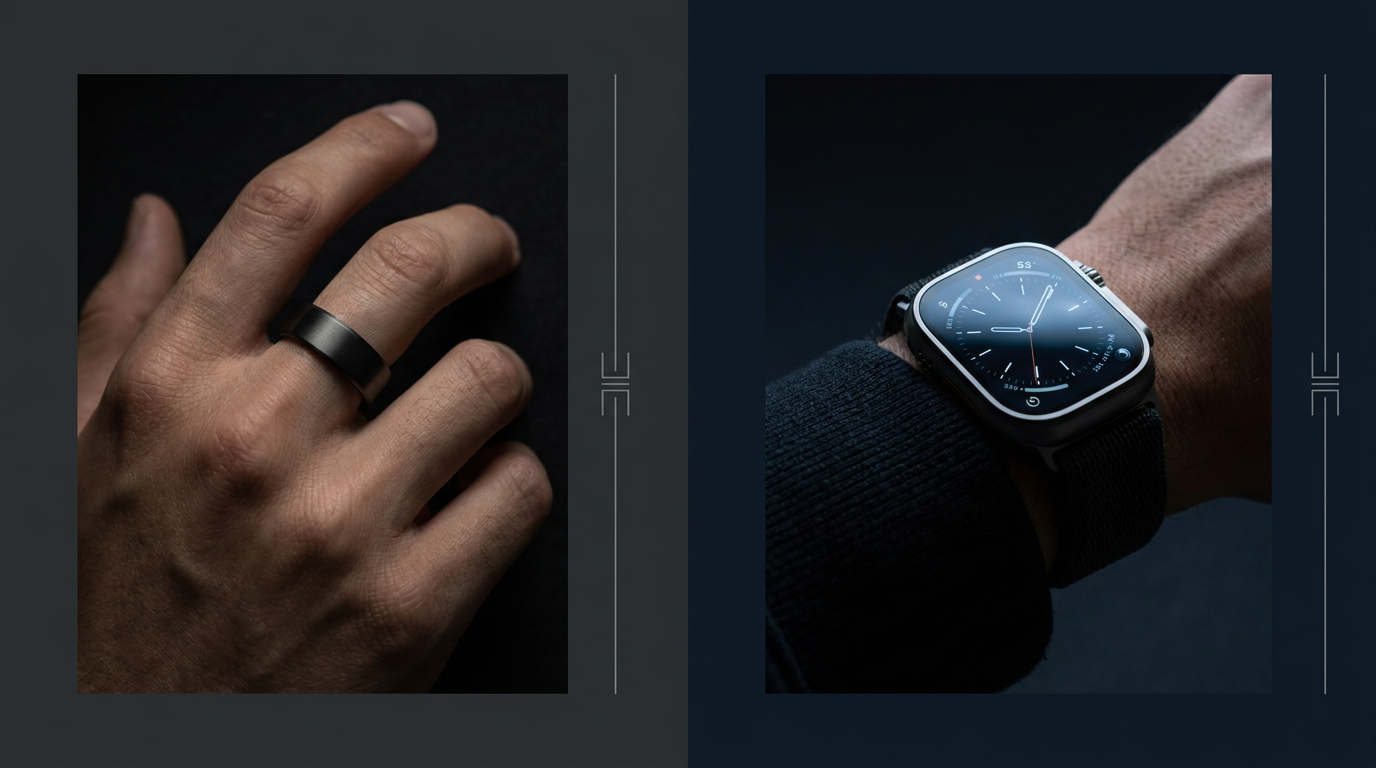
- Passive Health Advocates
- Prioritize unobtrusive, continuous monitoring and sleep comfort over real-time interaction.
- Active Performance Trackers
- Value real-time workout data, GPS accuracy, and ecosystem integration for athletic training.
- Ecosystem Integrationists
- Focus on how the wearable acts as an extension of the smartphone for payments, calls, and daily convenience.
What's not represented
- · Traditional watchmakers losing wrist real estate
- · Medical professionals relying on consumer data
Why this matters
Choosing the wrong wearable is a $300 to $500 mistake that often ends with the device abandoned in a drawer. Understanding the fundamental trade-off between active digital companions and passive health sentinels ensures you buy the tool that actually matches your daily habits.
Key points
- Smart rings excel at passive health monitoring, offering superior comfort for overnight sleep tracking.
- Smartwatches remain the undisputed choice for active workouts, providing GPS and real-time pacing data.
- Rings offer up to a week of battery life, while watches typically require daily charging.
- Many health enthusiasts now use both: a watch for daytime activity and a ring for nighttime recovery.
The defining wearable question of 2026 is no longer which brand to buy, but which part of the body to track. Consumers are increasingly forced to choose between the traditional smartwatch and the rapidly ascending smart ring. Both form factors utilize similar optical sensors to monitor heart rate, sleep, and physical activity, but they serve entirely different masters, with smart rings recently dominating crowdfunding momentum for health-focused wearables.[6][8]
The core philosophical difference lies in the level of interaction. Smartwatches are active digital companions designed to extend the smartphone onto the wrist, demanding attention through screens, apps, and notifications. Smart rings, by contrast, are passive health sentinels. They lack screens and vibration alerts, dedicating their entire surface area to quietly collecting biometric data in the background without adding to daily screen time.[5][6]
The case for the smart ring centers heavily on comfort and the biological advantages of the finger. The finger contains dense capillary networks close to the skin's surface, making it an exceptionally stable vascular bed for photoplethysmography (PPG) sensors. Because the ring sits in firm, circumferential contact with the skin, it suffers from far less motion artifact than a device sliding around on the back of the wrist.[5][6]
The case against the smart ring highlights its complete lack of real-time utility. Without a display, users cannot check their running pace, view incoming messages, or control their music without pulling out a smartphone. Furthermore, the rigid titanium form factor makes smart rings uniquely unsuited for heavy weightlifting, as gripping a barbell can scratch the device and press the internal sensors painfully into the finger.[1][3]

The evidence for smart rings is strongest in the realm of sleep and recovery tracking. Because devices like the Oura Ring 4 weigh less than five grams and emit no distracting light, users actually wear them to bed consistently. This compliance yields uninterrupted overnight data on heart rate variability and temperature trends, which algorithms use to generate highly accurate morning readiness scores.[1][4]
The case for the smartwatch revolves around active workout tracking and comprehensive ecosystem integration. Devices like the Apple Watch Series 11 and the Samsung Galaxy Watch 8 are unparalleled for structured exercise. They offer built-in GPS for precise route tracking, dedicated electrocardiogram (ECG) apps to detect irregular heart rhythms, and the ability to leave the smartphone at home while remaining connected via cellular data.[2][7]
The case for the smartwatch revolves around active workout tracking and comprehensive ecosystem integration.
The case against the smartwatch focuses on tracker fatigue and severe battery limitations. The vibrant screens and constant connectivity demand immense power, limiting most premium smartwatches to 18 to 36 hours of battery life. This forces users into a daily charging routine, often resulting in the watch sitting on a charger exactly when it should be tracking sleep or a lunchtime workout.[1][3]
The evidence for smartwatches shows that their sensors are clinically exceptional—when they are actually worn. A 2026 sleep study conducted with Stanford Health Care found that the Apple Watch clocked sleep duration down to the minute, aligning almost perfectly with laboratory polysomnography results. The watch's accuracy is undisputed, but its bulk makes overnight compliance a persistent challenge for many users.[2]

Financial considerations and battery life heavily quantify the divide between the two form factors. Premium smart rings routinely deliver six to eight days of battery life on a single charge, vastly outperforming the daily charging requirements of smartwatches. However, rings often carry hidden costs; while an Apple Watch requires a flat upfront purchase of roughly $399, devices like the Oura Ring pair a $349 hardware cost with a $6 monthly subscription to unlock the data.[4][7]
To bypass these inherent trade-offs, a growing demographic of health enthusiasts has adopted a dual-wearer approach. They rely on a smartwatch during the day for notifications, mobile payments, and workout tracking, then switch exclusively to a smart ring at night for unobtrusive recovery and sleep monitoring.[5][6]
Ultimately, the smart ring fits well when passive, continuous health monitoring is the primary goal. It is the optimal choice for individuals who prioritize sleep data above all else, prefer wearing traditional mechanical watches during the day, or actively want to minimize screen time and digital distractions.[1][5]

Conversely, the smart ring does not fit well when the user needs real-time pacing data during runs, wants to track complex interval workouts, or regularly lifts heavy weights that could damage the ring's exterior.[3]
The smartwatch fits well when the user wants a comprehensive, interactive digital companion. It is ideal for outdoor athletes who require on-wrist GPS, individuals managing specific heart conditions that benefit from ECG readings, and those who value the convenience of wrist-based payments and cellular connectivity.[2][7]
How we got here
2015
Smartwatches gain mainstream dominance with the launch of the first Apple Watch.
2018
Oura introduces its second-generation ring, establishing the finger as a viable alternative for sleep tracking.
2024
Samsung enters the smart ring market with the Galaxy Ring, validating the form factor for major tech ecosystems.
2026
Dual-wearer habits emerge as consumers increasingly pair daytime smartwatches with nighttime smart rings.
Viewpoints in depth
Passive Health Trackers
Argue that technology should fade into the background, collecting continuous biometric data without demanding attention.
This camp views the screen as a liability rather than a feature. They argue that the constant barrage of notifications, stand reminders, and glowing displays actively detracts from mental well-being. By moving the sensors to the finger, passive health trackers believe users can gain all the benefits of biometric monitoring—like illness prediction and sleep staging—without the psychological burden of wearing another screen.
Active Data Enthusiasts
Argue that real-time feedback is essential for athletic performance and daily utility.
For this group, a wearable is a tool for active intervention. They rely on the ability to glance at their wrist mid-run to check their heart rate zone or adjust their pacing. They argue that a device without a screen is fundamentally limited, as it requires pulling out a smartphone to make sense of the data it collects. To them, the smartwatch is an indispensable remote control for their digital and physical lives.
Digital Minimalists
Value the smart ring specifically because it helps break the cycle of constant connectivity.
Digital minimalists sit between the two extremes. They want the insights that come from tracking heart rate variability and sleep quality, but they actively want to disconnect from the internet. They champion the smart ring because it allows them to leave their phone in another room and wear a traditional mechanical watch, reclaiming their attention while still optimizing their physical health.
What we don't know
- Whether future smart rings will successfully integrate haptic feedback or basic notification systems without compromising battery life.
- How Apple will respond to the growing smart ring market, as rumors of an 'Apple Ring' remain unconfirmed.
Key terms
- Photoplethysmography (PPG)
- An optical technology using light to measure changes in blood volume at the skin's surface, used by both rings and watches to track heart rate.
- Heart Rate Variability (HRV)
- The variation in time between consecutive heartbeats, used as a key metric to measure physical recovery and stress levels.
- Polysomnography
- A comprehensive clinical sleep study used as the medical gold standard to evaluate the accuracy of consumer sleep trackers.
- SpO2
- An estimate of blood oxygen saturation levels, tracked by wearables to detect potential breathing disturbances during sleep.
Frequently asked
Can a smart ring track my runs without my phone?
No. Smart rings lack built-in GPS and screens, meaning you must carry your phone to track precise routes and view real-time pacing.
Do smart rings require a monthly subscription?
Many premium models, like the Oura Ring, require a monthly fee (around $6) to access detailed health data, though some alternatives like the Samsung Galaxy Ring do not.
Which device is more accurate for sleep tracking?
Both use similar optical sensors, but smart rings often provide more consistent sleep data because their lightweight design makes users more likely to wear them all night.
Can I wear a smart ring while lifting weights?
It is generally not recommended. Gripping heavy metal barbells can scratch the ring's exterior and cause discomfort by pressing the sensors into your finger.
Sources
Source coverage
8 outlets
3 viewpoints surfaced








[1]ZDNETPassive Health Advocates
I've worn the Oura Ring and Apple Watch for years: Here's which of two is more essential
Read on ZDNET →[2]9to5MacActive Performance Trackers
Here's how Apple Watch Series 11 stacks up against Oura, Fitbit, and Whoop, per WSJ
Read on 9to5Mac →[3]WareableActive Performance Trackers
Samsung Galaxy Ring vs Galaxy Watch 7: Which should you buy?
Read on Wareable →[4]Garage Gym ReviewsActive Performance Trackers
Oura Ring vs Apple Watch Comparison: Which Tracker Wins?
Read on Garage Gym Reviews →[5]SmartRingHQPassive Health Advocates
Smart Ring vs Smartwatch: The Honest 2026 Comparison
Read on SmartRingHQ →[6]JC VitalPassive Health Advocates
Smart Ring vs Smartwatch 2026: Which Is Right for You?
Read on JC Vital →[7]SamsungEcosystem Integrationists
Smart ring vs smartwatch: What are the differences?
Read on Samsung →[8]BackerRockEcosystem Integrationists
Smart Ring vs Smartwatch: Which Wearable Category Is Winning on Kickstarter?
Read on BackerRock →


Every angle. Every day.
Get shopping stories with full source coverage and perspective breakdowns delivered to your inbox.