
How Neuroaesthetics in Interior Design Shapes Brain Chemistry and Mental Health
Emerging research at the intersection of neuroscience and architecture reveals how the shapes, lighting, and textures of our homes directly alter our nervous system. By applying evidence-based design principles, spaces can be transformed into active tools for stress reduction.
By Factlen Editorial Team
- Clinical Researchers
- Focuses on the empirical, biological mechanisms of how space alters brain chemistry.
- Design Practitioners
- Focuses on translating scientific findings into practical, livable spaces.
- Editorial Analysts
- Focuses on synthesizing the broader implications of neuroaesthetics for everyday wellness.
What's not represented
- · Low-income housing developers
- · Renters with limited control over their spaces
Why this matters
You spend roughly 90% of your life indoors. Understanding how your physical environment subconsciously triggers either stress or relaxation allows you to design a home that actively supports your mental health, rather than subtly draining it.
Key points
- Neuroaesthetics is a scientific field studying how the brain responds to spatial environments, beauty, and design.
- Elements like natural light, biophilic patterns, and curved geometry can measurably lower cortisol levels and heart rates.
- The human brain processes natural fractal patterns, like wood grain, with extreme fluency, reducing cognitive load.
- Biometric tracking shows that the environments our bodies biologically relax in often differ from what our conscious minds prefer.
For decades, interior design has been treated largely as a matter of personal taste and aesthetic trends. We flip through magazines to find the right shade of blue or the perfect mid-century modern chair, judging spaces primarily by how they look. But a rapidly growing scientific discipline is fundamentally changing how we understand our built environments. We are beginning to realize that our homes are not just passive backdrops to our lives; they are active participants in our neurobiology.[7]
Enter neuroaesthetics, a multidisciplinary field at the intersection of brain science, architecture, and interior design. Rather than asking what looks stylish, neuroaesthetics asks a more profound question: how does the physical space around us alter our brain chemistry, our nervous system, and our emotional baseline? The answers are transforming interior design from a purely aesthetic pursuit into a recognized wellness practice.[1][7]
The premise is rooted in evolutionary biology. For millennia, the human brain evolved to scan natural environments for safety, resources, and threats. When we moved indoors—where the average person now spends roughly 90% of their life—our brains did not leave those evolutionary hardwirings behind. We still subconsciously process our surroundings within milliseconds, triggering either low-grade stress or deep relaxation before we even consciously register a room's decor.[6]
Advances in functional magnetic resonance imaging (fMRI) and biometric tracking have allowed researchers to literally see this process unfold. Scientists can now observe the brain lighting up in real-time when a person is exposed to specific architectural features. They track heart rate, blood pressure, and cortisol levels to measure exactly how a room impacts the body's stress response.[2]

The foundational discovery of neuroaesthetics dates back to the 1990s, when neurobiologists found that perceiving something beautiful—whether a painting, a piece of music, or a well-designed room—consistently activates the medial orbitofrontal cortex, the brain's reward and pleasure center. Beauty, it turns out, is not just a subjective opinion; it is a measurable neurological event that floods the brain with feel-good neurotransmitters.[7]
One of the most powerful applications of this science is biophilic design, which leverages the brain's innate preference for nature. Studies consistently show that incorporating natural elements into a home lowers blood pressure and reduces the stress hormone cortisol. But neuroaesthetics reveals that you don't necessarily need a living forest in your living room to reap these benefits.[6]
The brain responds remarkably well to "fractals"—complex, repeating patterns found abundantly in nature, such as the branching of trees, the veins of a leaf, or the ripples of water. Research highlights that the human visual system is highly proficient at processing these fractal patterns. Because the brain can decode them fluently and automatically, looking at fractals significantly reduces cognitive load and visual fatigue.[3]
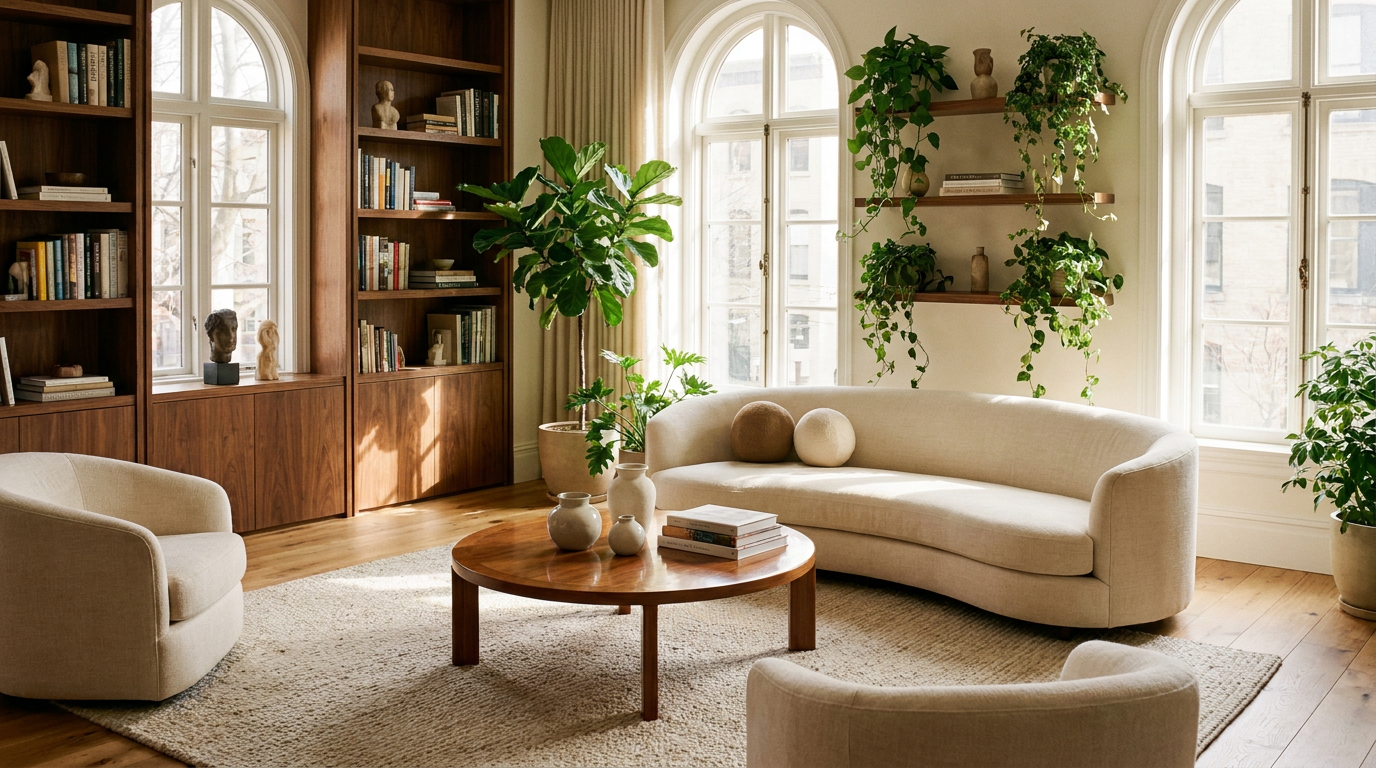
This explains why humans are universally drawn to materials like wood grain or natural stone. The inherent, non-repeating yet structured patterns in these materials provide the exact visual stimuli our brains evolved to process effortlessly. Incorporating these textures into flooring, furniture, or decor acts as a subconscious sigh of relief for the visual cortex.[3]

This explains why humans are universally drawn to materials like wood grain or natural stone.
The geometry of our spaces also plays a critical role in our emotional regulation. Neuroimaging studies have demonstrated that curvilinear spaces—rooms or furniture with soft, rounded edges—activate the brain's pleasure centers more strongly than rectilinear spaces. Sharp angles and jagged lines, conversely, can subtly activate the amygdala, the brain's threat-detection center, keeping the nervous system in a state of mild, continuous alertness.[1][3]
Lighting is another pillar of neuroaesthetic design, deeply tied to our circadian rhythms. The human brain relies on the shifting color temperature of natural daylight to regulate the production of hormones: blue-toned morning light stimulates cortisol for alertness, while warm, amber evening light triggers melatonin for sleep.[7]
When homes are blasted with bright, cool-toned LED lighting after sunset, it creates a biological incongruence. The brain becomes confused, disrupting sleep cycles and increasing anxiety. Neuroaesthetic design prioritizes dynamic lighting—maximizing natural daylight during working hours and utilizing dimmable, warm light sources at eye level or below to signal safety and rest in the evening.[7]
The real-world impact of these principles was famously demonstrated at the Milan Design Week in a collaboration between Google Arts & Culture, Johns Hopkins University's International Arts + Mind Lab, and architecture firms. The exhibit, titled "A Space for Being," invited visitors to walk through three distinct rooms while wearing biometric bands that tracked their heart rate, skin conductivity, and skin temperature.[4][5]
The rooms varied in their use of form, color, scent, and sound. At the end of the exhibit, visitors were shown their biological data, revealing which room actually put their nervous system at ease. Strikingly, many visitors discovered that the room their conscious mind "liked" the most was not the room that their body biologically relaxed in, highlighting the profound disconnect between conscious taste and subconscious well-being.[5]

This data-driven approach is increasingly being adopted in high-stress environments like hospitals and corporate offices, where neuroaesthetic principles have been linked to 15% to 30% increases in clinical recovery rates and employee satisfaction. But the true frontier is the residential home, where these concepts can be applied to everyday living.[1][7]
Applying these principles at home does not require a massive renovation budget. It can be as simple as decluttering to reduce visual noise, adding a few broad-leafed plants, swapping out harsh overhead bulbs for warm table lamps, or introducing a curved, textured rug to soften a highly angular room.[2]
The goal is to create "coherence"—a space that makes intuitive sense to the brain. When a home is coherent, it triggers the parasympathetic nervous system, the "rest and digest" state. The environment stops demanding cognitive energy to process, allowing the mind to fully restore itself.[7]

Of course, neuroaesthetics is not a one-size-fits-all prescription. The brain's "top-down" processing means that our cultural background, personal memories, and individual identities heavily mediate our baseline biological responses. A minimalist, curved room might soothe one person but feel uncomfortably sterile to another whose positive memories are tied to vibrant, eclectic spaces.[3]
As the field of neuroarts continues to accelerate, the line between healthcare and home design is blurring. We are entering an era where interior design is recognized as a vital form of preventive mental healthcare. By understanding the silent dialogue between our brains and our built environments, we can intentionally craft homes that not only look beautiful but actively help us heal, focus, and thrive.[4][7]
How we got here
1984
Early studies demonstrate that hospital patients with views of nature recover faster than those facing brick walls.
1990
Neurobiologists discover that perceiving beauty consistently activates the brain's reward center.
2019
Google Arts & Culture and Johns Hopkins debut 'A Space for Being' at Milan Design Week, tracking biometric responses to interior design.
2020s
Neuroaesthetics moves from academic theory into mainstream residential design, driven by a post-pandemic focus on home wellness.
Viewpoints in depth
Clinical Researchers
Focuses on the empirical, biological mechanisms of how space alters brain chemistry.
This camp emphasizes that aesthetic responses are not merely subjective opinions but measurable physiological events. Using fMRI and biometric data, researchers argue that our evolutionary hardwiring dictates our reactions to our surroundings. They advocate for using this empirical data to solve intractable problems in health and well-being, viewing the built environment as a critical, often overlooked factor in public health outcomes.
Design Practitioners
Focuses on translating scientific findings into practical, livable spaces.
For practitioners, neuroaesthetics provides a science-based vocabulary to explain why certain design principles—like balance, proportion, and biophilia—have always worked. They argue that while the science is complex, the application can be accessible. This camp focuses on balancing the universal biological rules of neuroaesthetics with the individual, cultural, and personal preferences of their clients, ensuring spaces feel like "home" rather than clinical laboratories.
Public Health Advocates
Focuses on the democratization of neuroaesthetic principles for broader societal benefit.
This perspective argues that access to neurologically supportive environments should not be a luxury reserved for high-end residential design. Advocates push for the integration of neuroaesthetics into public housing, schools, and hospitals. They highlight that since poor environmental design can chronically elevate cortisol and exacerbate mental health issues, implementing evidence-based design in public infrastructure is a matter of health equity and preventative care.
What we don't know
- How strongly personal memories and cultural backgrounds override baseline biological responses to specific design elements.
- The exact long-term neurobiological differences between living in a fully optimized neuroaesthetic home versus a standard modern apartment.
Key terms
- Neuroaesthetics
- A scientific field that studies how the brain and nervous system respond to beauty, art, and spatial environments.
- Biophilic Design
- An architectural approach that seeks to connect building occupants more closely to nature by incorporating natural lighting, plants, and organic materials.
- Fractals
- Complex, repeating geometric patterns found in nature, such as tree branches or wood grain, which the human brain processes with minimal effort.
- Orbitofrontal Cortex
- A region of the brain involved in emotional regulation and reward, which activates when a person perceives something beautiful.
- Circadian Lighting
- Lighting systems designed to match the natural progression of daylight, supporting the body's internal clock and hormone regulation.
Frequently asked
What is the main goal of neuroaesthetic design?
The primary goal is to create spaces that actively support mental and physical well-being by aligning the built environment with the brain's evolutionary hardwiring.
Do I need to buy expensive furniture to apply neuroaesthetics?
No. Many neuroaesthetic principles are low-cost or free, such as maximizing natural light, decluttering to reduce visual noise, and adding indoor plants.
How do sharp angles affect the brain?
Research suggests that environments dominated by sharp, jagged angles can subtly activate the amygdala, the brain's threat-detection center, keeping the nervous system in a state of mild alertness.
Why are natural textures like wood so calming?
Natural textures often contain fractals—repeating patterns that the human visual system processes very fluently, which reduces cognitive load and visual fatigue.
Sources
Source coverage
7 outlets
3 viewpoints surfaced







[1]ArchDailyDesign Practitioners
Neuroaesthetics and Neuroarchitecture: Designing for the Mind
Read on ArchDaily →[2]Artful LivingDesign Practitioners
Incorporating Neuroaesthetics Into Home Design
Read on Artful Living →[3]University of PennsylvaniaClinical Researchers
The Neuroaesthetics of Architecture and Built Environments
Read on University of Pennsylvania →[4]Johns Hopkins Arts + Mind LabClinical Researchers
Center for Applied Neuroaesthetics: Impact Thinking
Read on Johns Hopkins Arts + Mind Lab →[5]Google Arts & CultureDesign Practitioners
A Space for Being: Neuroaesthetics Exhibit
Read on Google Arts & Culture →[6]National Institutes of HealthClinical Researchers
The Impact of Biophilic Design on Stress Reduction and Cognitive Performance
Read on National Institutes of Health →[7]Factlen Editorial TeamEditorial Analysts
Synthesis by Factlen editorial team
Read on Factlen Editorial Team →

More in home
See all 26 stories →Kitchen Tech
The Science of Induction Cooking: How Magnets Are Revolutionizing the Modern Kitchen
8 sources
Household Science
Why Enzymatic Cleaners Are Replacing Harsh Chemicals in Homes
8 sources

Soil Science
The Science of No-Dig Gardening: Why Leaving Soil Undisturbed Yields Better Results
8 sources

Building Science
The Science of the 'Deep Energy Retrofit': How Older Homes Are Achieving Net-Zero
6 sources
Every angle. Every day.
Get home stories with full source coverage and perspective breakdowns delivered to your inbox.