
The Science of Induction Cooking: How Magnets Are Revolutionizing the Modern Kitchen
By replacing open flames and radiant coils with electromagnetic fields, induction cooktops are transforming how we cook. The technology offers unprecedented energy efficiency, faster heating times, and significant health benefits over traditional gas stoves.
By Factlen Editorial Team
- Public Health Advocates
- Medical professionals and researchers focused on indoor air quality and respiratory health.
- Energy & Climate Analysts
- Experts focused on grid efficiency, decarbonization, and household electrification.
- Culinary Professionals
- Chefs and home cooks focused on performance, precision, and kitchen workflow.
What's not represented
- · Traditional Cookware Manufacturers
- · Natural Gas Industry Representatives
Why this matters
Understanding how induction cooking works empowers consumers to make informed decisions about their kitchen appliances. Transitioning to induction not only lowers energy consumption and speeds up cooking times, but it also eliminates harmful indoor air pollutants associated with gas stoves, directly protecting household respiratory health.
Key points
- Induction cooktops use an alternating magnetic field to induce heat directly within the cookware, rather than heating the stove's surface.
- The technology is up to 90% energy efficient, significantly outperforming traditional gas and electric radiant stoves.
- By eliminating indoor combustion, induction cooking removes harmful pollutants like nitrogen dioxide and benzene from the home.
- Cookware must contain ferromagnetic materials, such as cast iron or magnetic stainless steel, to function on an induction surface.
Fire has been the center of human cooking for millennia. Even as we transitioned from wood to gas, and eventually to radiant electric coils, the fundamental mechanism remained the same: generate a heat source, and let that heat transfer to a cooking vessel. But a quiet revolution is replacing the flame with invisible physics. Induction cooking is rapidly becoming the gold standard for the modern kitchen, fundamentally altering how we apply heat to food.[1]
The adoption curve is steepening globally. In the United States alone, over 32 million households now utilize induction cooktops, representing nearly a fifth of the global market share. Driven by a combination of climate incentives, health awareness, and culinary precision, induction is moving from a niche luxury to a mainstream necessity. To understand why this shift is happening, one must look beneath the sleek, glass-ceramic surface to the electromagnetic science powering it.[1][8]
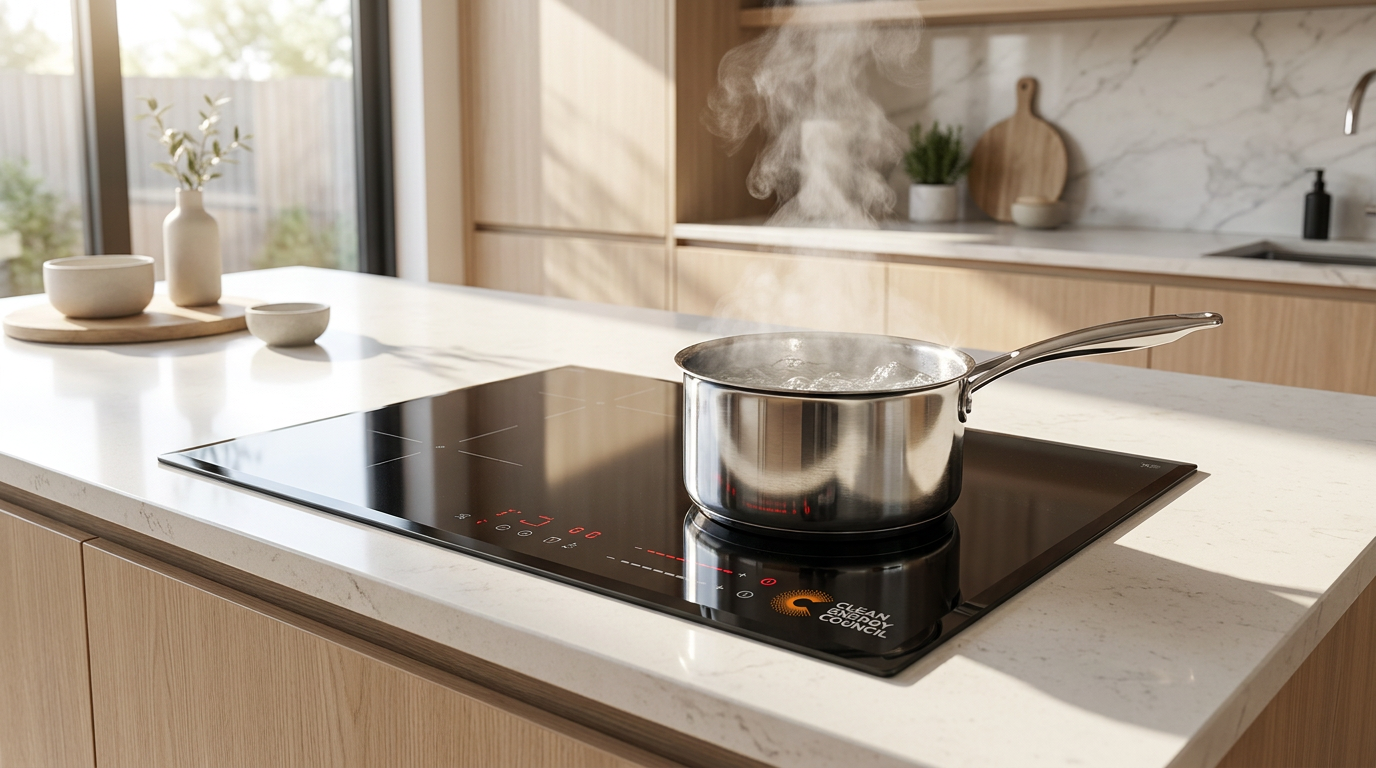
Unlike traditional gas or electric stoves, an induction cooktop does not actually generate heat itself. Instead, it turns the cookware into the heat source. Beneath the cooking zone lies a tightly wound spiral of copper wire. When the appliance is turned on, an alternating electrical current flows through this coil. This current does not heat the copper; rather, it creates a rapidly oscillating magnetic field that extends just above the surface of the glass.[2][3][4]
This magnetic field typically alternates its direction between 20,000 and 100,000 times per second, operating at a frequency of 20 to 100 kilohertz. Because the glass-ceramic surface of the cooktop is not magnetic or electrically conductive, the magnetic field passes right through it without interacting. The surface remains cool, completely unaffected by the invisible energy pulsing through it.[2][3][4]

The physics take effect only when a compatible piece of cookware is placed on the cooking zone. The cookware must be made of a ferromagnetic material—meaning it contains iron, such as cast iron or magnetic stainless steel. When this metal enters the oscillating magnetic field, the field induces an electrical current within the base of the pan.[2][5]
These induced currents are known as "eddy currents." They swirl chaotically through the metal of the cookware. However, the iron in the pan is not a perfect conductor; it has electrical resistance. As the eddy currents struggle to flow against this resistance, their kinetic energy is converted into thermal energy. In a matter of seconds, the metal of the pan becomes intensely hot, cooking the food inside it.[2][3][4]
This direct-heating mechanism results in unprecedented energy efficiency. Traditional gas stoves are notoriously wasteful; the flame heats the air around the pot, with only 55 to 60 percent of the thermal energy actually reaching the food. Standard electric coils fare slightly better at around 70 percent efficiency. Induction, however, transfers up to 90 percent of its electromagnetic energy directly into the cookware.[6][8]

Because so little energy is lost to the ambient air, induction is remarkably fast. Boiling a pot of water on an induction stove can take half the time of a high-output gas burner. Furthermore, this efficiency translates into a much cooler kitchen environment. Professional chefs and home cooks alike find that they no longer have to sweat through a dinner service, as the cooktop is not continuously radiating excess heat into the room.[5][6]
Because so little energy is lost to the ambient air, induction is remarkably fast.
Beyond speed and efficiency, the precision of induction is a major draw for culinary professionals. Because the heat is generated by an electrical field, it can be adjusted instantaneously. Dropping the power level immediately reduces the eddy currents, dropping the pan's temperature as quickly as turning down a gas flame. This allows for delicate tasks, like melting chocolate or holding a gentle simmer, without the risk of scorching.[4][5]
However, the most significant driver of recent induction adoption is public health. For decades, gas stoves were marketed as the chef's preferred tool, but recent scientific scrutiny has highlighted the severe indoor air quality issues associated with burning fossil fuels in the kitchen. Gas combustion releases a cocktail of pollutants directly into the home, including carbon monoxide, formaldehyde, and trace amounts of benzene.[7]
The most concerning byproduct is nitrogen dioxide (NO2). Studies conducted by organizations like the Rocky Mountain Institute and researchers at Stanford University have found that gas stoves frequently push indoor NO2 concentrations well above the Environmental Protection Agency's outdoor safety limits. This exposure has been linked to a 12 percent increase in the risk of childhood asthma in homes with gas stoves.[7]

Induction cooktops eliminate these point-source emissions entirely. By removing combustion from the kitchen, households can improve their indoor air quality overnight. For families with respiratory sensitivities, the transition from gas to induction is increasingly viewed not just as an appliance upgrade, but as a necessary health intervention.[1][7]
Safety extends beyond air quality. Because the cooktop itself does not generate heat, there is no open flame to catch a stray dish towel or sleeve on fire. While the glass surface does absorb some residual heat from the hot pan resting on it, it cools down significantly faster than a traditional electric radiant coil. Furthermore, if a pan is removed from the surface, the magnetic connection is broken, and the heating stops instantly.[2][4][7]
Despite its many advantages, induction technology does come with limitations. The most obvious is cookware compatibility. Because the system relies on magnetic fields, aluminum, copper, and glass cookware will not work. Consumers transitioning to induction often have to perform the "magnet test"—if a refrigerator magnet sticks firmly to the bottom of a pan, it will work on an induction stove.[2][5]

To bridge this gap, many premium cookware manufacturers now embed magnetic steel plates into the bases of their aluminum or copper pans, allowing them to interact with the induction coils while retaining the thermal properties of the other metals. Still, the need to potentially replace a beloved set of non-compatible pots remains a hurdle for some buyers.[1][5][6]
Cost is another factor. While prices have fallen significantly over the last decade, induction ranges still carry a premium over entry-level gas or electric models. However, government incentives, such as those included in the U.S. Inflation Reduction Act, are helping to offset these upfront costs for consumers looking to electrify their homes.[6][8]
There are also minor behavioral adjustments required. Induction cooking is so fast that the traditional rhythm of kitchen prep—chopping vegetables while the oil slowly heats up—must be re-learned. Ingredients need to be prepped and ready before the stove is turned on, lest the pan overheat in seconds.[5]
As the global push for decarbonization accelerates, the kitchen is becoming a focal point of residential electrification. Induction cooktops represent a rare technological leap where the environmentally friendly option is also objectively superior in performance. By harnessing the invisible power of electromagnetism, induction is proving that the future of cooking doesn't require a flame at all.[1][8]
How we got here
1930s
The fundamental principles of induction heating are first explored for industrial and early culinary applications.
1970s
The first consumer induction cooktops are introduced to the market, though high costs limit widespread adoption.
2009
Manufacturers begin experimenting with high-frequency induction models attempting to heat non-ferromagnetic metals, with limited commercial success.
2024–2026
Induction adoption accelerates rapidly, driven by energy efficiency standards, health studies on gas stoves, and government electrification incentives.
Viewpoints in depth
Culinary Professionals
Chefs and home cooks focused on performance, precision, and kitchen workflow.
For culinary professionals, the appeal of induction lies in its raw power and immediate responsiveness. Because the heat is generated electrically within the pan, dropping the power level stops the boil instantly, mimicking the control of a gas flame without the ambient heat. This creates a significantly cooler, more comfortable kitchen environment during long dinner services. However, some traditionalists note a learning curve: the lack of visual cues from a flame requires cooks to rely more on digital readouts, and techniques that involve lifting the pan off the heat (like tossing ingredients) temporarily break the magnetic connection.
Public Health Advocates
Medical professionals and researchers focused on indoor air quality and respiratory health.
Public health experts view the transition away from gas stoves as a critical intervention for indoor air quality. Gas combustion releases nitrogen dioxide (NO2), carbon monoxide, and benzene directly into living spaces, often exceeding outdoor safety standards. Pediatricians and asthma researchers point to data linking gas stove usage to a 12 percent increased risk of childhood asthma. From this perspective, induction is not merely a cooking upgrade, but a necessary measure to eliminate point-source pollution and protect vulnerable respiratory systems in the home.
Energy & Climate Analysts
Experts focused on grid efficiency, decarbonization, and household electrification.
Climate analysts champion induction technology for its unparalleled energy efficiency and its role in the broader electrification movement. By transferring up to 90 percent of its energy directly into the cookware, induction drastically reduces the total energy required to cook a meal compared to the 55 percent efficiency of gas. Furthermore, as electrical grids increasingly rely on renewable energy sources like wind and solar, transitioning households to induction cooktops severs their reliance on fossil fuels, significantly lowering the overall carbon footprint of residential buildings.
What we don't know
- How quickly the premium pricing of induction ranges will reach full parity with entry-level gas and electric models across all global markets.
- Whether future technological advancements will allow induction cooktops to efficiently heat non-ferromagnetic materials like pure copper or aluminum without specialized base plates.
Key terms
- Electromagnetic Induction
- The process of generating an electrical current in a conductive material by exposing it to a rapidly changing magnetic field.
- Eddy Currents
- Swirling loops of electrical current induced within the base of a pan by the cooktop's magnetic field, which generate heat as they encounter the metal's resistance.
- Ferromagnetic
- A property of certain metals, such as iron and specific types of steel, that allows them to be magnetized and interact with the induction cooktop's magnetic field.
- Nitrogen Dioxide (NO2)
- A harmful gaseous air pollutant produced by the combustion of fossil fuels, including gas stoves, which is linked to respiratory irritation and asthma.
Frequently asked
Can I use my current pots and pans on an induction stove?
It depends on the material. Induction requires ferromagnetic metal to work. Cast iron and magnetic stainless steel are fully compatible, while aluminum, copper, and glass will not work unless they have a magnetic base added by the manufacturer. You can test your current pans by seeing if a magnet sticks firmly to the bottom.
Does induction cooking use more electricity?
No, it actually uses less. Because induction transfers up to 90% of its energy directly into the cookware, it is highly efficient. It requires less electricity to boil water or cook a meal compared to traditional electric radiant coils, which lose much of their heat to the surrounding air.
Is the glass surface of an induction cooktop safe to touch?
The cooktop itself does not generate heat, so the areas around the pan remain cool. However, the glass directly under the pan will absorb residual heat from the hot cookware. It can get warm enough to burn, but it cools down significantly faster than a traditional electric burner once the pan is removed.
Do induction cooktops interfere with pacemakers?
Studies indicate that the risk of electromagnetic interference is extremely low under normal use. However, out of an abundance of caution, manufacturers and cardiologists generally recommend that individuals with pacemakers keep a distance of about two feet from the active cooking zone and consult their doctor.
Sources
Source coverage
8 outlets
3 viewpoints surfaced








[1]Factlen Editorial TeamPublic Health Advocates
Synthesis by Factlen editorial team
Read on Factlen Editorial Team →[2]VBGK HomeCulinary Professionals
How Does an Induction Cooktop Work? The Science Explained
Read on VBGK Home →[3]TutorChaseEnergy & Climate Analysts
Electromagnetic induction in induction cooktops
Read on TutorChase →[4]CNETEnergy & Climate Analysts
How induction cooktops work
Read on CNET →[5]Science of CookingCulinary Professionals
What is induction cooking
Read on Science of Cooking →[6]DataInteloEnergy & Climate Analysts
Induction Stove Market Analysis by Application and Product Type
Read on DataIntelo →[7]Bottega Del SartoPublic Health Advocates
Induction Vs Gas Stove: Health Impacts and Safety
Read on Bottega Del Sarto →[8]360 Research ReportsEnergy & Climate Analysts
Global Induction Cooktops Market Size and Growth Trends
Read on 360 Research Reports →

More in home
See all 26 stories →Neuroaesthetics
How Neuroaesthetics in Interior Design Shapes Brain Chemistry and Mental Health
7 sources

Household Science
Why Enzymatic Cleaners Are Replacing Harsh Chemicals in Homes
8 sources

Soil Science
The Science of No-Dig Gardening: Why Leaving Soil Undisturbed Yields Better Results
8 sources

Building Science
The Science of the 'Deep Energy Retrofit': How Older Homes Are Achieving Net-Zero
6 sources

Every angle. Every day.
Get home stories with full source coverage and perspective breakdowns delivered to your inbox.