
Beyond Fast Furniture: How to Identify High-Quality Wood and Joinery That Lasts Generations
As fast furniture contributes millions of tons to landfills annually, consumers are increasingly seeking pieces built to last. Understanding the differences between solid wood, veneer, and MDF, as well as recognizing traditional joinery like dovetails, is key to finding heirloom-quality furniture.
By Factlen Editorial Team
- Sustainable Design Advocates
- This camp emphasizes the urgent need to transition away from disposable composite furniture to reduce landfill waste and carbon emissions.
- Traditional Craftspeople
- Woodworkers and furniture historians focus on the structural superiority of time-tested joinery techniques.
- Value-Conscious Consumers
- Everyday buyers seek to balance upfront affordability with long-term durability and aesthetic appeal.
What's not represented
- · Large-scale fast furniture manufacturers
- · Low-income renters who rely on budget flat-pack furniture
Why this matters
With Americans throwing away over 12 million tons of furniture annually, knowing how to identify quality construction saves consumers from the endless cycle of replacing cheap, broken pieces. Understanding materials and joinery empowers buyers to invest in durable, heirloom furniture that reduces environmental waste and actually costs less over a lifetime.
Key points
- Fast furniture has created an environmental crisis, with over 12 million tons discarded annually in the U.S. and only 0.3% recycled.
- Solid wood offers unmatched durability and reparability, while MDF is prone to moisture damage and sagging.
- High-quality veneer over a plywood core is a legitimate, stable alternative to solid wood for large panels.
- Traditional joinery, such as dovetails and mortise-and-tenon, relies on mechanical interlocking rather than prone-to-fail adhesives.
- Investing in heirloom-quality furniture often proves cheaper over a lifetime compared to repeatedly replacing budget pieces.
For decades, the way we furnish our homes has mirrored the way we buy our clothes: fast, trend-driven, and ultimately disposable. The allure of flat-pack convenience and rock-bottom prices has transformed furniture from a lifelong investment into a temporary placeholder. Yet, as the environmental toll of this "fashionification" of home decor becomes impossible to ignore, a quiet rebellion is taking root. Consumers are increasingly turning their backs on sagging bookshelves and peeling laminates, seeking out pieces built with the intention of being passed down through generations.[1]
The scale of the fast furniture problem is staggering. According to the U.S. Environmental Protection Agency, Americans discard roughly 12.1 million tons of furniture and furnishings every single year—a figure that has multiplied more than five times since 1960. Of this massive mountain of discarded tables, chairs, and dressers, a dismal 80.1 percent goes straight to landfills. Unlike paper or aluminum, which boast robust recovery systems, less than half of one percent of furniture waste is actually recycled.[2]
This abysmal recycling rate is a direct result of how modern budget furniture is manufactured. A cheap dresser is rarely just wood; it is a complex, inseparable sandwich of composite boards, plastic laminates, metal fasteners, and chemical adhesives. Furthermore, the production of a single piece of fast furniture can emit upwards of 47 kilograms of carbon dioxide—roughly equivalent to burning five gallons of gasoline. Recognizing this unsustainable cycle, a growing movement of sustainable design advocates and conscious consumers is shifting the focus back to durability, reparability, and traditional craftsmanship.[1][3]

At the heart of this shift is a renewed understanding of materials, starting with the gold standard: solid wood. Crafted entirely from timber, solid wood furniture offers unparalleled load-bearing capacity and a natural resilience that engineered alternatives simply cannot match. Hardwoods like oak, maple, and cherry are particularly prized for their density and resistance to daily wear and tear. Crucially, solid wood is inherently forgiving; when a tabletop inevitably suffers a deep scratch or water ring, it can be sanded down and refinished, restoring it to its original beauty rather than condemning it to the curb.[4][5]
However, the conversation around quality materials often unfairly maligns veneer. While cheap, paper-thin laminates glued over particleboard are a hallmark of fast furniture, high-quality wood veneer is a staple of fine cabinetry. True veneer involves applying a thin slice of premium hardwood over a stable core, such as high-grade plywood. This technique allows furniture makers to showcase exotic or highly figured wood grains while actually preventing the warping and seasonal expansion that can plague large, solid wood panels. When executed correctly, veneered furniture is a durable, beautiful middle ground.[4][5]
The true culprit behind the disposable furniture crisis is Medium-Density Fiberboard (MDF) and its cousin, particleboard. Created by compressing wood fibers and synthetic resins under extreme heat and pressure, MDF is heavy, perfectly smooth, and incredibly cheap to produce. While it takes paint beautifully and serves well in low-traffic decorative applications, it lacks structural endurance. MDF is highly susceptible to moisture—swelling permanently if it gets wet—and it tends to sag over time when used for wide shelves or load-bearing surfaces. Most importantly, once the thin outer laminate chips or the core is damaged, MDF cannot be repaired.[4][5]

The true culprit behind the disposable furniture crisis is Medium-Density Fiberboard (MDF) and its cousin, particleboard.
Beyond the raw materials, the true test of a piece's longevity lies in its joinery—the methods used to connect the various components. In mass-produced furniture, joints are frequently held together by nothing more than metal staples, wooden dowels, and industrial adhesives. These shortcuts inevitably fail under the stress of daily use, leading to wobbly chairs and misaligned drawers. High-quality furniture, by contrast, relies on mechanical bonds where the wood itself is carved to interlock, distributing weight and resisting the forces that pull furniture apart.[1][6][7]
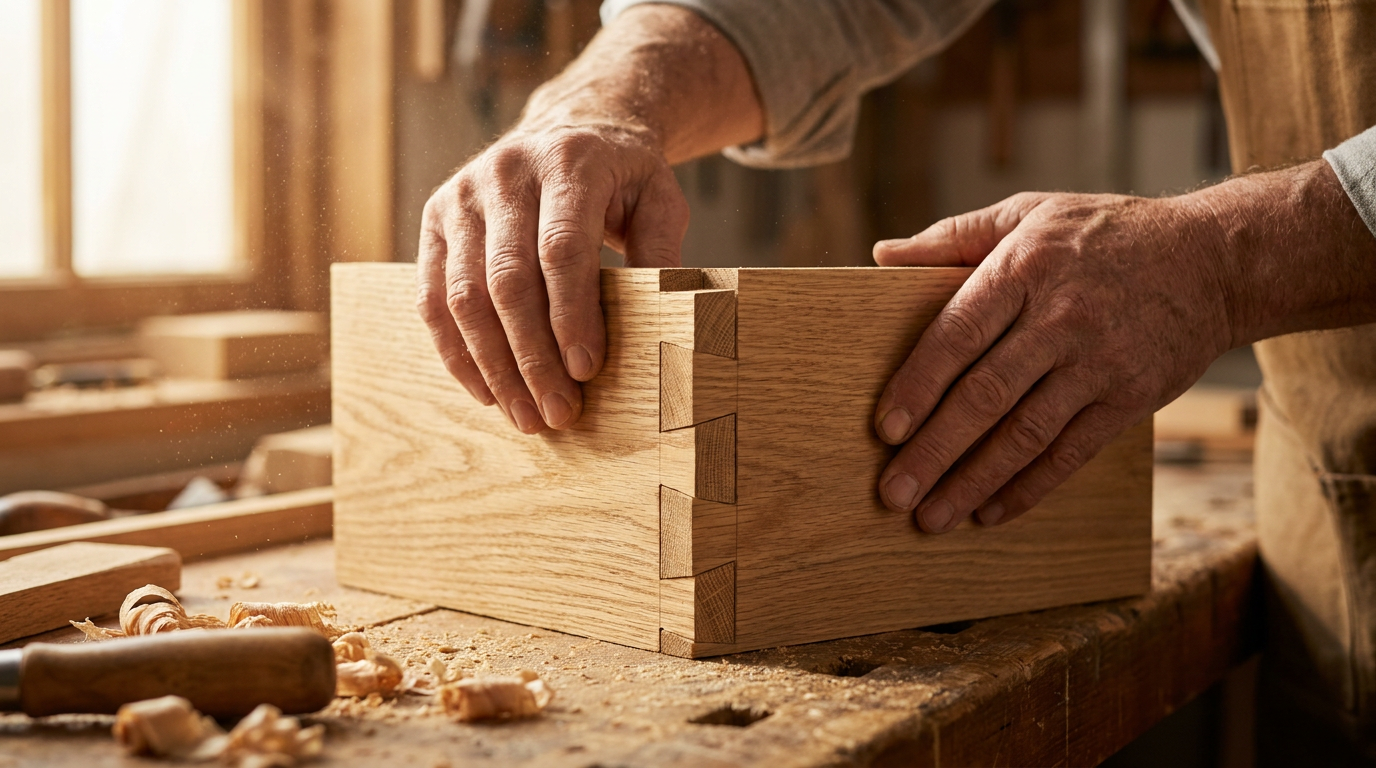
The most recognizable hallmark of this craftsmanship is the dovetail joint, universally considered the gold standard for drawer construction. A dovetail joint features a series of wedge-shaped cuts—the "tails" and "pins"—that slide together like puzzle pieces. Because of their trapezoidal shape, they create a mechanical bond that actually tightens when subjected to pulling forces. This makes dovetails virtually immune to the constant stress of a drawer being yanked open and pushed closed year after year, ensuring the piece remains functional for decades.[7][8]
For the structural frame of a piece—connecting table legs to aprons, or building the chassis of a chair—craftspeople rely on the mortise and tenon joint. This ancient technique, which dates back an astonishing 7,000 years to the world's oldest intact wooden architecture, involves fitting a precisely shaped protruding tongue (the tenon) into a matching carved-out slot (the mortise). This elegant, hidden connection creates tremendous strength and surface area for glue, naturally resisting the twisting and racking forces that cause cheaper furniture to wobble.[6][8]
In traditions like Danish Modern design, joinery transcends mere function and becomes a sculptural element of the furniture itself. Rather than simply attaching separate components, master woodworkers shape the wood so that armrests, backrests, and legs flow into one another in seamless, continuous lines. This integrated approach not only creates visually light and elegant silhouettes but also distributes structural weight evenly across the entire frame, proving that exceptional durability does not require visual bulk.[8]
Investing in this level of craftsmanship requires a shift in economic perspective, moving away from the upfront price tag and toward the cost-per-year of ownership. While a solid wood, traditionally joined dining table requires a higher initial investment, its lifespan is measured in generations rather than years. Conversely, replacing a cheap, sagging MDF table every five years quickly eclipses the cost of buying a quality piece once. This disposable culture has also devastated the repair economy; the Bureau of Labor Statistics notes that trades like upholstery and furniture refinishing are rapidly vanishing because it is now cheaper to replace a particleboard sofa than to fix it.[2][5]

For consumers navigating showrooms or vintage markets, identifying quality requires looking beyond the surface finish. A simple physical test is often the most revealing: lifting a piece to gauge its weight, as solid wood and high-grade plywood are significantly heavier than hollow-core or cheap particleboard alternatives. Inspecting the sides of drawers for the telltale interlocking pattern of dovetails, checking for continuous wood grain that wraps around edges, and ensuring that doors and drawers glide smoothly without racking are all practical ways to assess a piece's true pedigree.[1][4][7]
Ultimately, the rejection of fast furniture is about more than just aesthetics; it is a commitment to sustainable living and an appreciation for human skill. By learning to read the language of wood and joinery, consumers empower themselves to make choices that break the cycle of landfill waste. A well-crafted piece of furniture does not merely occupy space in a room; it anchors a home, aging gracefully alongside its owners and standing as a quiet testament to the enduring value of things built the right way.[1][2][3]
How we got here
7000 BCE
The earliest known use of mortise and tenon joints in wooden architecture is established, proving the ancient origins of mechanical joinery.
1950s
The Danish Modern movement popularizes sculptural, integrated joinery, blending structural integrity with minimalist aesthetics.
1980s
The mass adoption of MDF and particleboard revolutionizes the industry, drastically lowering prices but introducing the era of 'fast furniture'.
2018
U.S. furniture waste reaches a record 12.1 million tons annually, highlighting the environmental consequences of disposable home decor.
Present Day
A growing consumer backlash against flat-pack disposability sparks a resurgence in demand for solid wood, reparability, and traditional craftsmanship.
Viewpoints in depth
Sustainable Design Advocates
This camp emphasizes the urgent need to transition away from disposable composite furniture to reduce landfill waste and carbon emissions.
Environmental researchers and circular-economy advocates point to the staggering 12.1 million tons of furniture discarded annually in the U.S. alone. They argue that the true cost of "fast furniture" is externalized onto the environment, as pieces made from MDF, toxic resins, and plastic laminates are nearly impossible to recycle. This perspective champions a return to reparable, solid materials and urges the industry to adopt circular models where furniture is designed from the outset to be refurbished rather than replaced.
Traditional Craftspeople
Woodworkers and furniture historians focus on the structural superiority of time-tested joinery techniques.
For artisans, the integrity of a piece of furniture is defined by its mechanical bonds rather than chemical adhesives. They champion ancient techniques like the mortise and tenon and the dovetail joint, which rely on the physical interlocking of wood to resist the natural stresses of daily use. From this viewpoint, mass-produced furniture held together by staples and dowels is inherently flawed, while true craftsmanship creates heirloom pieces capable of lasting centuries.
Value-Conscious Consumers
Everyday buyers seek to balance upfront affordability with long-term durability and aesthetic appeal.
While acknowledging the superiority of solid wood, pragmatic consumers and interior design advisors often look for the "sweet spot" of value. They recognize that high-quality veneer over a stable plywood core can offer the beauty of premium hardwoods without the prohibitive cost or the risk of warping. This camp approaches furniture shopping as an investment calculation, weighing the higher initial price of well-made pieces against the guaranteed replacement costs of budget flat-pack alternatives.
What we don't know
- Whether major fast-furniture retailers will successfully transition to fully circular, recyclable materials by their stated 2030 climate goals.
- How the ongoing shortage of skilled repair tradespeople, like upholsterers and refinishers, will impact the long-term viability of restoring vintage pieces.
Key terms
- MDF (Medium-Density Fiberboard)
- An engineered wood product made by compressing wood fibers with synthetic resin under heat and pressure.
- Veneer
- A thin layer of real hardwood glued over a core material, such as plywood or MDF, to provide the appearance of solid wood.
- Dovetail Joint
- A woodworking technique using interlocking wedge-shaped cuts, commonly used in drawer construction to resist pulling forces.
- Mortise and Tenon
- An ancient joint where a protruding piece of wood (the tenon) fits perfectly into a carved-out slot (the mortise) for structural framing.
- Racking
- The tendency of a piece of furniture, like a chair or bookcase, to twist or lean out of square when subjected to lateral pressure.
Frequently asked
Is all veneer furniture low quality?
No. High-quality veneer applied over a stable plywood core is often used in fine furniture to create beautiful patterns and prevent the warping that can occur with large pieces of solid wood.
Why is MDF so common in modern furniture?
MDF is inexpensive, smooth, and takes paint or laminate exceptionally well. However, it is heavy, susceptible to moisture damage, and cannot be easily repaired if chipped or broken.
How can I tell if a piece is solid wood?
Look for continuous wood grain that wraps around the edges of the piece, visible end grain, and a generally heavier weight compared to engineered wood alternatives.
What makes a dovetail joint so strong?
Dovetail joints use wedge-shaped cuts that interlock like puzzle pieces. This trapezoidal shape creates a mechanical bond that actually tightens when subjected to pulling forces, making it ideal for drawers.
Sources
Source coverage
8 outlets
3 viewpoints surfaced








[1]Factlen Editorial Team
Synthesis by Factlen editorial team
Read on Factlen Editorial Team →[2]Earth911Sustainable Design Advocates
The Household Cost of Fast Furniture and the Collapse of Repair
Read on Earth911 →[3]Green Living MagazineSustainable Design Advocates
Rethinking Fast Furniture: The Environmental Impact of Disposability
Read on Green Living Magazine →[4]CanadaTablesValue-Conscious Consumers
Solid Wood vs Veneer vs MDF: What's the Difference?
Read on CanadaTables →[5]Originals SingaporeValue-Conscious Consumers
How to Choose Furniture That Lasts 10+ Years: Solid Wood vs Veneer vs MDF
Read on Originals Singapore →[6]Tip Top FurnitureTraditional Craftspeople
The Backbone of Quality: Understanding Mortise and Tenon Joints
Read on Tip Top Furniture →[7]Bay and BentTraditional Craftspeople
Dovetail Joints vs. Other Joints: A Guide to Better Woodworking
Read on Bay and Bent →[8]Egg CultureTraditional Craftspeople
Craftsmanship That Defines Danish Modern Furniture
Read on Egg Culture →

More in home
See all 26 stories →Kitchen Tech
The Science of Induction Cooking: How Magnets Are Revolutionizing the Modern Kitchen
8 sources

Household Science
Why Enzymatic Cleaners Are Replacing Harsh Chemicals in Homes
8 sources

Soil Science
The Science of No-Dig Gardening: Why Leaving Soil Undisturbed Yields Better Results
8 sources

Building Science
The Science of the 'Deep Energy Retrofit': How Older Homes Are Achieving Net-Zero
6 sources

Every angle. Every day.
Get home stories with full source coverage and perspective breakdowns delivered to your inbox.