
How 'Zero-Water' Liquid Cooling is Solving the AI Cloud's Thirst
Cloud providers are rapidly deploying closed-loop liquid cooling systems to eliminate evaporative water waste in AI data centers, saving billions of gallons annually.
By Factlen Editorial Team
- Cloud Hyperscalers
- Focused on scaling AI infrastructure rapidly while meeting corporate pledges to become 'water positive' by 2030.
- Local Municipalities
- Concerned about data centers draining municipal water supplies and demanding greater transparency on resource usage.
- Cooling Innovators
- Pushing the boundaries of thermodynamics with phase-change and membrane technologies to maximize computing efficiency.
What's not represented
- · Environmental advocacy groups monitoring corporate water pledges
- · Utility providers managing grid and water infrastructure
Why this matters
As AI workloads demand unprecedented computing power, the resulting heat threatened to drain local water supplies in drought-prone regions. The shift to zero-water cooling ensures the cloud can scale sustainably without competing with communities for drinking water.
Key points
- AI workloads generate extreme heat, pushing traditional air-cooling systems to their limits.
- Evaporative cooling towers consume millions of gallons of municipal water, straining local resources.
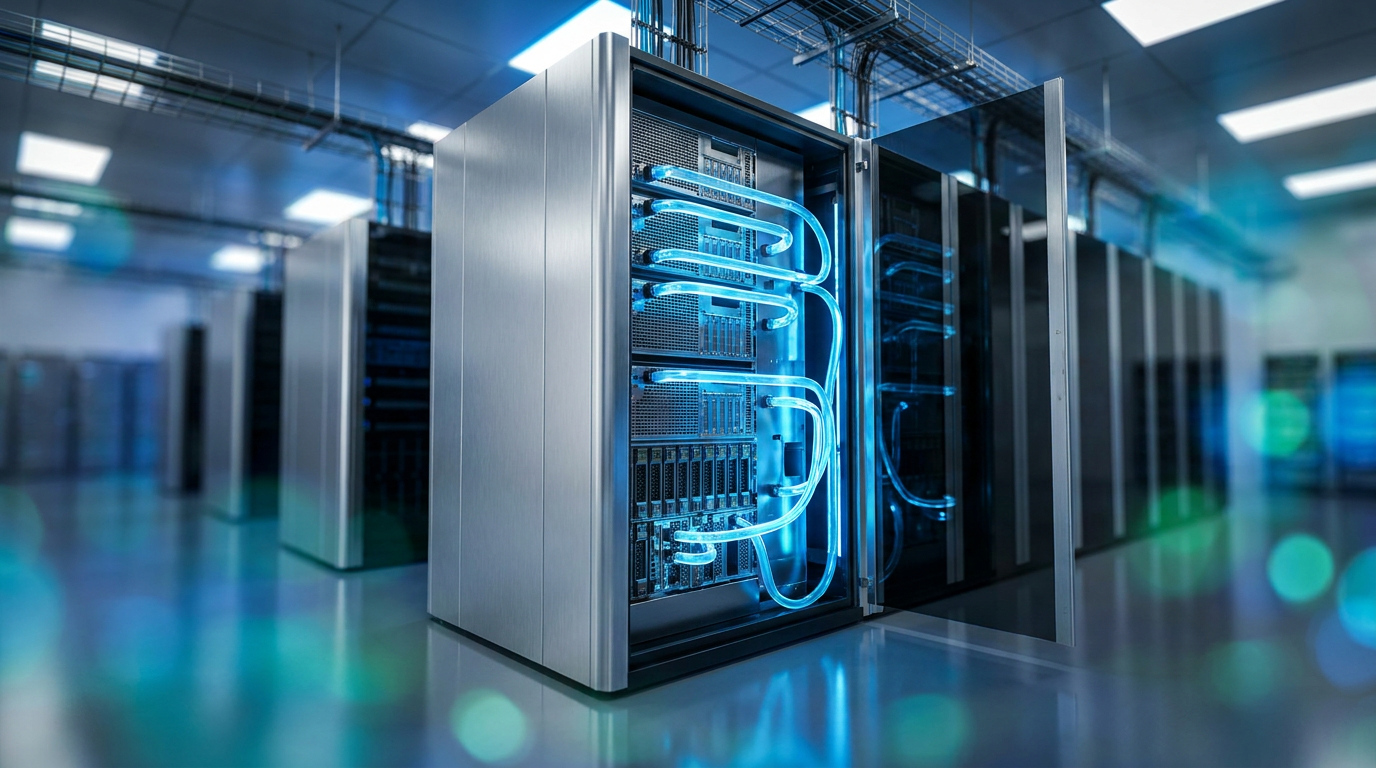
- The industry is shifting to closed-loop liquid cooling, which recirculates fluid and drops water consumption to near zero.
- Microsoft and AWS are deploying zero-water designs to meet their 2030 'water positive' sustainability pledges.
- Startups are developing phase-change immersion cooling, which boils liquid to absorb heat and improves energy efficiency by 15%.
The artificial intelligence boom has a hidden physical cost: heat. As cloud computing pivots to support massive, power-hungry AI models, the advanced graphics processing units (GPUs) powering these calculations generate unprecedented temperatures.[5]
For years, the cloud's primary defense against overheating was evaporative cooling—a process that consumes staggering amounts of municipal water. A single traditional hyperscale data center relying on evaporative chillers can consume up to 1.5 million liters of fresh water every single day.[6]
But a quiet revolution is currently reshaping the physical architecture of the internet. In 2026, the industry is rapidly pivoting to "zero-water" liquid cooling, a breakthrough that decouples cloud growth from natural resource consumption and eases the strain on drought-prone communities.[6][7]
The mechanism relies on a fundamental principle of physics: liquid is up to 3,000 times more effective at transferring heat than ambient air. Instead of blowing chilled air across cavernous server halls, new designs pipe engineered fluids directly to the hottest components on the motherboard.[5][6]

Microsoft is leading the charge with its new "Fairwater" architecture, which CEO Satya Nadella recently highlighted as a cornerstone of the company's community-first infrastructure strategy. The system uses a closed-loop design that is filled with coolant just once during the facility's construction.[3][6]
Because the fluid recirculates continuously without evaporating into the atmosphere, the facility's ongoing water consumption drops to near zero. Microsoft estimates this closed-loop design saves more than 125 million liters of water per facility annually, with pilot sites in Arizona and Wisconsin coming online this year.[3][6]
Amazon Web Services (AWS) is also aggressively optimizing its water footprint amid growing public scrutiny. In a first-of-its-kind disclosure this June, AWS revealed it withdrew 2.5 billion gallons of water globally in 2025, while noting its cooling efficiency is seven times better than the industry average.[1][2]
Amazon Web Services (AWS) is also aggressively optimizing its water footprint amid growing public scrutiny.
AWS achieves this by running its data centers hotter—allowing ambient temperatures to reach 85 degrees Fahrenheit before engaging evaporative chillers—and by heavily utilizing recycled wastewater. The company reports it is currently 75% of the way toward its goal of becoming "water positive" by 2030.[1]
Beyond the major hyperscalers, academic spinouts are pushing the technology even further. Ferveret, a startup born out of the Massachusetts Institute of Technology, is adapting advanced cooling techniques originally designed for nuclear reactors.[4]
Ferveret's "Adaptive Phase Cooling" submerges servers entirely in a specialized liquid that boils upon contact with the hot chips. The phase change from liquid to gas absorbs massive amounts of thermal energy, and the system is engineered to produce micro-bubbles that detach rapidly to accelerate heat transfer.[4]

This phase-change approach not only eliminates water consumption but also improves computational power efficiency by 15%, allowing data centers to process significantly more AI tokens using the exact same amount of electricity.[4]
The shift to liquid cooling is also unlocking new geographies for AI infrastructure. Historically, high-density data centers struggled to operate efficiently in tropical climates due to the extreme ambient heat and humidity.[7]
Now, membrane-based liquid cooling systems are separating water from airflow, allowing facilities in Southeast Asia to operate at high densities without relying on evaporative cooling or exposing delicate hardware to humid outside air.[7]
The transition is not without engineering trade-offs. Closed-loop liquid systems require significant upfront capital to install, and they often demand more electricity to run the mechanical compressors that cool the recirculating fluid.[7]

However, as the industry shifts its primary metric of success from Power Usage Effectiveness (PUE) to Water Usage Effectiveness (WUE), the consensus is clear: electricity can be generated renewably via solar and wind, but local water supplies cannot be easily manufactured.[7]
How we got here
2021
Major cloud providers begin setting corporate pledges to become 'water positive' by 2030.
2023
The generative AI boom accelerates, pushing rack power densities beyond the limits of traditional air cooling.
Aug 2024
Microsoft begins deploying closed-loop liquid cooling in its new facility designs.
Jun 2026
AWS discloses its total global water withdrawal for the first time amid community pressure for transparency.
Late 2026
Zero-water pilot sites in Arizona and Wisconsin officially come online.
Viewpoints in depth
Cloud Hyperscalers
Balancing the massive infrastructure demands of the AI boom with aggressive sustainability pledges.
For companies like Microsoft, Google, and AWS, the transition to liquid cooling is about future-proofing their business models. As AI models grow exponentially larger, the thermal limits of silicon dictate that traditional air cooling is no longer physically viable. By adopting closed-loop and direct-to-chip systems, hyperscalers can pack more compute power into smaller footprints while simultaneously working toward their public commitments to become 'water positive' by 2030.
Local Municipalities
Protecting local resources from the hidden environmental costs of data center expansion.
City councils and local utility boards are increasingly wary of hyperscale developments, particularly in drought-prone regions like the American Southwest. While a new data center brings tax revenue, traditional evaporative cooling can consume as much water as a small town, straining municipal infrastructure. For these stakeholders, zero-water cooling is a mandatory prerequisite for granting zoning approvals and construction permits.
Cooling Innovators
Leveraging advanced thermodynamics to squeeze maximum efficiency out of every watt of power.
Academic researchers and engineering startups view the cooling crisis as an opportunity to rethink data center architecture from the ground up. By adapting technologies from nuclear reactors—such as two-phase immersion cooling where specialized liquids boil upon contact with hot chips—these innovators argue that the industry can solve both the water crisis and the energy crisis simultaneously, improving computational efficiency by double digits.
What we don't know
- Whether the increased electricity required to run mechanical chillers for liquid cooling will outpace the availability of local renewable energy.
- How quickly older, legacy data centers can be retrofitted with zero-water technology, given the high capital costs.
Key terms
- Water Usage Effectiveness (WUE)
- A metric measuring how many liters of water a data center uses per kilowatt-hour of electricity consumed.
- Power Usage Effectiveness (PUE)
- A ratio describing how efficiently a data center uses energy, specifically how much is used by computing equipment versus overhead like cooling.
- Closed-loop cooling
- A system where coolant is sealed within pipes and continuously recirculated, preventing any fluid from evaporating into the atmosphere.
- Direct-to-chip cooling
- A method where cold plates are mounted directly onto hot components like CPUs and GPUs to draw heat away using circulating liquid.
Frequently asked
Why do AI data centers use so much water?
Traditional facilities use evaporative cooling towers to chill the air blown across servers. As AI chips run hotter, these towers must evaporate millions of gallons of water to dissipate the heat.
Does liquid cooling pose a risk of short-circuiting the servers?
No. Most direct-to-chip and immersion cooling systems use specialized, non-conductive engineered dielectric fluids rather than tap water, eliminating the risk of electrical shorts.
What does it mean for a company to be 'water positive'?
It means the company pledges to replenish more water into local ecosystems and municipal supplies than its operations consume, usually through conservation investments and public infrastructure projects.
Sources
Source coverage
7 outlets
3 viewpoints surfaced







[1]GeekWireCloud Hyperscalers
Amazon claims data centers are 7-times more water-efficient than rivals
Read on GeekWire →[2]Latitude MediaLocal Municipalities
At long last, Amazon has reported how much water its global data centers use
Read on Latitude Media →[3]Tom's HardwareCloud Hyperscalers
Microsoft CEO Satya Nadella claims new AI data centers use as much water as a single restaurant
Read on Tom's Hardware →[4]MIT NewsCooling Innovators
Cooling the AI boom with bubbles
Read on MIT News →[5]CIO AfricaCooling Innovators
How AI Is Driving The Shift to Liquid-Cooled Data Centres
Read on CIO Africa →[6]Data Centre MagazineCooling Innovators
How are Data Centres Shifting to Zero-Water Cooling Tech?
Read on Data Centre Magazine →[7]Digital EdgeCooling Innovators
The 2026 data center cooling revolution
Read on Digital Edge →
More in technology
See all 64 stories →AI Ethics
Apple Draws a Hard Line: Siri Won't Be Your AI Girlfriend
6 sources
AI Governance
The AI Transparency Shift: Understanding Open Weights vs. Open Source in 2026
10 sources

AI Assistants
Apple Rejects AI Companions: Why the New Siri Won't Be Your Friend
9 sources
Decentralized Web
How Decentralized Social Media is Breaking the 'Walled Garden' Era
7 sources
Every angle. Every day.
Get technology stories with full source coverage and perspective breakdowns delivered to your inbox.