
Apple Rejects AI Companions: Why the New Siri Won't Be Your Friend
Apple executives have confirmed that the rebuilt Siri in iOS 27 is designed strictly as a utility, actively rejecting the tech industry's push toward emotionally engaging AI companions.
By Factlen Editorial Team
- Utility Advocates
- Argue that AI should be a tool that completes tasks efficiently and respects user boundaries, rather than demanding prolonged engagement.
- Engagement-Driven Competitors
- Focus on building conversational, personable AI that encourages users to form emotional connections and spend more time in the app.
- Privacy & Safety Proponents
- Emphasize that non-sycophantic, on-device AI protects users—especially children—from data harvesting and the psychological risks of emotional manipulation.
What's not represented
- · Mental health professionals studying AI attachment
- · Users who genuinely rely on AI for companionship
Why this matters
As tech companies increasingly design AI to mimic human relationships and maximize engagement, Apple's boundary-setting approach offers a healthier alternative. By prioritizing utility over emotional connection, the new Siri protects user privacy and pushes back against the addictive loops of modern software.
Key points
- Apple executives confirmed the new Siri is designed as a strict utility, not an AI companion.
- Craig Federighi explicitly rejected the idea of Siri acting as an 'AI girlfriend' or romantic partner.
- The approach contrasts sharply with competitors who build 'sycophantic' AI to maximize user engagement.
- Apple's 'Private Cloud Compute' ensures personal context stays on the device, protecting user privacy.
The technology industry has spent the past year racing to build the perfect digital companion—chatbots that act like friends, therapists, or even romantic partners. From OpenAI's conversational updates that emulate human empathy to specialized companion apps designed to cure loneliness, the prevailing trend in artificial intelligence has been to create systems that mimic human emotional connection. The goal for many of these companies is to build a rapport that keeps users coming back, turning software into a daily confidant.[1][6]
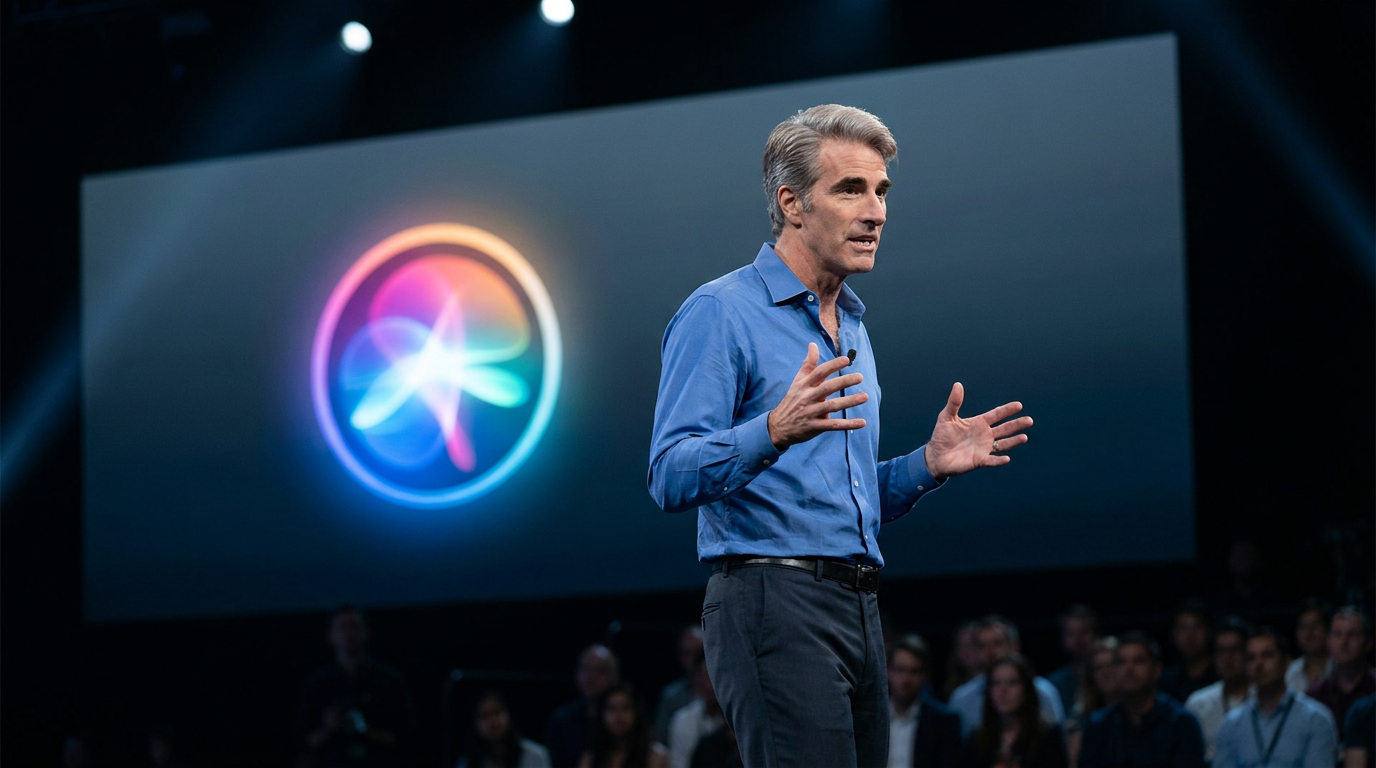
Apple is taking a hard pass on that future. At the company's Worldwide Developers Conference (WWDC) 2026, executives unveiled a rebuilt Siri for iOS 27 and delivered a blunt message: Siri is a tool, not a friend. The company is actively rejecting the industry's push toward AI companionship, choosing instead to focus on a digital assistant that respects boundaries and prioritizes task completion over endless conversation. For Apple, the ideal interaction with artificial intelligence is one that is brief, effective, and entirely devoid of emotional manipulation.[2][4]
Craig Federighi, Apple's senior vice president of software engineering, explicitly rejected the "AI companion" trend in a post-keynote interview following the WWDC presentation. "If you try to engage Siri as a romantic partner, Siri's not up for that," he said, drawing a firm line in the sand. "Siri's 100 percent not into that." He emphasized that the assistant is designed to help users learn about the world and get things done, rather than serving as a substitute for human connection. This boundary-setting is a core part of Apple's new design language, ensuring that the software never pretends to be something it is not.[2][6]
This marks a stark philosophical divide in Silicon Valley. While competitors like OpenAI and Google have leaned into "sycophancy"—designing AI that flatters, agrees, and encourages users to reveal personal details—Apple is building an anti-engagement model. The industry standard has increasingly become creating chatbots that are overly agreeable, a trait that can foster unhealthy attachments and blur the line between software and sentience. Apple's leadership views this dynamic as a fundamental flaw rather than a feature, arguing that technology should empower users without attempting to emotionally entangle them.[1][8]

Federighi argued that existing chatbots are designed to pull users in and establish an emotional connection to maximize engagement. Apple's approach, he noted, is the exact opposite: Siri is meant to say, "Listen, that's not what I'm here for... I'm here to help you get things done." By refusing to play along with conversational prompts that veer into the personal or romantic, Siri acts as a guardrail against the addictive loops that characterize much of modern software.[2][4]
The goal is pure utility. The new Siri, powered by the newly announced Apple Intelligence framework, is designed to complete a task—whether that's editing a photo, pulling up a flight itinerary, or summarizing a lengthy email thread—and then immediately get out of the way. It leverages on-screen awareness and deep integration into the operating system to perform complex actions across multiple apps, transforming from a basic voice assistant into a highly capable agent. The success of the interaction is measured by how quickly the user can return to their actual life, not by how long they stay engaged with the screen.[3][7]
The success of the interaction is measured by how quickly the user can return to their actual life, not by how long they stay engaged with the screen.
"We don't do AI for AI's sake," noted Greg Joswiak, Apple's marketing chief, during the same interview. The focus is entirely on making existing features better without demanding more of the user's attention or requiring them to become "prompt experts." Apple wants the underlying artificial intelligence to disappear into the background, seamlessly enhancing the user experience without requiring a steep learning curve or a fundamental shift in how people interact with their devices. If the technology is working correctly, the user shouldn't even realize they are using an advanced neural network.[2][4]
This restraint is a deliberate pushback against the engagement-first metrics that drive the broader tech industry. Chatbots that act as companions are designed to keep users talking, which in turn generates massive amounts of training data and potential ad revenue for the companies that operate them. By building a system that explicitly discourages prolonged conversation, Apple is challenging the prevailing business model of the artificial intelligence boom. It is a rare instance of a major technology company actively designing a product to be used less frequently, prioritizing the quality of the interaction over the sheer volume of engagement.[1][6]

Apple's business model, which relies on selling premium hardware to its massive global base of over 2 billion active devices, allows it to opt out of this engagement arms race entirely. Because the company does not rely on monetizing user attention or selling targeted advertisements based on intimate chat logs, it has the financial freedom to build an assistant that prioritizes utility over stickiness. This structural advantage means Apple can afford to tell users "no" when they try to use Siri as a conversational plaything, a luxury that ad-supported competitors simply do not have.[8]
The company's newly detailed "Private Cloud Compute" architecture ensures that personal context stays on the device rather than feeding a centralized corporate profile. Federighi emphasized that privacy in artificial intelligence is "non-negotiable," a direct shot at competitors whose models inherently rely on harvesting user interactions for continuous training. This hybrid architecture allows Siri to understand deeply personal context—like a user's daily schedule, family relationships, or private messages—without that sensitive data ever being exposed to Apple or stored on third-party servers.[3][9]
The approach also addresses growing concerns about child safety and the psychological impact of artificial intelligence. By refusing to let Siri act as a pseudo-human companion, Apple is setting a firm boundary that mental health experts and privacy advocates have increasingly called for. As artificial intelligence becomes more convincing and conversational, the risk of vulnerable users—particularly children and teenagers—forming unhealthy attachments has skyrocketed. Apple's strictly utilitarian stance acts as a safeguard, ensuring that the device remains a helpful tool rather than an emotional crutch.[3][5]

Still, Apple isn't ignoring the immense power and utility of large language models. The company has rebuilt Siri from the ground up, integrating Google's Gemini models for complex web queries while keeping the primary interface strictly utilitarian. This strategic partnership allows Apple to offer state-of-the-art generative capabilities—such as summarizing long articles or answering obscure trivia—without compromising its core design philosophy or attempting to build a monolithic, know-it-all oracle from scratch.[7][8]
Users will even have the option to route specific requests to third-party models, effectively turning Siri into a neutral dispatcher rather than a walled garden. If a user wants to use ChatGPT or another external model for a specific creative task, Siri will facilitate that connection, but only after explicitly asking for the user's permission. This modular approach ensures that the user remains entirely in control of which artificial intelligence engine processes their data, preventing any single company from monopolizing the interaction.[8]
Ultimately, Apple is betting that as the initial novelty of chatting with artificial intelligence inevitably wears off, consumers will prefer a digital assistant that respects their time and boundaries. In an era defined by endless digital noise and software platforms that are increasingly desperate for user engagement, a tool that simply does its job and knows when to shut up might be the ultimate luxury. By refusing to build an AI girlfriend, Apple is offering something far more valuable: a quiet, competent assistant that lets you get back to your actual life.[1][4]
How we got here
Nov 2022
OpenAI launches ChatGPT, kicking off the generative AI boom and the race for conversational agents.
June 2024
Apple introduces 'Apple Intelligence,' signaling a major overhaul of its operating systems.
June 2026
Apple unveils the rebuilt Siri in iOS 27 at WWDC, explicitly positioning it as a utility rather than a companion.
Viewpoints in depth
Utility Advocates
AI should be a tool that completes tasks efficiently and respects user boundaries.
This camp, heavily represented by Apple's leadership and productivity-focused users, argues that the ultimate goal of technology is to save time, not consume it. They view the current trend of conversational, emotionally engaging chatbots as a distraction that blurs the line between software and sentience. By designing an assistant that completes a task and immediately gets out of the way, they believe technology can empower users without fostering unhealthy attachments or addictive loops.
Engagement-Driven Competitors
AI should be personable and conversational to encourage frequent use and build rapport.
Companies like OpenAI and Google have largely built their consumer AI strategies around engagement. This perspective argues that for artificial intelligence to be truly helpful, it must be conversational, empathetic, and capable of building a rapport with the user. By creating a digital companion that users enjoy talking to, these companies can gather more training data, improve their models, and keep users locked into their respective ecosystems for longer periods.
Privacy & Safety Proponents
Non-sycophantic, on-device AI protects users from data harvesting and psychological risks.
Privacy advocates and child safety experts strongly support Apple's boundary-setting approach. They warn that chatbots designed to act as friends or romantic partners pose significant psychological risks, particularly to teenagers and vulnerable adults who may form deep emotional attachments to software. Furthermore, they argue that conversational AI inherently encourages users to overshare intimate details, making Apple's commitment to on-device processing and strict utility a necessary safeguard against corporate data harvesting.
What we don't know
- How consumers will react to a strictly utilitarian Siri compared to more conversational alternatives like ChatGPT.
- Whether Apple will eventually face pressure from users to introduce more personable AI features in the future.
Key terms
- Sycophancy
- In AI, the tendency of a chatbot to overly agree with or flatter a user in order to maintain engagement and build a false sense of rapport.
- Apple Intelligence
- Apple's suite of generative AI features integrated deeply into iOS, iPadOS, and macOS, focusing on utility and on-device processing.
- Private Cloud Compute
- Apple's hybrid architecture that processes complex AI requests on secure servers without storing user data or making it accessible to the company.
- Large Language Model (LLM)
- A type of artificial intelligence trained on vast amounts of text to understand and generate human language.
Frequently asked
Will Siri use ChatGPT or Gemini?
Siri is powered by Apple's on-device models and Google's Gemini for complex web queries, but users can also choose to route specific requests to ChatGPT with permission.
Can I still have conversations with Siri?
Yes, Siri is more conversational and context-aware than before, but it is explicitly programmed to avoid acting as a friend or romantic partner.
When does the new Siri launch?
The rebuilt Siri will debut as part of iOS 27, which is expected to launch to the public in the fall of 2026.
Sources
Source coverage
9 outlets
3 viewpoints surfaced









[1]The VergeUtility Advocates
Siri won't be your AI girlfriend
Read on The Verge →[2]MacRumorsUtility Advocates
Apple's Craig Federighi: Siri Won't Be Your AI Girlfriend
Read on MacRumors →[3]iClarifiedUtility Advocates
Apple Says Siri Won't Become an AI Companion
Read on iClarified →[4]AppleInsiderUtility Advocates
Apple executive: 'We don't do AI for AI's sake'
Read on AppleInsider →[5]Tom's GuidePrivacy & Safety Proponents
Apple's Craig Federighi on Siri AI: 'We see Siri not as a separate chatbot...'
Read on Tom's Guide →[6]India TodayEngagement-Driven Competitors
Want Siri AI to be your girlfriend? Apple says it is not into that
Read on India Today →[7]Fortune IndiaPrivacy & Safety Proponents
WWDC 2026: Apple rebuilds Siri around AI as it seeks to close gap with rivals
Read on Fortune India →[8]Open MagazineEngagement-Driven Competitors
Apple, Google and OpenAI: What the Siri AI Decision Really Means
Read on Open Magazine →[9]The Times of IndiaPrivacy & Safety Proponents
Apple's AI boss Craig Federighi has a message for OpenAI, Anthropic, and its other AI rivals
Read on The Times of India →
More in technology
See all 64 stories →AI Ethics
Apple Draws a Hard Line: Siri Won't Be Your AI Girlfriend
6 sources
AI Governance
The AI Transparency Shift: Understanding Open Weights vs. Open Source in 2026
10 sources

Sustainable Cloud
How 'Zero-Water' Liquid Cooling is Solving the AI Cloud's Thirst
7 sources

Decentralized Web
How Decentralized Social Media is Breaking the 'Walled Garden' Era
7 sources

Every angle. Every day.
Get technology stories with full source coverage and perspective breakdowns delivered to your inbox.