
How Decentralized Social Media is Breaking the 'Walled Garden' Era
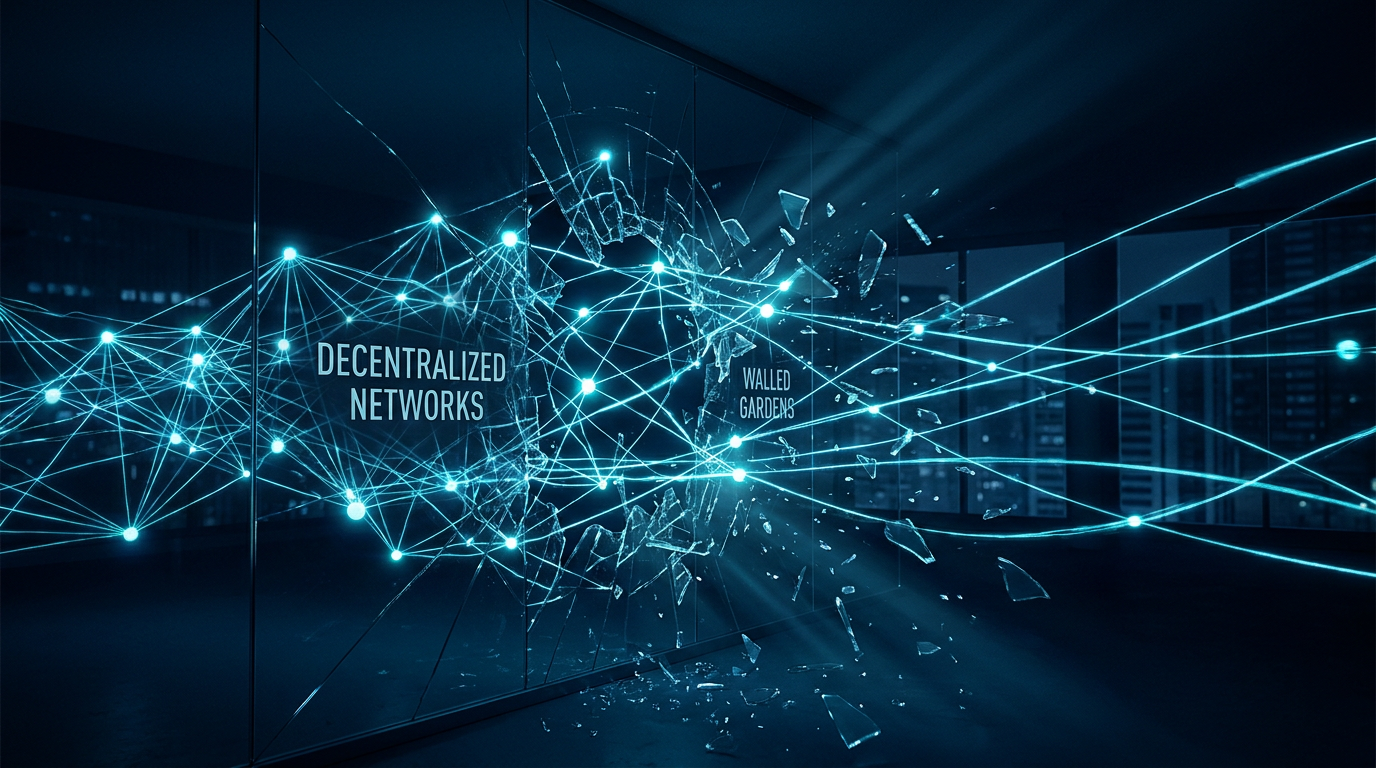
A new generation of social platforms is adopting open protocols, allowing users to own their data, choose their algorithms, and communicate seamlessly across different apps.
By Factlen Editorial Team
- Open-Web Advocates
- Argue that decentralized protocols are essential for protecting free speech, privacy, and user autonomy from corporate monopolies.
- Protocol Developers
- Focus on the technical architecture required to make account portability and custom algorithms seamless for everyday users.
- Commercial Tech Giants
- View open protocols as a way to tap into broader networks and reduce the burden of building entirely closed ecosystems from scratch.
What's not represented
- · Traditional ad-based social networks
- · Non-technical mainstream users
Why this matters
For the first time in a decade, internet users are gaining the ability to pack up their digital lives—followers, posts, and identity—and move them to a new platform without starting over. This shift transfers power away from corporate algorithms and back into the hands of the people actually creating the content.
Key points
- Decentralized protocols allow users on different social apps to communicate seamlessly, much like email.
- The AT Protocol enables users to migrate their accounts and followers to new servers without losing data.
- Users can subscribe to custom algorithms, choosing exactly how their feeds are curated.
- Moderation is handled locally by server admins and shared community blocklists rather than a central corporate team.
The internet of the 2010s was defined by "walled gardens"—closed corporate ecosystems where tech giants locked in users, their data, and their social graphs. If you wanted to leave a platform because you disliked its algorithm or its leadership, you had to leave your friends and followers behind. The switching costs were intentionally designed to be insurmountable.[7]
That paradigm is fundamentally shifting. A quiet revolution in social media architecture is replacing corporate silos with open protocols, creating what technologists call the "Fediverse" and the decentralized web. Instead of renting space on a single company's servers, users are moving to systems where they own their digital identities outright.[5][7]
To understand this shift, look at how email works. A user with a Gmail account can seamlessly send a message to a colleague using Outlook, Apple Mail, or Yahoo. The underlying technology—SMTP—is an open protocol that no single company owns. You don't need a Gmail account to talk to someone on Gmail.[1][7]

Decentralized social media applies this exact logic to posts, likes, and follows. Instead of one massive central server controlled by a single CEO, the network consists of thousands of independent servers that all speak the same language. A user on one server can follow and interact with a user on a completely different server, seamlessly.[4][7]
Currently, the decentralized landscape is dominated by two primary languages, or protocols. The first is ActivityPub, which was officially recognized as a recommended standard by the World Wide Web Consortium (W3C) in 2018. It serves as the foundational plumbing for much of the modern decentralized web.[1]
ActivityPub powers Mastodon, the microblogging platform that saw a massive surge in adoption in late 2022. It allows anyone to spin up their own "instance" or server—perhaps one dedicated to journalists, or bird watchers, or a specific university—while still interacting with the broader global network.[4][5]
The protocol gained unprecedented mainstream validation when Meta announced that its text-based app, Threads, would integrate with ActivityPub. This allowed over 175 million Threads users to optionally share their posts with the wider Fediverse, marking the first time a major tech giant voluntarily opened its walled garden to an outside protocol.[3]

The protocol gained unprecedented mainstream validation when Meta announced that its text-based app, Threads, would integrate with ActivityPub.
The second major standard is the AT Protocol, developed by Bluesky. While ActivityPub focuses heavily on server-to-server communication, the AT Protocol was designed from the ground up to prioritize account portability and algorithmic choice.[2]
On an AT Protocol network, your identity is decoupled from the server hosting your data. If a user becomes dissatisfied with how their current host is managing the platform, they can migrate their entire account—including their followers, handle, and post history—to a new provider without breaking any links. It is the social media equivalent of keeping your phone number when switching wireless carriers.[2][4]
This portability fundamentally changes the power dynamic between platforms and users. In the walled-garden model, platforms can aggressively monetize users or change the feed algorithm to maximize outrage because the switching costs are too high for users to leave.[6]
Decentralization lowers that switching cost to near zero. Furthermore, it unbundles the hosting of content from the curation of content. Users on Bluesky, for instance, can subscribe to custom algorithms built by third parties, choosing whether they want a chronological feed, a feed of only positive news, or a feed dedicated solely to a specific hobby.[2][5]

However, this architectural shift introduces complex new challenges, primarily around content moderation. When there is no central authority or corporate trust-and-safety team, who removes illegal or harmful content from the network?[7]
The decentralized answer is layered moderation. Server administrators set baseline rules for their specific communities, and users can subscribe to shared blocklists or community-driven moderation services. If a specific server becomes a haven for bad actors, other servers can simply "defederate" or sever ties with it entirely, isolating the toxic community from the rest of the network.[6][7]

The financial model also remains an open question. Running servers and storing media costs money. Without the highly targeted, data-harvesting advertising engines of the walled gardens, decentralized platforms rely heavily on crowdfunding, grants, or premium subscription tiers to keep the lights on.[5]
Despite these hurdles, the momentum is clear. The transition from closed platforms to open protocols represents the most significant structural change to the internet in fifteen years, promising a future where users, not corporations, own their digital lives.[7]
How we got here
Jan 2018
The W3C officially publishes ActivityPub as a recommended web standard.
Late 2022
Mastodon experiences a massive surge in users seeking alternatives to centralized platforms.
Feb 2024
Bluesky opens up federation, allowing anyone to host their own server on the AT Protocol.
Jun 2024
Meta integrates Threads with ActivityPub, connecting millions of mainstream users to the Fediverse.
Viewpoints in depth
Open-Web Advocates
Argue that decentralized protocols are essential for protecting free speech and user autonomy.
Organizations like the Electronic Frontier Foundation view the shift toward decentralization as a necessary correction to the monopolistic power of the 2010s internet. They argue that when a single corporation controls the digital public square, users are vulnerable to arbitrary censorship, algorithmic manipulation, and sudden policy changes. By distributing power across thousands of independent servers, the network becomes resilient against corporate overreach and single points of failure.
Protocol Developers
Focus on the technical architecture required to make account portability seamless for everyday users.
Engineers working on standards like the AT Protocol emphasize that true user freedom requires more than just servers talking to each other; it requires zero switching costs. Their primary goal is building infrastructure where a user's identity is cryptographically tied to them, not their host. They believe that if migrating to a new social media server is as easy as changing an email provider, platforms will be forced to compete on user experience rather than relying on the hostage-taking of social graphs.
Commercial Tech Giants
View open protocols as a way to tap into broader networks and reduce the burden of building closed ecosystems.
For companies like Meta, adopting open protocols represents a strategic pivot. Rather than trying to build a new network entirely from scratch and convincing users to rebuild their audiences, integrating with ActivityPub allows them to instantly plug into an existing, vibrant ecosystem. It also serves as a preemptive defense against antitrust regulators, allowing massive tech firms to demonstrate that they are participating in open, interoperable web standards rather than maintaining strict monopolies.
What we don't know
- Whether mainstream users will tolerate the added friction of choosing servers and algorithms.
- How decentralized networks will fund their massive server costs without targeted advertising.
- If community-driven moderation can successfully scale to handle state-sponsored disinformation.
Key terms
- Fediverse
- A portmanteau of 'federation' and 'universe,' referring to the collection of independent social media servers that can communicate with each other.
- ActivityPub
- An open, decentralized social networking protocol recognized by the W3C, used by platforms like Mastodon and Threads.
- AT Protocol
- A newer networking technology created by Bluesky that prioritizes the ability to move your account between servers and choose your own feed algorithm.
- Walled Garden
- A closed platform where the provider has total control over the ecosystem, making it difficult for users to leave or interact with outside networks.
- Instance
- An individual, independently operated server within a decentralized network that hosts a specific community of users.
Frequently asked
Can I take my followers with me if I leave a platform?
Yes. On networks using the AT Protocol (like Bluesky), your identity and follower graph are tied to you, not the server. You can migrate to a new host without losing your connections.
Do I have to pay to use decentralized social media?
Most instances are free to join, but because they don't rely on invasive advertising, many servers ask for voluntary donations or offer premium tiers to cover hosting costs.
Who is in charge of moderating bad behavior?
There is no central authority. Individual server administrators set the rules for their own communities, and users can subscribe to third-party moderation services or blocklists to filter their feeds.
What is the difference between ActivityPub and the AT Protocol?
ActivityPub is an older, W3C-recognized standard focused on letting different servers talk to each other. The AT Protocol is a newer standard built specifically to allow seamless account migration and custom algorithms.
Sources
Source coverage
7 outlets
3 viewpoints surfaced







[1]W3COpen-Web Advocates
ActivityPub Specification
Read on W3C →[2]AT ProtocolProtocol Developers
The AT Protocol: A Social Networking Technology Created by Bluesky
Read on AT Protocol →[3]The VergeCommercial Tech Giants
Meta’s Threads is now fully integrated with the Fediverse
Read on The Verge →[4]TechCrunchProtocol Developers
Bluesky opens up federation, letting anyone run their own server
Read on TechCrunch →[5]WiredProtocol Developers
The Decentralized Web Is Finally Becoming User-Friendly
Read on Wired →[6]Electronic Frontier FoundationOpen-Web Advocates
Why Decentralized Social Media Matters for Free Speech
Read on Electronic Frontier Foundation →[7]Factlen Editorial Team
Synthesis by Factlen editorial team
Read on Factlen Editorial Team →

More in technology
See all 64 stories →AI Ethics
Apple Draws a Hard Line: Siri Won't Be Your AI Girlfriend
6 sources

AI Governance
The AI Transparency Shift: Understanding Open Weights vs. Open Source in 2026
10 sources

AI Assistants
Apple Rejects AI Companions: Why the New Siri Won't Be Your Friend
9 sources

Sustainable Cloud
How 'Zero-Water' Liquid Cooling is Solving the AI Cloud's Thirst
7 sources

Every angle. Every day.
Get technology stories with full source coverage and perspective breakdowns delivered to your inbox.