
The Resurgence of Intergenerational Cohousing: How Neighborhoods are Rebuilding the Village
As the loneliness epidemic impacts all age groups, a growing movement of intergenerational cohousing communities is using intentional architecture and shared resources to foster deep social connection.
By Factlen Editorial Team
- Public Health Researchers
- Focus on the biological and psychological necessity of multi-generational social ties to combat the loneliness epidemic.
- Community Advocates
- Emphasize the practical benefits of shared resources, mutual support, and intentional neighborhood design.
- Market Analysts
- View the trend through the lens of housing affordability, real estate optimization, and the booming co-living economy.
What's not represented
- · Traditional Real Estate Developers
- · Zoning Board Officials
Why this matters
With social isolation increasingly recognized as a severe public health risk, intergenerational living models offer a proven, structural blueprint for reducing anxiety, lowering living costs, and improving the daily quality of life for both young families and older adults.
Key points
- Intergenerational cohousing blends private homeownership with shared amenities like commercial kitchens and community gardens.
- The architectural design forces positive social friction, combating the modern epidemic of loneliness.
- Older adults benefit from a built-in support network that preserves their agency and cognitive health.
- Young families benefit from 'alloparenting,' sharing the burdens of childcare with neighbors.
- The broader co-living market is projected to reach $16.05 billion by 2030 due to housing affordability pressures.
- Despite its benefits, the model faces high financial barriers to entry and requires exhausting consensus-building.
Modern society has engineered a paradox: we are more digitally connected than any humans in history, yet we are living through an unprecedented epidemic of profound isolation. From teenagers navigating the anxieties of adolescence to older adults facing the quiet emptiness of an empty nest, loneliness has become a defining public health crisis of the 21st century. The National Council on Aging reports that roughly one in three older adults feels isolated from others, a metric that correlates directly with accelerated cognitive decline and higher mortality rates. Yet, the crisis spans generations, with young adults reporting some of the highest rates of chronic loneliness.[4]
In response to this fracturing of the social fabric, a quiet revolution in residential design is gaining momentum. Intergenerational cohousing—a model that deliberately blends the autonomy of private homeownership with the deep social support of a village—is emerging as a structural antidote to modern isolation. Rather than accepting the binary choice between an isolated single-family home and an age-segregated institutional facility, a growing number of Americans are choosing to build their own neighborhoods from scratch.[7]
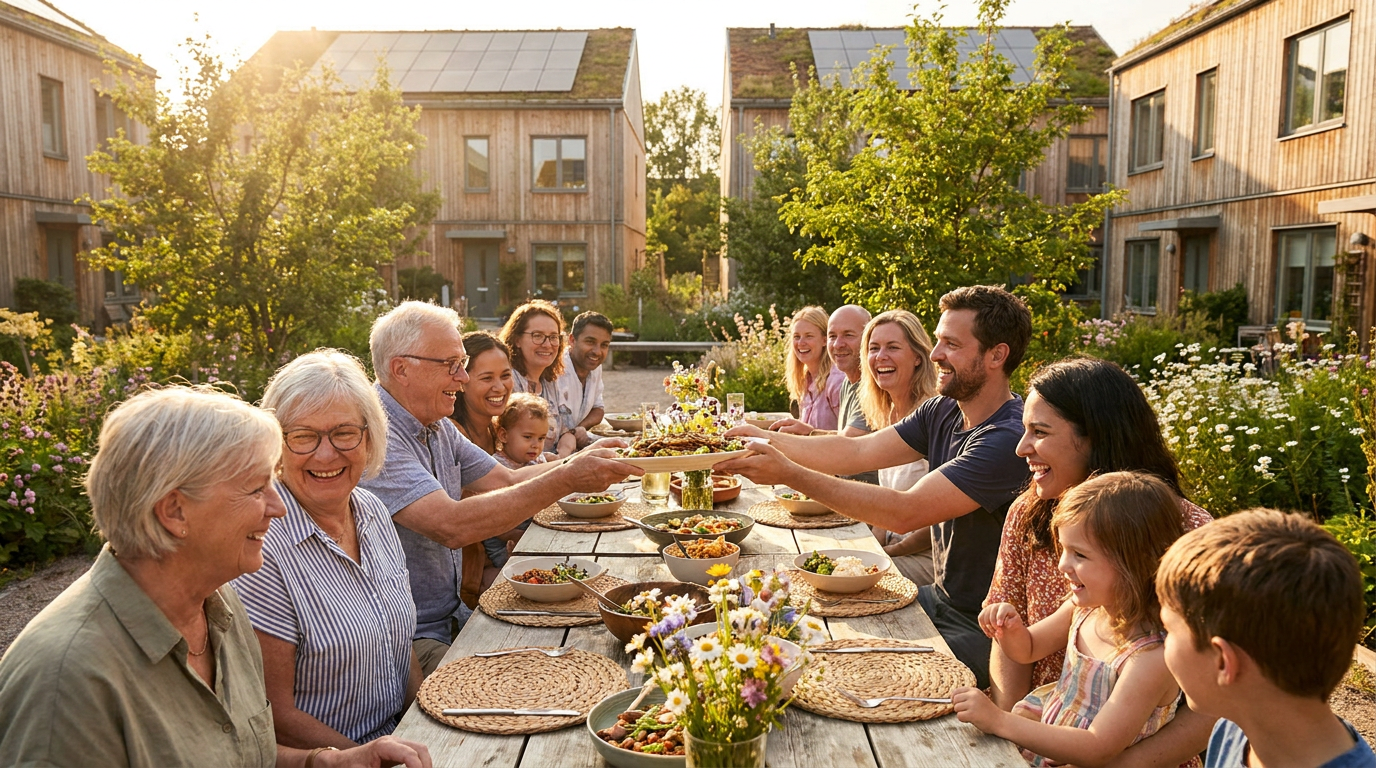
The mechanism of cohousing is fundamentally architectural. Unlike a commune, where property and finances are entirely pooled, cohousing residents own their individual, fully-equipped private homes. However, these homes are intentionally clustered around extensive shared amenities. The physical layout usually features a pedestrian-friendly courtyard and a central "Common House"—a large facility equipped with a commercial-grade kitchen, expansive dining areas, guest suites, and recreational spaces.[3][7]
This design forces what urban planners call "positive social friction." Residents cannot help but bump into their neighbors while walking to their front doors or checking the mail. The architecture makes isolation difficult and connection effortless. Beyond the physical layout, the social mechanism is driven by self-governance. Residents manage the community themselves, sharing property maintenance, organizing weekly communal meals, and making decisions through consensus rather than outsourcing control to a property management company.[3][7]

Medical anthropologists and researchers are increasingly viewing this model not just as a lifestyle choice, but as a biological necessity. Research published by Cambridge University Press highlights the concept of "evolutionary mismatch"—the theory that human biology evolved over hundreds of thousands of years to thrive in small, multi-generational, highly interdependent groups.[1]
For 90 percent of human history, our ancestors relied heavily on continuous social cooperation for survival. The modern shift toward isolated nuclear families and age-segregated living is, biologically speaking, a radical and unnatural experiment. Researchers argue that the resulting evolutionary mismatch is a primary driver of modern anxiety, depression, and maternal stress, making intentional communities a way to realign our environments with our biological wiring.[1]
For older adults, the health benefits of this realignment are profound. Studies highlighted by Frontiers in Public Health demonstrate that intergenerational interventions significantly reduce loneliness and enhance both mental and physical health. In a cohousing environment, older residents are surrounded by a built-in support network. If someone doesn't appear for a communal meal or pick up their mail, neighbors notice immediately.[2]
For older adults, the health benefits of this realignment are profound.
Crucially, cohousing preserves agency. Unlike traditional assisted living facilities, which can inadvertently instill "learned helplessness" by dictating schedules and removing daily responsibilities, cohousing requires active participation. Older adults maintain their independence, contribute to the community's governance, and engage in meaningful daily tasks, which gerontologists note is vital for preserving cognitive function and a sense of purpose.[2][7]
The benefits flow equally in the other direction, particularly for younger families. Modern parenting is often characterized by intense pressure and isolation, a stark contrast to the historical norm of "alloparenting," where childcare was shared among a wide network of relatives and neighbors. In an intergenerational community, the burden on the nuclear family is dramatically reduced.[1]
Children in these environments grow up with surrogate grandparents and a pack of peers right outside their door. They benefit from observing and participating in a diverse ecosystem of ages, developing empathy, communication skills, and a sense of security. Parents, in turn, gain access to informal childcare, shared school runs, and the profound relief of not having to navigate child-rearing entirely alone.[1][7]
Beyond the social and health benefits, powerful economic forces are driving the shift toward shared living. As housing affordability reaches crisis levels across the globe, the broader co-living market is experiencing explosive growth. According to data from Grand View Research, the global co-living market was valued at $7.82 billion in 2024 and is projected to more than double to $16.05 billion by 2030, growing at a compound annual rate of 13.5 percent.[5]

Cohousing taps into this economic efficiency through the radical sharing of resources. Because the community owns a centralized Common House, individual private homes can be built with smaller footprints. Residents share high-speed internet, heavy tools, lawnmowers, and bulk food purchases. This economy of scale not only lowers the individual cost of living but significantly reduces the community's overall environmental footprint.[5][7]
The momentum is visible on the ground. The Cohousing Association of the United States reports that there are now over 200 established cohousing communities nationwide, with dozens more in the formation stage. Their recent data showed a 163 percent growth in their Community Launch Program, indicating a surge of interest from groups actively trying to get new projects off the ground.[3]
This growth is also breaking out of its traditional strongholds. While cohousing has historically been concentrated on the coasts and in college towns, projects like Oak Park Commons are bringing the model to the urban Midwest. As Illinois' first intergenerational cohousing community, the 24-unit development demonstrates that the desire for eco-conscious, communal living is becoming a mainstream, nationwide pursuit.[6]

However, advocates are quick to note that cohousing is not a frictionless utopia. The very elements that make it successful—self-governance and deep interdependence—also make it exhausting. Reaching consensus on community rules, budget allocations, and maintenance schedules requires endless meetings and a high degree of emotional intelligence. Interpersonal conflicts are inevitable, and the threat of burnout among founding members is a well-documented vulnerability.[7]
Furthermore, the financial and bureaucratic barriers to entry remain daunting. Building a custom neighborhood requires millions of dollars in upfront capital, years of navigating restrictive municipal zoning laws, and the patience to hold a group of future neighbors together through a grueling development process.[7]

Despite these hurdles, the core philosophy of intergenerational cohousing offers a vital blueprint for the future of residential design. Even for those who will never live in a formal cohousing community, the underlying principles—prioritizing shared spaces, fostering mutual reliance, and designing neighborhoods that encourage cross-generational connection—provide a roadmap for curing the modern epidemic of isolation.[7]
How we got here
1970s
The modern cohousing concept originates in Denmark as families seek to share childcare and daily chores.
1991
The first cohousing community in the United States, Muir Commons, is completed in California.
2020–2023
The global pandemic severely exacerbates the loneliness epidemic, sparking renewed interest in communal living models.
2026
The broader co-living market surges toward a projected $16 billion valuation as intergenerational communities expand globally.
Viewpoints in depth
Public Health Researchers
Viewing cohousing as a structural medical intervention.
Medical anthropologists and public health officials increasingly view housing as a social determinant of health. Researchers argue that human biology is fundamentally mismatched with the isolated nuclear family model. By structurally mandating daily social friction—bumping into neighbors on the way to the communal kitchen or sharing childcare duties—cohousing acts as a preventative medical intervention against cognitive decline in older adults and anxiety in younger generations.
Community Advocates
Prioritizing intentionality, self-governance, and mutual reliance.
For residents and advocates, the appeal lies in reclaiming agency over daily life. Rather than outsourcing childcare, property maintenance, and eldercare to the market, these communities pool their labor and resources. Advocates stress that cohousing is not a passive real estate product but an active lifestyle choice that requires continuous emotional investment, consensus-building, and a willingness to prioritize the collective over pure individual convenience.
Urban Planners & Market Analysts
Analyzing the economic efficiency and scalability of shared living.
Real estate analysts and urban planners focus on the profound economic efficiencies of the model. As housing costs outpace wage growth, the broader co-living sector is exploding. Analysts note that by centralizing expensive amenities—commercial kitchens, guest suites, and heavy tools—individual private footprints can be smaller and more affordable. However, they caution that restrictive municipal zoning laws and the high upfront capital required for custom builds remain significant bottlenecks to widespread adoption.
What we don't know
- Whether the high upfront capital costs of cohousing can be lowered enough to make the model accessible to low-income families.
- How long-term demographic shifts within established communities will affect their sustainability as founding members age.
- To what extent municipal zoning laws will adapt to allow for more dense, shared-amenity housing models.
Key terms
- Intergenerational Cohousing
- A planned residential community featuring private homes clustered around shared spaces, intentionally designed to foster daily interaction among people of all ages.
- Alloparenting
- A system of parenting in which individuals other than the biological parents act in a parental role, sharing the burden of childcare.
- Evolutionary Mismatch
- A concept in evolutionary biology suggesting that modern physical and mental health issues arise because human bodies evolved for environments vastly different from today's society.
- Common House
- The central hub of a cohousing community, typically featuring a large dining room, commercial kitchen, laundry facilities, and recreational spaces.
- Intentional Community
- A planned residential community designed from the start to have a high degree of social cohesion and teamwork.
Frequently asked
What is the difference between cohousing and a commune?
Unlike a commune where finances and property are entirely pooled, cohousing residents own their individual, fully-equipped private homes and maintain independent finances, while sharing ownership of communal spaces.
Do residents have their own private spaces?
Yes. Every household has its own private residence, complete with a kitchen, bathrooms, and living areas. The community simply offers additional, optional shared spaces.
How are decisions made in a cohousing community?
Most communities use a consensus-based governance model, where residents manage the property themselves through regular meetings and committees rather than hiring a traditional property management company.
Is intergenerational cohousing only for older adults and families?
No. These communities intentionally seek a demographic mix, welcoming single adults, young couples without children, growing families, and retirees to create a balanced, village-like ecosystem.
Sources
Source coverage
7 outlets
3 viewpoints surfaced







[1]Cambridge University PressPublic Health Researchers
Intergenerational cohousing promotes mutual support and a stronger sense of community
Read on Cambridge University Press →[2]Frontiers in Public HealthPublic Health Researchers
Needs of Social Isolation, Loneliness, and Intergenerational Interventions in the United States: A Scoping Review
Read on Frontiers in Public Health →[3]Cohousing Association of the USCommunity Advocates
2024 Growth and Impact Report: The State of US Cohousing
Read on Cohousing Association of the US →[4]National Council on AgingPublic Health Researchers
How Intergenerational Programs Ease Loneliness for Older Adults
Read on National Council on Aging →[5]Grand View ResearchMarket Analysts
Co-living Market Size, Share & Trends Analysis Report, 2025 - 2030
Read on Grand View Research →[6]Oak Park CommonsCommunity Advocates
Illinois' First Intergenerational Cohousing Community Prepares to Open
Read on Oak Park Commons →[7]Factlen Editorial Team
Synthesis by Factlen editorial team
Read on Factlen Editorial Team →

More in lifestyle
See all 37 stories →Building Science
Passive House Design Explained: How Ultra-Low Energy Homes Actually Work
8 sources
Future of Work
The Four-Day Workweek Is No Longer a Theory: What the Global Data Actually Shows
8 sources

Aquascaping
The Science of Aquascaping: How Underwater Gardens Are Rewiring Mental Health
9 sources

Modern Romance
The Rise of 'Slow Dating': How Intentionality is Replacing the Swipe-Right Culture
8 sources

Every angle. Every day.
Get lifestyle stories with full source coverage and perspective breakdowns delivered to your inbox.