
Passive House Design Explained: How Ultra-Low Energy Homes Actually Work
By relying on extreme insulation and heat-recovering ventilation, the Passive House standard reduces heating and cooling energy by up to 90%. As construction premiums shrink, the building science once viewed as an eco-luxury is becoming an economic necessity.
By Factlen Editorial Team
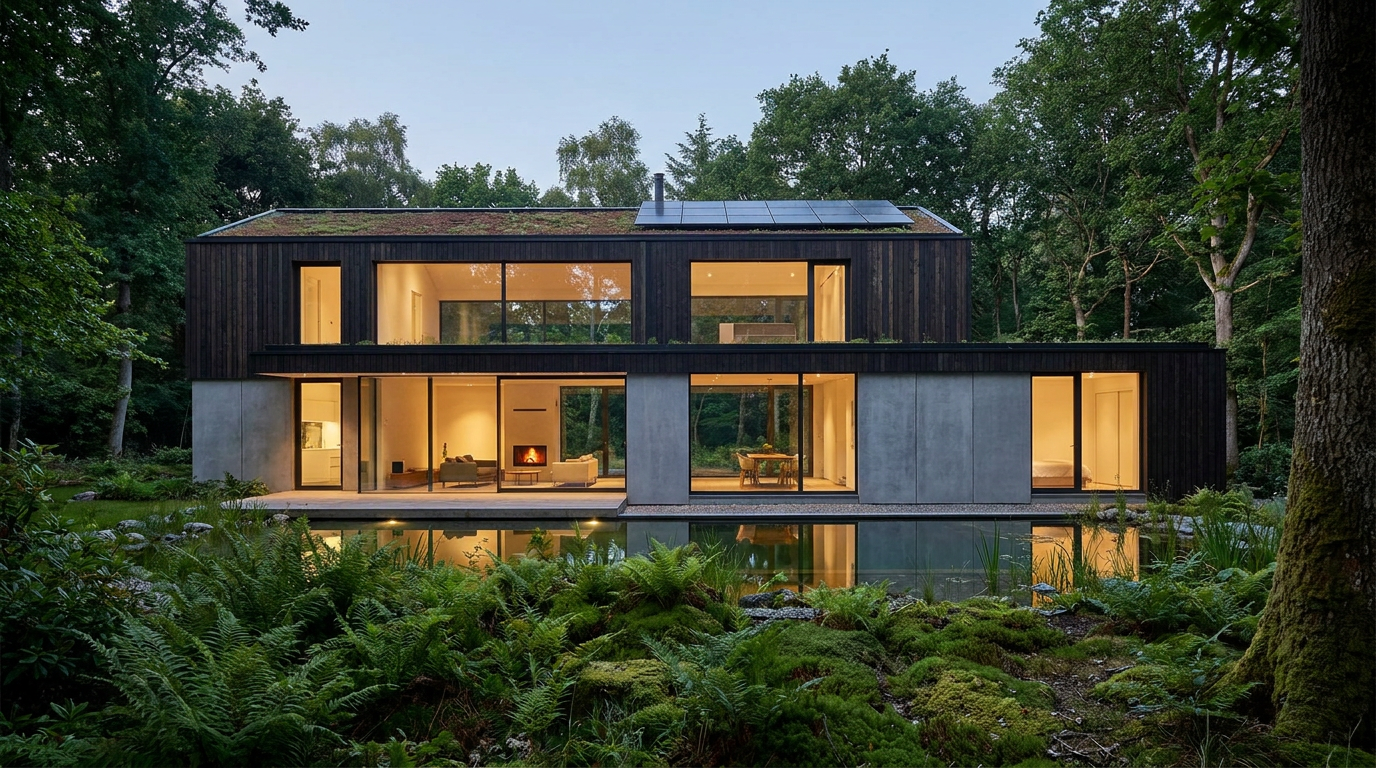
- Fabric-First Advocates
- Argue for strict, universal building envelope standards to permanently reduce energy demand before adding renewables.
- Climate-Adaptive Pragmatists
- Believe that adjusting metrics for extreme local climates and integrating with existing building codes accelerates mass market adoption.
- Homeowners & Investors
- Focus on the shrinking upfront construction premium versus the massive long-term operational savings and indoor comfort.
What's not represented
- · Conventional volume homebuilders who argue that strict airtightness standards slow down construction timelines.
- · Low-income housing advocates concerned about the short-term upfront costs of high-performance retrofits.
Why this matters
As global energy prices rise and government subsidies expire, the way we build homes is fundamentally shifting. Understanding the Passive House standard empowers homeowners and buyers to look past superficial greenwashing and invest in building physics that permanently eliminate up to 90% of their heating and cooling bills.
Key points
- Passive House is a rigorous building standard that reduces heating and cooling energy use by up to 90%.
- The standard relies on five principles: super-insulation, airtightness, high-performance windows, thermal bridge elimination, and heat recovery ventilation.
- Heat Recovery Ventilators (HRVs) provide constant fresh air while recycling the thermal energy of outgoing stale air.
- The historical 15-30% construction cost premium has shrunk to 5-10% in mature markets.
- Upcoming EU regulations will mandate similar ultra-high energy performance for all new buildings by 2030.
The global housing landscape is undergoing a quiet but profound mathematical shift. As energy prices remain volatile and temporary government utility subsidies expire across Europe and beyond, the cost of keeping a conventional home comfortable is climbing steadily. For decades, homeowners accepted high winter heating bills and summer air-conditioning costs as an unavoidable tax on shelter. Today, a growing segment of the market is rejecting that premise entirely.[1]
Enter the Passive House, or Passivhaus. Originally developed in Germany in the early 1990s, this rigorous building standard has evolved from a niche eco-luxury into a highly practical blueprint for modern construction. It is not a brand of architecture or a specific aesthetic, but rather a strict, performance-based physics standard that dictates exactly how a building must handle thermal energy.[6]
The core promise of the standard is staggering: a building engineered to use up to 90% less heating and cooling energy than conventional construction. A certified Passive House maintains a stable, comfortable indoor temperature year-round with almost no reliance on active furnaces or heavy-duty air conditioning systems.[1][6]
To understand how this is possible, architects often rely on a simple analogy. A standard modern home built to current codes is like a thermal coffee mug—it holds heat for a little while, but it constantly requires a fresh pour of hot water (or active heating) to stay warm. A Passive House operates like a high-end vacuum thermos. It locks in the existing temperature so effectively that the ambient heat generated by human bodies, cooking appliances, and sunlight is often enough to keep the entire house warm in the dead of winter.[5]
Achieving this "thermos" effect relies on five strict, interlocking design principles: super-insulation, extreme airtightness, high-performance windows, the complete elimination of thermal bridges, and mechanical ventilation with heat recovery.[6]

The first four principles focus entirely on the building's envelope. Walls, roofs, and foundations are packed with exceptionally thick insulation, while triple-glazed windows are meticulously sealed into the framing. Crucially, thermal bridges—areas where heat can easily bypass insulation through conductive materials like steel beams or concrete joints—are engineered out of the design entirely. The result is a continuous, unbroken thermal barrier.[5][6]
Because a Passive House is virtually airtight, it cannot rely on drafty windows, wall gaps, or structural leaks for fresh air. This is where the fifth principle, often described as the "lungs" of the house, comes into play: the Heat Recovery Ventilator (HRV) or Energy Recovery Ventilator (ERV).[4][7]
An HRV system is an ingenious mechanical device consisting of two parallel ducts. One duct constantly pulls stale, humid air out of kitchens, bathrooms, and living spaces. The other duct draws fresh, cold air in from the outside. Inside the unit's heat exchanger, the two airstreams pass each other in opposite directions through a matrix of thin plates, without ever physically mixing.[4]
An HRV system is an ingenious mechanical device consisting of two parallel ducts.
During this counterflow process, the outgoing warm air transfers up to 90% of its thermal energy to the incoming cold air. On a freezing winter day, the fresh air entering the living room has already been pre-warmed by the exhaust air leaving the house. This continuous heat recycling is what virtually eliminates the need for a traditional furnace.[4]

Energy Recovery Ventilators (ERVs) take this mechanism a step further by transferring moisture as well as heat. In hot, humid climates, an ERV strips moisture from the incoming summer air, keeping the interior comfortably dry. Conversely, in cold climates, HRVs are often preferred to aggressively expel the excess indoor humidity generated by cooking and showering, preventing condensation and mold from forming inside the airtight envelope.[7]
Beyond the sheer energy savings, this constant mechanical ventilation fundamentally changes the indoor living experience. Because all incoming air passes through fine filters, Passive Houses actively block pollen, dust, and outdoor pollution. Studies show that carbon dioxide levels in these homes rarely exceed 1,000 parts per million, whereas CO2 in conventionally ventilated bedrooms can easily spike overnight, leading to grogginess and poor sleep quality.[1][7]
The financial math behind Passive House construction has shifted dramatically over the last decade. Historically, building to this exacting standard carried a hefty 15% to 30% cost premium due to the need for specialized components and highly trained labor. Today, thanks to optimized factory-built systems and mature supply chains, that premium has shrunk to between 5% and 10% in established markets.[1]
In some regions, the construction premium has vanished entirely. Long-term data from the UK's Exeter City Council revealed that an initial 20% cost premium for Passivhaus projects in 2009 actually inverted to a 4% cost saving by 2024, largely because conventional building codes have become increasingly complex and expensive to meet.[1]
The operational savings are where the standard truly pays dividends. A conventional new build might require 150 kilowatt-hours per square meter annually for heating. A certified Passive House is strictly capped at 15 kWh/m²—a massive 90% reduction. For a typical family home, this translates to hundreds or even thousands of euros saved every single year, permanently insulating the owners from geopolitical energy shocks.[1][5]

As the standard gains global traction, a philosophical debate has emerged over how best to scale it. The original Passivhaus Institut (PHI) in Germany maintains a strict, universal performance target. They argue that holding the line on rigorous metrics pushes the global construction industry to elevate its baseline quality, rather than settling for localized compromises.[3]
In the United States, the Passive House Institute US (Phius) split from PHI to create climate-specific targets. Phius argues that adjusting the metrics for America's extreme climate zones—and integrating the certification with existing US programs like Energy Star—makes the standard more achievable for local builders, thereby accelerating mass adoption. PHI purists counter that lowering the bar dilutes the standard's transformative potential.[3]
Regardless of which specific certification a builder pursues, the underlying physics are rapidly becoming mandatory. The European Union's upcoming Zero Emission Building (ZEB) mandates will require all new public buildings to achieve ultra-high energy performance by 2028, and all new residential buildings by 2030.[1]

Similarly, analyses of the UK's proposed 2025 Future Homes Standard suggest that simply bolting solar panels onto conventional homes will not prevent rising heating bills. True long-term affordability requires the "fabric first" approach pioneered by Passive House, ensuring the building itself retains energy before relying on external generation.[2]
Ultimately, the Passive House standard proves that true sustainability does not require sacrificing comfort. By investing in the building's fundamental physics rather than oversized heating and cooling systems, homeowners are securing healthier, quieter, and radically more efficient spaces for decades to come.[8]
How we got here
Late 1980s
The Passive House concept is developed by physicists Bo Adamson and Wolfgang Feist.
1991
The first Passivhaus prototype is constructed in Darmstadt, Germany, proving the physics work in reality.
2015
The Passive House Institute US (Phius) introduces climate-specific standards tailored for North America.
2024
UK municipal data reveals the historical 20% construction premium for Passive Houses has effectively disappeared in optimized projects.
2030
The EU's Zero Emission Building (ZEB) mandate takes effect, requiring all new buildings to meet ultra-high energy performance targets.
Viewpoints in depth
Universal Standard Purists
Advocates for maintaining a single, strict global metric to force the construction industry to elevate its baseline.
Organizations like the original Passivhaus Institut (PHI) argue that the 15 kWh/m² heating demand limit should remain a universal absolute. They believe that compromising the standard to accommodate local building codes or extreme climates dilutes the fundamental physics that make the system work. By holding a hard line, they argue, the standard forces manufacturers to innovate better windows and insulation, ultimately dragging the entire global construction industry toward a higher baseline of quality.
Market-Adaptive Pragmatists
Proponents of adjusting the metrics for local climates to accelerate mass adoption by volume builders.
Groups like the Passive House Institute US (Phius) argue that a one-size-fits-all metric designed for central Europe does not scale efficiently in places like the humid American South or the freezing Midwest. By adjusting the performance targets based on specific climate zones and integrating the certification with existing local programs (like the EPA's Energy Star), they believe the standard becomes economically viable for volume homebuilders, leading to a much faster reduction in aggregate carbon emissions.
Economic Analysts
Focus on the shifting return on investment as energy subsidies expire and factory-built components scale.
Financial analysts and real estate economists note that the "eco-luxury" label of Passive House is outdated. As government energy subsidies expire across Europe and utility rates normalize at higher baselines, the operational savings of a home that requires 90% less heating are massive. Furthermore, as prefabricated, factory-built wall panels and standardized HRV units reach economies of scale, the upfront construction premium is vanishing, turning the standard into a pure financial play for long-term investors.
What we don't know
- How quickly the skilled labor shortage in the broader construction industry will adapt to the rigorous airtightness standards required for mass Passive House adoption.
- Whether future government building codes will fully adopt the strict Passivhaus metrics or settle for softer, predictive-modeling targets.
Key terms
- Thermal Bridge
- An area in a building's envelope, such as a steel beam or concrete joint, where heat transfers more easily than the surrounding materials, causing energy loss.
- Heat Recovery Ventilator (HRV)
- A mechanical system that supplies fresh outdoor air to a home while capturing and reusing the heat from the exhausted indoor air.
- U-value
- A measure of how effective a material is as an insulator; lower numbers indicate better insulation and less heat loss.
- EnerPHit
- The official Passive House certification standard specifically designed for retrofitting and renovating existing buildings.
- Fabric First
- An architectural approach that prioritizes maximizing the performance of the building's envelope (insulation and airtightness) before relying on mechanical heating or solar panels.
Frequently asked
Can you open the windows in a Passive House?
Yes, you can open the windows at any time. However, because the mechanical ventilation system provides a constant supply of filtered fresh air, you rarely need to open them for ventilation purposes.
Is a Passive House only for cold climates?
No. The same super-insulation and airtightness that keep heat inside during winter also keep the heat out during summer. Energy Recovery Ventilators (ERVs) are often used in hot climates to manage humidity.
Can an existing home be converted into a Passive House?
Yes, though it is challenging. The Passivhaus Institut created a specific retrofit standard called EnerPHit, which uses the same principles but with slightly more forgiving metrics to account for existing structural limitations.
Does a Passive House require a specific architectural style?
No. The standard is entirely performance-based. While compact, simple shapes are easier and cheaper to certify, a Passive House can be designed in any architectural style, from traditional to ultra-modern.
Sources
Source coverage
8 outlets
3 viewpoints surfaced







[1]BIOBUILDSHomeowners & Investors
Passive House Costs After 3 Years: Full Breakdown
Read on BIOBUILDS →[2]Passivhaus TrustFabric-First Advocates
Passivhaus compared to the proposed FHS 2025
Read on Passivhaus Trust →[3]The Passive House NetworkFabric-First Advocates
PHI and Phius: What's the Difference?
Read on The Passive House Network →[4]ExplainThatStuffHomeowners & Investors
How does HRV/ERV heat recovery ventilation work?
Read on ExplainThatStuff →[5]Magdalena Kidoń ArchitektHomeowners & Investors
Energy-Efficient House vs Passive House. Investor's Guide to Standards, Costs and Real Benefits
Read on Magdalena Kidoń Architekt →[6]YourHomeFabric-First Advocates
'Passive House' | YourHome
Read on YourHome →[7]RiseHomeowners & Investors
The Top HRVs or ERVs for Passive House Design
Read on Rise →[8]Factlen Editorial TeamClimate-Adaptive Pragmatists
Synthesis by Factlen editorial team
Read on Factlen Editorial Team →

More in lifestyle
See all 37 stories →Community Design
The Resurgence of Intergenerational Cohousing: How Neighborhoods are Rebuilding the Village
7 sources

Future of Work
The Four-Day Workweek Is No Longer a Theory: What the Global Data Actually Shows
8 sources

Aquascaping
The Science of Aquascaping: How Underwater Gardens Are Rewiring Mental Health
9 sources

Modern Romance
The Rise of 'Slow Dating': How Intentionality is Replacing the Swipe-Right Culture
8 sources

Every angle. Every day.
Get lifestyle stories with full source coverage and perspective breakdowns delivered to your inbox.