
How AI and Drones Are Accelerating Global Landmine Clearance
Humanitarian organizations and tech developers are deploying AI-equipped drones to rapidly map and clear landmines, transforming a historically slow and dangerous process.
By Factlen Editorial Team
- Humanitarian Demining Organizations
- Focuses on civilian safety, rigorous validation, and returning land to communities.
- Defense Technology Developers
- Prioritizes processing speed, algorithmic accuracy, and reducing physical risk to operators.
- Military & Strategic Analysts
- Analyzes the geopolitical implications and the ongoing arms race between military hardware and clearance tech.
What's not represented
- · Local farmers and agricultural workers waiting to reclaim their land
- · Traditional manual deminers adapting to new technological workflows
Why this matters
Traditional landmine clearance is a painstakingly slow and dangerous process that leaves millions of acres of vital farmland unusable for decades. By pairing commercial drones with artificial intelligence, demining organizations are radically accelerating the mapping of hazardous zones, saving civilian lives and restoring global agricultural capacity at an unprecedented scale.
Key points
- Globally, an estimated 110 million unexploded landmines threaten civilians and paralyze agricultural economies.
- Humanitarian organizations are pairing commercial drones with AI to radically accelerate the mapping of hazardous zones.
- Platforms like SpotlightAI can process thousands of drone images in seconds, identifying explosive threats with high accuracy.
- Multi-sensor fusion, including thermal imaging and ground-penetrating radar, allows AI to detect buried and obscured mines.
- AI is heavily used for 'area reduction,' forensically proving that suspected zones are safe for civilian return.
- Despite technological leaps, AI acts as a force multiplier rather than a replacement for human deminers, due to strict clearance standards.
For decades, the process of clearing landmines has been a painstaking, millimeter-by-millimeter endeavor, fraught with lethal risk and moving at a glacial pace. Globally, an estimated 110 million unexploded landmines remain scattered across more than 60 countries, paralyzing agricultural economies and threatening civilian lives long after conflicts end. The sheer scale of modern contamination—most notably in Ukraine, where initial estimates suggested 174,000 square kilometers of land were potentially mined—has forced a radical rethinking of humanitarian mine action. Traditional manual sweeps simply cannot meet the urgency of the crisis.[1][6]
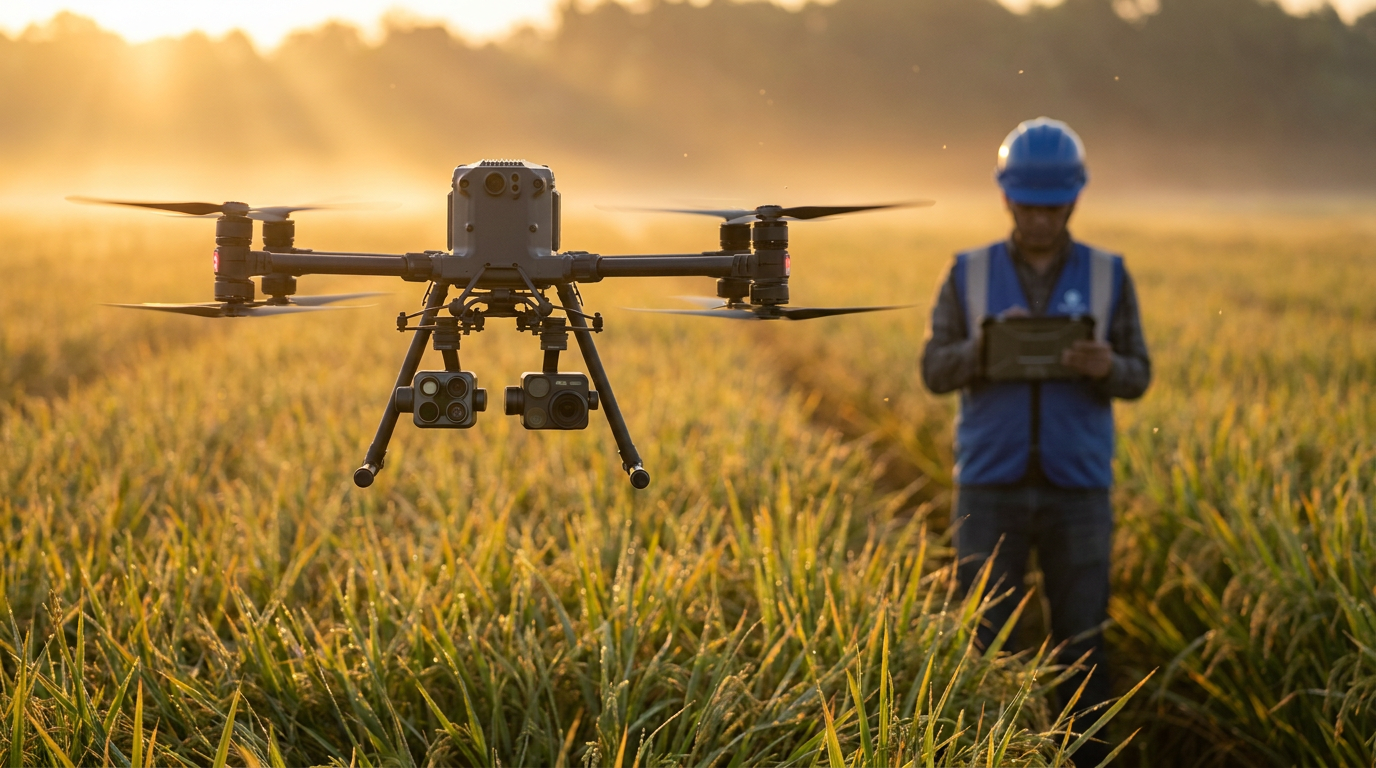
In response, a coalition of humanitarian organizations, defense technology firms, and data scientists has pioneered a new approach: pairing commercial unmanned aerial vehicles (UAVs) with advanced artificial intelligence. This technological shift is transforming the "non-technical survey" phase of demining, allowing teams to map vast swathes of territory without ever stepping foot in a minefield. By flying drones equipped with high-resolution cameras over suspected areas, operators can capture massive datasets that are then fed into machine learning algorithms trained to recognize the visual signatures of explosive remnants.[5][7]
The primary claim driving this adoption is a massive increase in processing speed and scale. Safe Pro Group’s SpotlightAI platform, for example, has processed over one million drone images in Ukraine, identifying more than 23,000 explosive threats across 5,300 hectares of land. The software can analyze individual high-resolution images in fractions of a second—a task that would take human analysts several minutes per photo. This rapid processing generates sub-centimeter, GPS-tagged maps that guide clearance teams directly to the hazards, drastically reducing the time spent searching empty fields.[6][8]
The mechanism behind these AI models relies on supervised deep learning. Developers train neural networks using proprietary datasets containing hundreds of thousands of labeled images of various landmines, grenades, and unexploded ordnance (UXO). When new drone footage is uploaded, the AI scans for geometric anomalies, metallic reflections, and specific casing shapes, placing bounding boxes around probable threats. To support forward operations in remote areas without reliable internet access, systems like SpotlightAI ONSITE utilize edge computing, processing the video feed locally on a ruggedized laptop connected directly to the drone's controller.[6]

However, visual detection alone is insufficient, as many mines are buried beneath the soil or obscured by dense vegetation. To address this, developers are moving toward multi-sensor fusion. Platforms like SubSphere’s Deminer integrate data from RGB cameras, thermal infrared sensors, LiDAR, and ground-penetrating radar (GPR). Each sensor provides a unique layer of evidence: LiDAR strips away digital vegetation to reveal ground disturbances, GPR identifies subsurface anomalies, and magnetometers detect metallic firing pins hidden below the surface.[7]
However, visual detection alone is insufficient, as many mines are buried beneath the soil or obscured by dense vegetation.
Thermal imaging provides particularly compelling evidence for buried threats. Landmines—whether encased in metal or plastic—possess different thermal conductivity than the surrounding soil. During the rapid temperature shifts of early morning or late evening, buried objects heat up and cool down at different rates than the earth around them. Thermal cameras mounted on low-flying drones capture these temperature contrasts, allowing the neural network to identify the distinct thermal "shadow" of a buried mine that would be entirely invisible to the naked eye.[7][9]
Beyond finding explosives, AI is proving equally valuable in proving where mines are not. The HALO Trust, the world’s largest humanitarian demining organization, utilizes AI and satellite imagery to forensically map safe zones. By overlaying drone footage with satellite data from Planet Labs and analyzing it via Amazon Web Services, HALO has successfully canceled vast areas previously suspected of contamination. This evidence-based area reduction has helped shrink Ukraine's suspected hazard zones from the size of Florida down to the size of Massachusetts, allowing thousands of farmers to safely return to their fields.[1][5]

Despite these breakthroughs, the demining sector remains highly cautious, and the evidence supporting AI autonomy carries transparent limitations. AI systems do not perform physical clearance; they act strictly as a force multiplier for human teams. The UN standard for humanitarian demining requires a 99.6% clearance rate, leaving virtually no margin for algorithmic error. Consequently, AI outputs are currently treated as advisory maps rather than definitive declarations of safety, and every AI-flagged zone must still be validated by traditional survey methods and human deminers.[3][9]
Furthermore, the technology faces a continuous cat-and-mouse game against evolving military hardware. As detection methods improve, so do the mines. Modern high-tech landmines are increasingly equipped with magnetic influence sensors or seismic triggers designed to detonate when a drone or mechanical detector approaches. The very technology used to find the mine can sometimes activate it, complicating the deployment of low-flying UAVs and requiring constant updates to the AI's threat-recognition parameters.[2]

To keep pace with these challenges, the development of demining AI is becoming increasingly decentralized and localized. In July 2025, the United Nations Development Programme (UNDP) hosted an "AI Data Jam" hackathon in Kyiv, giving local IT engineers access to 30,000 real-world field images to train new detection models. The winning team, "Mine Watch AI," developed highly accurate algorithms that are now being integrated into official humanitarian workflows, demonstrating how open-source collaboration can accelerate defense-tech innovation.[4]
The implications of this technology extend far beyond Eastern Europe. The HALO Trust and its partners are adapting these AI and drone methodologies for post-conflict zones globally, from the agricultural plains of Angola to the urban rubble of Syria. Researchers are also testing drone-mounted magnetic resonance sensors capable of detecting the specific molecular signature of explosive compounds, which could eventually eliminate the false positives caused by harmless scrap metal.[3][5]

Ultimately, the integration of artificial intelligence into humanitarian mine action represents a critical pivot from manual endurance to data-driven precision. While fully autonomous robotic clearance remains a long-term goal, the current generation of AI-equipped drones is already saving lives by keeping humans out of the most dangerous survey zones. By transforming how evidence of contamination is gathered and analyzed, this technology is accelerating the day when war-torn landscapes can be safely returned to the communities that depend on them.[1][5]
How we got here
2022–2023
The escalation of the war in Ukraine creates one of the most heavily mined landscapes in the world, prompting a crisis in traditional clearance methods.
Late 2024
Safe Pro Group's SpotlightAI processes its first massive datasets, identifying thousands of explosive threats using drone imagery.
July 2025
The UNDP hosts the AI Data Jam hackathon in Kyiv, accelerating the development of localized, open-source demining algorithms.
Early 2026
Humanitarian organizations like The HALO Trust begin scaling multi-sensor drone surveys globally, applying lessons learned in Ukraine to other post-conflict zones.
Viewpoints in depth
Humanitarian Deminers
Focuses on civilian safety, rigorous validation, and returning land to communities.
For organizations like The HALO Trust and the UNDP, the primary metric of success is not technological sophistication, but civilian safety. They view AI as a powerful tool for 'area reduction'—proving where mines are not, rather than just where they are. Because the UN standard demands a 99.6% clearance rate, these groups emphasize that AI cannot replace human judgment. They advocate for a cautious, evidence-based integration of technology, ensuring that algorithms are rigorously field-tested before being trusted to declare land safe for returning farmers.
Defense Technology Developers
Prioritizes processing speed, algorithmic accuracy, and reducing physical risk to operators.
Firms like Safe Pro Group and SubSphere approach the crisis as a massive data-processing bottleneck. They argue that traditional manual sweeps are unsustainably slow given the scale of modern contamination. By leveraging edge computing, multi-sensor fusion, and supervised deep learning, developers aim to remove humans from the most dangerous phases of the survey process. Their focus is on scaling the technology, expanding the datasets to recognize hundreds of ordnance types, and pushing the boundaries of what autonomous systems can detect beneath the soil.
Strategic Analysts
Analyzes the geopolitical implications and the ongoing arms race between military hardware and clearance tech.
Military and geopolitical analysts view the demining tech boom through the lens of force protection and strategic recovery. They note that the rapid clearance of agricultural land is essential for stabilizing post-conflict economies and global food supplies. However, they also highlight the ongoing 'cat-and-mouse' dynamic: as detection technologies improve, militaries deploy increasingly sophisticated mines equipped with magnetic or seismic sensors designed to thwart those very detection methods, necessitating continuous innovation in the clearance sector.
What we don't know
- Whether AI models can be trained to reliably detect novel, improvised explosive devices (IEDs) that lack standard manufacturing signatures.
- How quickly fully autonomous robotic clearance vehicles can be safely deployed without human oversight.
- The long-term funding sustainability for deploying advanced multi-sensor drone fleets across all global post-conflict zones.
Key terms
- Unexploded Ordnance (UXO)
- Explosive weapons such as bombs, shells, and grenades that failed to detonate as intended and remain a hidden hazard.
- Non-Technical Survey (NTS)
- The initial phase of demining that uses data, interviews, and aerial imagery to identify hazardous areas without physically entering them.
- Ground-Penetrating Radar (GPR)
- A geophysical method that uses radar pulses to image the subsurface, detecting buried objects like landmines.
- Sensor Fusion
- The process of combining data from multiple different sensors, such as thermal cameras and radar, to improve detection accuracy.
- Edge Computing
- Processing data locally on a device (like a laptop connected to a drone) rather than uploading it to a distant cloud server, crucial for remote field operations.
Frequently asked
Can AI drones physically remove the landmines?
No. Currently, AI drones are used strictly for detection and mapping. Physical clearance is still performed by trained human deminers or specialized armored vehicles.
How does thermal imaging detect buried mines?
Landmines absorb and release heat at different rates than the surrounding soil. Thermal cameras detect these slight temperature differences, especially during sunrise and sunset.
Is this technology only being used in Ukraine?
While Ukraine is currently a major testing ground due to the scale of contamination, organizations like The HALO Trust are deploying these systems globally, including in Angola and Syria.
Will AI replace human deminers?
Experts emphasize that AI acts as a force multiplier, not a replacement. The UN requires a 99.6% clearance rate, meaning human validation remains essential.
Sources
Source coverage
9 outlets
3 viewpoints surfaced









[1]National Defense MagazineMilitary & Strategic Analysts
Ukraine War Spurs Demining Tech Advancements
Read on National Defense Magazine →[2]UN NewsHumanitarian Demining Organizations
Deminers race to keep up with military technology
Read on UN News →[3]Geo Week NewsMilitary & Strategic Analysts
How Drones and AI Are Helping Clear 36,000 Landmines in Ukraine
Read on Geo Week News →[4]UNDPHumanitarian Demining Organizations
UNDP Ukraine ANNUAL REPORT • 2025
Read on UNDP →[5]The HALO TrustHumanitarian Demining Organizations
Pioneering innovative technology to save lives
Read on The HALO Trust →[6]Safe Pro GroupDefense Technology Developers
Safe Pro AI Unveils SpotlightAI ONSITE Software Application
Read on Safe Pro Group →[7]SubSphereDefense Technology Developers
Drone-based Landmine Detection
Read on SubSphere →[8]DroneLifeDefense Technology Developers
SpotlightAI 3.0: Enhancing Landmine Detection in Ukraine
Read on DroneLife →[9]CEUR Workshop ProceedingsDefense Technology Developers
Intelligent Landmine Detection with Unmanned Aerial Vehicle Mounted Thermal Camera
Read on CEUR Workshop Proceedings →
Every angle. Every day.
Get defense security stories with full source coverage and perspective breakdowns delivered to your inbox.