
The Science of Bioluminescent Beaches and Where to Find Them
Microscopic marine organisms create dazzling neon-blue light shows along coastlines worldwide. Here is the science behind the glow, where to experience it, and how to capture it on camera.
By Factlen Editorial Team
- Marine Biologists
- Focus on the evolutionary arms race of the 'burglar alarm' effect and the delicate nutrient balance required to sustain dinoflagellate populations.
- Eco-Tourism Advocates
- Emphasize the need for strict regulations, such as banning gas-powered boats and chemical sunscreens, to protect permanent bio-bays from being destroyed by over-tourism.
- Night Sky Photographers
- Highlight the technical dedication required to track unpredictable red tides, scout locations during the day, and execute long-exposure techniques in pitch-black conditions.
What's not represented
- · Local coastal residents
- · Marine conservation policymakers
Why this matters
Understanding the delicate ecosystems behind bioluminescent bays helps travelers make sustainable choices that protect these rare natural wonders. It also provides photographers and nature enthusiasts with the technical knowledge needed to witness and capture one of the ocean's most elusive phenomena.
Key points
- Bioluminescence is a chemical reaction produced by microscopic marine plankton called dinoflagellates.
- The glow acts as a defense mechanism to startle predators and attract larger fish to eat their attackers.
- Permanent bioluminescent bays require a delicate balance of warm water, nutrients, and a narrow geographic opening.
- Photographing the phenomenon requires a tripod, a wide aperture lens, and long exposure times of 10 to 30 seconds.
- Light pollution, chemical sunscreens, and boat fuel pose significant threats to these fragile ecosystems.
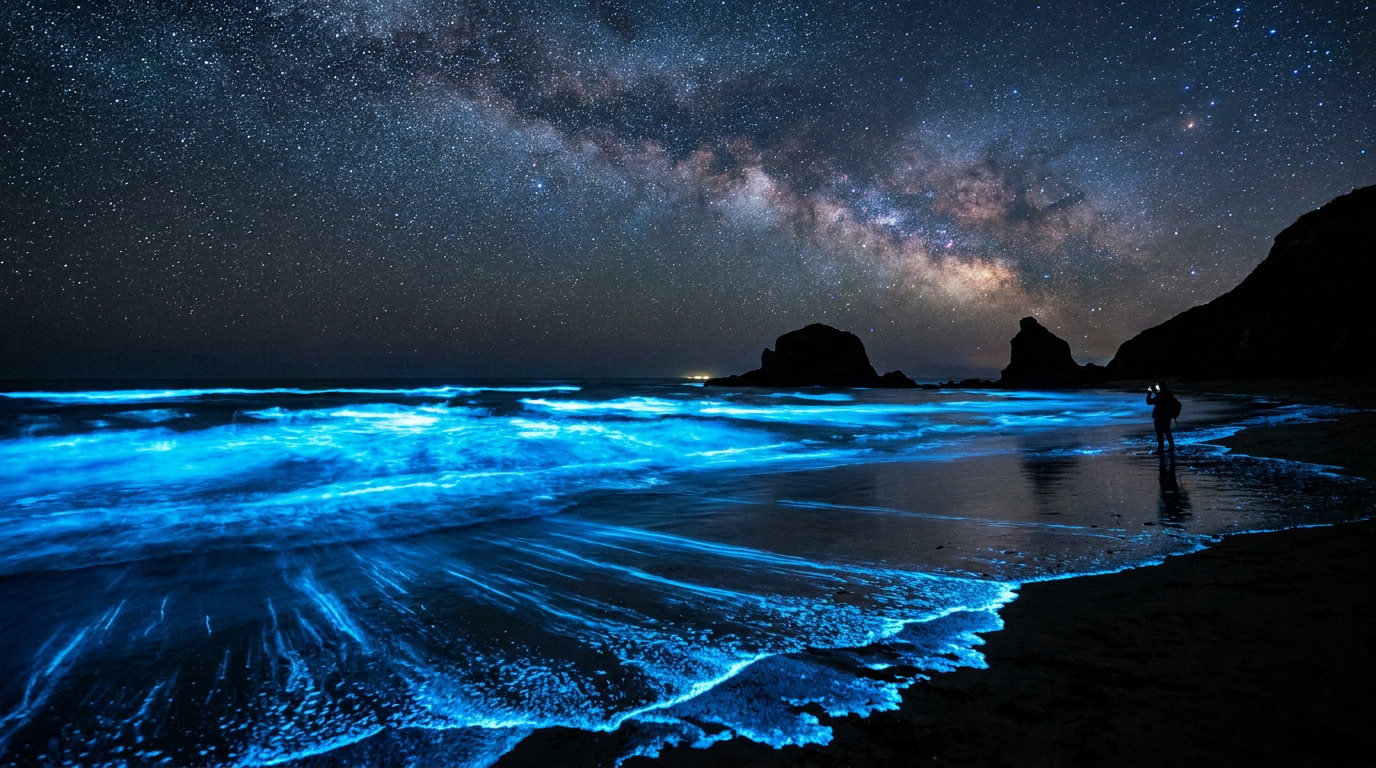
Walking along a dark shoreline, a traveler kicks the wet sand, and the ground suddenly erupts in a spray of neon-blue sparks. In the water, crashing waves glow with an ethereal, electric light, and fish darting through the shallows leave glowing contrails in their wake. This is not a digital special effect, but the phenomenon of ocean bioluminescence. As travelers increasingly seek out unique, nature-driven experiences, visiting these glowing shores has become a major draw in the growing trend of "noctourism"—traveling specifically for nocturnal sightseeing. From the warm lagoons of the Caribbean to the rugged coastlines of the Pacific Northwest, these natural light shows offer a rare glimpse into the hidden, microscopic ecosystems that thrive just beneath the ocean's surface.[4][5]
The mesmerizing glow is the result of a highly evolved chemical reaction produced by living organisms. While various marine creatures—from deep-sea anglerfish to certain species of jellyfish and crustaceans—possess bioluminescent capabilities, the spectacular glowing beaches experienced by coastal travelers are almost entirely the work of microscopic plankton. Specifically, the stars of this aquatic light show are dinoflagellates, a type of single-celled marine organism that floats near the ocean's surface. When these tiny organisms congregate in high concentrations, their collective light can illuminate entire bays, transforming the water into a liquid starry sky.[1][2]
At the cellular level, the glow is driven by a precise biological mechanism. Inside the dinoflagellate, a light-emitting molecule called luciferin reacts with an enzyme known as luciferase. When oxygen is introduced to this combination, it triggers a rapid oxidation process that releases energy in the form of cold, blue-green light. Crucially, this reaction is not continuous. Dinoflagellates only emit light when they are mechanically stimulated or agitated. The physical stress of a breaking wave, the hull of a passing boat, a kayak paddle slicing through the water, or even the subtle pressure changes from a swimming fish are enough to trigger the chemical flash.[1][2]

Scientists believe this bioluminescence serves a vital evolutionary purpose: survival. For a single-celled organism at the very bottom of the marine food chain, avoiding predators is a constant challenge. The sudden burst of light acts as a "burglar alarm" defense mechanism. When a dinoflagellate is disturbed by a primary predator, such as a tiny, shrimp-like copepod, it flashes its neon light. This sudden illumination is designed to startle the immediate threat, but more importantly, it acts as a beacon to attract larger secondary predators. The glow effectively spotlights the copepod, inviting a larger fish to swoop in and eat the dinoflagellate's attacker, allowing the microscopic plankton to escape unharmed.[1][7]
While dinoflagellates exist in oceans worldwide, permanent bioluminescent bays are incredibly rare. These ecosystems require a highly specific set of environmental conditions to thrive year-round. The water must be warm, shallow, and rich in nutrients, often supported by surrounding mangrove forests that drop organic material into the water. Furthermore, the geography of the bay plays a critical role. The most vibrant bio-bays feature a narrow opening to the sea, which allows the tide to bring the plankton in but traps them inside the lagoon, allowing their population density to reach the millions per gallon required for a spectacular visual display.[2][5]
Puerto Rico is widely considered the global capital of bioluminescent tourism, boasting three permanent bio-bays. The most famous is Mosquito Bay, located on the small island of Vieques. Holding the Guinness World Record for the brightest bioluminescent bay on Earth, Mosquito Bay offers an unparalleled viewing experience. Interestingly, the bay's brightness actually intensified following the devastation of Hurricane Maria in 2017. Marine biologists noted that the storm's massive ecological upheaval temporarily disrupted the bay, but the subsequent influx of nutrients caused the dinoflagellate population to inexplicably double, resulting in an even more vibrant glow in the years that followed.[4][5]

Beyond Puerto Rico, a handful of other locations offer reliable bioluminescent displays. In Jamaica, the Luminous Lagoon in Falmouth is renowned for its warm, shallow waters where visitors are encouraged to swim and watch their own movements ignite the water. In the Maldives, the famous "Sea of Stars" effect washes up on the shores of Vaadhoo Island, creating glowing footprints in the sand. Meanwhile, in the continental United States, the Indian River Lagoon in Florida and the San Juan Islands in Washington State host seasonal blooms, drawing kayakers and nature enthusiasts during the warm summer months when the plankton populations peak.[4][5]
Beyond Puerto Rico, a handful of other locations offer reliable bioluminescent displays.
In many parts of the world, however, bioluminescence is a fleeting and unpredictable event. These transient blooms are often linked to a phenomenon known as a "red tide." During the day, massive concentrations of dinoflagellates can turn the ocean surface a murky pink, red, or rust color. Because the algae are pushed by winds and ocean currents, they can suddenly appear along a stretch of coastline and vanish just as quickly. Coastal photographers and enthusiasts often scout for these red tides during daylight hours, knowing that the murky daytime water will translate into a brilliant neon-blue spectacle once the sun goes down.[3][7]
Capturing this phenomenon on camera is notoriously difficult, and travelers relying on standard smartphone settings are often left with pitch-black images. Because the light emitted by the plankton is relatively faint, photographing bioluminescence requires specialized equipment and a solid understanding of low-light photography. A sturdy tripod is the most critical piece of gear, as the camera must remain perfectly still to gather enough light over an extended period. Photographers also rely on fast lenses with wide maximum apertures—typically f/1.8 or f/2.8—to allow as much light as possible to reach the camera's sensor.[3][6]
The standard technique involves shooting long exposures. Depending on the ambient light and the intensity of the bloom, photographers will leave the camera shutter open for anywhere from 10 to 30 seconds. Because the dinoflagellates only glow when agitated, capturing a still body of water will yield nothing but darkness. Photographers must either time their exposures to capture the crashing of a wave or physically interact with the scene—tossing a handful of sand into the shallows, splashing the water, or walking through the frame to leave a trail of glowing footprints while the shutter remains open.[3][6]

To compensate for the dark conditions, ISO settings must be pushed significantly higher than in daytime photography, often ranging from 800 to 3200. While this introduces digital noise or grain into the image, modern camera sensors and post-processing software can effectively clean up the final shot. Focusing in the dark presents another major hurdle; autofocus systems generally fail on pitch-black beaches. Photographers typically switch to manual focus, using a bright flashlight to illuminate a rock or the shoreline to set their focal distance before turning the light off and beginning the exposure.[3][6]
While chasing bioluminescence is a thrilling pursuit, it is accompanied by pressing conservation concerns. The delicate balance that sustains permanent bio-bays is easily disrupted by human activity. Chemical sunscreens, insect repellents, and the hydrocarbons leaked by gas-powered boat engines can be highly toxic to dinoflagellates. In response, many of the world's premier locations, including Mosquito Bay, have implemented strict regulations. Powered vessels are often banned entirely, and visitors are restricted to exploring the waters via clear-bottom kayaks, ensuring the ecosystem remains undisturbed while still allowing for an immersive experience.[1][4]
Light pollution is another existential threat to the noctourism industry. The blue-green glow of the plankton is easily washed out by ambient light. For the best viewing experience, travelers must plan their visits around the lunar cycle, aiming for a new moon or a heavily overcast night. However, as coastal development increases, artificial light from hotels, streetlamps, and beachfront properties threatens to permanently dim the visibility of these natural wonders. Conservationists argue that preserving dark skies is just as critical to the survival of bioluminescent tourism as protecting the water quality itself.[4][5]

It is also important for travelers to distinguish between harmless bioluminescence and toxic algal blooms. While the dinoflagellates that illuminate Puerto Rico and Jamaica are safe to swim among, some species of glowing plankton produce dangerous neurotoxins. Certain red tides can deplete oxygen in the water, causing massive fish kills, and release airborne toxins that cause respiratory irritation in humans. Local authorities actively monitor water conditions, and travelers are always advised to check regional environmental advisories before wading into an unpredictable, transient bloom.[1][7]
Ultimately, the enduring appeal of bioluminescent beaches lies in their fragile, ephemeral nature. They are a vivid reminder of the complex, microscopic life that sustains the broader ocean ecosystem. As noctourism continues to grow in popularity, the challenge for both travelers and local governments will be balancing the desire to witness this natural magic with the rigorous conservation efforts required to protect it. By embracing sustainable practices and respecting the delicate environmental parameters that allow these organisms to thrive, we can ensure that the ocean's living light show continues to captivate future generations.[4][7]
Viewpoints in depth
Marine Biologists
Focus on the evolutionary arms race of the 'burglar alarm' effect and the delicate nutrient balance required to sustain dinoflagellate populations.
For marine biologists, bioluminescence is far more than a tourist attraction; it is a critical window into the microscopic food web of the ocean. Researchers study the 'burglar alarm' hypothesis to understand how single-celled dinoflagellates use light to manipulate the behavior of larger predators. They also monitor the health of permanent bio-bays, noting that the delicate balance of mangrove-derived nutrients, water temperature, and salinity is highly susceptible to climate change. The unexpected doubling of Mosquito Bay's brightness after Hurricane Maria provided researchers with unprecedented data on how these ecosystems recover and adapt to massive environmental shocks.
Eco-Tourism Advocates
Emphasize the need for strict regulations to protect permanent bio-bays from being destroyed by over-tourism.
Eco-tourism advocates argue that the very popularity of bioluminescent bays threatens their existence. They champion strict local regulations, such as the banning of gas-powered boats, which leak hydrocarbons that are lethal to dinoflagellates. Advocates also push for mandatory use of clear-bottom kayaks and the prohibition of chemical sunscreens and insect repellents in the water. Furthermore, they campaign heavily against coastal light pollution, arguing that unchecked beachfront development and artificial lighting will permanently wash out the natural glow, destroying the noctourism industry that many local economies rely upon.
Night Sky Photographers
Highlight the technical dedication required to track unpredictable red tides and execute long-exposure techniques in pitch-black conditions.
For night sky and landscape photographers, capturing bioluminescence is considered one of the ultimate technical challenges. Photographers must often scout locations during the day, looking for the telltale pinkish hue of a red tide, before returning at night to set up in total darkness. They emphasize the necessity of high-end gear—sturdy tripods to withstand coastal winds, and fast prime lenses capable of gathering faint light. The community frequently shares real-time tracking data on social media to chase transient blooms, balancing the excitement of the hunt with the rigorous post-processing required to reduce digital noise from high-ISO exposures.
What we don't know
- The exact long-term impact of rising global ocean temperatures on the frequency and intensity of bioluminescent blooms.
- Why certain transient red tides produce dangerous neurotoxins while others remain completely harmless to marine life.
- The complete biochemical pathway that allows dinoflagellates to sense mechanical stress and trigger their light-emitting response so rapidly.
Key terms
- Dinoflagellates
- Single-celled marine plankton responsible for the majority of coastal ocean bioluminescence.
- Luciferin
- The light-emitting organic compound found within bioluminescent organisms.
- Luciferase
- The enzyme that catalyzes the oxidation of luciferin, resulting in the production of light.
- Noctourism
- A growing travel trend focused on nighttime experiences, such as stargazing or viewing bioluminescence.
- Red Tide
- A dense daytime bloom of algae that often appears pink or red on the water's surface, which can indicate bioluminescence at night.
Frequently asked
Why do bioluminescent bays only glow at night?
The dinoflagellates actually bioluminesce during the day as well, but the light they emit is too faint to be seen against the brightness of the sun.
Is it safe to swim in bioluminescent water?
Usually yes, but some glowing algal blooms (known as red tides) can produce toxins that irritate the skin and respiratory system. Always check local advisories.
Can I capture the glow with my smartphone?
Most smartphones struggle to capture the faint light. A dedicated camera with manual settings for long exposures and a tripod is highly recommended.
What is the best time of month to see the glow?
A new moon or a heavily overcast night is ideal. Any ambient moonlight will wash out the faint blue glow of the plankton.
Sources
Source coverage
7 outlets
3 viewpoints surfaced







[1]Global RescueMarine Biologists
What makes a bioluminescent beach glow
Read on Global Rescue →[2]Marine Biological LaboratoryMarine Biologists
America's 5 Best Bioluminescent Beaches
Read on Marine Biological Laboratory →[3]Nature TTLNight Sky Photographers
How to Photograph Ocean Bioluminescence
Read on Nature TTL →[4]Lonely PlanetEco-Tourism Advocates
9 of the best places in the world to see bioluminescence
Read on Lonely Planet →[5]SmarterTravelEco-Tourism Advocates
Best Bioluminescent Bays in the World
Read on SmarterTravel →[6]PictureCorrectNight Sky Photographers
How to Photograph Bioluminescence
Read on PictureCorrect →[7]Factlen Editorial TeamEco-Tourism Advocates
Synthesis by Factlen editorial team
Read on Factlen Editorial Team →

Every angle. Every day.
Get travel stories with full source coverage and perspective breakdowns delivered to your inbox.